


Qualified appointment setting books meetings only with prospects verified against BANT – Budget, Authority, Need, and Timeline — so closers speak only to buyers who are ready, willing, and able to purchase. Unlike lead generation, which delivers contacts, qualified appointment setting delivers confirmed meetings that convert at far higher rates.
The data tells a stark story: traditional lead generation delivers contact lists where 40% are invalid emails, 30% have outdated job titles, and the remaining 30% have zero awareness of your brand. Meanwhile, companies using BANT-qualified appointment models achieve 25-40% close rates compared to the 3-5% typical of unqualified leads.

Most B2B teams lose 40–60% of qualified prospects to broken handoffs and weak qualification. Take our 2-minute diagnostic to find out where your pipeline is bleeding — and how to fix it.
Start the Quiz → Takes 2 minutes. No email required to start.This guide breaks down what actually makes appointments ‘qualified’ in 2026—and how the shift from activity-based metrics to outcome-based accountability is transforming B2B pipeline generation.
How First-Party Intent Data Powers Qualified Appointment Setting
Most qualified appointment setting services start with a purchased list. Demand Nexus starts with behavior.
We operate six owned B2B media brands — AITechTrend, MarTechTrend, FinTechFilter, HRTechTrend, DevTechTrend, and LegalTechTrend — reaching 15M+ active decision-makers. When a VP of Risk at a regional bank reads three articles on FinTechFilter about AML fraud automation, that’s a first-party intent signal: a known person, a real company, a verified behavior, captured in real time.
This is the foundation of our Waterfall model. Instead of cold-targeting a demographic and hoping for interest, we reach prospects who have already demonstrated they’re researching the problem your product solves. Outreach becomes context-aware. Conversion rates climb. And every BANT qualification call starts with a prospect who already knows why you’re relevant.
| WHAT MAKES AN APPOINTMENT QUALIFIED |
- Budget — funds for the solution are already allocated, not hypothetical.
- Authority — the confirmed decision-maker (or a direct influencer) is in the meeting.
- Need — a specific, articulated business pain the solution addresses.
- Timeline — a defined window for making a decision, not “someday”.
- Handover — every meeting ships with an Appointment Handover Sheet (AHO): BANT notes, pain points, competitor intel, and recommended approach.
That’s what separates intent-powered qualified appointment setting from the standard approach of “blast a list and see who bites.

What Separates a Qualified Appointment from a Qualified Lead?
Understanding this distinction is fundamental to fixing a broken funnel.
A qualified lead is someone who has shown surface-level interest—downloading a whitepaper, signing up for a newsletter, or attending a webinar. They’re researching, but they’re not ready for a sales conversation. Traditional vendors call this an “MQL” and charge you handsomely for a .csv file of names.
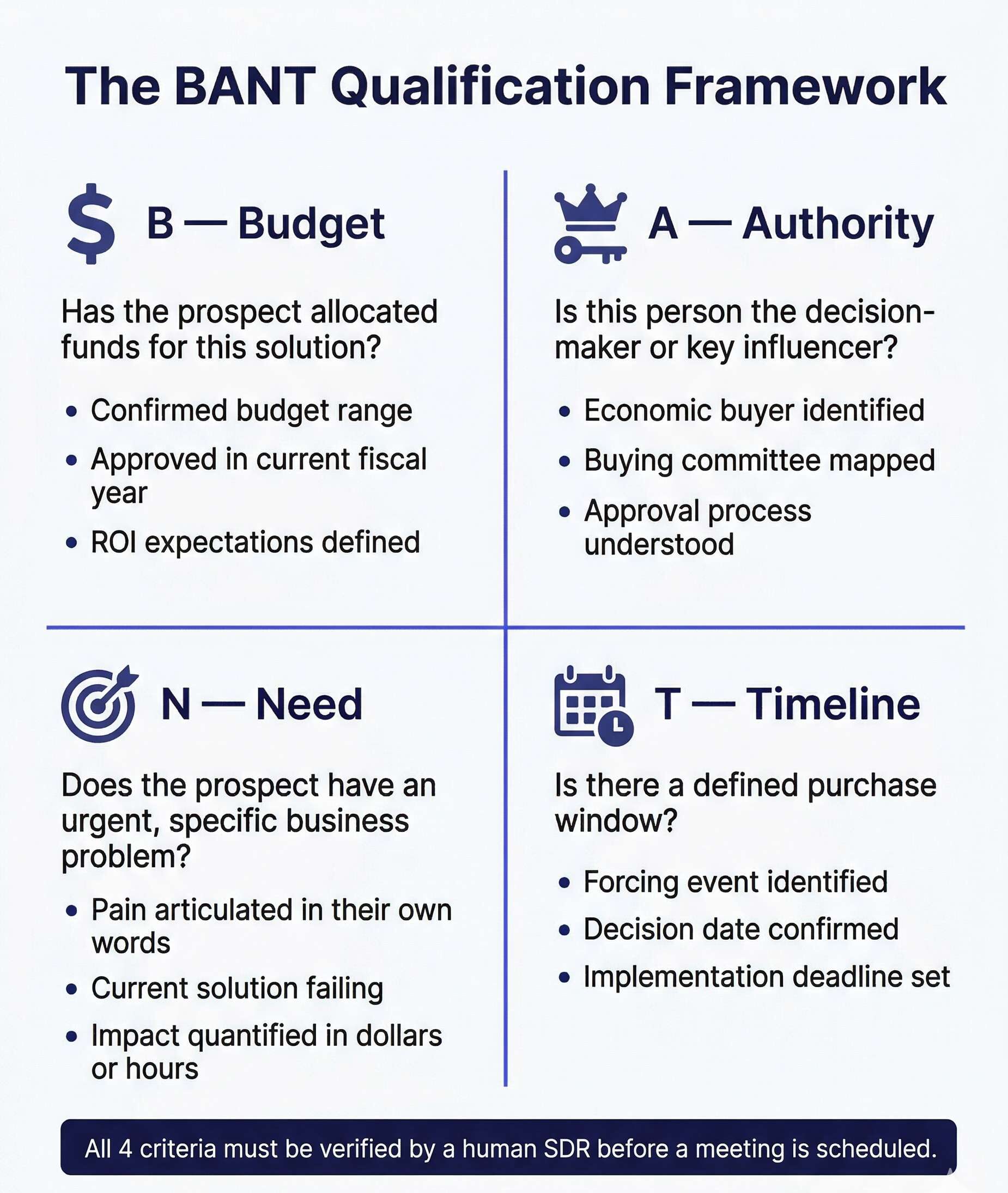
A qualified appointment is fundamentally different. It’s a scheduled meeting with someone who has been verified across four critical dimensions—the BANT framework that separates tire-kickers from actual buyers:
Budget: They’ve confirmed allocated funds exist for this purchase
Authority: They can make or directly influence the buying decision
Need: They’ve articulated specific pain points your solution addresses
Timeline: They have a defined window for making a purchase decision
Here’s the practical difference: A marketing director who downloads your eBook is a qualified lead. That same marketing director, after confirming they have Q2 budget allocated, decision-making authority, an urgent integration problem, and a contract renewal deadline in 90 days—that’s a qualified appointment.
The gap between these two represents where most B2B companies hemorrhage sales productivity.
What Does It Mean for an Appointment to Be Pre-Qualified?
Pre-qualification is everything that happens before the calendar invite lands on your AE’s calendar. It’s the difference between a meeting that converts and one that politely goes nowhere.
Most companies skip this step. A prospect fills out a form, gets routed to sales, and the AE spends the first 20 minutes of the call doing the discovery work that should have happened upstream. The meeting wasn’t pre-qualified — it was just scheduled.
Genuinely pre-qualified appointments go through three gates before they reach your team:
Gate 1 — ICP and Intent Fit. The prospect matches your ideal customer profile and has demonstrated active research behavior in your category. Not a demographic guess — a behavioral signal.
Gate 2 — BANT Verification Call. A trained SDR conducts a structured 10–15 minute qualifying call that explicitly confirms budget exists, authority is present, the need is real and articulated, and a buying timeline is in place. If any element is absent, the appointment isn’t booked.
Gate 3 — Documentation Before Handoff. Everything surfaced during qualification — verbatim pain point quotes, competitor context, timeline pressure, objections raised — is captured and transferred to your AE before the meeting.
Only after all three gates are cleared does a prospect become a pre-qualified appointment. The practical result: your AEs open calls already knowing the prospect’s exact problem, budget situation, and urgency driver — instead of spending the first half of the meeting figuring it out.
This is why pre-qualified appointments achieve close rates of 25–40%, while meetings that skip this process close at 3–5%.
Why This Matters More Than Ever in 2026
The B2B landscape has fundamentally shifted. With 60% of buyers minimizing direct sales interactions, every conversation must count. Your sales team can’t afford to spend 50+ hours per week re-qualifying leads that should never have reached them.
The economics are compelling:
Traditional MQL approaches deliver MQL-to-SQL conversion rates around 13%, with the average B2B company paying $198 per lead. That means for every 100 leads purchased, only 13 even warrant a sales conversation—and far fewer will close.
BANT-qualified appointments flip this model. When prospects have been verified for budget, authority, need, and timeline before reaching your AEs, conversion rates jump to 25-40%. Your sales team stops playing detective and starts closing deals.
This isn’t incremental improvement. It’s the difference between your team closing 12 deals from 400 MQLs (spending 600+ hours qualifying) versus closing 17 deals from 60 verified appointments (spending under 200 hours, all on actual selling).
The “Glass Box” vs. “Black Box” Problem
Most B2B companies have been operating in a “Black Box” model without realizing it.
You invest $50,000 in content. You hand it to a syndication vendor. What do you actually receive? A spreadsheet of 500 “leads” where 40% are fake contacts, 30% have wrong information, and the remaining 30% have no idea who you are or why you’re calling.
The Black Box model survives because vendors are paid for activity, not outcomes. They have no incentive to verify quality—they get paid whether those leads convert or not.
The “Glass Box” alternative operates on complete transparency:
| Attribute | “Black Box” MQL | “Glass Box” BANT Appointment |
|---|---|---|
| Identity | Anonymous (IP-based) | Known person with verified title |
| Timeliness | Weeks or months old | Real-time engagement |
| Exclusivity | Sold to competitors | Proprietary first-party signal |
| Specificity | Vague “interest” | Specific content engagement tracked |
| Accuracy | 40-50% false positives | 85%+ signal accuracy |
| Deliverable | A .csv of “leads” | A BANT-verified meeting with context |
The question isn’t whether one approach is better—the data makes that obvious. The question is why anyone still pays for Black Box leads.
The Five-Stage Qualification Process That Actually Works
Moving from unqualified leads to verified appointments requires systematic rigor, not hopeful guesswork. Here’s the framework that produces meetings your AEs are eager to work:
Stage 1: ICP Alignment and Intent Signal Capture
Qualification starts before any outreach. The foundation is first-party intent data—not purchased lists, but behavioral signals from prospects actively researching solutions in your category.
This means knowing that “Jane Doe, VP of Risk at Acme Bank” just read three articles about AML fraud automation, not that “an anonymous IP from somewhere seems interested in AI.”
First-party intent signals are known (not anonymous), real-time (not weeks old), proprietary (not sold to competitors), and specific (not vague).
Stage 2: Multi-Channel Engagement with Context
Armed with demonstrated intent, outreach becomes context-aware rather than cold. This isn’t generic “just checking in”—it’s referencing the specific content they engaged with and the problems that content addresses.
Effective engagement uses personalized email sequences, LinkedIn outreach with relevant content, and phone conversations that acknowledge their research journey. The prospect shouldn’t feel ambushed; they should feel understood.
Stage 3: BANT Verification Call
This is where most qualification processes fail. A trained SDR conducts a 10-15 minute qualification call that explicitly verifies each BANT element—not with checkbox questions, but with genuine discovery:
Budget verification: “Have you allocated budget for solving this problem?” Listen for specific numbers, budget cycles, or approval processes.
Authority mapping: “Walk me through your decision-making process. Who else needs to be involved?” Ideal answers identify them as decision-maker or reveal who is, enabling next steps.
Need articulation: “What’s the business impact of this problem going unsolved?” Document specific pain points in their own words—these become ammunition for your AE.
Timeline confirmation: “When do you need this implemented? What’s driving that timeline?” Look for forcing events: contract renewals, board mandates, compliance deadlines, expansion plans.
Red flags that disqualify: vague answers (“sometime this year”), no budget authority (“I’d have to check”), theoretical interest (“we might explore this”), or blocked access to decision-makers.
Stage 4: Comprehensive Documentation
The qualification call is only valuable if insights transfer to your AE. This means documenting BANT scores (1-5 for each element), verbatim quotes on pain points, competitor intel, objections raised, and agreed next steps.
This documentation becomes the foundation for what separates good appointments from great ones—the handover.
Stage 5: The Appointment Handover
Here’s where the entire model either succeeds or fails.
A typical handover: “I booked a meeting with Jane at Acme Corp. She’s interested in our product. Here’s the calendar invite.”
Your AE walks in blind. They waste 15 minutes asking discovery questions the SDR already covered. They deliver a generic demo. The prospect loses interest. The deal stalls.
A qualified handover delivers everything your AE needs to win:
The 30-second hook: “Current CLM tool takes 8 weeks to negotiate contracts. Losing 3-4 deals/month ($200K revenue). Contract expires March 31—needs replacement by then.”
Complete BANT verification with verbatim quotes. Competitor analysis—what they’re using now, why it’s failing, what else they’ve evaluated. Documented objections with recommended counters. Specific next steps agreed upon.
Your AE opens the call: “Jane, based on what you shared with our team, I understand you’re losing 3-4 deals per month because contract cycles are taking 8 weeks. You mentioned your team is expanding into 3 new states and you need this fixed by April 1. Let me show you exactly how we’ve solved this for companies like yours—starting with how we cut cycle time by 70%.”
That’s not a sales call. That’s a tailored consultation. The close rate difference is measurable.
What Is a Qualified Sales Meeting — and How Is It Different from a Qualified Appointment?
These two terms are often used interchangeably. They shouldn’t be. The distinction matters operationally.
A qualified appointment is the outcome of the pre-sales process — the scheduled meeting, verified across BANT, booked on your AE’s calendar with a prospect who has confirmed budget, authority, need, and timeline. It’s the gatekeeping function.
A qualified sales meeting is what happens inside that appointment — and its quality depends entirely on how well intelligence was transferred from the SDR to the AE. You can have a BANT-qualified appointment that turns into a poor sales meeting if the handoff is broken.
This is where the Appointment Handover Sheet (AHO) becomes the operational bridge between the two.
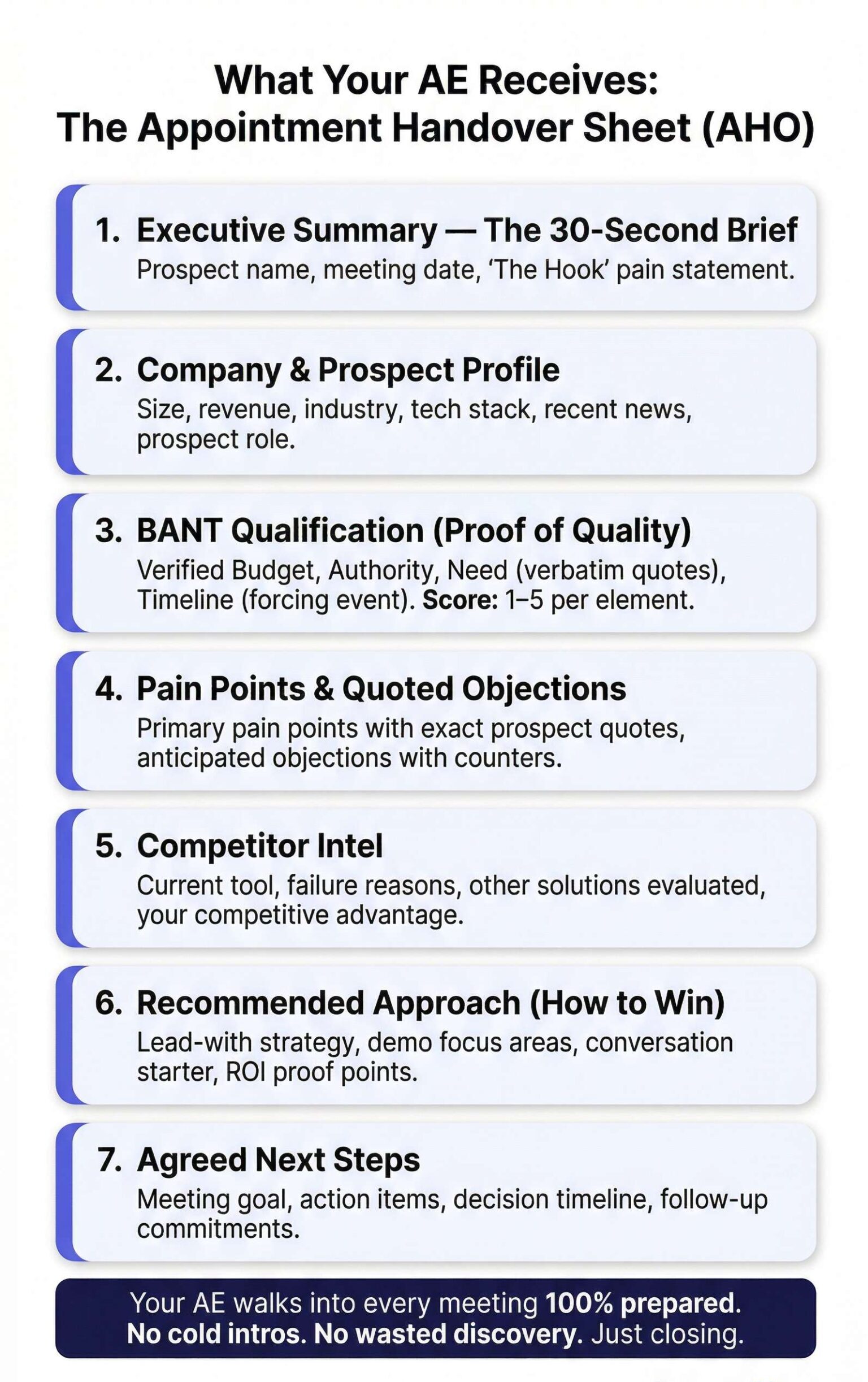
The AHO is a structured document delivered to your AE 24–48 hours before every meeting. It contains:
- The 30-second hook — the prospect’s core problem, stated in their own words, with the business impact quantified
- Full BANT verification notes — not checkbox summaries, but documented evidence for each element with verbatim quotes
- Competitor intelligence — what they’re currently using, why it’s failing, what alternatives they’ve evaluated
- Objections already raised — with recommended counters your AE can prepare for
- Agreed next steps — what the prospect expects to happen in the meeting
Without the AHO, even a BANT-qualified appointment becomes an unqualified sales meeting. Your AE walks in with a calendar invite and a name. With it, they walk in knowing “We’re bleeding deals because legal can’t keep up” — and can open the call directly addressing that reality.
The result is a qualified sales meeting in the truest sense: a conversation where your AE isn’t doing discovery, they’re closing.
Real-World Impact: Qualified vs. Unqualified Prospects
Consider a B2B software company evaluating two potential meetings:
| Criteria | Qualified Prospect (TechFirm) | Unqualified Prospect (SmallRetail) |
|---|---|---|
| Industry | Technology (ICP match) | Retail (outside ICP) |
| Company Size | 1,000+ employees | 20 employees |
| Annual Revenue | $100M+ | $2M |
| Budget | Dedicated software budget confirmed | Limited, no allocated budget |
| Decision-Maker | VP of Sales with purchasing authority | Store Manager (can’t approve) |
| Engagement | Demo requested after content engagement | No response to outreach |
| Timeline | Contract renewal in 90 days | “Maybe next year” |
TechFirm warrants your AE’s time. SmallRetail doesn’t—regardless of how much you paid for that “lead.”
The discipline to say no to unqualified prospects is what protects your sales team’s productivity.
The Pay-for-Performance Shift
The fundamental problem with traditional lead generation is misaligned incentives. Vendors get paid for activity (leads delivered), not outcomes (meetings that convert).
The alternative model: Pay for Appointments, not lists.
This means billing only occurs for BANT-verified meetings that appear on your sales team’s calendar. No-shows get replaced at no cost. You retain complete intelligence on every prospect touched—it’s your asset forever.
The financial comparison:
| Model | Monthly Cost | Meetings/Month | AE Qualification Time | Close Rate | Annual ROI |
|---|---|---|---|---|---|
| In-House SDR Hire | $62,500+ | ~60 | 30 hours/week | ~20% | 40-60% |
| Traditional PPL Vendor | $5,000 | ~10 | 20 hours/week | ~5% | 10-20% |
| Pay-for-Appointment Model | $7,500-16,000 | 15-40+ | <5 hours/week | ~35%+ | 120-180% |
The ROI gap isn’t marginal—it’s transformational.
Best Practices for Appointment Qualification in 2026
Beyond the framework, these operational details separate high-performing appointment programs:
Leverage first-party intent signals: Prospects who engage with relevant content demonstrate interest through behavior, not just demographics. Prioritize engagement recency and depth over static list attributes.
Time your outreach strategically: Research shows optimal connection windows are 11 AM-12 PM and 4-5 PM, particularly mid-week. But more important than timing is context—reaching out when intent signals are fresh.
Document everything in their words: Verbatim quotes from qualification calls become your AE’s most powerful tool. “We’re bleeding deals because legal can’t keep up” is infinitely more valuable than “prospect expressed interest in efficiency.”
Set clear meeting expectations: Prospects who know what to expect show up more often and engage more productively. Confirm the meeting purpose, who should attend, and what decisions might follow.
Create feedback loops: Post-meeting ratings from AEs identify which appointments convert and why. This intelligence improves targeting and qualification criteria continuously.
The Bottom Line
In 2026, qualified appointments aren’t a nice-to-have—they’re the difference between sales teams that close deals and sales teams that chase ghosts.
The shift is straightforward: Stop paying for activity. Start paying for accountability. Stop accepting “Black Box” lists of unknown quality. Demand “Glass Box” transparency where every prospect is verified, every signal is documented, and every meeting comes with the context your AEs need to win.
Companies that make this shift convert at 25-40% instead of 3-5%. They reduce cost per closed deal by 50-70%. They free their sales teams to do what they were hired for—closing business.
The framework exists. The data proves it works. The only question is whether you’ll keep feeding the MQL machine or start building a pipeline of meetings that actually convert.
Ready to transform your pipeline from unqualified leads to BANT-verified appointments?
Demand Nexus delivers guaranteed, qualified meetings through our proprietary Waterfall model—backed by first-party intent data from six niche media brands reaching 15M+ engaged decision-makers.
Every appointment includes a comprehensive Appointment Handover Sheet (AHO) so your AEs walk in 100% prepared to close.
How Much Does Qualified Appointment Setting Cost? (And What Are You Actually Paying For?)
“B2B appointment setting cost” is one of the most searched questions in this space — and the answer most vendors give is deliberately vague. Here’s what the numbers actually look like across three models.
In-House SDR Team All-in cost (salary, benefits, management overhead, tools, training) runs $62,500+ per month for a functional team. You get roughly 60 meetings per month, but your AEs spend 30+ hours per week re-qualifying prospects who were never properly vetted. Close rate hovers around 20%. Cost per closed deal: $5,208+. Annual ROI: 40–60%.
Traditional Pay-Per-Lead Vendor Typically priced at ~$300–500 per lead. At $5,000/month you receive roughly 10–20 “leads” — a CSV of contacts who may or may not have heard of you, with no BANT verification and no accountability for whether they convert. Close rate: ~5%. Cost per closed deal: $10,000+. Annual ROI: 10–20%.
BANT-Qualified Appointment Setting (Demand Nexus Waterfall) Priced at $7,500–$16,000/month depending on volume tier. You receive 15 to 40+ BANT-verified meetings per month — prospects who have confirmed budget, authority, need, and timeline before they land on your AE’s calendar. Close rate: ~35%. Cost per closed deal: $1,220–$1,500. Annual ROI: 120–180%+.
The cost-per-meeting for Demand Nexus ($400–500) looks similar to traditional PPL at surface level. The difference is what that meeting actually is. A PPL “lead” is a form submission. A Demand Nexus appointment is a verified conversation with a decision-maker who knows why they’re meeting you, has confirmed budget, and has a timeline for a decision.
You’re not paying for a name on a list. You’re paying for a meeting that has a real probability of closing.
What’s included in every appointment (regardless of tier): BANT verification, Appointment Handover Sheet (AHO), direct calendar scheduling, no-show replacement within 5 business days at no cost, complete data ownership — all prospect intelligence is yours permanently.
For pricing details by volume tier, see our full pricing page.
Contact us: sales@demandnexus.io | www.demandnexus.io
FAQs
What is a qualified appointment?
A qualified appointment is a booked meeting with a prospect verified against BANT - Budget, Authority, Need, and Timeline — meaning the buyer has allocated funds, decision-making authority, an articulated need, and a defined purchase timeline.
What is the difference between a lead and a qualified appointment?
A lead is a contact who has shown some activity, while a qualified appointment is a confirmed meeting with a BANT-verified buyer. Leads must be re-qualified and chased; qualified appointments are ready for a closing conversation.
What is BANT qualification?
BANT qualification verifies four criteria before a meeting is booked: Budget allocated, Authority to decide, a real Need, and a defined Timeline. Meetings that meet all four convert at far higher rates than unqualified leads.
What is an Appointment Handover Sheet (AHO)?
The AHO is the document that transfers everything captured during qualification to your Account Executive before the meeting. It includes the prospect's BANT verification, verbatim quotes on pain points, competitor intel, objections raised, and agreed next steps. Instead of walking in blind and wasting the first 15 minutes on re-discovery, your AE opens the call already knowing the prospect's exact problem, budget situation, and urgency driver.
How does a Pay-for-Performance appointment model work?
You only pay for BANT-verified meetings that actually appear on your sales team's calendar. No-shows are replaced at no cost. You retain all the prospect intelligence generated — it's your data asset, not the vendor's. Compare this to traditional PPL vendors where you pay upfront for a list regardless of whether a single meeting ever happens.
How many qualified appointments can we realistically expect per month?
Demand Nexus's Waterfall model is SLA-backed at 15+, 25+, or 40+ BANT-qualified meetings per month depending on your pod tier. Based on a ~35% close rate, that translates to 5+ closed deals per month from the Essentials Pod alone — with your AEs spending less than 5 hours per week on qualification, versus the 30+ hours typical of in-house SDR models.
How much does B2B qualified appointment setting cost?
The cost depends on the model. Traditional pay-per-lead vendors charge $300–500 per lead with no BANT verification and close rates around 5%, making the real cost per closed deal $10,000+. In-house SDR teams run $62,500+/month all-in with close rates around 20%. Demand Nexus's BANT-qualified appointment setting runs $7,500–$16,000/month for 15 to 40+ verified meetings, with close rates around 35% and a cost per closed deal of $1,220–$1,500. The meaningful comparison isn't cost-per-meeting — it's cost-per-closed-deal and annual ROI. Our model delivers 120–180%+ ROI versus 10–20% for traditional lead vendors.