



Tip 1: Call Intent-Signaled Accounts First
The single highest-impact change a cold calling program can make is to prioritize accounts that are showing active research behavior. First-party intent signals from owned media properties (like the DemandNexus properties AITechTrend, MarTechTrend, HRTechTrend, FinTechFilter, LegalTechTrend, DevTechTrend) and third-party signals from providers like Bombora and 6sense identify accounts researching your category before they fill out a form. Calling these accounts first produces engagement rates of 40-50% compared to 4-6% on unfiltered lists.

Most B2B teams lose 40–60% of qualified prospects to broken handoffs and weak qualification. Take our 2-minute diagnostic to find out where your pipeline is bleeding — and how to fix it.
Start the Quiz → Takes 2 minutes. No email required to start.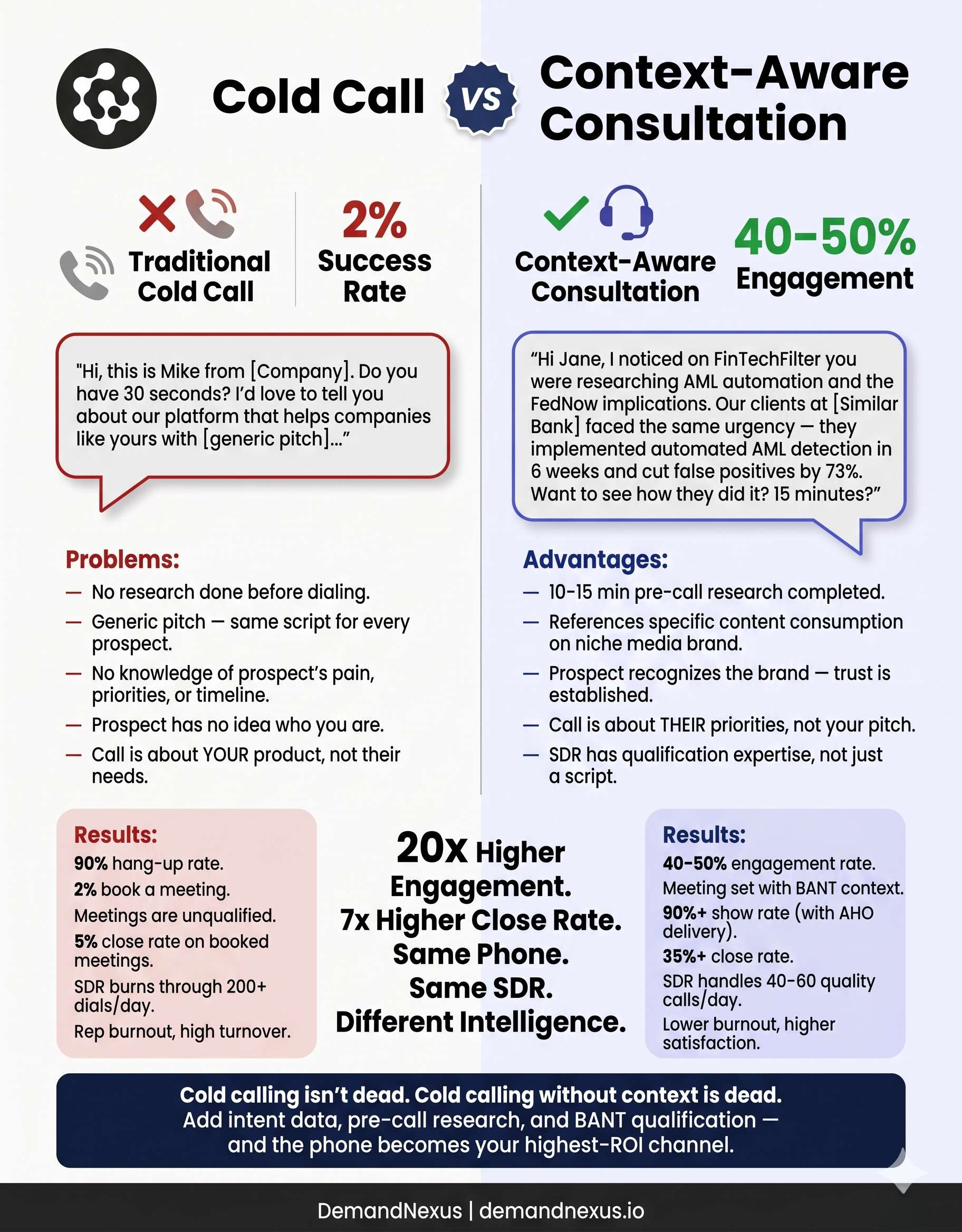
Tip 2: Verify Direct Dials Before Dialing
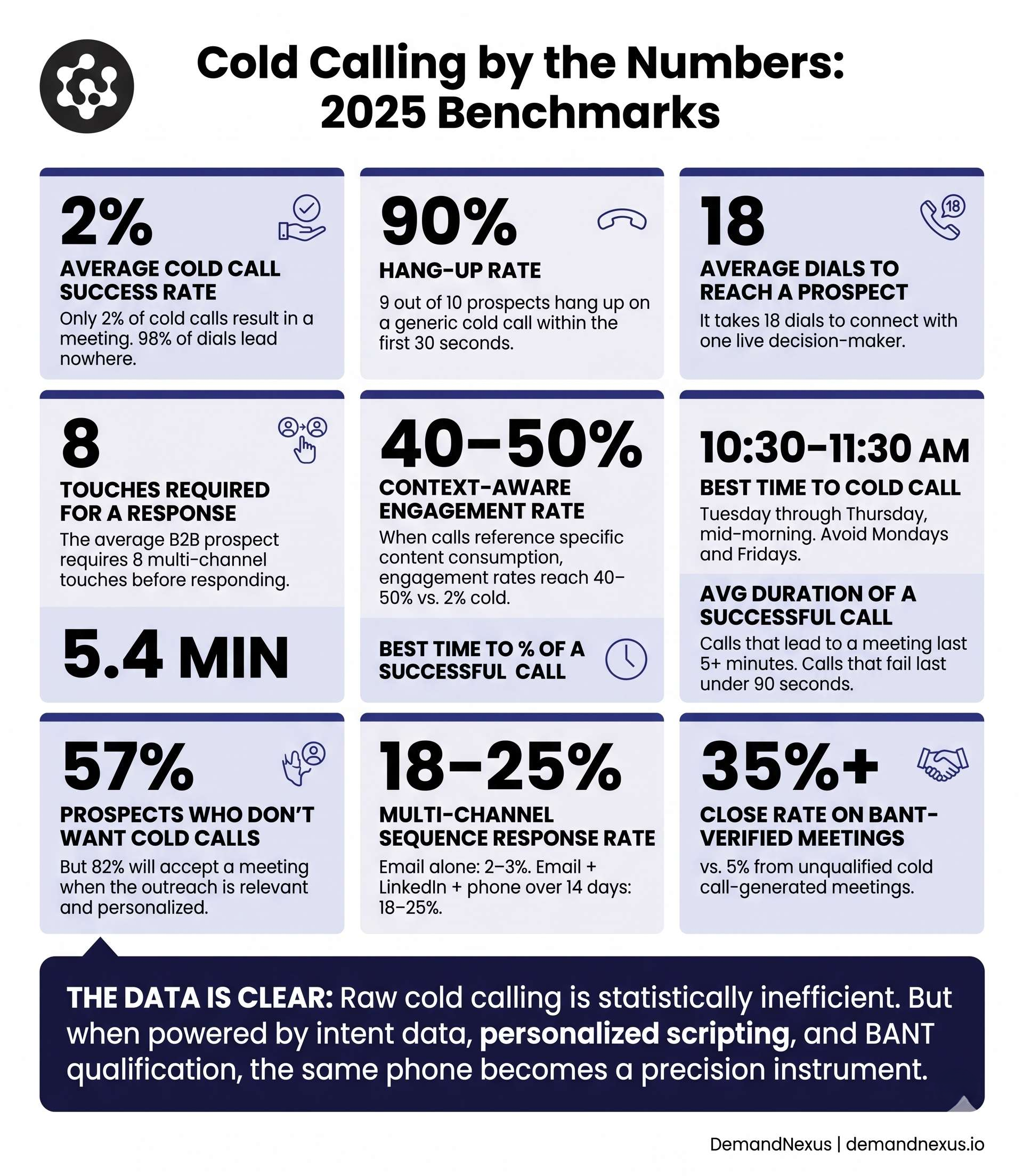
SDRs waste 30-40% of their dialing time reaching gatekeepers, voicemail systems, or wrong numbers. Investing in verified direct dial data from providers like ZoomInfo, Apollo, or Cognism, and validating phone numbers before loading them into sequences, increases connect rate immediately. A 10% improvement in data accuracy translates directly into 10% more conversations per day.
Tip 3: Call During Peak Connect Windows
Data consistently shows that Tuesday through Thursday between 10am and 12pm and between 2pm and 4pm in the prospect’s local time zone are the peak connect windows. Monday mornings and Friday afternoons are the worst. Align your call blocks to these windows and reserve non-peak hours for email, LinkedIn, and research tasks. For detailed scheduling data, see demandnexus.io/best-time-to-cold-call/.
Tip 4: Replace Permission-Based Openers
‘Do you have a moment?’ and ‘Is this a bad time?’ are the two most common cold call openers and two of the least effective. They invite a ‘no’ by framing the call as an interruption. Replace them with a context-aware opener that references something specific about the prospect’s company: a recent hire, a funding round, a product launch, or a content consumption signal. The prospect is more likely to stay on the line when the call feels relevant rather than random. For techniques on building effective openers, see demandnexus.io/cold-calling-techniques/.
Tip 5: State the Problem, Not the Product
After the opener, state the problem you solve in the prospect’s language, not your marketing language. ‘We help companies reduce pipeline waste’ is a product pitch. ‘Most B2B teams see 87% of their MQLs rejected by sales, which means the pipeline your team is building is mostly unusable’ is a problem statement that resonates because the prospect is likely living it. Problem statements earn conversations. Product pitches earn hang-ups.

Tip 6: Ask One Good Question Early
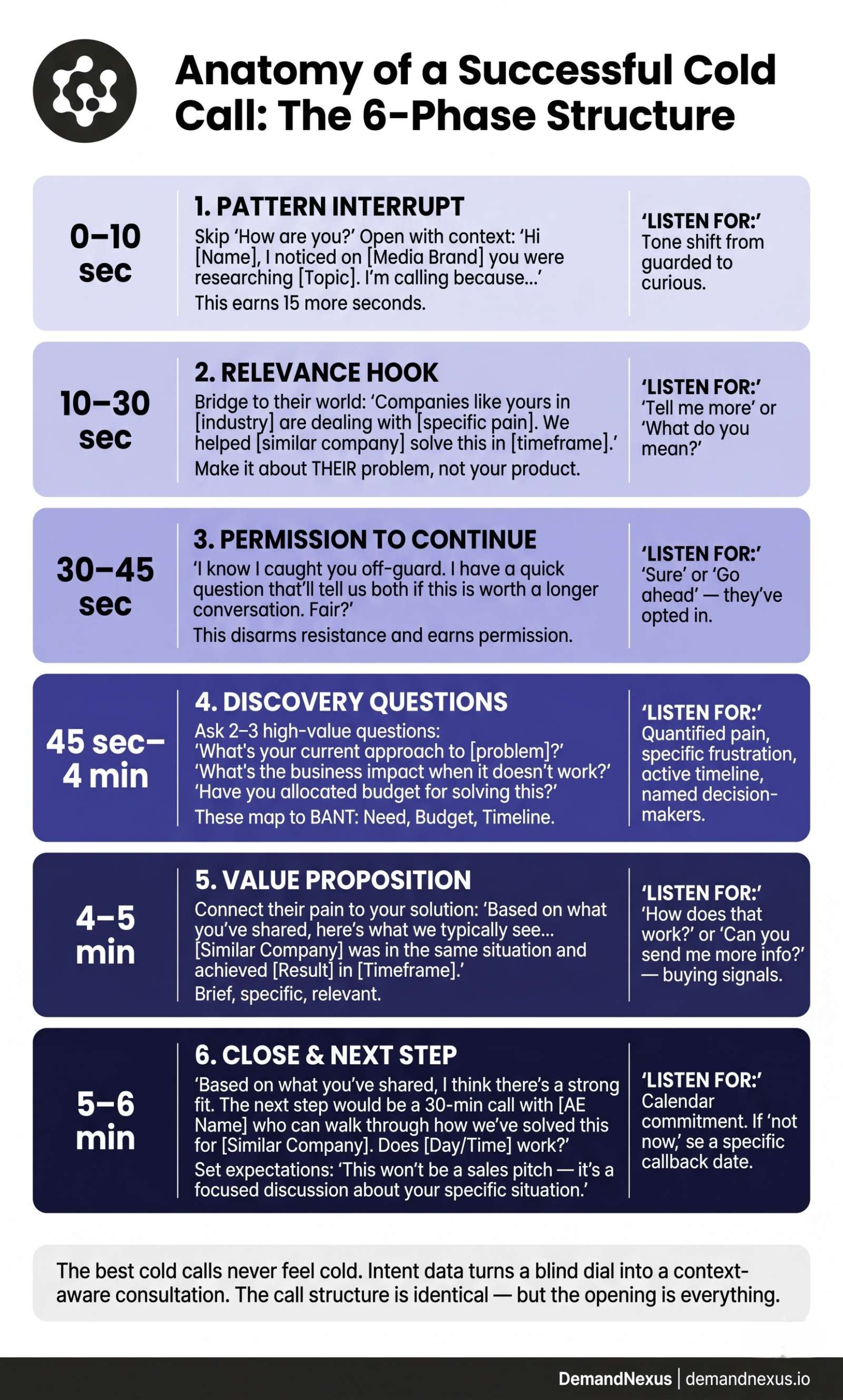
The fastest way to convert a cold call from a monologue into a conversation is to ask a single, relevant question within the first 45 seconds. Not a qualifying question yet, but a genuine curiosity question about their situation: ‘How is your team currently handling the qualification step before meetings are booked?’ A question shifts the dynamic from seller-pushing-information to seller-seeking-understanding, which is where productive calls live.
Tip 7: Qualify Before You Book
Never book a meeting without verifying at least Budget and Need on the call. Authority and Timeline are important too, but Budget and Need are the minimum viable qualification for a meeting that has a chance of progressing. A meeting booked without qualification has a 50-70% show rate and a low close rate. A meeting booked with BANT verification has a 90%+ show rate and a close rate more than 200% higher. The extra two minutes of qualification on the call saves hours of wasted AE time downstream.
Tip 8: Leave a Voicemail That Ties to Your Next Touch
Most cold calling advice says to skip voicemails. This is wrong for B2B. A voicemail that references your next email (‘I am sending you a short email with the benchmark data I mentioned’) creates a bridge between channels and increases the likelihood that the prospect opens the email. Keep voicemails under 30 seconds, reference one specific thing, and end with your name and number. For complete voicemail scripts, see demandnexus.io/cold-call-voicemails/.
Tip 9: Track Conversation Rate Separately From Connect Rate
Connect rate measures whether you reached the prospect. Conversation rate measures whether the prospect engaged in a substantive dialogue. These are different metrics with different drivers. A high connect rate with a low conversation rate indicates an opener problem. A low connect rate with a high conversation rate indicates a targeting problem. Tracking both reveals where the specific bottleneck is.
Tip 10: Debrief Every Call
The SDRs who improve fastest are the ones who debrief every call immediately after hanging up: what worked, what did not, what would they change next time. A 30-second self-debrief after each call produces more improvement than a weekly coaching session. For teams, a daily 15-minute call review where SDRs share their best and worst calls accelerates skill development across the whole team. For structured training approaches, see demandnexus.io/cold-calling-training/.
FAQs
What is the number one cold calling tip for B2B?
Call intent-signaled accounts first. The single biggest driver of cold calling success is targeting quality. Calling accounts that are actively researching solutions in your category produces engagement rates of 40-50% compared to 4-6% on unfiltered lists. Every other tip amplifies this one.
How do I get better at cold calling fast?
Focus on three things in order: improve your targeting (call the right accounts), improve your opener (replace permission questions with context), and add BANT qualification to every conversation. Then debrief every call. Measurable improvement typically appears within 30 days of implementing these changes.
How many cold calls should an SDR make per day?
The right number depends on the model. High-volume traditional programs target 80-120 dials per day. Intent-driven programs with deeper pre-call research typically target 40-60 dials per day. The intent-driven model produces more meetings per day despite fewer dials because the conversion rate per dial is 5-10x higher.
Put These Tips Into Practice
If you want to see how these tips apply to your specific ICP and outbound motion, take the qualification diagnostic at demandnexus.io/start-quiz/ or book a cold calling strategy session at demandnexus.io/book-a-call.