



The traditional approach floods your pipeline with unqualified contacts who did an activity. The modern approach delivers BANT-verified appointments that convert. This article explores why pay-for-performance appointment generation is replacing traditional outsourced SDR services—and how this shift can transform your sales outcomes.

Most B2B teams lose 40–60% of qualified prospects to broken handoffs and weak qualification. Take our 2-minute diagnostic to find out where your pipeline is bleeding — and how to fix it.
Start the Quiz → Takes 2 minutes. No email required to start.What Is an Outsourced SDR?
An outsourced SDR is a professional hired through a third-party provider to handle the early stages of the sales funnel, including prospecting, lead qualification, and initial outreach. Unlike in-house SDRs, these external sales experts work as part of a managed service, bringing specialized expertise in industries like SaaS, fintech, and enterprise technology.
However, outsourced SDR services vary dramatically in what they actually deliver.
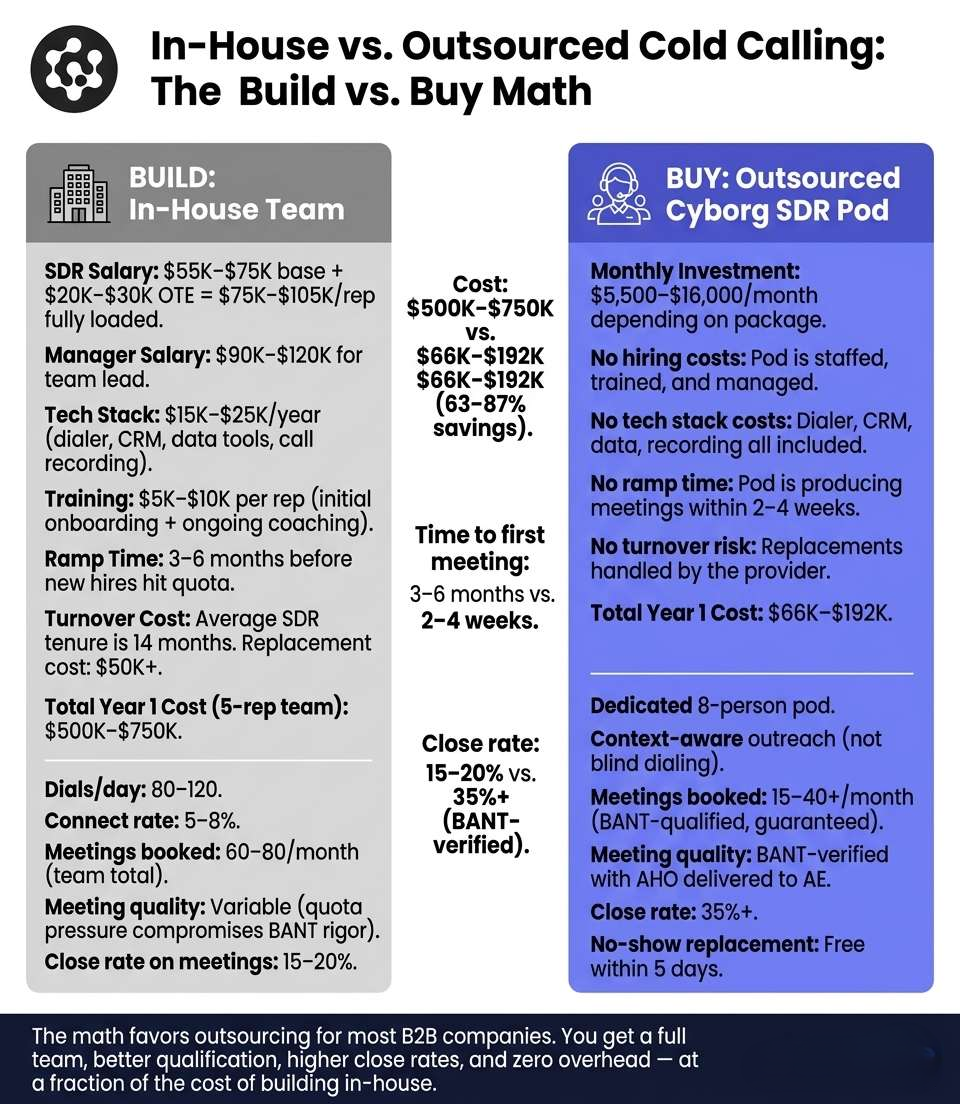

Traditional outsourced SDRs focus on activity metrics: emails sent, calls made, and meetings booked—regardless of quality. This creates the same problem you’d have with an in-house team: quota pressure leads SDRs to book marginal meetings and hope the Account Executive figures it out.
Performance-based SDR services focus on outcomes: verified appointments with prospects who have confirmed Budget, Authority, Need, and Timeline (BANT). You only pay for meetings that meet your qualification criteria.

The difference in results is dramatic. Traditional SDR approaches produce meetings where 60-80% are unqualified. Performance-based models with rigorous BANT verification achieve 90%+ qualified appointment rates.
Why Traditional SDR Outsourcing Often Fails
When CROs and VPs of Sales consider outsourcing appointment generation, they face a legitimate fear: “Will outsourced SDRs understand my product and represent my brand as well as in-house reps?”
This anxiety is understandable. The stereotype exists because most outsourced SDR models suffer from conflicting incentives.
The Root Cause: Volume vs. Quality
Internal and traditional outsourced SDRs face a dilemma. When the month-end deadline approaches, quota pressure wins over quality standards. SDRs skip qualification steps, book marginal meetings, and hope the AE figures it out.
A typical scenario looks like this:
- SDR: “Are you interested in a demo?”
- Prospect: “Sure, I’d like to learn more.”
- SDR books meeting immediately without asking about budget, authority, need, or timeline.
- Result: The prospect shows up curious but unqualified. The AE wastes 60 minutes only to discover they’re a junior employee doing research for a project 18 months away.
The Financial Impact
This qualification gap creates massive hidden costs. Consider a typical B2B company’s traditional lead generation spend:
- 400 MQLs per month at $125 each = $50,000 spend
- 15% MQL-to-SQL conversion = 60 SQLs
- 20% SQL-to-close rate = 12 deals
- Sales team spends 600 hours on 400 leads
- Cost per deal: $4,167
- Sales hours per deal: 50 hours
The majority of sales time goes toward chasing and re-qualifying leads rather than closing deals.
The Pay-for-Performance Appointment Model
The pay-for-performance appointment (PPA) model inverts the traditional approach. Instead of paying for activities or lead volume, you pay only for BANT-verified, scheduled meetings that appear on your sales team’s calendar.
What Changes with Pay-for-Performance:
| Factor | Traditional Outsourced SDR | Pay-for-Performance Model |
|---|---|---|
| Payment Trigger | Retainer or per lead/activity | Meeting held and attended |
| What You Receive | List of contacts who did an activity | Scheduled, BANT-verified appointment |
| Risk | You bear qualification risk | Provider bears qualification risk |
| Lead Quality | Low-intent, activity-based | High-intent, pre-qualified |
| Your Team’s Role | Re-qualify and chase (50% selling time) | Close deals (100% selling time) |
| No-Show Protection | You’ve already paid | Automatic replacement at no cost |
The Financial Difference:
When companies switch from traditional lead generation to pay-for-performance appointments, the results shift dramatically:
- 60 BANT-qualified appointments per month
- 95% already qualify as SQLs
- 30-35% SQL-to-close rate = 17-21 deals
- Sales team spends less than 5 hours on qualification
- Cost per deal: $1,220-$1,765
- Sales hours per deal: 10.6 hours
This represents a 58% lower cost per deal, 79% reduction in wasted sales time, and 40%+ more deals closed.
What Makes BANT Qualification Actually Work?
BANT qualification is only as good as its enforcement. The difference between effective and ineffective BANT comes down to rigorous verification and accountability.
Effective BANT Verification Requires:
Budget Verification
- Verified: “We have $150K allocated for this” or “This is in our approved tech spend”
- Not Qualified: “I’ll need to check with finance” or “Budget hasn’t been approved yet”
Authority Mapping
- Verified: “I’m the VP of Operations and make the final decision” or “I’m on the buying committee alongside [names]”
- Not Qualified: “I’d need to talk to my manager” or “I’m just gathering information”
Need Assessment
- Verified: “We’re manually doing this and it’s taking 40 hours/month” or “Compliance is forcing us to upgrade by Q2”
- Not Qualified: “Just researching for future” or “Not an immediate priority”
Timeline Confirmation
- Verified: “We need implementation by March 31” or “Our contract expires in 60 days”
- Not Qualified: “No specific timeline” or “Someday, maybe next year”
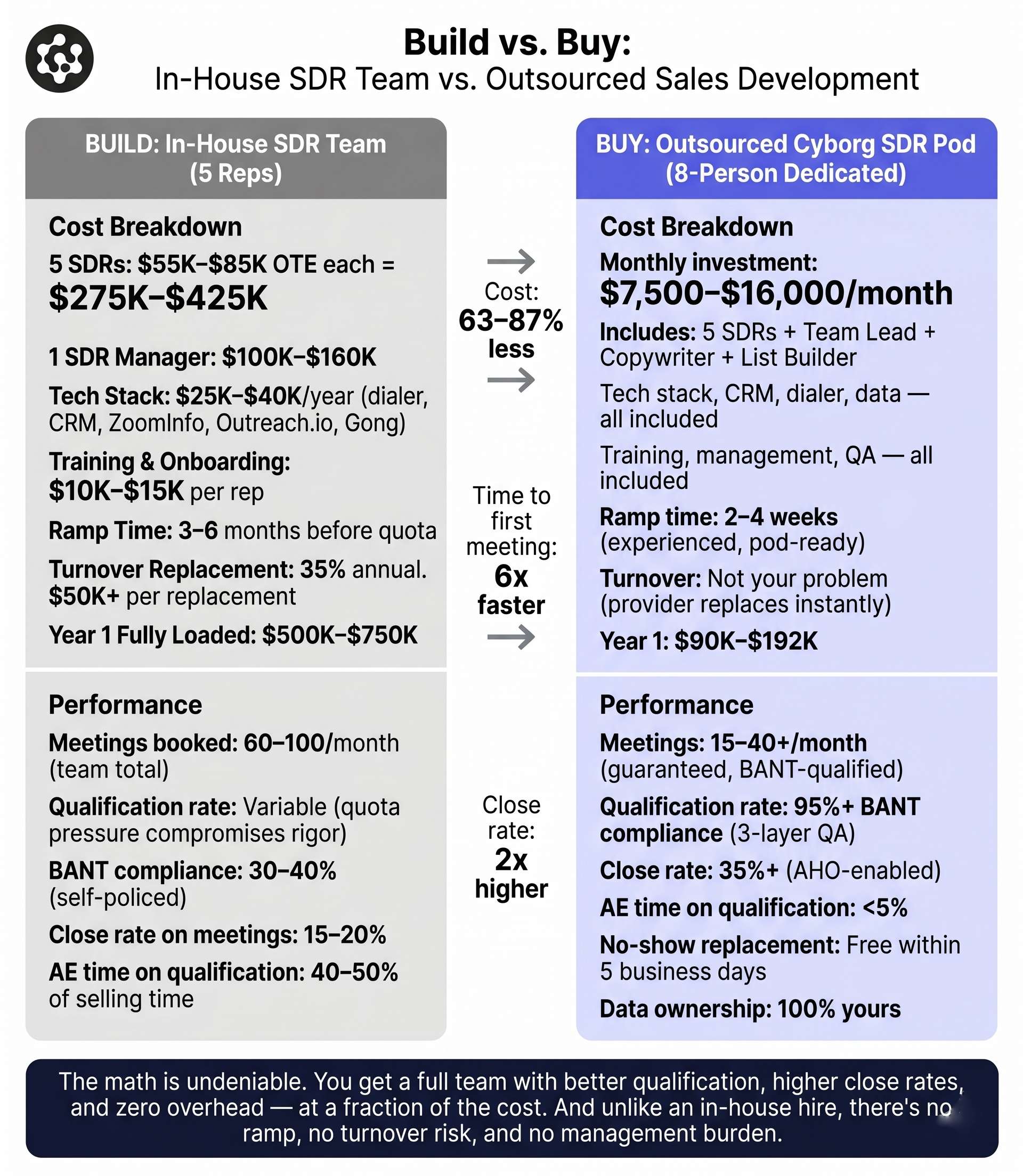
The accountability mechanism matters equally. When providers are paid for quality rather than volume, SDRs have zero incentive to cut corners. If an appointment is unqualified, it gets replaced at no cost—which means rigorous qualification is rewarded.
The Role of First-Party Intent Data in Modern SDR Services
The most effective outsourced SDR services today leverage first-party intent data rather than relying on cold outreach or purchased contact lists.
Why First-Party Intent Beats Third-Party Data:
| Dimension | Third-Party Intent Data | First-Party Intent Data |
|---|---|---|
| Identity | Anonymous (IP addresses only) | Known person with name and title |
| Timing | Delayed (weeks old, aggregated) | Real-time engagement |
| Availability | Public (competitors buy same data) | Proprietary and exclusive |
| Specificity | Broad (“Interested in AI”) | Specific content engagement tracked |
| Accuracy | 40-50% false positives | 85%+ signal accuracy |
When an SDR reaches out to someone who has already engaged with relevant content, the conversation shifts from cold interruption to context-aware consultation. This approach achieves 40-50% engagement rates compared to 10% or less for traditional cold outreach.
The outreach becomes personalized and relevant because the SDR knows exactly what topics the prospect has been researching and can reference specific pain points they’ve demonstrated interest in.
The Cyborg SDR Model: AI for Research, Humans for Relationships
The future of outsourced SDR services isn’t 100% AI automation or 100% human effort—it’s the intelligent combination of both.
What AI Handles (Scale):
- Monitor thousands of intent signals across target accounts
- Scan job postings and databases to identify trigger events
- A/B test messaging variations at scale
- Track KPIs and flag anomalies in real-time
- Prioritize prospects by propensity to buy
What Humans Handle (Value):
- Build trust through genuine conversations
- Navigate complex objections with empathy
- Ask diagnostic questions that uncover real needs
- Verify BANT criteria through skilled discovery
- Deliver context-rich handoffs to Account Executives
The Performance Comparison:
| Metric | 100% AI SDR | 100% Human SDR | AI-Amplified Human |
|---|---|---|---|
| Emails Sent/Month | 10,000 | 500 | 2,000 |
| Reply Rate | 1% | 8% | 15% |
| Qualified Meetings | 10 | 20 | 60 |
| Brand Risk | Extreme | None | Minimal |
The AI-amplified human approach delivers 3X the qualified meetings of pure human teams at lower cost, while avoiding the brand damage and spam complaints that plague fully automated approaches.
The Appointment Handover Sheet: What Your AE Actually Needs
The quality of information passed from SDR to Account Executive determines whether qualified meetings convert to closed deals. Most handoffs provide minimal context: “Spoke to Jane. She has a need. Call her.”
Effective outsourced SDR services deliver a comprehensive Appointment Handover Sheet (AHO) that includes:
Executive Summary (30-Second Brief)
- Prospect name, title, and company
- The specific hook: why this meeting matters now
- Critical timeline pressures or forcing events
Complete BANT Verification
- Budget: Specific allocation confirmed with verbatim quotes
- Authority: Decision-maker identified with buying committee mapped
- Need: Documented pain points in prospect’s own words
- Timeline: Confirmed deadlines and decision timeframe
Conversation Intelligence
- Competitor information: what they’re currently using and why it’s failing
- Objections raised during qualification and how they were handled
- Recommended approach for the sales conversation
- Success criteria: what the prospect needs to see to move forward
This level of handoff documentation enables AEs to enter conversations fully prepared, dramatically improving close rates from the typical 20% to 35%+ on qualified appointments.
How to Evaluate Outsourced SDR Providers
When selecting an outsourced SDR partner, evaluate these factors:
Pricing Model Alignment
- Pay-per-lead models create misaligned incentives
- Retainer models guarantee activity but not outcomes
- Pay-for-performance models align provider success with your revenue goals
Qualification Rigor
- How specifically is BANT verified?
- What happens when an appointment doesn’t meet criteria?
- What accountability mechanisms exist for quality assurance?
Data and Transparency
- Do you receive full access to all prospect interactions?
- Can you see the entire qualification conversation?
- Do you own the data at the end of the engagement?
Handoff Quality
- What information does the AE receive before each meeting?
- Is there documented proof of BANT qualification?
- Does the handoff include competitive intelligence and recommended approach?
No-Show and Quality Guarantees
- What happens if a prospect doesn’t show up?
- What happens if a meeting doesn’t meet qualification criteria?
- How quickly are replacements delivered?
Measuring Outsourced SDR Success: The Right KPIs
While the number of meetings scheduled is a common metric, it’s not the most meaningful. Focus instead on:
Meeting-to-Opportunity Acceptance Rate: The percentage of scheduled meetings that convert into sales opportunities. This measures true qualification quality. Target: 35%+ for BANT-verified appointments versus 15-20% for traditional models.
Attendance Rate: Tracks how many prospects show up for scheduled meetings. Well-qualified appointments with confirmed attendance commitments achieve 90%+ attendance. Traditional models often see 60-70%.
AE Time Investment: How many hours does your sales team spend re-qualifying leads versus selling? With effective outsourced SDR services, AEs should spend less than 5 hours per week on qualification—down from 20-30 hours with traditional approaches.
Cost Per Closed Deal: The ultimate efficiency metric. Traditional lead generation often costs $4,000-$10,000 per closed deal. Pay-for-performance appointments typically deliver $1,200-$1,800 per closed deal.
ROI Comparison:
| Model | Monthly Cost | Meetings | AE Close Rate | Annual ROI |
|---|---|---|---|---|
| In-House SDR Hire | $62,500+ | ~60 | ~20% | 40-60% |
| Traditional Pay-Per-Lead | $5,000 | ~10 | ~5% | 10-20% |
| Pay-for-Performance | $5,500-$16,000 | 15-40+ | ~35% | 120-180% |
Conclusion
Outsourcing SDRs is no longer simply about offloading prospecting work—it’s about fundamentally changing how you generate qualified pipeline. The shift from activity-based to outcome-based models transforms outsourced SDR services from a cost center into a predictable revenue engine.
The key differentiators that drive success:
- Pay-for-performance pricing that aligns provider incentives with your revenue goals
- Rigorous BANT verification with accountability mechanisms that ensure quality
- First-party intent data that enables context-aware outreach instead of cold interruption
- AI-amplified human expertise that combines scale with relationship-building skill
- Comprehensive handoff documentation that prepares AEs to close
When these elements come together, outsourced SDR services deliver what in-house teams and traditional vendors cannot: a consistent flow of qualified appointments that convert at 3X typical rates, with full transparency into every step of the process.
The question isn’t whether outsourced SDRs can represent your brand effectively. It’s whether your current approach—in-house or outsourced—achieves the rigor, accountability, and qualification standards that modern B2B sales requires.
Ready to see how pay-for-performance appointment generation can transform your pipeline?
Contact DemandNexus to discuss your specific qualification criteria, target accounts, and revenue goals. Learn how BANT-verified appointments backed by first-party intent data can deliver 15+ qualified meetings per month with zero-risk billing guarantees.