



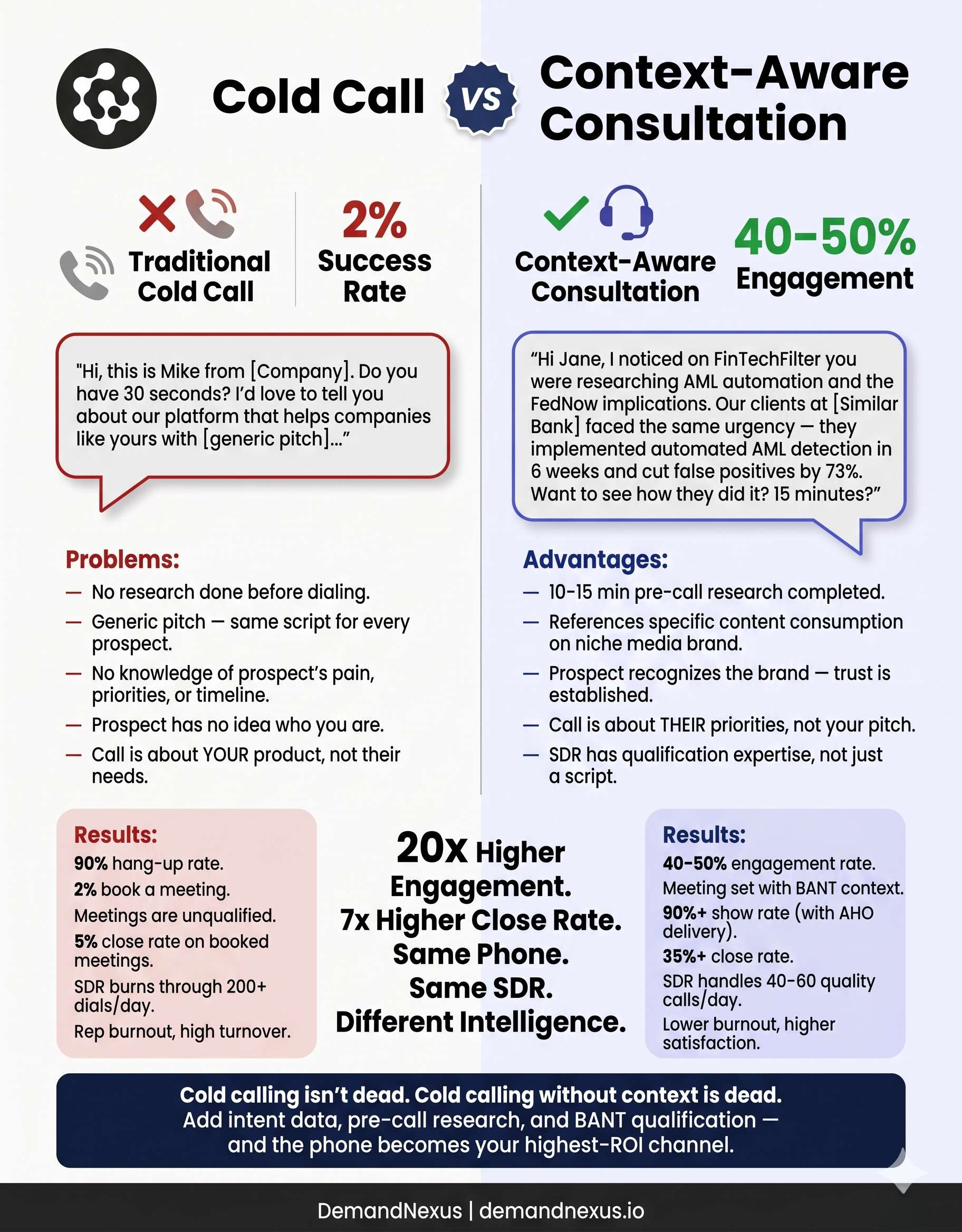
Traditional cold calling achieves roughly 1-3% success rates. Meanwhile, context-aware consultations that leverage first-party intent data consistently achieve 40-50% engagement rates with decision-makers. The difference isn’t just technique—it’s having actionable intelligence before you dial.

Most B2B teams lose 40–60% of qualified prospects to broken handoffs and weak qualification. Take our 2-minute diagnostic to find out where your pipeline is bleeding — and how to fix it.
Start the Quiz → Takes 2 minutes. No email required to start.This guide explores why most cold calling scripts fail, what separates high-performing outreach from generic pitches, and how to transform cold calls into context-aware consultations that actually convert.
Why Traditional Cold Calling Scripts Fail
The fundamental problem with traditional cold calling scripts is they treat outreach as a numbers game. Call enough people, the logic goes, and some percentage will convert. This approach produces predictable results: approximately 90% hang-up rates, frustrated sales teams, and damaged brand reputation.
Consider the typical cold call opener: “Hi, this is [Name] from [Company]. Do you have 30 seconds?” This approach fails because it offers the prospect nothing of value. There’s no context, no relevance, and no reason for a busy executive to engage.

The legacy model forces sales representatives into an impossible position. They’re dialing blind—reaching out to contacts with no verified interest, no understanding of their current priorities, and no insight into whether they’re even the right person to speak with. Even the best script can’t overcome a fundamental lack of intelligence about the prospect.
The Context-Aware Alternative
Context-aware calling represents a fundamentally different philosophy. Instead of starting with a cold list and hoping for engagement, it begins with verified intent signals—real behavioral data indicating a prospect is actively researching solutions in your category.

Here’s what that looks like in practice. When a VP of Operations at a target company reads multiple articles about supply chain automation, downloads a whitepaper on logistics optimization, and revisits pricing content within a two-week period, that’s not a guess. That’s verified, real-time behavior indicating active interest.
An SDR armed with this intelligence opens the conversation differently: “Hi Jane, I’m reaching out because I noticed you were researching supply chain automation challenges. Our clients in manufacturing faced similar urgency around reducing fulfillment times. They cut cycle times by 40% within six weeks. What prompted your research?”
This isn’t a cold call. It’s a context-aware consultation based on demonstrated interest. The prospect recognizes the relevance. The conversation is about their priorities, not a sales pitch.
Elements of High-Converting Cold Calling Scripts
Whether you’re building internal capability or working with an appointment generation partner, effective cold calling scripts share common elements that distinguish them from generic templates.
The Permission-Based Opener
Strong openers acknowledge you’re interrupting while immediately establishing relevance. The key is leading with context rather than asking for time.
Generic approach: “Hi [Name], is now a bad time for a quick chat?”
Context-aware approach: “Hi [Name], I’m calling because I saw you were researching [specific topic]. Our clients at [similar company] faced the same challenge. Is this something you’re actively working on?”
The difference is specificity. When prospects hear that you’ve done your homework, engagement rates increase dramatically because the call is immediately relevant to their work.
Diagnostic Questions Over Discovery Questions
Traditional scripts focus on discovery questions designed to qualify leads. Context-aware scripts use diagnostic questions that demonstrate expertise while uncovering the real business problem.
Discovery question: “How are you currently handling [challenge]?”
Diagnostic question: “Based on what you were researching, it sounds like [specific pain point] might be creating downstream issues with [business impact]. What prompted you to start looking at solutions now?”
Diagnostic questions show you understand their world. They position the SDR as a peer who can have a substantive conversation, not someone reading from a checklist.
BANT Verification That Doesn’t Feel Like Interrogation
BANT qualification—verifying Budget, Authority, Need, and Timeline—is essential for ensuring meetings are productive. But the approach matters enormously.
Organizations that rigorously verify BANT criteria before scheduling appointments see dramatically different outcomes. BANT-qualified appointments convert to opportunities at 25-40% rates compared to 3-5% for standard marketing leads. The difference is that every meeting involves someone who can buy, has allocated budget, has an urgent need, and has a defined timeline.
Effective BANT verification weaves qualification into natural conversation:
Budget: “It sounds like this is a priority. Has your team allocated budget for solving this, or are you still building the business case?”
Authority: “Beyond yourself, who else would need to be involved in evaluating solutions like this?”
Need: “What’s the business impact of not solving this in the next quarter?”
Timeline: “When would you ideally need this implemented to hit your goals?”
The key is asking these questions naturally within a conversation about the prospect’s challenges, not as a checklist at the end of the call.
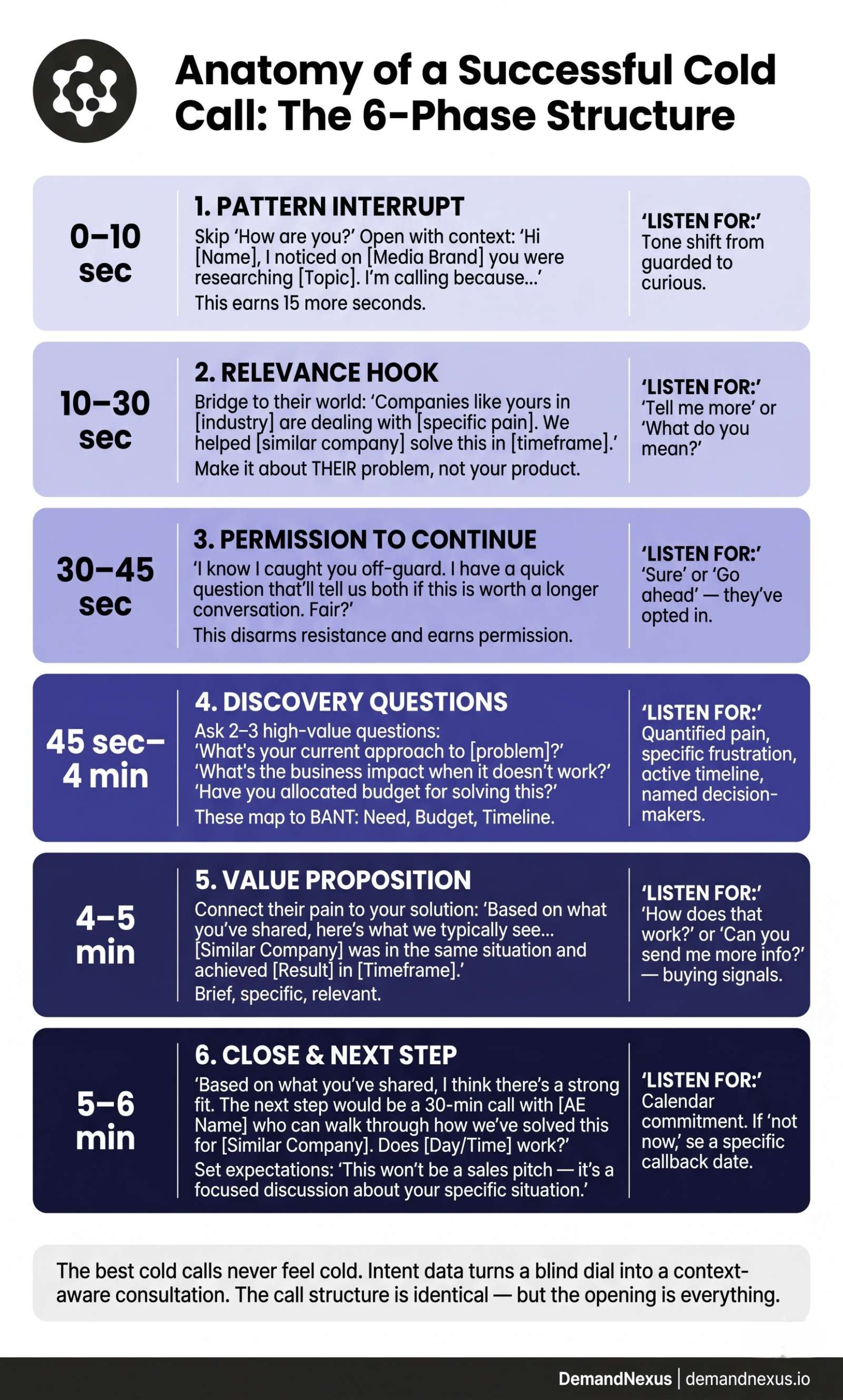
Cold Call Script Template: The Fill-in-the-Blank Framework
Most cold calling scripts fail because they’re written for the wrong moment. The framework below works because it’s built around the prospect’s context, not your pitch. Each slot has two options — choose the one that fits your situation.
[OPENER] Option A (intent-triggered): “Hi [Name], I’m calling because I saw you were researching [specific topic]. Companies in [industry] usually hit that problem when [trigger event].” Option B (trigger event): “Hi [Name], I noticed [company] recently [expansion/funding/product launch]. When that happens, teams usually run into [specific challenge].”
[CONTEXT HOOK] “[Similar company] was dealing with the same thing — [quantified pain, e.g., ‘spending 40 hours a month manually processing X’]. We helped them [specific result] in [timeframe].”
[DIAGNOSTIC QUESTION] “What’s prompting you to look at this now — is it [pain A] or more of a [pain B] situation?” (Let them talk. Listen for urgency and ownership.)
[BANT BRIDGE] Budget: “It sounds like this is a priority. Has your team set aside budget for solving this, or are you still building the internal case?” Authority: “If you decided to move forward, who else would need to be part of that conversation?” Timeline: “When would you need this running to hit your goals for [quarter/initiative]?”
[THE ASK] “Based on what you’ve shared, I think it’s worth a 20-minute call with [specialist/AE name]. They can walk you through exactly how [similar company] solved this — no pitch, just a focused look at whether there’s a fit. Does [day] work?”
Use this framework as the backbone for all the industry-specific scripts below. The structure stays the same; the context changes.
Cold Calling Scripts by Industry
Generic scripts produce generic results. The following B2B cold calling scripts are built for specific buyer contexts — use the one that matches your prospect’s world.
B2B Cold Calling Script for IT Services
SDR: “Hi [Name], I’m calling because I saw you were researching [managed services/IT infrastructure/cloud migration]. Companies scaling past [headcount/revenue milestone] usually hit the same bottleneck — internal IT can’t keep up without outside support. Is that something your team is navigating right now?”
Prospect: “We’ve been thinking about it.”
SDR: “That makes sense. [Similar IT services client] was in the same position — their internal team was handling 200 tickets a month and still missing SLAs. We helped them cut resolution time by 60% in the first quarter. What’s driving the conversation on your end — is it capacity, coverage hours, or something more specific?”
[BANT check and close as per framework above]
SaaS Cold Calling Script
SDR: “Hi [Name], I’m reaching out because I saw [company] was looking at [onboarding automation/revenue ops/CS tooling]. Fast-growing SaaS teams usually hit this wall around [ARR milestone or team size] — the process that worked at Series A breaks by Series B. Does that sound familiar?”
Prospect: “Yeah, we’re definitely feeling that.”
SDR: “That’s exactly why I called. [SaaS client name] had the same issue — manual onboarding was dragging time-to-value out to 45 days. We brought it down to 12. I’d love to show you what they did differently. Do you have budget allocated for this in [Q/year], or are you still scoping?”
[BANT check and close as per framework above]
Cold Calling Script for Software Sales
SDR: “Hi [Name], teams evaluating [category — e.g., CRM, data platforms, dev tooling] tend to reach out to us because they’ve hit a wall with their current setup — usually around [integration gaps, scalability, or adoption]. Is that part of what’s prompting your research?”
Prospect: “Partly. We’re looking at a few options.”
SDR: “Totally normal at this stage. When [similar software company] was evaluating, their main concern was [specific objection — e.g., migration complexity]. We had them live in three weeks with zero data loss. What’s the biggest hesitation on your team’s side right now?”
[BANT check and close as per framework above]
Cold Calling Script for Website Design and Digital Agencies
SDR: “Hi [Name], I’m calling because I noticed [company] is [expanding/launching a new product line/entering a new market]. That usually means the existing website is starting to feel like it’s lagging behind where the business actually is. Has that conversation come up internally?”
Prospect: “We’ve been talking about a redesign.”
SDR: “Perfect timing then. [Similar B2B client] went through the same — their site hadn’t been touched in three years and conversion rates were suffering for it. Post-redesign they saw a 38% lift in qualified demo requests. Who owns that decision on your side — is it marketing, or does it involve your CTO as well?”
[BANT check and close as per framework above]
Cold Calling Script for Financial Services and FinTech
SDR: “Hi [Name], I’m reaching out because I saw you were reading about [AML compliance/payment infrastructure/embedded finance] — specifically the [regulation/FedNow/open banking] angle. Firms at your stage are under real pressure to upgrade before the compliance window closes. Is that something you’re actively scoping?”
Prospect: “It’s on our roadmap.”
SDR: “Roadmap means different things at different firms — some teams are six weeks out, others are twelve months. Where does it sit for you? Is budget allocated, or is this still getting approved?”
[BANT check and close as per framework above]
B2B Telemarketing Script for Lead Generation
SDR: “Hi [Name], I’m calling on behalf of [client company]. We work with [industry] companies that are trying to fill their pipeline with decision-maker meetings rather than raw leads. I’ll be upfront — the reason I’m calling is that your company fits the profile of teams that typically get the most out of what we do. Do you have 90 seconds for me to explain why?”
Prospect: “Go ahead.”
SDR: “Great. [Client] generates qualified appointments with verified budget and authority — not MQLs that go cold. The last campaign we ran for a [similar company] produced 22 BANT-qualified meetings in 30 days. For context, their previous approach was producing about 4 usable meetings per month from the same budget. What does your current lead gen setup look like?”
[BANT check and close as per framework above]
Cold Calling Script Examples: Context-Aware Templates
The following scripts illustrate the context-aware approach for different B2B scenarios. Note how each example leads with specific intelligence about the prospect rather than generic value propositions.
SaaS/Technology Cold Calling Script
This script works for technology solutions where the prospect has demonstrated intent through content engagement.
SDR: “Hi [Prospect Name], this is [Your Name]. I’m reaching out because I saw you were researching [specific topic from content engagement]. Our clients in [industry] faced the same challenge—[Client Name] was spending 40 hours monthly on manual processes before they automated. What prompted your research?”
Prospect: “We’re evaluating options. Our current setup isn’t scaling.”
SDR: “That makes sense. When systems don’t scale, it usually shows up in either team productivity or error rates. Which is hitting you harder right now?”
Prospect: “Both, honestly. We’re growing fast and things are breaking.”
SDR: “Growth pain is good pain, but timing matters. You mentioned scaling issues—is this something your team has allocated budget to address, or are you still building the case internally?”
Prospect: “We have Q2 budget for this. It’s a priority.”
SDR: “Perfect. Would it make sense to schedule 30 minutes with one of our solutions architects who specializes in [specific challenge]? They can show you exactly how [similar company] solved this and reduced their processing time by 60%. How does Thursday look?”
This script works because it references specific behavior, asks diagnostic questions that demonstrate expertise, naturally qualifies budget and timeline, and proposes a clear next step tied to their stated priorities.
Executive-Level Cold Calling Script
Calling C-suite executives requires brevity and immediate strategic relevance. Lead with business impact, not product features.
SDR: “Hi [CEO Name], this is [Your Name]. I work with CEOs in [industry] who are trying to solve [strategic challenge]. Based on [company’s] recent [expansion/funding/initiative], I thought this might be relevant. Do you have two minutes?”
Prospect: “What’s this about?”
SDR: “I’ll be direct. [Similar CEO] told me their biggest bottleneck was [specific pain point]—it was costing them [quantified impact] monthly. We helped them cut that by 70% in six weeks. I’m curious if [prospect’s company] is facing similar challenges as you scale.”
Prospect: “We’re dealing with something like that, yes.”
SDR: “That’s exactly why I called. If I could show you how [similar company] solved this—and the timeline to see similar results—would 15 minutes be worth your time? I can keep it focused on the business case, not a product demo.”
Executives respond to specificity and peer examples. Referencing similar CEOs who faced comparable challenges creates immediate credibility.
Competitive Replacement Script
When prospects are using a competitor’s solution, the approach requires acknowledging their current investment while highlighting specific gaps.
SDR: “Hi [Prospect Name], I noticed [company] is currently using [Competitor]. How’s that working for your team?”
Prospect: “It’s okay. Why do you ask?”
SDR: “We’ve had several conversations with teams moving away from [Competitor]—usually because of [common pain point]. Is that something you’ve experienced, or has it been working well?”
Prospect: “Actually, we’ve had some frustrations with [specific issue].”
SDR: “That’s what we hear most. [Client Name] switched last quarter specifically because of that issue. They’re now seeing [quantified improvement]. I’m not suggesting you need to switch—but if you’re open to it, I’d love to show you what they did differently. Worth 15 minutes to see if there’s a fit?”
This approach validates their current choice while opening the door to comparison. It positions the conversation as information-gathering rather than a hard sell.
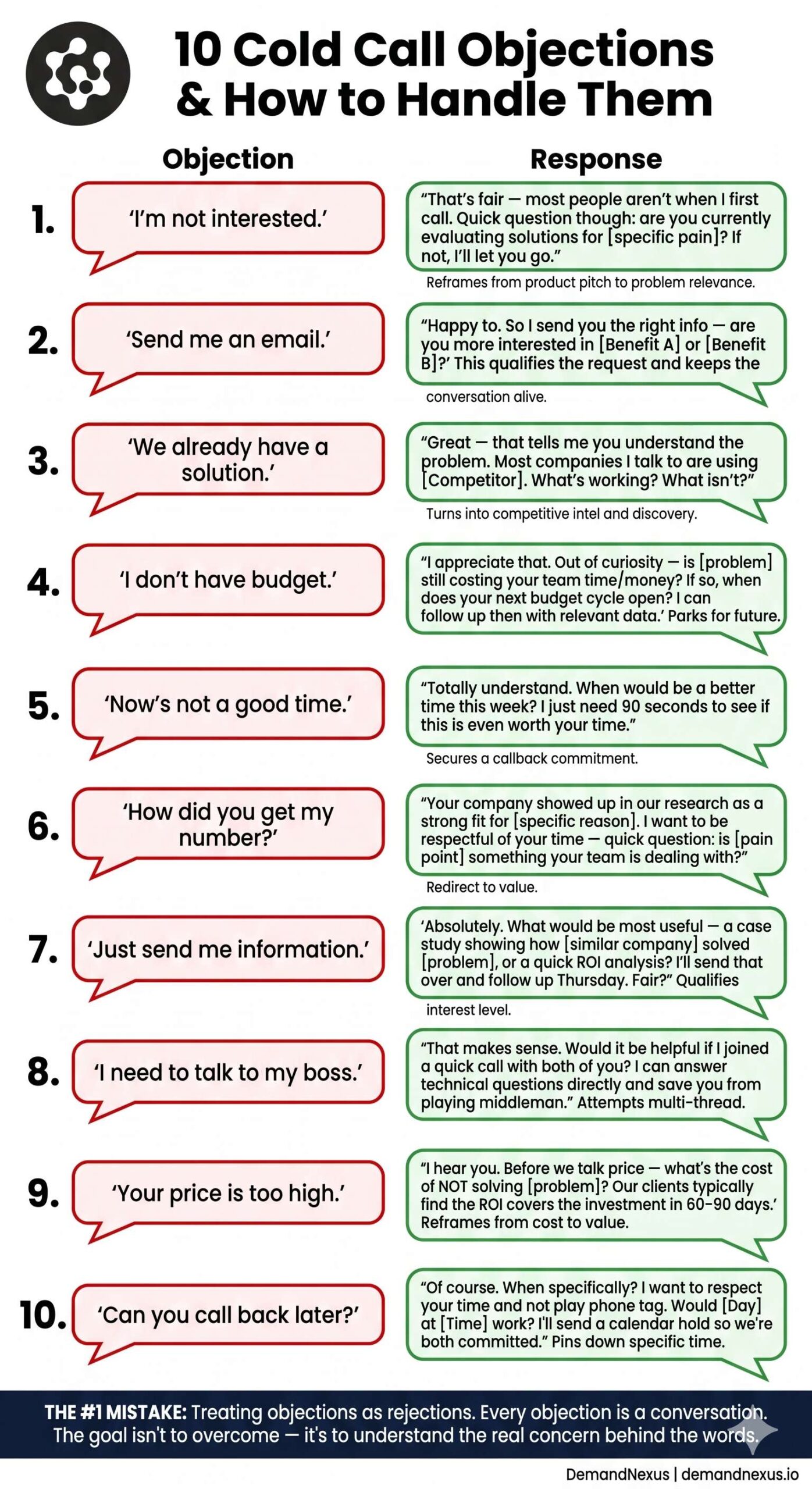
How to Write a Cold Call Script in 5 Steps
Most cold call scripts are written backwards — they start with what the seller wants to say instead of what the buyer needs to hear. Here’s how to build one that actually converts.
Step 1: Define the specific trigger you’re calling about. Every great script starts with context, not a pitch. Before you write a single line, answer: what specific behavior, event, or signal tells you this prospect should hear from you today? It could be content they engaged with, a company announcement, a contract renewal window, or a hiring spike. If you can’t name the trigger, you’re not ready to write the script.
Step 2: Write the opener around their world, not yours. Your opener should reference the trigger directly and name a problem the prospect recognizes. Avoid openers that lead with your company name, what you do, or how long you need. Lead with: “I’m calling because I saw you were researching X” — not “I’m calling because we help companies with Y.”
Step 3: Build in one proof point from a comparable company. The fastest way to earn 60 more seconds on a cold call is to reference a result at a company similar to theirs. Keep it specific: industry, metric, and timeframe. “A VP of Ops at a mid-market SaaS company reduced their onboarding time from 45 days to 12 in one quarter” outperforms any generic value statement.
Step 4: Write diagnostic questions, not discovery questions. Discovery questions gather information for you. Diagnostic questions demonstrate that you already understand their world and invite them to confirm or correct your framing. Instead of “How do you currently handle X?”, try “Most teams your size are hitting [specific friction] by this stage — is that showing up for you, or is it more of a [alternative friction]?”
Step 5: Define the exact ask before you finish the script. Know precisely what you’re asking for at the end of the call before you start writing the script. A 20-minute call with a solutions architect? A specific AE? A demo with a pre-loaded use case? Vague closes produce vague outcomes. Write the ask first, then build the script backward from it.
The Objection Handling Difference: Human Judgment vs. Scripts
Where context-aware calling truly separates from traditional scripts is objection handling. Generic scripts provide if-then responses that often feel robotic and miss the real concern beneath the stated objection.
Consider this scenario:
Prospect: “We have no budget for this.”
Script-based response: Marks the lead as Closed-Lost: No Budget. Moves to next call.
Context-aware response: “That makes sense—this would be a new line item. How does your team typically get new strategic projects like this funded? What does that process look like?”
This response uncovers the real situation. The prospect might explain they need executive sponsorship and a business case. The SDR responds: “Perfect. If we can show the ROI, who would need to sign off?” Now the entire buying process is revealed, and the deal moves forward.
The difference is human judgment. Experienced SDRs recognize that “no budget” often means “no budget allocated yet” rather than “we can never afford this.” They ask follow-up questions that uncover the path forward rather than accepting surface objections at face value.
Beyond the Script: The Appointment Handover
The most overlooked element of effective cold calling isn’t the script itself—it’s what happens after a meeting is booked. When account executives walk into meetings without context, they waste the first 15 minutes asking discovery questions that should have been covered during qualification.
High-performing appointment generation includes comprehensive handover documentation that tells the AE everything they need to close the deal. This includes verified BANT criteria with specific details (not just yes/no checkboxes), the prospect’s stated pain points in their own words, competitive intelligence about what they’re currently using and why it’s failing, anticipated objections and how to handle them, and a recommended approach for the meeting.
When AEs receive this level of intelligence, meeting dynamics change completely. Instead of opening with discovery questions, they can start with: “Based on what you shared with our team, I understand you’re struggling with [specific pain point], you have $X budget allocated, and you need this live by [date]. Let me show you exactly how we solve this.”
This preparation transforms meetings from exploratory conversations into focused discussions about solution fit—which is why organizations that provide detailed handover documentation see significantly higher close rates.
How to Build Context-Aware Calling Capability
Implementing context-aware calling requires three foundational elements: intent data, skilled callers, and rigorous qualification processes.
Intent Data Foundation
Context-aware calling starts with knowing which prospects are actively researching solutions in your category. First-party intent data—behavioral signals from prospects engaging with industry content—provides the most actionable intelligence because it’s specific, real-time, and proprietary.
Unlike third-party intent data that identifies company-level interest (which could be anyone at the organization), first-party intent identifies the specific individual, their role, and exactly what content they engaged with. This transforms outreach from “your company might be interested” to “you were researching this specific topic yesterday.”
Human Expertise for Relationship Building
AI tools can identify intent signals, scale list building, and A/B test messaging at volume. But the actual conversations require human judgment. Navigating nuanced objections, building multi-threaded relationships across buying committees, and improvising when conversations take unexpected turns—these require expertise that scripts alone cannot provide.
The most effective model is what might be called a “Cyborg” approach: AI handles research at scale while humans handle the valuable work of building trust, showing empathy, asking diagnostic questions, and closing deals. AI identifies the right 500 prospects from 10,000 possibilities. Humans build the relationships that convert those prospects into customers.
Rigorous BANT Qualification
The final element is process discipline. Every prospect should be verified against BANT criteria before scheduling meetings with account executives. This means confirming budget is allocated (not just “we could find budget”), identifying the actual decision-maker (not just an interested researcher), validating specific and urgent need (not just general curiosity), and establishing a concrete timeline (not just “sometime this year”).
Organizations that enforce rigorous BANT qualification see appointment-to-opportunity conversion rates of 90% or higher, compared to 50-70% for standard approaches. The difference is that every meeting involves a prospect who is ready to buy, willing to buy, able to buy, and ready to buy now.
Cold Calling Best Practices for 2026 and Beyond
As B2B buying continues to evolve, several best practices distinguish high-performing cold calling programs from generic outreach.
Lead with context, not pitch. Every call should reference something specific about the prospect—their research behavior, their company’s recent news, their stated priorities. Generic openers produce generic results.
Ask diagnostic questions. Position yourself as an expert who can help diagnose their situation, not a salesperson trying to qualify them. The best SDRs let prospects talk 70% of the time while they listen and ask clarifying questions.
Verify before you schedule. Booking unqualified meetings wastes everyone’s time and damages your credibility with sales teams. Rigorous BANT verification ensures every meeting has a real chance of converting.
Document everything. The conversation insights gathered during qualification calls are incredibly valuable for account executives. Capture verbatim quotes, specific pain points, competitive intelligence, and recommended approaches.
Measure quality, not just quantity. Connect rates and meetings booked are vanity metrics if those meetings don’t convert. Focus on appointment-to-opportunity conversion rates and track which approaches produce qualified pipeline.
The Economics of Context-Aware Calling
Understanding the economic difference between traditional cold calling and context-aware approaches clarifies why this matters for B2B organizations.
Traditional cold calling requires high volume to produce results. With 1-3% success rates, generating 10 qualified meetings might require 500-1,000 dials. Sales teams burn significant hours on unproductive outreach, and the meetings that do result often lack qualification.
Context-aware calling inverts this equation. By starting with prospects who have demonstrated intent, engagement rates increase to 40-50%. Fewer calls produce more qualified meetings. And because those meetings involve BANT-verified prospects, conversion rates to opportunity and closed deals increase substantially.
The financial impact compounds. When appointments convert at 35% to closed deals instead of 5%, the cost per customer acquisition drops dramatically even if the cost per appointment is higher. Organizations that prioritize quality over volume consistently achieve better ROI despite higher per-meeting costs.
Transform Your Calling Strategy
The era of dialing blind with generic scripts is ending. B2B buyers expect relevance, and organizations that deliver context-aware consultations instead of cold pitches are winning the competition for attention.
Whether you build this capability internally or partner with specialists, the principles remain the same: start with intent data that identifies active buyers, lead conversations with context rather than pitch, verify BANT criteria rigorously before scheduling meetings, and arm your account executives with the intelligence they need to close.
The question isn’t whether cold calling still works—57% of executives prefer phone outreach for a reason. The question is whether you’re calling with context or calling blind.
Ready to transform your calling results? Demand Nexus delivers BANT-qualified appointments with comprehensive handover documentation, powered by first-party intent data and expert human qualification. Contact us at sales@demandnexus.io to learn how context-aware calling can fill your pipeline with ready-to-close opportunities.
FAQs
What is a good cold call opening line?
The most effective cold call opening lines reference something specific about the prospect rather than asking for their time. For example: "Hi [Name], I'm calling because I saw you were researching [specific topic] — companies in [industry] usually hit that problem when [trigger]. Is that part of what's prompting your search?" This approach works because it demonstrates prior research, establishes immediate relevance, and invites dialogue rather than demanding it. Avoid openers like "Do you have 30 seconds?" — they hand the prospect an easy exit before you've given them a reason to stay.
How do I write a cold calling script for IT services?
An IT services cold calling script should open with a specific trigger — either a company growth signal, a technology shift in their stack, or research behavior around managed services or infrastructure. The middle of the call should focus on a diagnostic question that surfaces their current constraint (capacity, coverage gaps, or SLA failures) rather than pitching your services directly. The best IT services scripts reference a comparable client with a quantified result — for example, reducing ticket resolution time by 60% — before moving into BANT qualification. The ask should be a focused technical conversation with a solutions architect, not a generic sales meeting.
What makes a B2B cold calling script different from a general sales script?
B2B cold calling scripts require a longer path to the decision-maker, a buying committee-aware qualification process, and metrics-driven proof points that resonate with business buyers rather than individual consumers. In B2B, the opener must reference a business context (growth, compliance pressure, operational friction) rather than a personal pain. The qualification section must account for multiple stakeholders — budget owners, technical evaluators, and final decision-makers are often different people. And the close is almost never a direct sale; it's a next step that moves the deal into the AE's hands with full context documented in a qualification handover.