



Introduction: The Funnel That’s Actually Broken
The B2B SaaS marketing funnel is supposed to be the engine that converts curious visitors into committed customers. In theory, it’s elegant: guide prospects through awareness, engagement, exploration, and conversion. In practice, it’s a leaky disaster. Here’s the uncomfortable truth most vendors won’t tell you: the median MQL-to-SQL conversion rate is just 13%. That means 87% of leads marketing sends to sales are rejected or abandoned. For every 100 leads your funnel produces, only 3-5 actually close. This isn’t a funnel optimization problem. It’s a fundamental architecture problem. This article examines why traditional SaaS marketing funnels fail, introduces a radically different approach built on BANT-qualified appointments, and shows you how to stop measuring success by lead volume and start measuring it by revenue.What is a SaaS Marketing Funnel (And Why Most Are Designed to Fail)?
A SaaS marketing funnel maps the customer journey from initial awareness to subscription and retention. The traditional model assumes prospects move linearly through stages: Awareness → Interest → Desire → Action. The problem? Modern B2B buyers don’t move linearly. They zigzag through research, comparisons, and indecision. They download your whitepaper, ignore your emails for three months, then suddenly request a demo after seeing a LinkedIn post. More critically, traditional funnels measure the wrong things. Marketing automation platforms use point-based lead scoring: webinar attendance (+15 points), email click (+5 points), pricing page visit (+20 points). Hit 50 points? Congratulations, you’re an “MQL.” The fatal flaw: this measures engagement, not buying readiness. A college student researching for a class project can hit 50 points. A competitor analyzing your messaging can hit 100 points. A junior analyst with zero budget or authority can become an “MQL.” None of these are real buyers but they all consume your sales team’s time.The “Frankenstein Funnel” Problem
Traditional SaaS funnels force prospects through multiple stages: Anonymous visitor → Lead → MQL → SAL → SQL → Opportunity → Closed-Won.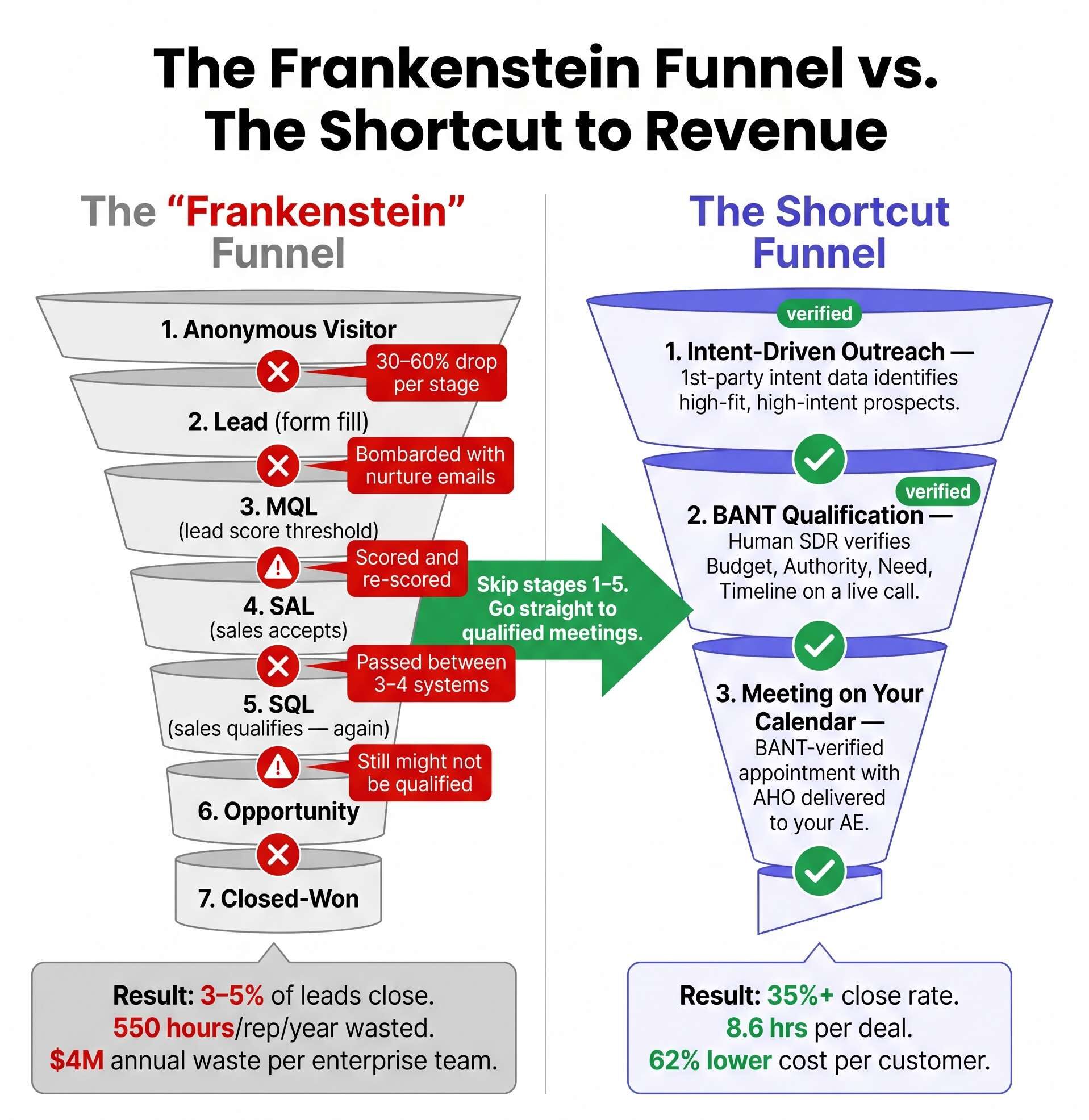 Each transition is a friction point where 30-60% of leads drop off. By the time a lead reaches sales, they’ve been bombarded with nurture emails, retargeted with ads, scored and re-scored, and passed between systems. And they still might not be qualified.
The economics are brutal. For an enterprise sales team, bad leads waste approximately $4 million annually. Each sales representative loses 550 hours per year pursuing unqualified prospects.
This is what we call the “MQL Black Hole” a funnel stage where the majority of leads disappear into a void of wasted effort.
Each transition is a friction point where 30-60% of leads drop off. By the time a lead reaches sales, they’ve been bombarded with nurture emails, retargeted with ads, scored and re-scored, and passed between systems. And they still might not be qualified.
The economics are brutal. For an enterprise sales team, bad leads waste approximately $4 million annually. Each sales representative loses 550 hours per year pursuing unqualified prospects.
This is what we call the “MQL Black Hole” a funnel stage where the majority of leads disappear into a void of wasted effort.
The Four Stages of a Traditional Funnel (And Where Each One Breaks)
1. Awareness: Generating Noise, Not Signal
At the awareness stage, prospects discover your brand through search engines, social media, or content marketing. The traditional approach: publish educational content, run ads, optimize for keywords. Where it breaks: You’re generating volume, not intent. Someone who reads a blog post about “cloud security trends” isn’t necessarily a buyer they might be a journalist, a student, or a competitor. Traditional awareness tactics can’t distinguish between genuine interest and casual browsing. The alternative: Build awareness through proprietary first-party intent data. When a known decision-maker (not an anonymous IP address) engages with specific content about solving specific problems, that’s a signal. Everything else is noise.2. Engagement: Trading Forms for Hope
The engagement stage attempts to convert awareness into contact information. Traditional approach: offer lead magnets, gate content behind forms, hope people download your eBook. Where it breaks: You’re collecting contacts, not qualifying buyers. Someone who downloads “The Complete Guide to API Integration” hasn’t told you whether they have budget, authority, need, or timeline. They’ve just told you they have an email address and 20 minutes to kill. The alternative: Instead of trading forms for hope, verify engagement through human conversation. A trained SDR conducting a 15-minute BANT discovery call can determine in real-time whether someone is a genuine opportunity or a tire-kicker.3. Exploration: Demos Without Context
During exploration, prospects evaluate your solution against alternatives. Traditional approach: offer free trials, freemium plans, and comparison pages. Where it breaks: Your sales team enters demos blind. They don’t know the prospect’s specific pain points, budget constraints, decision-making process, or competitive alternatives. Every demo becomes a generic pitch instead of a tailored solution presentation. The alternative: Every meeting should include comprehensive pre-meeting intelligence. When your AE walks into a call knowing the prospect’s exact pain points (in their own words), their allocated budget, their decision timeline, and their competitive landscape, they’re positioned to close – not to pitch.4. Conversion: Closing Deals That Shouldn’t Have Been Opened
Conversion transforms prospects into customers. Traditional approach: streamline checkout, optimize calls-to-action, follow up relentlessly. Where it breaks: You’re optimizing for conversion of poorly qualified leads. A 2% conversion rate on 1,000 unqualified leads produces 20 customers and wastes your sales team’s time on the other 980. The alternative: Focus on conversion rate from qualified opportunities, not raw leads. A 35% conversion rate on 50 BANT-verified appointments produces 17 customers with a fraction of the wasted effort.The BANT Framework: Qualification That Actually Works
Developed by IBM, BANT is the gold standard for B2B lead qualification. It answers the only question that matters: “Is this person ready to buy?” B — Budget: Does the prospect have allocated funds or the ability to secure budget? Not “are they interested in pricing” but “have they confirmed they can pay?” A — Authority: Is the prospect a decision-maker or key influencer? Not “do they have a nice title” but “can they sign the contract?” N — Need: Does the prospect have a genuine business problem your solution solves? Not “are they vaguely interested” but “what happens if they don’t solve this problem?” T — Timeline: Is there an active buying window? Not “might they buy someday” but “when do they need this implemented?” Here’s the comparison that matters:| Factor | Lead Scoring | BANT Qualification |
|---|---|---|
| Measures | Digital behavior | Buying readiness |
| Verification | Automated/passive | Human-verified |
| Budget | No validation | Budget confirmed |
| Authority | No check | Decision-maker identified |
| Interest | Inferred | Explicit need articulated |
| Timeline | Assumed | Timeline confirmed |
| SQL Conversion | 13% | 90%+ sales-ready |
The Appointment Generation Model: Cutting Out the Waste
Instead of the traditional funnel (Traffic → Lead → MQL → SAL → SQL → Opportunity), the appointment generation model delivers: Outbound Outreach → BANT Qualification → Scheduled Meeting with Decision-Maker. The result? Sales receives only qualified opportunities with confirmed budget availability, decision-making authority, active business need, and purchase timeline.The Economics Tell the Story
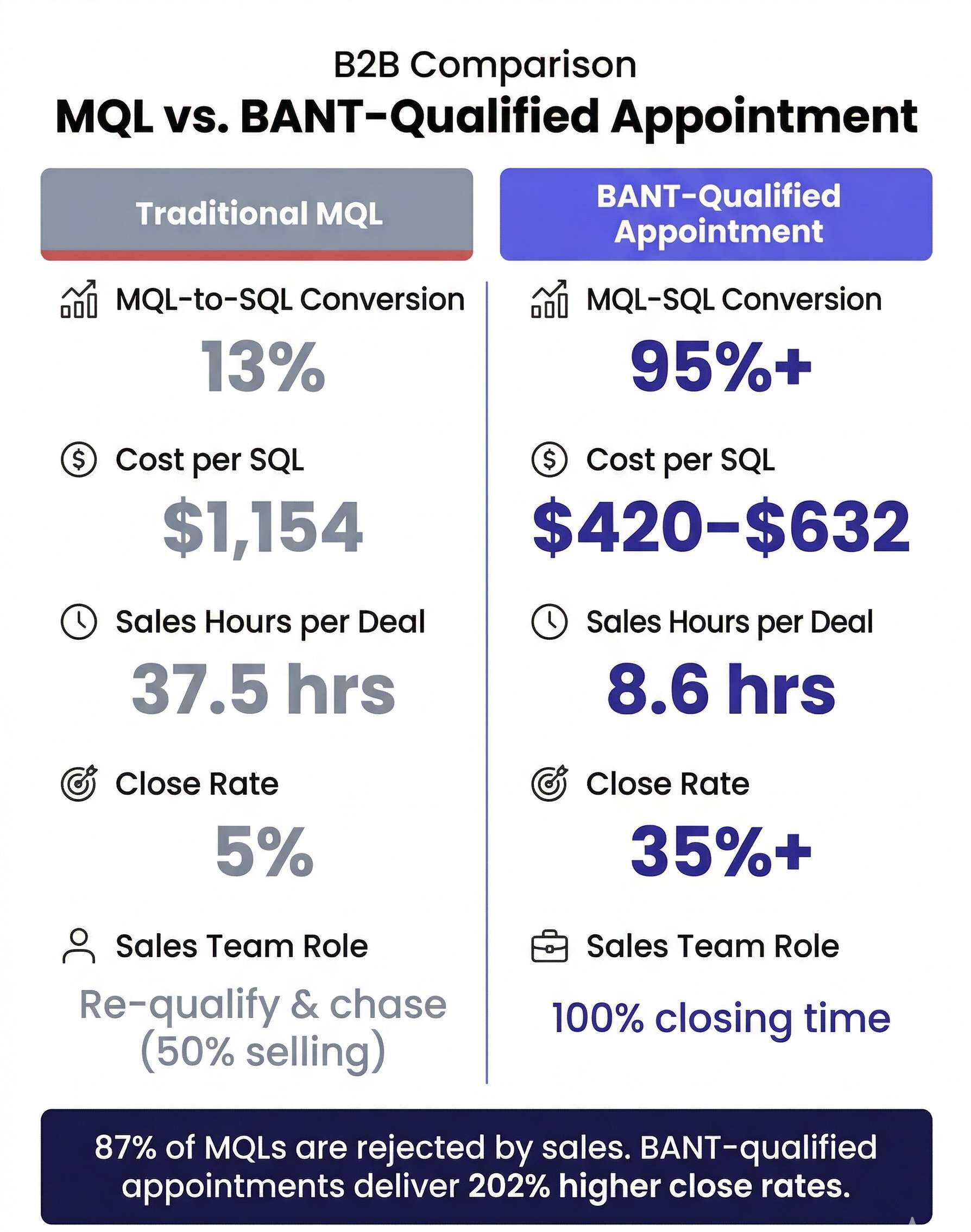
Traditional MQL Model:- Cost per MQL: $150
- MQL-to-SQL conversion: 13%
- Cost per SQL: $1,154
- Hours wasted per SQL: 8-12 hours of sales time
 BANT-Qualified Appointment Model:
- Cost per appointment: $400-600
- Appointment-to-SQL conversion: 95%+
- Cost per SQL: $420-632
- Hours wasted: Less than 1 hour (pre-qualified)
The “Glass Box” vs. “Black Box” Difference
Most lead generation vendors operate as “black boxes.” You pay for leads, you receive a CSV file, and you have no visibility into how those leads were sourced, qualified, or verified. The “Glass Box” approach is fundamentally different:| Attribute | “Black Box” MQL | “Glass Box” Approach |
|---|---|---|
| Identity | Anonymous (IP-based) | Known (Name, Title, Company) |
| Timeliness | Delayed (Weeks/Months old) | Real-Time (Engaging right now) |
| Exclusivity | Public (Sold to competitors) | Proprietary (Exclusive signal) |
| Specificity | Broad (Vague “interest”) | Specific (Exact content engagement) |
| Accuracy | 40-50% False Positives | 85%+ Signal Accuracy |
| Deliverable | A CSV of “leads” | A BANT-Verified Meeting |
The Appointment Handover Sheet: Your AE’s Secret Weapon
The most valuable deliverable in qualified appointment generation isn’t the meeting itself it’s the intelligence that accompanies it. An Appointment Handover Sheet (AHO) is a comprehensive briefing document delivered to your AE 24-48 hours before every meeting. It contains: Executive Summary: The 30-second brief your AE reads five minutes before the call who they’re meeting, what’s driving urgency, and the key hook. BANT Verification: Documented proof of budget allocation, authority mapping, specific needs (in the prospect’s own words), and confirmed timeline with forcing events. Conversation Intelligence: Key hooks to mention, hot buttons to address, objections to expect (with recommended counters), and competitive intelligence. Recommended Approach: Specific guidance on how to position your solution for this particular prospect’s situation. This is not a “lead.” This is an intelligence briefing. Your AE walks into the meeting knowing the entire political and business landscape. Your AE closes the deal.Measuring What Matters: Funnel Metrics That Actually Predict Revenue
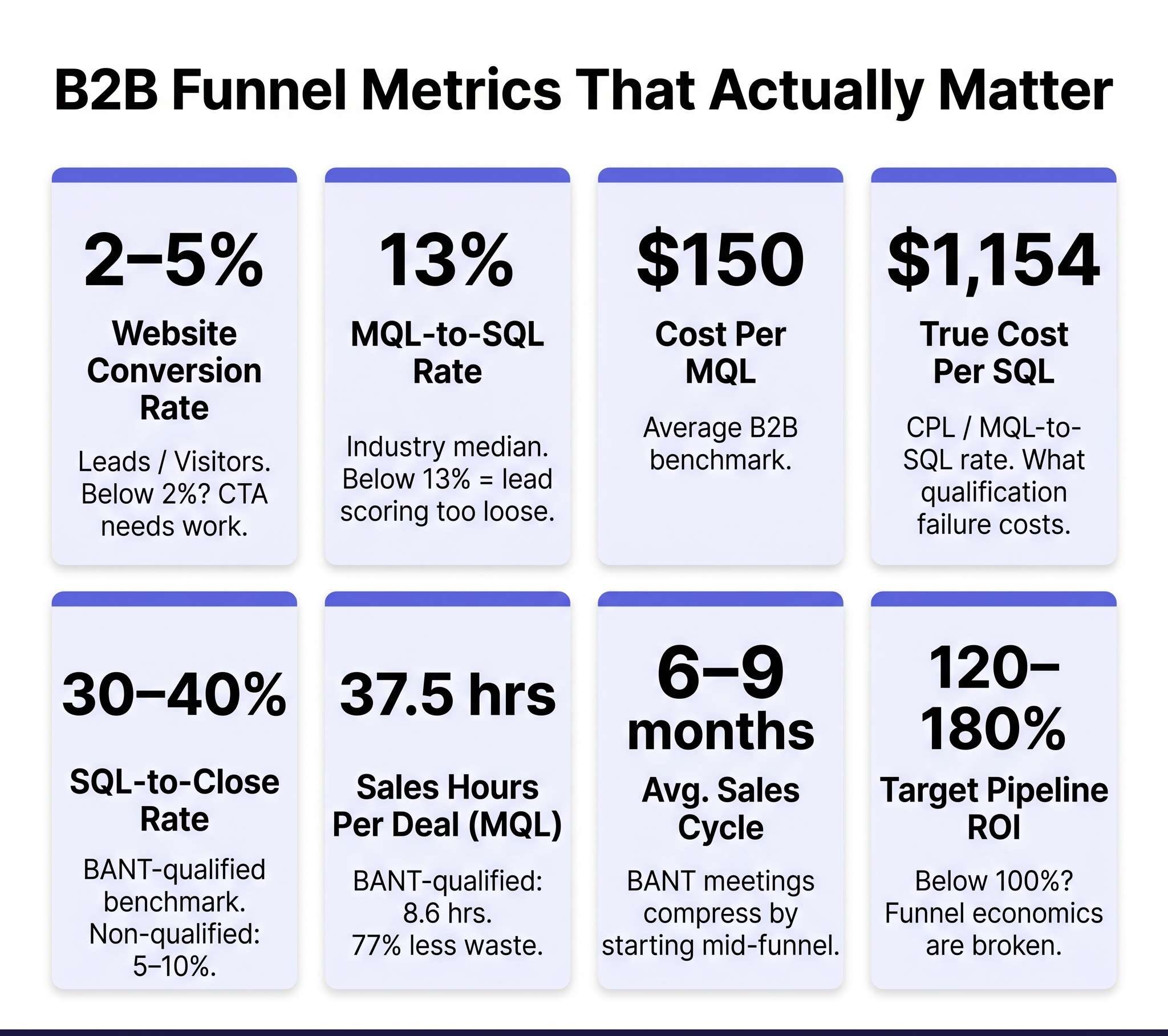 Stop measuring vanity metrics. Start measuring outcomes.
| Metric | Traditional Focus | Outcome Focus |
|---|---|---|
| Success Measure | Lead Volume | Qualified Appointments |
| Conversion Metric | MQL-to-SQL (13%) | Appointment-to-Close (25-40%) |
| Efficiency Metric | Cost per Lead | Cost per Closed Deal |
| Time Metric | Time-to-Lead | Sales Hours per Deal |
| Quality Metric | Lead Score | BANT Verification Score |
Why Traditional Funnels Will Keep Failing
The AIDA model assumes buyers move through Awareness → Interest → Desire → Action in a predictable sequence. Modern B2B buyers don’t work this way. They research for months before engaging with sales. They involve multiple stakeholders with different priorities. They compare extensively before committing. And they’re increasingly suspicious of being “nurtured” by marketing automation. A flexible, value-driven approach requires:- Human verification of buying readiness (not automated scoring)
- First-party intent data (not purchased lists sold to competitors)
- BANT qualification before scheduling meetings (not after)
- Comprehensive handover documentation (not “interested, call them”)
- Pay-for-performance accountability (not activity-based billing)
Case Study: From Funnel Failure to Pipeline Success
A mid-sized B2B SaaS company selling project management software struggled with low trial-to-paid conversions. Their traditional funnel generated 400 MQLs per month at $125 each – a $50,000 monthly spend. The problem: Only 15% converted to SQL (60 SQLs), and only 20% of those closed (12 deals). Sales spent 600 hours monthly chasing 400 leads. Cost per deal: $4,167. Sales hours per deal: 50 hours. The solution: They shifted to BANT-qualified appointments. 60 appointments per month at $500 each – a $30,000 monthly spend. The result: 95% were already SQL-qualified (57 SQLs). 30% closed (17 deals). Sales spent 180 hours on 60 meetings instead of 600 hours on 400 leads. The improvement:- 42% more deals closed
- 58% lower cost per deal
- 79% reduction in wasted sales time
- 40% budget savings
Your Next Steps: Escaping the MQL Black Hole
If you’re ready to stop feeding the funnel with leads that never convert, consider these action items: Audit your current funnel economics. Calculate your true cost per closed deal, including sales time wasted on unqualified leads. The number will be higher than you expect. Redefine qualification. Move from engagement-based scoring to BANT verification. A lead who opened three emails isn’t qualified. A lead who confirmed budget, authority, need, and timeline is qualified. Demand transparency. If your lead generation partner can’t tell you exactly how leads are sourced, qualified, and verified, you’re buying a black box. Align incentives. Pay-for-performance models that bill for qualified appointments (not delivered leads) ensure your partner is accountable for outcomes, not activities. Equip your AEs. Every meeting should include comprehensive pre-call intelligence. If your sales team is entering calls blind, they’re set up to fail.Ready to Transform Your Funnel?
The choice is clear: continue feeding the MQL Black Hole and watching 80% of your leads evaporate, or embrace BANT qualification and start delivering meetings that actually convert. Demand Nexus specializes in BANT-qualified appointment generation for B2B technology companies through The Waterfall – a Pay-for-Performance Appointment model that guarantees 15+ qualified meetings per month with zero-risk billing. The Waterfall delivers:- BANT-verified appointments with confirmed budget, authority, need, and timeline
- Comprehensive Appointment Handover Sheets for every meeting
- Full data ownership – every lead touched, every conversation, every insight
- No-show protection with automatic replacement at no cost
FAQs
Why do most B2B SaaS marketing funnels fail to convert leads into customers?
Most B2B SaaS marketing funnels fail because they measure engagement rather than buying readiness. Traditional lead scoring systems award points for actions like email clicks, webinar attendance, and pricing page visits — but these behaviors don't confirm that a prospect has budget, decision-making authority, an active need, or a purchase timeline. The result is a median MQL-to-SQL conversion rate of just 13%, meaning 87% of leads that marketing hands to sales are wasted. The root problem isn't optimization — it's architecture. Funnels built around MQLs are designed to generate volume, not revenue.
What is BANT qualification and how does it differ from traditional lead scoring?
BANT (Budget, Authority, Need, Timeline) is a human-verified qualification framework developed by IBM that determines whether a prospect is genuinely ready to buy. Unlike automated lead scoring — which assigns points based on digital behavior — BANT qualification requires a trained SDR to confirm through direct conversation that a prospect has allocated budget, holds decision-making authority, has articulated a specific business need, and has a defined purchase timeline. Where lead scoring produces SQLs at a 13% rate, BANT-verified appointments convert at 90%+, because every meeting is with someone who is ready, willing, and able to buy now.

Most B2B teams lose 40–60% of qualified prospects to broken handoffs and weak qualification. Take our 2-minute diagnostic to find out where your pipeline is bleeding — and how to fix it.
Start the Quiz → Takes 2 minutes. No email required to start.What is a Pay-for-Performance Appointment model and how does it reduce pipeline waste?
A Pay-for-Performance Appointment (PPA) model means you only pay for meetings that actually take place and meet your defined BANT criteria — not for CSV lists of contacts or unverified "leads." Demand Nexus's Waterfall model operates on this principle: if a prospect no-shows, they're replaced within five business days at no charge. If a prospect doesn't meet your BANT criteria, you aren't billed. This shifts the risk from the buyer to the appointment generation partner, directly aligning incentives with pipeline outcomes rather than activity volume. The result is a cost per SQL that runs significantly lower than traditional MQL models, while sales teams spend their time closing rather than re-qualifying.
What is an Appointment Handover Sheet (AHO) and why does it matter for sales performance?
An Appointment Handover Sheet (AHO) is a comprehensive pre-meeting intelligence briefing delivered to an Account Executive 24–48 hours before every BANT-qualified appointment. It includes a 30-second executive summary, documented BANT verification (budget, authority, need, and timeline — in the prospect's own words), key conversation hooks, likely objections with recommended counters, and competitive intelligence. Rather than walking into a demo blind, the AE arrives knowing the prospect's exact pain points, decision-making structure, and urgency drivers. This is the difference between a generic pitch and a targeted close — and it's a core reason why BANT-qualified appointment models consistently outperform traditional demand generation.
How does first-party intent data improve B2B SaaS funnel quality compared to purchased lead lists?
First-party intent data captures real-time engagement from known decision-makers interacting with content on owned media properties — not anonymous IP addresses or recycled contact databases sold to multiple vendors simultaneously. When a VP of Operations reads three articles about integration failures on a niche B2B media brand, that's a verified, exclusive, and timely buying signal. Purchased lead lists, by contrast, are typically weeks or months old, shared with competitors, and riddled with false positives. First-party intent data enables outreach that's relevant to what the prospect is actively researching right now, which is why it drives the 40–50% engagement rates that cold outreach can't match.