



But here is the problem most ABS practitioners face: even the best account selection and personalization strategies fail when your sales team spends more than 50% of their time re-qualifying unvetted contacts. Precision targeting without qualification rigor is the most expensive leak in B2B sales. The solution is not just better targeting—it is a fundamentally different approach to how meetings reach your Account Executives.

Most B2B teams lose 40–60% of qualified prospects to broken handoffs and weak qualification. Take our 2-minute diagnostic to find out where your pipeline is bleeding — and how to fix it.
Start the Quiz → Takes 2 minutes. No email required to start.In this guide, we cover the ABS definition, process, framework, key metrics, and tools—and explain exactly how BANT-qualified appointment generation converts theoretical ABS into consistent, closed revenue. If you are also measuring the broader performance layer of your ABM programs, see our guide to ABM metrics and KPIs.
What Is Account-Based Selling (ABS)?
Account-based selling is a B2B sales strategy that targets a curated list of high-value accounts, engaging them with personalized outreach tailored to their specific business challenges. ABS aligns sales and account-based marketing (ABM) efforts, leveraging data-driven insights to build relationships with multiple stakeholders within each account simultaneously.
Unlike traditional sales, which prioritizes lead volume, ABS focuses on quality: converting, retaining, and expanding key accounts for long-term revenue growth. It is ideally suited to B2B companies with complex sales cycles, where decisions involve multiple decision-makers and a single closed deal can represent significant ARR.
However, even the most sophisticated ABS strategy breaks down at the point of execution. Research shows that 79% of marketing leads never convert—not because targeting failed, but because qualification did. The gap between identifying an account and having a genuine buying conversation is where most ABS programs leak pipeline. This is why the handoff between ABM data and sales engagement must be governed by rigorous BANT criteria, not activity-based scoring.
ABS vs. Traditional Sales: Key Differences
ABS diverges from traditional sales in fundamental ways that affect pipeline quality, sales team efficiency, and revenue predictability.

| Aspect | Account-Based Selling (ABS) | Traditional Sales |
| Focus | High-value target accounts matching ICP | Broad lead generation by volume |
| Approach | Personalized, multi-stakeholder engagement | Generalized outreach at scale |
| Sales Cycle | Shorter for high-fit, BANT-verified accounts | Longer—less targeted, more re-qualification |
| Goal | Deep relationships, high ACV, expansion revenue | Volume of conversions |
| Qualification | BANT verified before AE engagement | AE spends meeting time qualifying |
| Pipeline Quality | Pre-verified buying readiness | Mixed—AE must separate signal from noise |
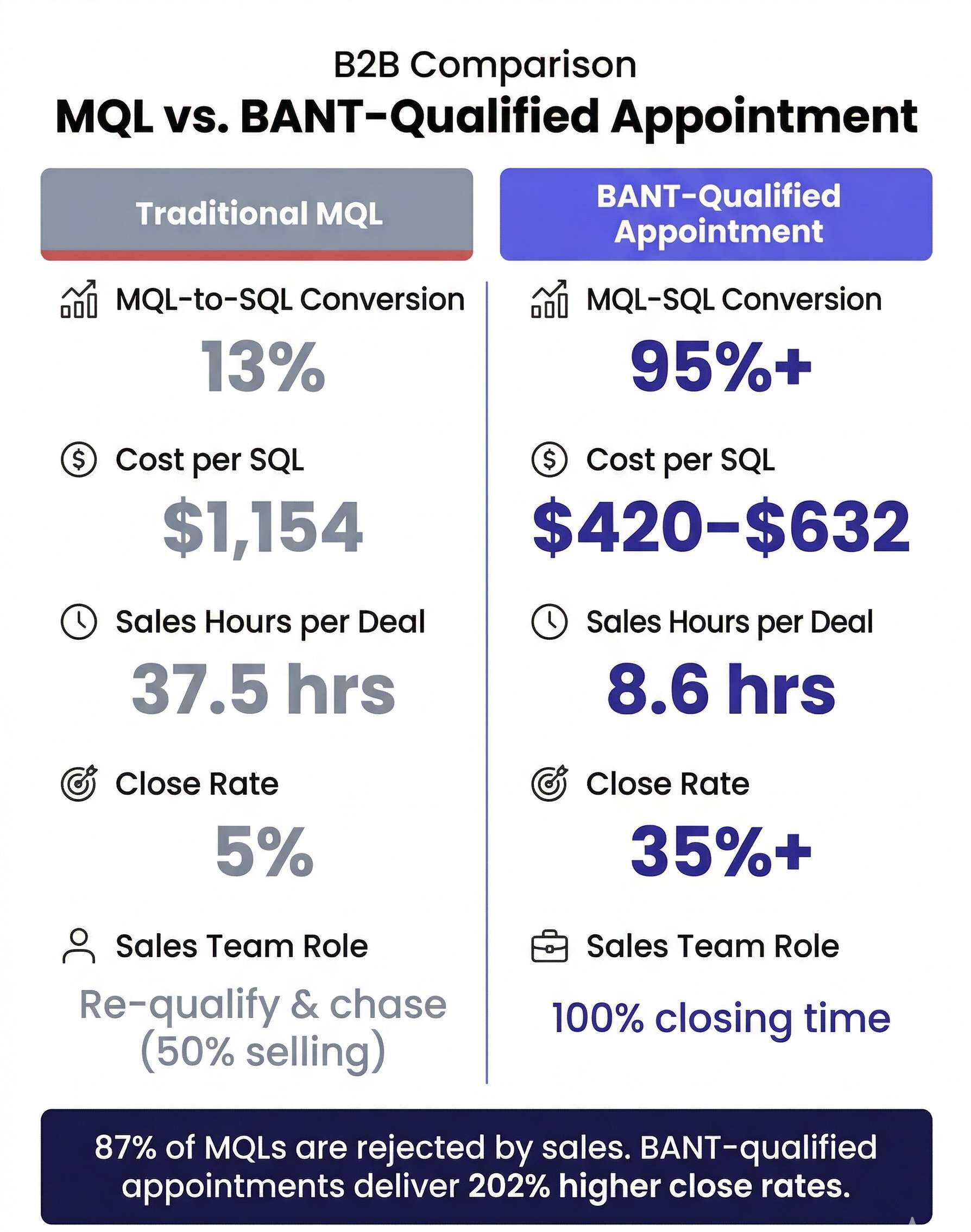
The critical differentiator in a high-performing ABS model is not targeting precision alone—it is that qualification happens before the meeting, not during it. When AEs walk into every conversation knowing the prospect has confirmed Budget, Authority, Need, and Timeline, conversion rates move from 3–5% to 25–40%.
Benefits of Account-Based Selling
ABS delivers measurable advantages for B2B companies targeting enterprise accounts or navigating complex buying committees:
Higher Conversion Rates
Personalized outreach resonates with decision-makers—but only if those decision-makers are pre-verified as ready to buy. When prospects are BANT-qualified before reaching your AE, conversion rates move from the 3–5% industry average to 25–40%. For a practical look at how ABM engagement drives this qualification depth, see the linked resource.
Shorter Sales Cycles
Targeting high-fit accounts reduces cycle time by up to 30%. When AEs walk into every meeting knowing the prospect can afford the solution, can make the decision, has an urgent need, and has a defined timeline—deals close faster because discovery has already happened.
Increased Revenue and ACV
ABS programs focus on accounts with the highest expansion potential. Larger deal sizes and upsell opportunities drive higher average contract values. Qualified prospects do not need to be ‘sold’—they need to be shown the solution to problems they have already articulated and quantified.
Better Sales and Marketing Alignment
ABS naturally aligns sales and marketing because both teams measure success by the same outcome: closed revenue from target accounts. When your B2B ABM campaigns and sales qualification processes share a common ICP and BANT standard, incentives align and finger-pointing between teams disappears.
Improved Customer Retention
Prospects who were properly qualified become customers who actually need your solution. Proper qualification reduces churn because you are not force-fitting your product into accounts that were never a genuine fit.
The ABS Framework: A Structured Model
The ABS framework is often depicted as a flipped funnel—starting narrow at target account selection and widening through stakeholder engagement and relationship expansion. For comprehensive ABM examples that illustrate how this framework plays out across different industries, see the linked resource.
The four stages of a high-performing ABS framework are:
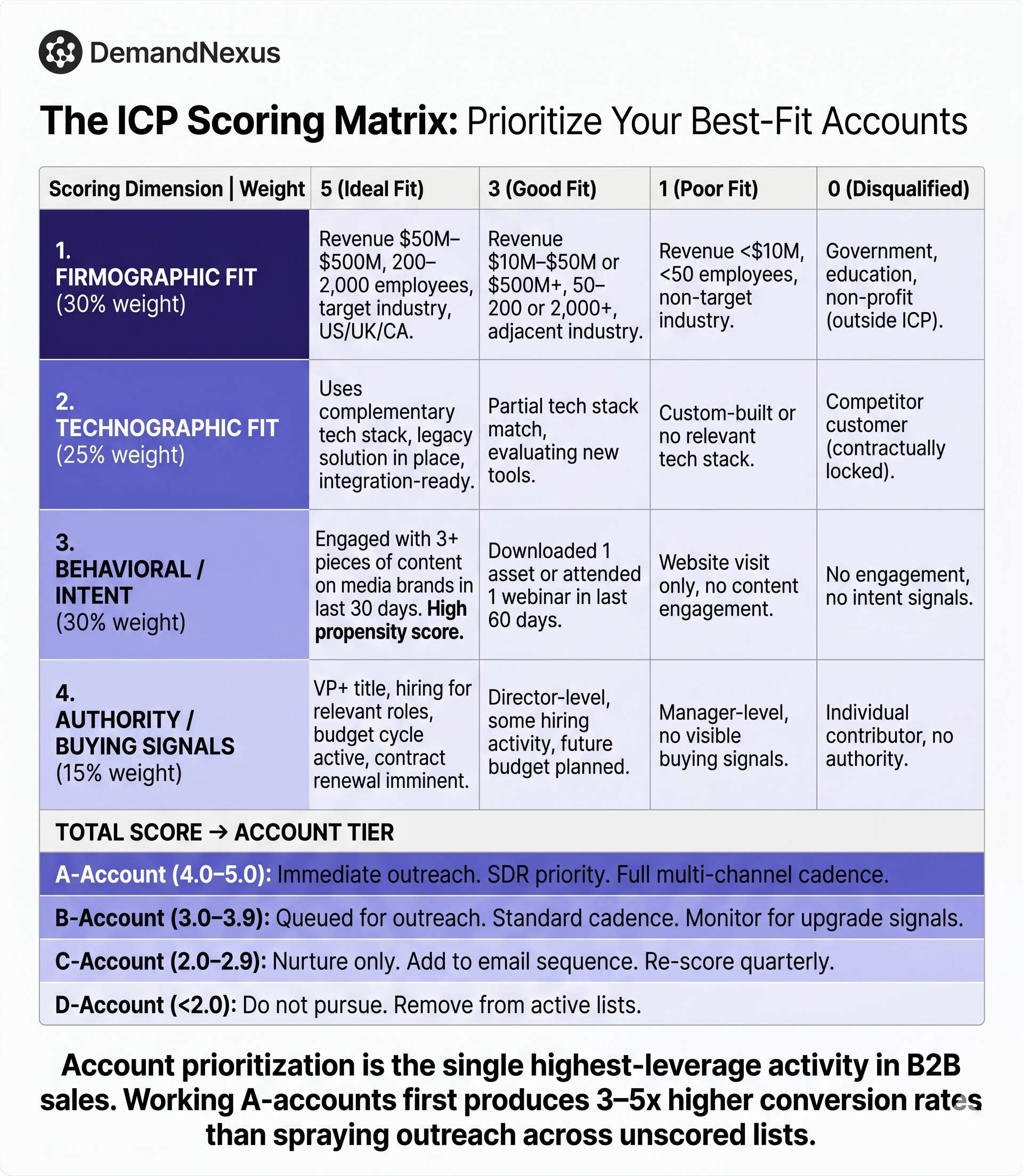
- Identify: Define ICP, build target account list, map buying committees using firmographic, technographic, and intent signals.
- Engage: Activate multi-channel personalized outreach—email sequences, LinkedIn, cold calling, and content tailored to each account’s specific challenges.
- Qualify: Verify BANT before any meeting reaches the AE calendar. This is the stage most ABS frameworks skip—and the most expensive mistake in B2B sales.
- Close and Expand: AEs enter every call with full context, close with higher rates, and identify expansion opportunities within existing accounts.
The critical insight: most ABS implementations invest heavily in the first two stages and almost nothing in the third. The result is AEs meeting with ‘interested’ contacts rather than verified buyers.
How to Implement an Account-Based Selling Process
Building an effective ABS process requires cross-functional alignment, a clear ICP, and—critically—a qualification standard that governs what reaches your AE’s calendar. Here is a step-by-step implementation guide.
Step 1: Define Your Ideal Customer Profile (ICP)
Build your ICP based on firmographics and behavioral data: company size, industry vertical, technology stack, growth indicators, and funding or revenue signals. The more precise your ICP, the higher your eventual conversion rate—because you are concentrating effort on accounts that genuinely fit.
Step 2: Build a Target Account List
Select accounts that align with your ICP, prioritizing those with the greatest cross-sell, upsell, or expansion potential. Use ABM intent data to surface accounts actively researching your category—first-party intent signals from owned media properties are significantly more accurate (85%+ signal accuracy) than third-party intent data (40–50% false positives).
Step 3: Map Stakeholders Within Each Account
Identify key decision-makers and influencers within each target account: economic buyers, technical evaluators, champions, and blockers. Document the buying committee structure. Authority verification at this stage prevents the most common ABS failure: spending cycles on contacts who cannot authorize a purchase.
Step 4: Develop Personalized, Account-Specific Content
Craft content tailored to each account’s specific challenges—not generic whitepapers. Use an ABM template framework to scale personalization without sacrificing relevance. Context-aware outreach that references specific industry challenges and the prospect’s known pain points generates 40–50% engagement rates versus 10% for generic cold outreach.
Step 5: Execute Multi-Channel Outreach
Coordinate engagement across email sequences, LinkedIn outreach, cold calling, and webinars. Multi-channel sequences with consistent, personalized messaging outperform single-channel approaches by 3–5x. Every touchpoint should reference the account’s specific context—not broadcast generic value propositions.
Step 6: Qualify Before Handoff—Not After
This is where most ABS implementations fail. Traditional ABS generates ‘interested leads’ and hands them to AEs to qualify. The result: AEs spend 50%+ of their time on non-selling activities. The account-based marketing services model at DemandNexus inverts this—BANT qualification happens before any meeting reaches the calendar.
Before any meeting is booked, verify all four BANT criteria:
- Budget: Has the prospect allocated funds, or is there a clear path to budget within 90 days? (‘Have you allocated budget for this initiative?’)
- Authority: Is this contact the economic buyer or a direct influencer with C-suite access? (‘Who has final sign-off on this decision?’)
- Need: Is there an active, quantified business problem your solution directly addresses? (‘What is the business impact of not solving this?’)
- Timeline: Is there a buying decision expected within 1–6 months, ideally with a forcing event? (‘When are you looking to make a decision?’)
When all four are confirmed before the meeting, your AE walks in knowing the prospect can afford the solution, can make the decision, has an urgent need, and has a timeline that fits your quarter.
Step 7: Deliver the Appointment Handover Sheet (AHO)
The difference between a 5% close rate and a 35%+ close rate often comes down to one thing: did your AE have context before the meeting?
An Appointment Handover Sheet (AHO) is a structured pre-meeting briefing delivered 24–48 hours before every confirmed appointment. It contains:
- Full BANT verification notes with verbatim prospect quotes
- Key pain points the prospect articulated and their quantified business impact
- Competitive intelligence: what they are currently using, why it is failing
- Anticipated objections with recommended counters
- A suggested opening approach tailored to that specific prospect
When your AE reads ‘Current CLM tool takes 8 weeks to negotiate contracts. Losing 3–4 deals per month ($200K revenue). Contract expires March 31—needs replacement by then,’ they walk into a tailored conversation, not a generic demo.
Step 8: Measure, Attribute, and Optimize
Track performance using revenue-predictive metrics—not activity metrics. A/B test outreach and qualification approaches. The right KPIs focus on meetings that convert, not calls made or emails sent.
ABS and ABM: A Synergistic Revenue Model
ABS works hand-in-hand with account-based marketing to create a unified revenue engine. ABM generates targeted awareness and warms up accounts with relevant content; ABS converts that interest through personalized sales engagement and verified qualification.
The missing link in most ABM-to-ABS transitions is qualification rigor. ABM generates interest; BANT qualification verifies buying readiness. Without that verification step, you are flooding AEs with ‘interested but not ready’ contacts that create friction, burnout, and inaccurate pipeline forecasts.
The synergy works when: ABM warms the account → BANT qualification verifies readiness → ABS closes with context. Each function measures success by the same outcome: closed revenue from target accounts.
Key Metrics for ABS Success
The most common measurement mistake in ABS is tracking activity metrics—emails sent, calls made, MQLs generated—rather than revenue-predictive outcomes. For a comprehensive view of how these KPIs fit into a broader ABM measurement framework, see our ABM metrics and KPIs guide. The core ABS metrics to track are:
| Metric | Formula | Why It Matters |
| BANT Qualification Rate | (BANT-Verified / Total Engaged) × 100 | Measures qualification rigor—the quality gate before the AE |
| Meeting-to-Opportunity Rate | (Opportunities / Meetings Held) × 100 | Gauges the quality of meetings reaching your AE |
| Deal Velocity | Time from qualified opportunity to close | Measures cycle efficiency—lower is better |
| AE Close Rate on Qualified Meetings | (Closed-Won / Meetings Held) × 100 | The ultimate signal of meeting quality |
| Cost Per Qualified Meeting | Total Spend / BANT-Qualified Meetings | True efficiency metric—replaces cost per lead |
| Average Deal Size | Total Revenue / Number of Deals | Reflects impact of high-value targeting |
| Account Engagement Score | Interactions per account (clicks, views, replies) | Shows campaign resonance within target accounts |
| Customer Lifetime Value (CLV) | (Revenue per account × Lifespan) – CAC | Validates long-term fit of qualified accounts |
The shift that changes everything: stop measuring leads generated and start measuring meetings that convert. When your ABS program is governed by BANT qualification, these metrics naturally align—because every meeting on the calendar represents a verified buying opportunity.
Case Study: How BANT-Qualified Appointments Transform ABS Results
A B2B SaaS company offering enterprise solutions had a sophisticated account-targeting model but was generating minimal closed revenue from it.
The Challenge: Only 10% of targeted accounts converted, with sales cycles averaging 120 days. AEs spent 50+ hours per week chasing and re-qualifying low-intent contacts. Cost per deal exceeded $4,000.
The Problem: Their ABS strategy excelled at targeting and personalization but failed at qualification. AEs were receiving ‘interested leads’—contacts who downloaded a whitepaper or attended a webinar—rather than prospects verified as ready to buy.
The Solution: They implemented rigorous BANT qualification before any meeting reached the AE calendar. Every prospect was verified on all four criteria. AEs received comprehensive Appointment Handover Sheets with full BANT notes, pain points, competitive intelligence, and a recommended approach.
The Results in Six Months:
| Metric | Before BANT-Qualified ABS | After BANT-Qualified ABS |
| Conversion Rate | 10% | 35% |
| Average Sales Cycle | 120 days | 75 days |
| Average Deal Size | Baseline | +25% |
| AE Time on Non-Selling Activities | 50+ hours/week | < 10 hours/week |
| Cost Per Deal | Baseline | -58% |
The key insight: ABS targeting identified the right accounts. BANT qualification ensured only ready buyers reached the sales team. The combination delivered 7x better conversion than targeting alone.
The Financial Reality of ABS Execution Models
Most ABS implementations fail not because of poor targeting, but because of inefficient execution. Here is how the cost and outcome models compare:
| Model | Annual Cost | Meetings/Month | AE Qualification Time | AE Close Rate | ROI |
| In-House SDR Hire | $75K+ | ~60 | 30 hrs/week | ~20% | 40–60% |
| Traditional Pay-Per-Lead | $60K | ~10 | 20 hrs/week | ~5% | 10–20% |
| BANT-Qualified Appointments (DemandNexus Waterfall) | $90K | 15–40+ | < 5 hrs/week | 35%+ | 120–180% |
The difference is not just cost—it is what your AEs spend their time doing. When meetings are pre-qualified, your highest-paid sales professionals spend 100% of their time closing deals rather than 50% re-qualifying contacts who were never ready to buy.
Account-Based Selling Tools and Technology
Technology streamlines ABS processes and enhances personalization at scale. The right stack depends on your team size and account complexity, but the most impactful ‘tool’ in any ABS program is the qualification process itself.
| Tool Category | Purpose | Impact on ABS |
| CRM (e.g. Salesforce, HubSpot) | Account management, pipeline tracking | Central source of truth for account activity |
| Sales Engagement Platform | Multi-channel outreach coordination | Consistent stakeholder engagement at scale |
| ABM Intent Data Platform | Surface in-market account signals | First-party data delivers 85%+ accuracy vs 40-50% for third-party |
| BANT Qualification Process | Verify buying readiness before AE handoff | 7x conversion improvement—the highest-ROI ‘tool’ in the stack |
| Appointment Handover Sheet (AHO) | Brief AEs with full pre-meeting context | Moves close rate from 5% to 35%+ per qualified meeting |
| ABM Analytics | Track meeting-to-revenue attribution | Continuous optimization of targeting and qualification |
Overcoming Common ABS Challenges
Stakeholder Complexity and Multi-Threading
Enterprise accounts involve multiple decision-makers with competing priorities. Map the buying committee at the qualification stage—verify authority before the AE meeting, not during it. Use ABM engagement tactics to activate multiple stakeholders simultaneously rather than relying on a single champion.
Qualification Inconsistency Across the Team
Subjective qualification produces inconsistent pipeline quality. Implement BANT scoring (1–5 on each criterion) with a minimum threshold (e.g., 4.0 average) to remove subjectivity. Only prospects meeting your criteria reach the calendar. Consistent standards produce predictable pipeline.
Poor AE Preparation and Context Transfer
AEs entering meetings without context default to generic demos. The Appointment Handover Sheet eliminates this problem. Verbatim quotes, competitor intelligence, and a recommended approach transform cold discovery calls into warm, targeted conversations that move deals forward.
Data Quality and Intent Signal Accuracy
Generic third-party intent data has 40–50% false positive rates—your competitors are buying the same signals. First-party ABM data from owned media properties delivers 85%+ signal accuracy because it reflects direct, opt-in engagement with your content rather than inferred browsing behavior across anonymous third-party networks.
How DemandNexus Delivers Account-Based Selling at Scale
DemandNexus operationalizes the ABS framework through a Pay-for-Performance Appointment (PPA) model—the Waterfall. Rather than delivering lead lists or unverified MQLs, DemandNexus delivers BANT-qualified appointments directly to your AE’s calendar, backed by a no-show replacement guarantee.
The Waterfall model begins with first-party intent data captured across six owned B2B media brands—AITechTrend, MarTechTrend, HRTechTrend, FinTechFilter, LegalTechTrend, and DevTechTrend—reaching 15M+ decision-makers. When a prospect engages with relevant content, an 8-person Instant Pod initiates context-aware outreach that references the specific content consumed.
Every prospect who reaches your calendar has been:
- Identified via first-party intent signals from niche B2B media content
- Engaged through context-aware, human-led outreach (not automated sequences)
- BANT-qualified on all four criteria by a trained SDR
- Scheduled with a confirmed calendar invitation
- Documented with a full Appointment Handover Sheet delivered to your AE
You only pay for meetings that happen and meet your BANT criteria. If a prospect no-shows, they are replaced within five business days at no charge. For a full breakdown of pricing tiers and guarantee structure, see DemandNexus account-based marketing services.
FAQs
What is account-based selling (ABS) and how does it differ from traditional B2B sales?
Account-based selling (ABS) is a B2B sales strategy that treats each high-value target account as a market of one, engaging multiple stakeholders with personalized outreach tailored to their specific business challenges. Unlike traditional sales, which prioritizes lead volume and lets AEs qualify on the fly, ABS focuses on a curated list of accounts that match your Ideal Customer Profile. The critical differentiator in high-performing ABS programs is that qualification happens before the meeting—prospects are verified on Budget, Authority, Need, and Timeline (BANT) so that every conversation your AE takes is with a confirmed, ready-to-buy decision-maker. See also: account-based marketing overview.
Why do most account-based selling strategies fail to deliver consistent pipeline?
Most ABS implementations fail not because of poor targeting but because of a broken qualification handoff. Teams invest heavily in ICP definition, stakeholder mapping, and personalized content—then undermine it all by sending unvetted 'interested leads' to AEs. Research shows 79% of marketing leads never convert, and AEs in traditional ABS models spend more than 50% of their time on non-selling activities. The fix is BANT qualification before any meeting reaches the AE calendar: confirming budget is allocated, the contact holds or influences the buying decision, an active pain point exists, and a specific purchase timeline is in place.
What is a BANT-qualified appointment and why does it matter for account-based selling?
A BANT-qualified appointment is a scheduled meeting with a verified decision-maker who has confirmed all four qualification criteria — Budget (funds are allocated or securable), Authority (they are the economic buyer or a direct influencer), Need (they have an active, quantified business problem your solution solves), and Timeline (they have a buying window within 1–6 months, ideally with a forcing event). In account-based selling, BANT-qualified appointments are the bridge between targeting precision and closed revenue. Companies that implement BANT verification before AE engagement report conversion rates of 25–40% compared to the 3–5% industry average for unqualified outreach — and AE time on non-selling activities drops from 50+ hours per week to under 10.
What is an Appointment Handover Sheet (AHO) and how does it improve ABS close rates?
An Appointment Handover Sheet (AHO) is a structured pre-meeting briefing document delivered to an Account Executive 24–48 hours before a confirmed meeting. It contains: a 30-second executive summary with the key urgency hook; full BANT verification notes with verbatim prospect quotes; the prospect's primary pain points and quantified business impact; competitive intelligence on what they currently use and why it is failing; anticipated objections with recommended counters; and a suggested opening approach tailored to that specific account. AEs equipped with an AHO enter calls knowing the exact pain, approved budget, decision-making structure, and deadline—positioning them to close rather than discover.
How do you measure success in an account-based selling program?
The most common mistake in ABS measurement is tracking activity metrics — emails sent, calls made, MQLs generated — rather than revenue-predictive outcomes. High-performing ABS programs shift measurement to: BANT Qualification Rate (the percentage of engaged prospects who meet all four qualification criteria), Meeting-to-Opportunity Rate (how many confirmed appointments become active pipeline), Deal Velocity (time from qualified opportunity to close), Cost Per Qualified Meeting (total program spend divided by BANT-verified meetings held), and ultimately AE Close Rate on qualified appointments versus unqualified leads. When your ABS program is built on BANT-qualified appointments rather than lead volume, these metrics naturally align — because every meeting on the calendar represents a verified buying opportunity, not a contact who might eventually become one.
How do account-based selling and account-based marketing work together?
ABS and ABM are complementary functions in a unified revenue model. ABM generates targeted awareness and warms accounts with relevant content—particularly through ABM campaigns and intent-driven content programs. ABS converts that interest through personalized sales engagement and BANT-verified qualification. The synergy breaks down when the handoff between marketing-generated interest and sales engagement lacks a qualification standard. When both functions measure success by the same outcome—closed revenue from target accounts—and share a common BANT threshold, the combined model outperforms either function in isolation.
How do you measure success in an account-based selling program?
High-performing ABS programs shift measurement from activity metrics to revenue-predictive outcomes: BANT Qualification Rate (percentage of engaged prospects who meet all four criteria), Meeting-to-Opportunity Rate (how many confirmed appointments become active pipeline), Deal Velocity (time from qualified opportunity to close), Cost Per Qualified Meeting (total spend divided by BANT-verified meetings held), and AE Close Rate on qualified appointments versus unqualified leads. For a full measurement framework, see the ABM metrics and KPIs guide.