


ABM intent data is the backbone of high-impact account-based marketing (ABM) campaigns, enabling B2B marketers to pinpoint accounts actively researching solutions. By leveraging buyer intent signals, businesses can align their ABM strategies with accounts showing strong purchase propensity, especially in sectors like healthcare. This data-driven approach transforms ABM campaigns by ensuring timely, relevant outreach that resonates with decision-makers.
But here’s the critical question most marketers miss: What type of intent data are you using, and what happens after you capture the signal?

Most B2B teams lose 40–60% of qualified prospects to broken handoffs and weak qualification. Take our 2-minute diagnostic to find out where your pipeline is bleeding — and how to fix it.
Start the Quiz → Takes 2 minutes. No email required to start.In this in-depth guide, we explore ABM intent data, its types, the critical difference between third-party and first-party signals, and how to convert intent into BANT-qualified appointments that actually close.
What Is ABM Intent Data?
ABM intent data refers to digital signals that indicate a company’s or individual’s interest in researching products, services, or solutions relevant to your offering. Unlike traditional lead generation, which casts a wide net, ABM intent data focuses on high-value accounts within your Ideal Customer Profile (ICP), identifying those with a high propensity to buy.
In the context of ABM marketing, intent data acts as a compass, guiding campaigns to engage accounts at the right moment with hyper-relevant messaging, boosting conversions and ROI.
However, not all intent data is created equal—and the source of your data fundamentally determines the quality of your outcomes.
Why ABM Intent Data Matters for B2B Marketing
ABM intent data transforms B2B marketing by providing actionable insights that enhance targeting and engagement. Its key benefits include:

Precision Targeting: Focuses on accounts actively researching solutions, reducing wasted efforts.
Timely Outreach: Engages prospects when buying intent peaks, shortening sales cycles.
Personalized Campaigns: Enables tailored messaging that addresses specific pain points.
Higher ROI: Prioritizes high-value accounts, maximizing campaign impact.
Sales-Marketing Alignment: Provides shared data to unify account-based selling and marketing efforts.
In industries like healthcare, where buying decisions involve multiple stakeholders and long cycles, intent data is critical for identifying accounts ready to engage.
Types of ABM Intent Data: The Critical Distinction
Understanding the types of intent data helps marketers choose the right signals for their ABM campaigns. But beyond the standard categories, there’s a more fundamental distinction that determines your competitive advantage.
The Standard Categories
| Type | Description | Examples |
|---|---|---|
| First-Party | Data collected from your own digital properties | Website visits, form submissions, email opens |
| Second-Party | First-party data from trusted partners or vendors | Partner website behavior, event attendance |
| Third-Party | Aggregated data from external sources | Search queries, content consumption across sites |
| Behavioral | Online actions signaling purchase intent | Pricing page visits, competitor research |
| Contextual | Context around engagement indicating intent | Content topic relevance, time-of-day patterns |
| Declared/Zero-Party | Information prospects explicitly share | Survey responses, budget details |
The Real Question: Third-Party vs. First-Party Intent
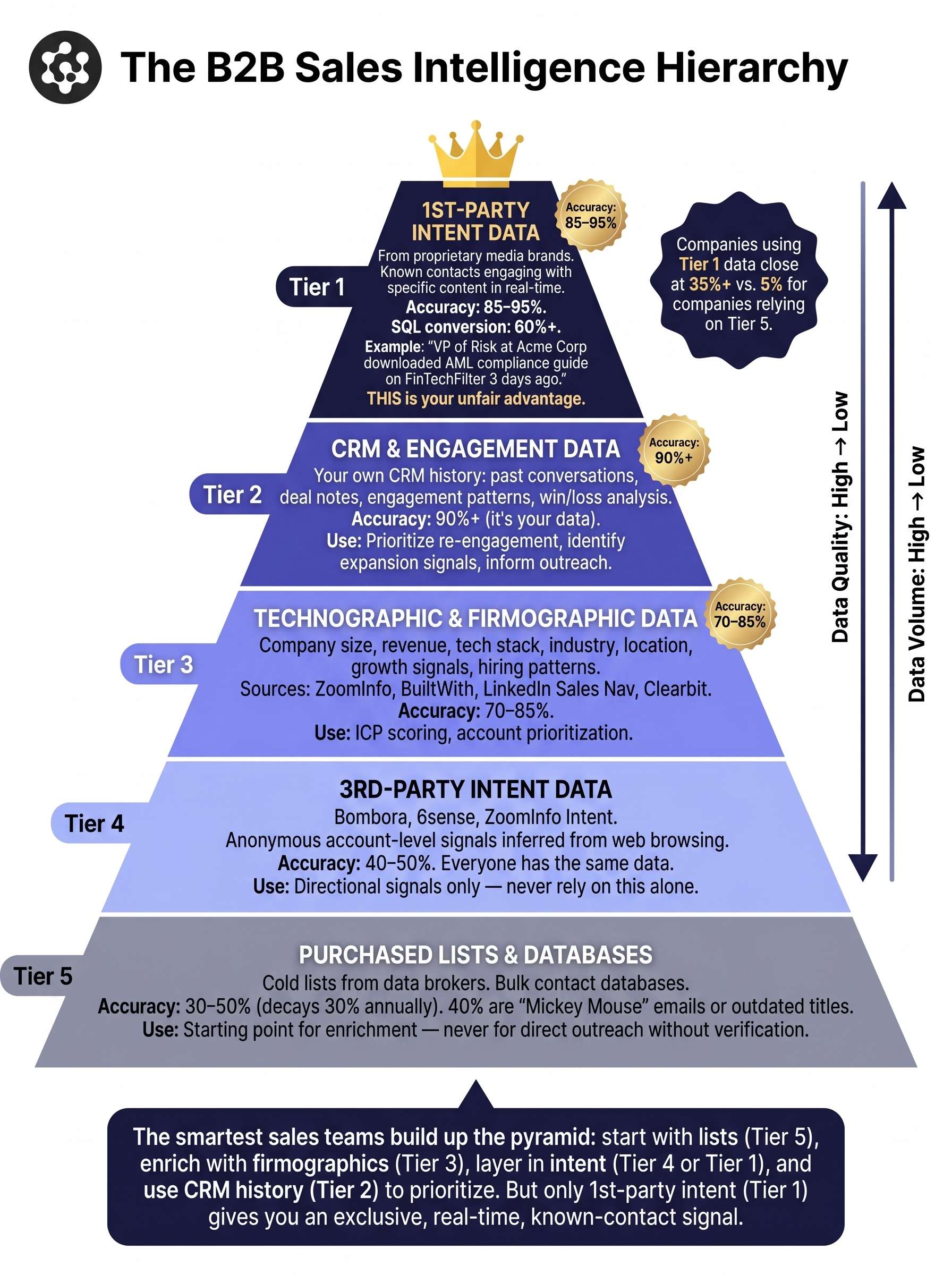
Most marketers have been told to use third-party intent data from providers like Bombora, 6sense, or ZoomInfo. The pitch sounds compelling: know which accounts are researching your category, target them with precision, and dramatically improve conversion rates.
The reality is different.
The Third-Party Intent Problem:
Third-party intent data is a commodity, not a competitive advantage:
- Anonymous: Based on IP addresses only—you’re targeting shadows, not decision-makers
- Delayed: Weeks or months old by the time it reaches you
- Public: Your competitors are purchasing the exact same data
- Broad: Vague signals like “interested in AI” rather than specific, actionable intent
- Expensive: $15,000-$100,000/year for data that yields only 10-20% improvement in MQL-to-SQL conversion
- Inaccurate: 40-50% of signals don’t correspond to actual buying committees
The First-Party Intent Advantage:
First-party intent data—signals captured directly from engaged audiences on owned properties—offers a fundamentally different asset:
- Known: Real names, titles, and companies—not anonymous IP addresses
- Real-Time: Captured in the moment of engagement, not aggregated weeks later
- Proprietary: Exclusive data your competitors cannot access
- Specific: Detailed signals showing exactly what topics prospects are researching
- Higher Accuracy: 85%+ signal accuracy versus 40-50% with third-party data
The difference isn’t marginal—it’s transformational. When you know that “Jane Doe, VP of Risk at Acme Bank, just read three articles about AML fraud automation,” you have a fundamentally different starting point than “an anonymous IP from Acme Bank seems interested in AI.”
How to Use ABM Intent Data in Campaigns
ABM intent data powers targeted, effective campaigns. Here are key ways to integrate it into your marketing:
1. Prioritize High-Intent Accounts
Use intent signals to create a “hot accounts” list, focusing on companies showing strong buying intent. First-party data can identify accounts researching specific solutions—like healthcare compliance or fintech automation—with the precision of knowing exactly what content they consumed.
2. Personalize Outreach with Context
This is where most ABM programs fail. Generic personalization (“I noticed your company is in healthcare”) isn’t enough. Context-aware outreach based on specific content engagement transforms response rates.
Consider the difference:
Generic cold outreach: “Hi Jane, I’d love to discuss compliance solutions with you.”
Context-aware outreach: “Hi Jane, I saw you were researching AML automation and the FedNow implications. Our clients at similar banks faced the same urgency. They implemented automated AML detection in 6 weeks and cut false positives by 73%. Want to see how they did it? 15 minutes?”
This context-aware approach achieves 40-50% engagement rates versus the 90% hang-up rate of traditional cold calls.
3. Align Sales and Marketing Around Qualified Opportunities
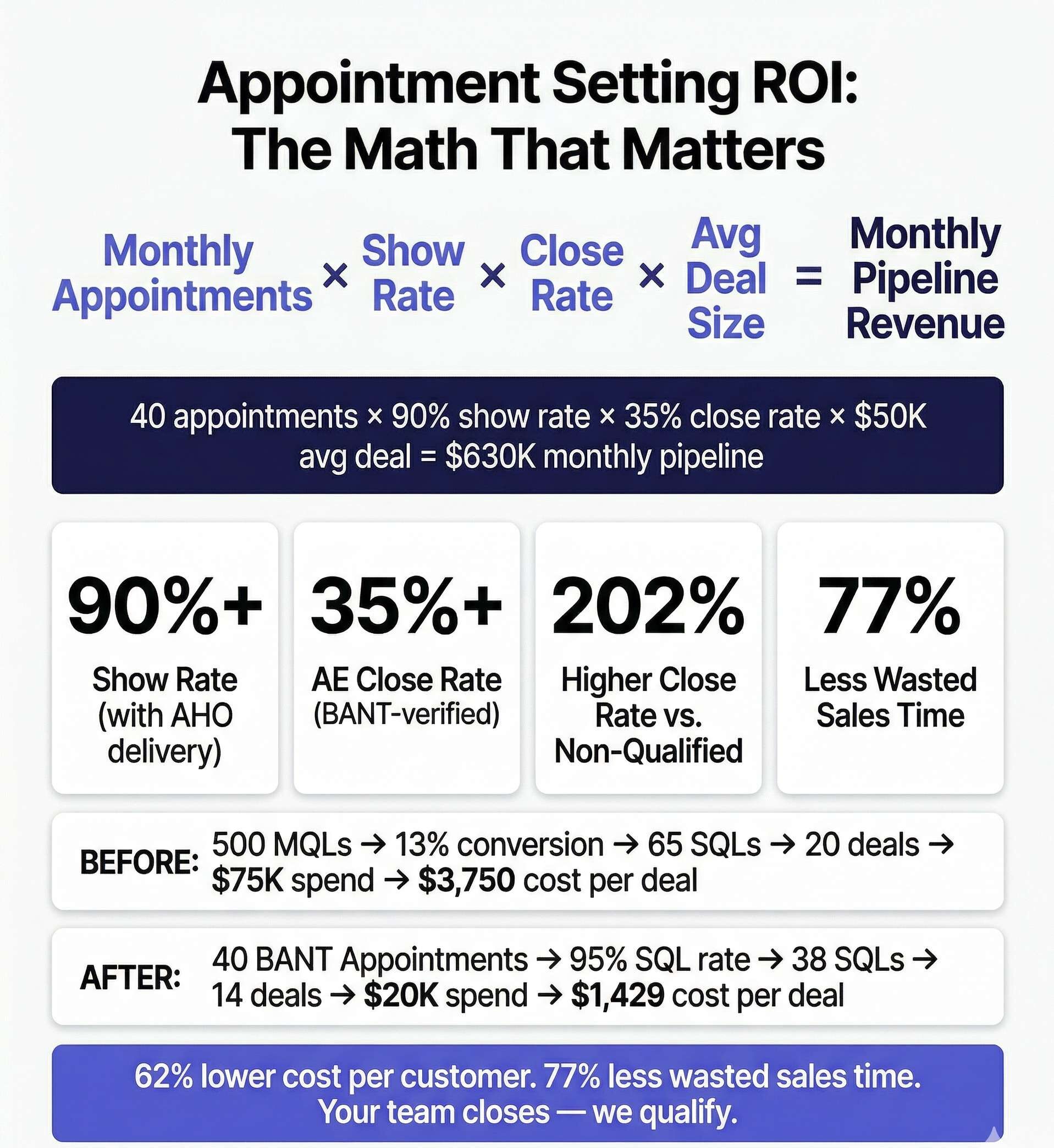
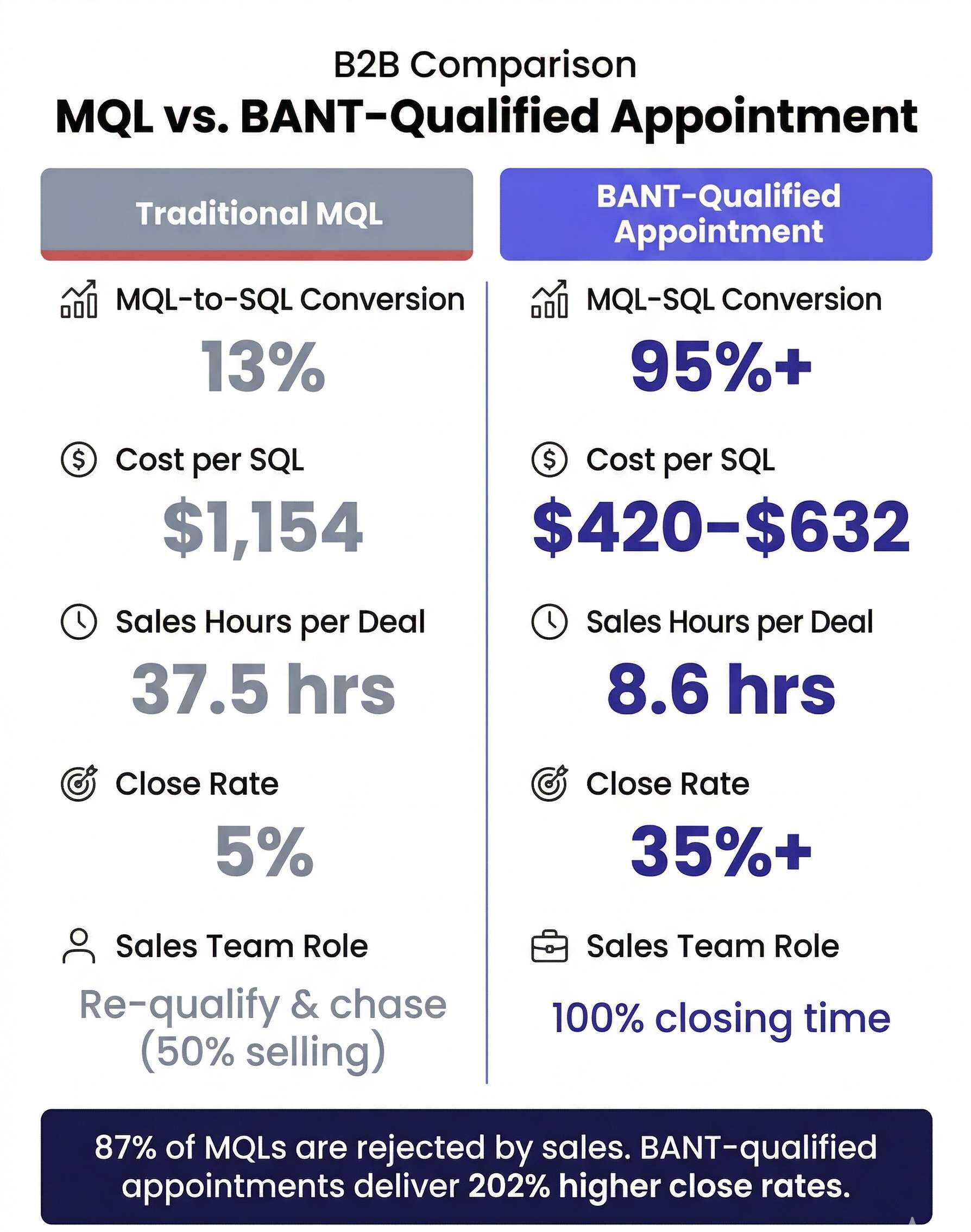
Share intent data across teams to unify efforts—but go beyond data sharing. The real alignment happens when marketing delivers appointments, not just leads. When sales receives a meeting with confirmed Budget, Authority, Need, and Timeline (BANT), the handoff friction disappears.
4. Time Interventions Precisely
Monitor spikes in intent signals to trigger timely outreach. First-party signals enable real-time response—engaging prospects while they’re actively researching, not weeks after the fact.
5. Rescue Stalled Deals
Track intent patterns to identify at-risk deals. If engagement spikes again after going cold, re-engage with fresh, relevant content before competitors do.
6. Intercept Competitor Activity
Use intent data to detect accounts researching competitors. Deploy targeted content highlighting your solution’s advantages—but only when you have specific intelligence about what the prospect is actually evaluating.
7. Optimize Ad Targeting
Create ad audiences based on intent data, ensuring your budget focuses on accounts showing active interest. First-party audiences deliver dramatically better performance than third-party lookalike targeting.
8. Track Champions’ Job Changes
Monitor when key contacts move to new roles. Reach out within their first 100 days to leverage existing relationships and shorten sales cycles.
9. Identify Upsell Opportunities
Use intent data to spot existing customers researching complementary solutions, enabling targeted upsell or cross-sell campaigns.
10. Measure What Matters: Appointments and Pipeline
Don’t just track intent signal intensity—track what intent converts to. The ultimate metric isn’t MQLs generated but qualified appointments delivered and pipeline created.
Best Practices for Using ABM Intent Data
To maximize the value of ABM intent data, follow these best practices:
Define Your ICP: Align intent data with your Ideal Customer Profile to target high-fit accounts. Intent signals from poor-fit accounts are noise, not opportunity.
Select Relevant Topics: Choose intent keywords that reflect serious buying interest—specific solutions like “healthcare cybersecurity compliance” rather than broad categories like “IT security.”
Prioritize Data Quality Over Quantity: First-party intent signals from engaged audiences outperform aggregated third-party data. Fewer, higher-quality signals beat thousands of questionable ones.
Integrate with Your Tech Stack: Connect intent data to CRMs for seamless workflows—but ensure the data includes enough context for meaningful follow-up.
Create Response Playbooks: Develop specific outreach strategies for different intent scenarios, mapping signals to tailored messaging.
Qualify Before Handoff: Don’t dump raw intent signals on sales. Verify BANT criteria before scheduling meetings. This transforms the meeting from discovery to solution presentation.
From Intent Signal to Qualified Appointment: The Waterfall Approach
Here’s where most ABM intent strategies break down: they stop at the signal. You identify high-intent accounts, maybe pass them to SDRs, and hope for the best. The result? Low conversion rates, frustrated sales teams, and wasted intent data.
The solution is a systematic “waterfall” approach that converts intent signals into BANT-verified appointments:
Stage 1: Capture the Intent Signal
Start with proprietary first-party data—known individuals demonstrating real-time, specific intent through content engagement.
Stage 2: Context-Aware Human Outreach
Use the intent signal as fuel for personalized outreach. Reference the specific content consumed, demonstrate understanding of the prospect’s challenges, and offer relevant value.
Stage 3: BANT Qualification
Before scheduling any meeting, verify all four BANT criteria through skilled conversation:
- Budget: Have they allocated funds for this type of solution?
- Authority: Is the prospect a decision-maker or key influencer?
- Need: Is the business problem real, specific, and urgent?
- Timeline: When do they expect to make a decision?
Stage 4: Appointment Handover with Full Context
Deliver a comprehensive briefing document (an Appointment Handover Sheet) to your AE that includes:
- The exact intent signals that triggered outreach
- Verified BANT criteria with specific proof points
- Key pain points in the prospect’s own words
- Competitive intelligence gathered during qualification
- Recommended approach and potential objections
Your AE walks into the meeting 100% prepared to close—not to conduct discovery.
Case Study: First-Party Intent Drives 182% Improvement in SQL Conversion
A B2B SaaS company struggled with their ABM program. Despite investing in third-party intent data, only 28% of meetings converted to SQLs, and AEs complained that 70% of appointments were unqualified.
The Problem:
- Third-party intent signals were weeks old and broadly targeted
- SDRs passed along “interested” contacts without BANT verification
- AEs received calendar invites with nothing but a prospect name and company
- Sales spent 600 hours monthly on unqualified conversations
The Solution:
The company shifted to a first-party intent approach with rigorous BANT qualification:
- Intent signals came from prospects actively engaging with relevant content in real-time
- Every prospect was BANT-verified before scheduling
- AEs received comprehensive Appointment Handover Sheets with full context
- Meetings became solution presentations, not discovery calls
The Results (6 Months):
| Metric | Before | After | Change |
|---|---|---|---|
| BANT-Qualified Rate | 30% | 94% | +213% |
| SQL Conversion | 28% | 89% | +182% |
| AE Satisfaction Score | 3.8/10 | 9.2/10 | +142% |
| Close Rate | 18% | 35% | +94% |
| Cost per Deal | $4,167 | $1,765 | -58% |
| Pipeline Generated | $1.2M/month | $4.8M/month | +300% |
The key insight: Fewer meetings, but all qualified. The company booked 13% fewer meetings per month but closed 450% more deals because every appointment was with a verified buyer.
ABM Intent Data in Healthcare: A Prime Use Case
In healthcare, where buying decisions are complex and involve multiple stakeholders, ABM intent data shines—but only when the data is specific enough to enable relevant outreach.
Signals like searches for “patient data security” or engagement with HIPAA compliance content allow marketers to target hospitals or health systems with precisely tailored campaigns. A context-aware approach lets you engage IT directors, compliance officers, and clinical leadership simultaneously—each with messaging relevant to their specific concerns.
The key is moving beyond vague “healthcare IT” signals to specific intent indicators: which compliance framework they’re researching, what integration challenges they’re exploring, which competitors they’re evaluating.
Overcoming ABM Intent Data Challenges
Using ABM intent data comes with challenges. Here’s how to address them:
Data Quality: Prioritize first-party intent over third-party aggregated data. The quality gap isn’t marginal—it’s the difference between actionable intelligence and noise.
Signal Timing: Third-party data is often weeks old. First-party signals captured in real-time enable immediate, relevant follow-up while intent is hot.
Qualification Rigor: Don’t pass raw intent signals to sales. Build BANT verification into your process before scheduling appointments.
Handoff Context: AEs shouldn’t walk into meetings blind. Comprehensive appointment briefings transform meeting quality and close rates.
Data Ownership: Ensure you retain full ownership of all prospect data, engagement intelligence, and qualification insights. This data asset compounds over time.
Your ABM Intent Data Playbook
ABM intent data empowers B2B marketers to target high-value accounts with precision—but only when you move beyond commodity third-party signals to proprietary first-party intent, and when you convert that intent into qualified appointments rather than raw leads.
Start with the right data source: First-party intent signals from engaged audiences outperform aggregated third-party data by every measure.
Personalize with context: Generic outreach wastes good intent signals. Reference specific content engagement for dramatically higher response rates.
Qualify before handoff: BANT verification transforms meeting quality from 30% qualified to 94% qualified.
Enable your AEs: Comprehensive appointment briefings with full context, pain points, and recommended approach turn discovery calls into closing conversations.
Track pipeline, not MQLs: The metric that matters is qualified appointments delivered and deals closed—not intent signals captured.
Whether in healthcare, fintech, or other B2B sectors, intent data can transform your ABM campaigns into revenue-driving machines. But the transformation requires more than better data—it requires a systematic approach that converts signals into qualified opportunities.
Ready to see the difference first-party intent makes?
DemandNexus helps B2B technology companies generate BANT-qualified appointments using proprietary first-party intent data. Our “Glass Box” approach delivers complete transparency: you know exactly who engaged with what content, how they were qualified, and what intelligence your AE needs to close.
The Guarantee: 15+ BANT-verified appointments per month, backed by zero-risk billing. You only pay for meetings that meet your qualification criteria.
Contact us: sales@demandnexus.io | www.demandnexus.io
FAQs
What is ABM intent data, and how is it different from traditional lead generation?
ABM intent data refers to digital signals — content engagement, page visits, topic research — that indicate a specific account is actively evaluating solutions in your category. Unlike traditional lead generation, which casts a wide net and delivers volume-based contact lists, ABM intent data focuses exclusively on high-fit accounts within your ICP that are demonstrating active buying behavior. The critical distinction most marketers miss is the source of that data: third-party intent signals (from providers like Bombora or 6sense) are anonymous, weeks old, and sold to your competitors simultaneously — whereas first-party intent signals, captured from owned or partnered media properties, identify real named individuals engaging with specific content in real time. That difference determines whether your outreach is relevant or noise.
Why doesn't third-party intent data convert well, even when it identifies "in-market" accounts?
Third-party intent data underperforms because it's built on structural limitations that no amount of optimization can fix. The signals are IP-based — meaning you're targeting company locations, not actual decision-makers. They're aggregated weekly or bi-weekly, so by the time the data reaches your SDRs, the prospect may have already shortlisted vendors. And critically, the same data is sold to 5–10 competitors simultaneously, eliminating any timing advantage. Studies show that 40–50% of third-party intent signals don't correspond to actual buying committees — they reflect research activity from junior employees, analysts, or competitors. The result: high spend ($15,000–$100,000/year), marginal lift (10–20% improvement in MQL-to-SQL conversion), and SDRs burning hours on accounts that were never real opportunities.
How does BANT qualification improve the conversion rate from intent signal to closed deal?
BANT (Budget, Authority, Need, Timeline) qualification inserts a human verification layer between intent signal and sales meeting — and that layer is where most conversion gains are captured. Without BANT, a high-intent signal gets passed to sales as a "warm lead," but the AE still has to spend discovery time determining whether the prospect has actual budget, real authority to buy, a quantified business problem, and an active decision timeline. With BANT qualification applied before scheduling, that discovery work is complete before the meeting begins. The result is that appointments convert to SQLs at 90%+ rather than the 13% median for MQL-to-SQL conversion from unqualified lead scoring. Fewer meetings, but every meeting is with a verified buyer — which is why BANT-qualified appointment models consistently produce 30–40% close rates versus 18–20% from traditional funnel approaches.
What is an Appointment Handover Sheet (AHO), and why does it matter for ABM campaigns?
An Appointment Handover Sheet (AHO) is a comprehensive pre-meeting intelligence briefing delivered to your account executive 24–48 hours before every BANT-qualified appointment. It contains the specific intent signals that triggered outreach (e.g., which articles the prospect read, on which media property), documented BANT verification with the prospect's exact words, mapped pain points, competitive intelligence gathered during qualification, and a recommended approach for the meeting. The AHO matters for ABM campaigns because it closes the gap between intent capture and meeting execution — ensuring the AE walks in with full context rather than a calendar invite and a company name. In practice, AHOs transform meetings from discovery calls into solution presentations, which is a primary driver of the close rate improvement seen in first-party intent programs.
How should B2B marketers measure the success of an ABM intent data program?
The right metrics for an ABM intent data program are pipeline-focused, not activity-focused. Tracking intent signals captured, MQLs generated, or email open rates measures the top of a process that may never produce revenue. The metrics that actually predict outcomes are: BANT-qualified appointment rate (what percentage of intent signals result in a verified meeting), appointment-to-SQL conversion rate (target: 90%+), cost per closed deal (not cost per lead), and total pipeline generated per month. Companies that shift from MQL-based measurement to appointment-based measurement typically find their reported "efficiency" drops initially — because they're measuring fewer, higher-quality activities — but revenue and close rates improve substantially. The benchmark worth targeting: 15+ BANT-verified appointments per month at a cost-per-SQL that's 40–60% lower than equivalent paid channel spend.