



The global outsourced sales development market is projected to exceed $7.2 billion by 2027, and appointment setting is its fastest-growing segment. The reason is straightforward: hiring, training, and managing an internal SDR team costs $62,500+ per month when you factor in salaries, benefits, tools, management overhead, and ramp time. Most companies burn through that budget for six months before they see consistent pipeline.

Most B2B teams lose 40–60% of qualified prospects to broken handoffs and weak qualification. Take our 2-minute diagnostic to find out where your pipeline is bleeding — and how to fix it.
Start the Quiz → Takes 2 minutes. No email required to start.Outsourced appointment setting eliminates that ramp period entirely. But the real question is not whether to outsource it is how to avoid the mistakes that turn outsourcing into another line item with no ROI.
This guide covers everything: what outsourced appointment setting actually delivers, the pricing models you need to understand, the red flags that separate genuine partners from list-burning call centers, and the qualification standards that determine whether outsourced meetings actually convert.
What Is Outsourced Appointment Setting?
Outsourced appointment setting is the practice of engaging a third-party provider to prospect, qualify, and schedule sales meetings on behalf of your company. Instead of your internal sales team spending 60-70% of their time on prospecting activities, an external team handles the entire top-of-funnel workflow from identifying target accounts and building contact lists to conducting multi-channel outreach and booking confirmed meetings with decision-makers.

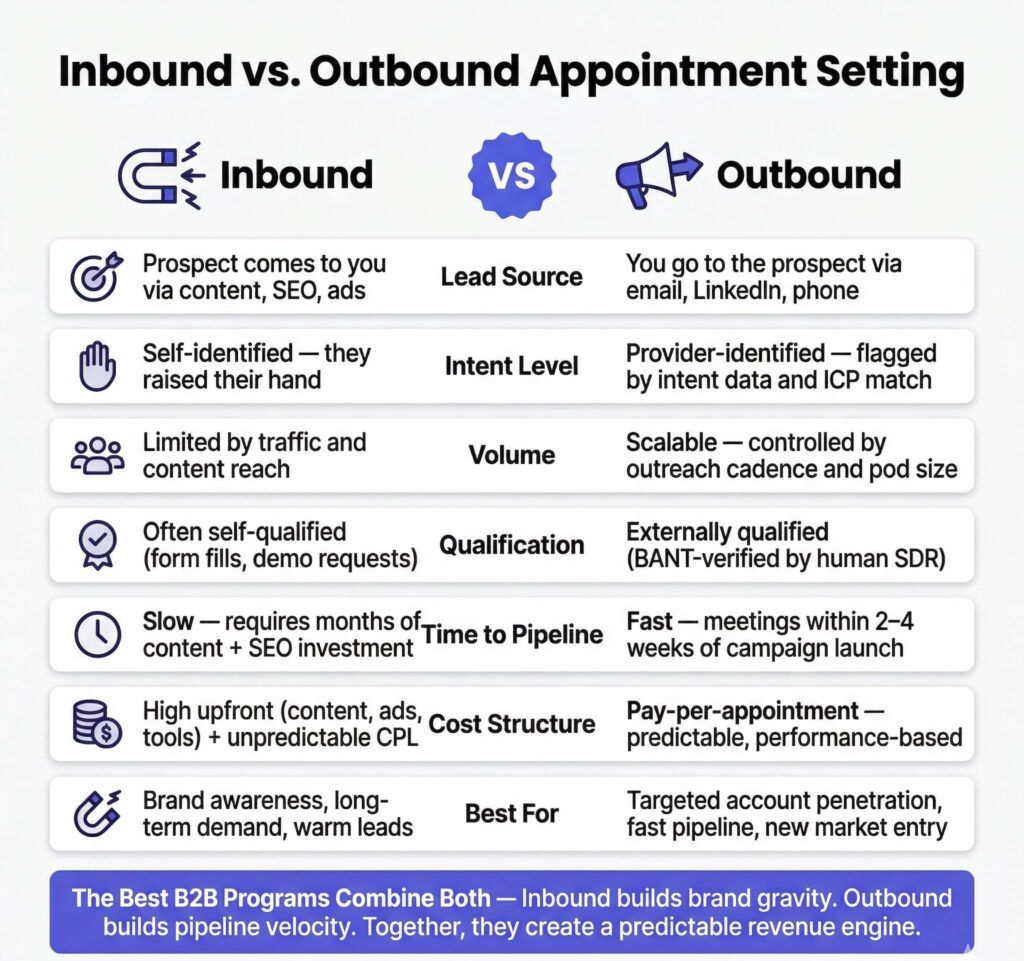
The outsourced team typically operates as an extension of your brand. They use your messaging, your value proposition, and your ideal customer profile (ICP) to engage prospects through email, phone, LinkedIn, and other channels. The output is not a list of “interested leads” or form fills it is actual meetings scheduled on your sales team’s calendar.

This is fundamentally different from outsourced lead generation, which typically delivers contact information or MQLs that your team must still qualify. Outsourced appointment setting goes further by confirming that each prospect meets specific qualification criteria before scheduling the meeting. For a deeper comparison of these two approaches, see our breakdown of lead generation vs. appointment setting.
Why B2B Companies Are Outsourcing Appointment Setting in 2026
The In-House Cost Problem
Building an in-house appointment setting function requires a minimum investment of $750,000 annually for even a small team. That figure includes base salaries for 3-4 SDRs ($55-75K each), a team lead or manager ($90-120K), sales engagement platform licenses ($15-25K per seat annually), data and enrichment tools ($20-40K), plus benefits, training, and ramp time.
The hidden cost is even larger: it takes 3-6 months for a new SDR to reach full productivity. During that ramp period, you are paying full salary and overhead while generating minimal pipeline. When SDRs leave (and the average tenure is just 14 months), you restart the cycle entirely.
Outsourcing eliminates the ramp problem. A competent outsourced appointment setting partner launches within 30 days and delivers meetings from month one because their SDRs are already trained, their processes are proven, and their infrastructure is in place.
The Quality Problem with Traditional Outsourcing
Not all outsourced appointment setting is created equal. The market is flooded with providers who measure success by activity volume calls made, emails sent, “leads generated” rather than meeting quality. The result is a calendar full of meetings with unqualified prospects who have no budget, no authority, no urgency, and no genuine interest.
The median MQL-to-SQL conversion rate across the B2B industry is just 13%. That means if your outsourced provider is delivering unqualified leads disguised as “appointments,” 87 out of every 100 meetings will waste your AE’s time.
The solution is not to avoid outsourcing it is to demand a qualification standard that eliminates this waste. The most effective standard in B2B appointment setting is BANT (Budget, Authority, Need, Timeline), which verifies that each prospect has allocated or securable budget, decision-making authority, an active and specific pain point, and a concrete purchase timeline before the meeting is ever scheduled. Learn more about how BANT qualification transforms appointment quality in our guide to qualified appointment setting.
Outsourced Appointment Setting Pricing Models
Hourly or Retainer Model
Under this model, you pay a fixed monthly retainer (typically $3,000-$8,000) for a dedicated SDR or team. The provider commits to a set number of hours or activities per week. The advantage is predictability you know your monthly cost. The disadvantage is that you are paying for effort, not results. If the team books zero meetings in a given month, you still pay the full retainer.
Cost-Per-Lead (CPL) Model
CPL pricing charges you a fixed fee for each “lead” delivered typically a contact who filled out a form or expressed some level of interest. Prices range from $50 to $500+ per lead depending on industry and targeting criteria. The fundamental problem with CPL is that it incentivizes quantity over quality. The provider makes more money by delivering more leads, regardless of whether those leads are actually qualified to buy. Your team inherits the qualification burden.
Pay-Per-Appointment (PPA) Model
PPA pricing charges only for meetings that are actually scheduled and confirmed. Prices typically range from $250 to $1,000+ per appointment depending on the target market and qualification depth. This is the most aligned model because both parties share the same incentive: booked meetings.
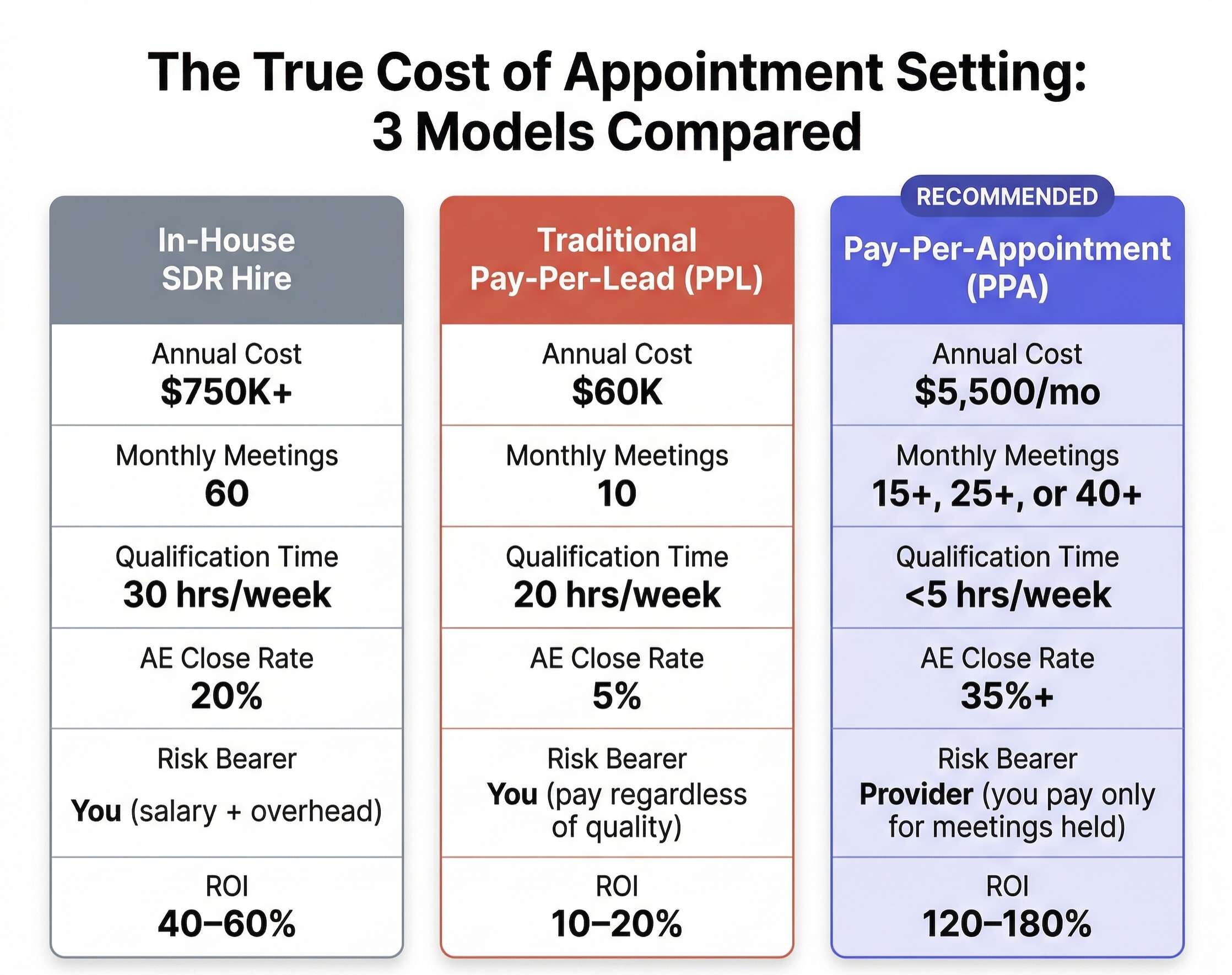
However, PPA alone is not sufficient. If the “appointment” is a meeting with someone who cannot buy, you have simply shifted the waste from lead lists to your AE’s calendar. The critical differentiator is what happens before the meeting gets scheduled.
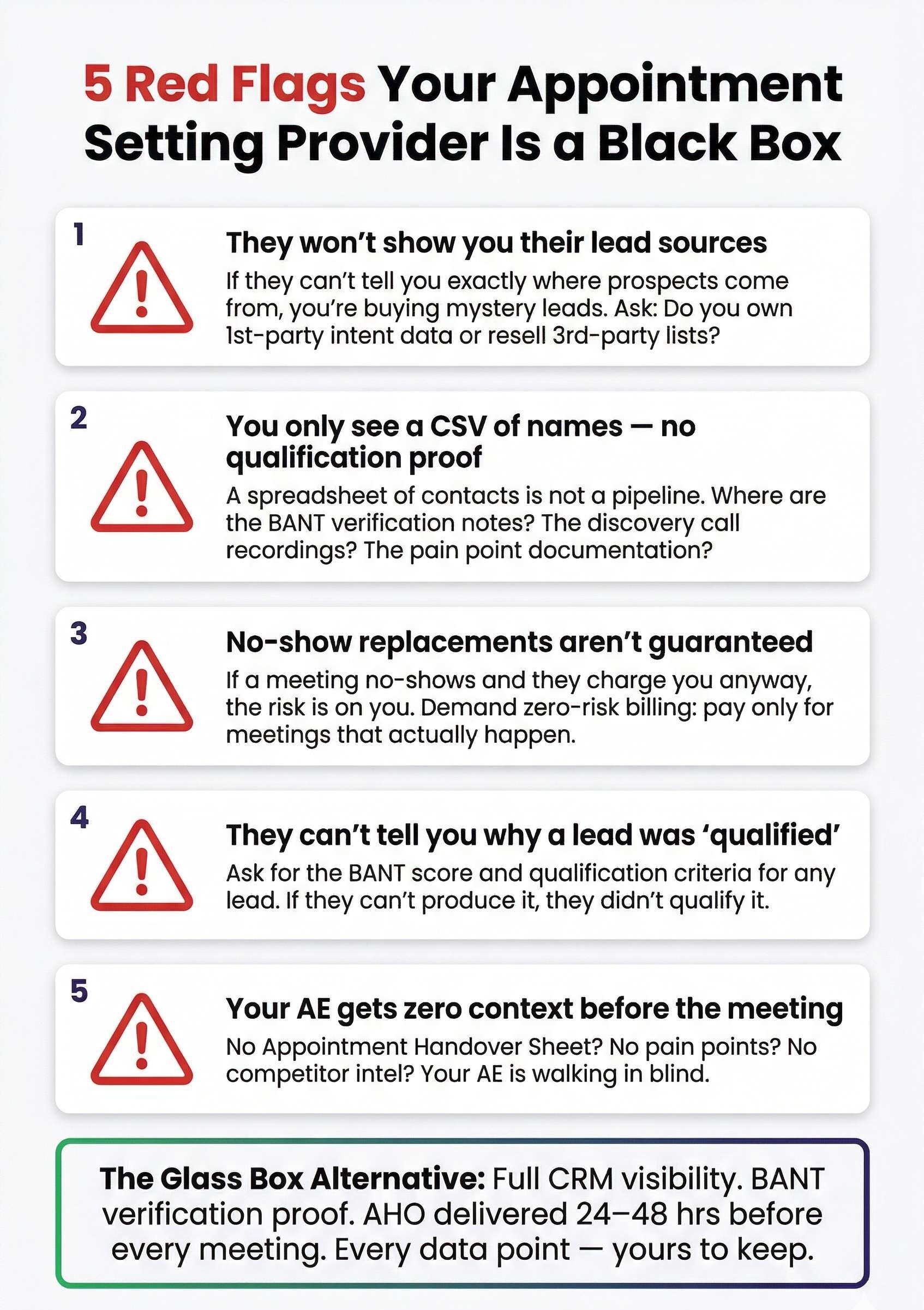
The most sophisticated providers combine PPA pricing with rigorous BANT qualification. Under this model which DemandNexus calls the Waterfall you pay only for meetings where the prospect’s Budget, Authority, Need, and Timeline have been verified through a live discovery conversation before the appointment is booked. If a meeting does not meet your agreed BANT criteria, you are not billed. If a prospect no-shows, the meeting is replaced within five business days at no charge. This shifts the qualification risk entirely to the provider and ensures your AEs walk into every meeting prepared to close. Explore the full details of DemandNexus’s B2B appointment setting services to see how this model works in practice.
How to Evaluate an Outsourced Appointment Setting Provider
Qualification Methodology
Ask every prospective provider the same question: “What specific criteria must a prospect meet before you schedule a meeting on our calendar?” If the answer is vague “they expressed interest” or “they match your ICP” that is a red flag. The answer should include specific, verifiable qualification criteria with evidence requirements.
The gold standard is BANT verification with verbatim proof: exact budget amounts and sources, confirmed decision-making authority with names and titles of all stakeholders, specific and quantified pain points, and a concrete purchase timeline with forcing events. Any provider unwilling to commit to this level of verification is selling you activity, not outcomes.
Data Sourcing and Intent Signals
Where does the provider source their prospect data? If they are buying cold lists from third-party brokers, those contacts have been sold to dozens of competitors and are burned out. If they rely exclusively on LinkedIn Sales Navigator, they are limited to the same database every other provider uses.
The most effective providers leverage proprietary first-party intent data signals from audiences they own or control, not data rented from aggregators. For example, DemandNexus operates six niche B2B media brands (including AITechTrend, MarTechTrend, FinTechFilter, HRTechTrend, DevTechTrend, and LegalTechTrend) reaching 15M+ monthly decision-makers. When a VP of Engineering reads three articles about API infrastructure on DevTechTrend, that is a verified, real-time intent signal that no competitor has access to. This first-party approach delivers engagement rates 4-6x higher than cold outreach from purchased lists.
Transparency and Reporting
Can you see exactly what the outsourced team is doing? Demand full CRM visibility into every stage of the funnel: how many prospects were contacted, how many responded, how many qualified, how many were disqualified (and why), and how many converted to scheduled meetings. Providers who operate as a “black box” sending you appointments without letting you see the funnel are hiding something, usually a high disqualification rate or low-quality data sources.
AE Enablement and Meeting Preparation
What does your AE receive before each meeting? If the answer is “a calendar invite with a name and company,” that is table stakes in 2010 but unacceptable in 2026. The best outsourced providers deliver comprehensive pre-meeting intelligence often called an Appointment Handover Sheet (AHO) that includes an executive summary, verified BANT details with verbatim quotes, conversation intelligence, anticipated objections, competitive context, and recommended opening strategy.
This is the difference between your AE walking in cold and your AE walking in fully prepared to close. Studies show that meetings backed by detailed handover documentation convert at 2-3x the rate of blind meetings. If you want to understand the full anatomy of effective AE preparation, see our guide on what appointment setters actually do.
Outsourced Appointment Setting vs. In-House: When to Choose Each
In-house makes sense when you have an established, high-performing sales org with deep institutional knowledge, unlimited budget for a 6-month ramp, and a management team with experience running SDR programs. For most companies especially those in growth stage, entering new markets, or without existing SDR infrastructure outsourcing delivers faster time-to-pipeline, lower risk, and better unit economics.
The hybrid model is increasingly popular in 2026: outsource the top-of-funnel prospecting and qualification to a specialist, while keeping your AEs focused exclusively on closing. This approach maximizes the efficiency of your most expensive sales resource (AE time) while eliminating the management burden of running an SDR function. For companies exploring how to structure their sales team for maximum efficiency, our article on B2B sales team structure provides a useful framework.
FAQs
How much does outsourced appointment setting cost?
Pricing varies by model. Retainer models range from $3,000-$8,000/month. Pay-per-appointment models typically charge $250-$1,000 per meeting depending on market complexity and qualification depth. The most important factor is not the per-meeting cost but the cost per closed deal — a $500 meeting that converts at 35% costs less per deal than a $250 meeting that converts at 5%. For detailed cost breakdowns, see our appointment setting costs guide.
How quickly can an outsourced team start delivering meetings?
Most competent providers launch within 30 days of kickoff. The first meetings typically appear on your calendar within 4-6 weeks. Providers who promise meetings in week one are likely sacrificing qualification quality for speed.
What industries benefit most from outsourced appointment setting?
Any B2B industry with deal sizes above $25,000 and sales cycles longer than 30 days benefits. SaaS, professional services, managed IT services, financial technology, and enterprise software are the most common verticals. The higher your average deal value, the more outsourcing makes sense — the cost per meeting is easily justified by a single closed deal.
Should I outsource B2C appointment setting differently than B2B?
Yes. B2C appointment setting typically involves higher volume, shorter qualification cycles, and different channel preferences (phone and SMS are more effective). B2B appointment setting requires deeper qualification, longer nurture sequences, and multi-threaded engagement across buying committees. Make sure your provider specializes in the model that matches your business.
How do I measure the ROI of outsourced appointment setting?
Track three metrics: cost per qualified meeting, meeting-to-opportunity conversion rate, and cost per closed deal. If your outsourced partner delivers 15 meetings at $500 each ($7,500/month) and 35% convert to opportunities that close at your standard rate, calculate the pipeline value generated against your investment. The best programs deliver 120-180%+ annual ROI.