



The sweet spot is a structured framework: defined opening hooks, qualification questions mapped to BANT criteria, proven objection responses, and clear closing techniques all delivered in a conversational tone that feels human rather than rehearsed.

Most B2B teams lose 40–60% of qualified prospects to broken handoffs and weak qualification. Take our 2-minute diagnostic to find out where your pipeline is bleeding — and how to fix it.
Start the Quiz → Takes 2 minutes. No email required to start.This guide provides ready-to-use frameworks for cold calls, cold emails, LinkedIn outreach, and qualification conversations including the specific questions that separate genuine buyers from tire-kickers and the follow-up sequences that turn “not right now” into a scheduled meeting.
Cold Call Appointment Setting Script Framework
The Opening (First 15 Seconds)
You have exactly 15 seconds before a prospect decides to stay on the line or hang up. The opening must accomplish three things: establish who you are, create immediate relevance, and give them a reason to keep listening.
Pattern-interrupt openers outperform traditional introductions by 2-3x. Instead of “Hi, this is [name] from [company], how are you today?” which signals a sales call instantly use a trigger-based opener that references something specific to the prospect.
Example framework: “Hi [Name], this is [Your Name]. I noticed [specific trigger: their company just raised a Series C / they posted a job for VP of Engineering / they published an article about scaling challenges]. I work with [similar companies/roles] who face [specific pain point related to trigger]. Is it worth 90 seconds to see if this is relevant?”
The trigger creates relevance. The peer reference builds credibility. The 90-second ask is low-commitment enough to keep them engaged. For more cold calling strategies, see our comprehensive guide to cold calling success, and for tips on handling the first few seconds effectively, read our cold calling tips article.

The Discovery Bridge (30-60 Seconds)
If the prospect agrees to listen, transition immediately into a discovery question not a pitch. The goal is to get them talking about their situation, which gives you qualification data while building rapport.
Framework: “Most [titles] I speak with are dealing with one of two challenges right now [Challenge A: e.g., their SDR team is booking meetings but conversion rates are below 15%] or [Challenge B: e.g., they’re spending too much time re-qualifying leads that should never have reached their AEs]. Which of these resonates, or is there something else entirely?”
This accomplishes two things: it positions you as someone who understands their world (credibility), and it opens a conversation about their specific pain (qualification). Whatever they respond with becomes your bridge to BANT questions.
BANT Qualification Questions
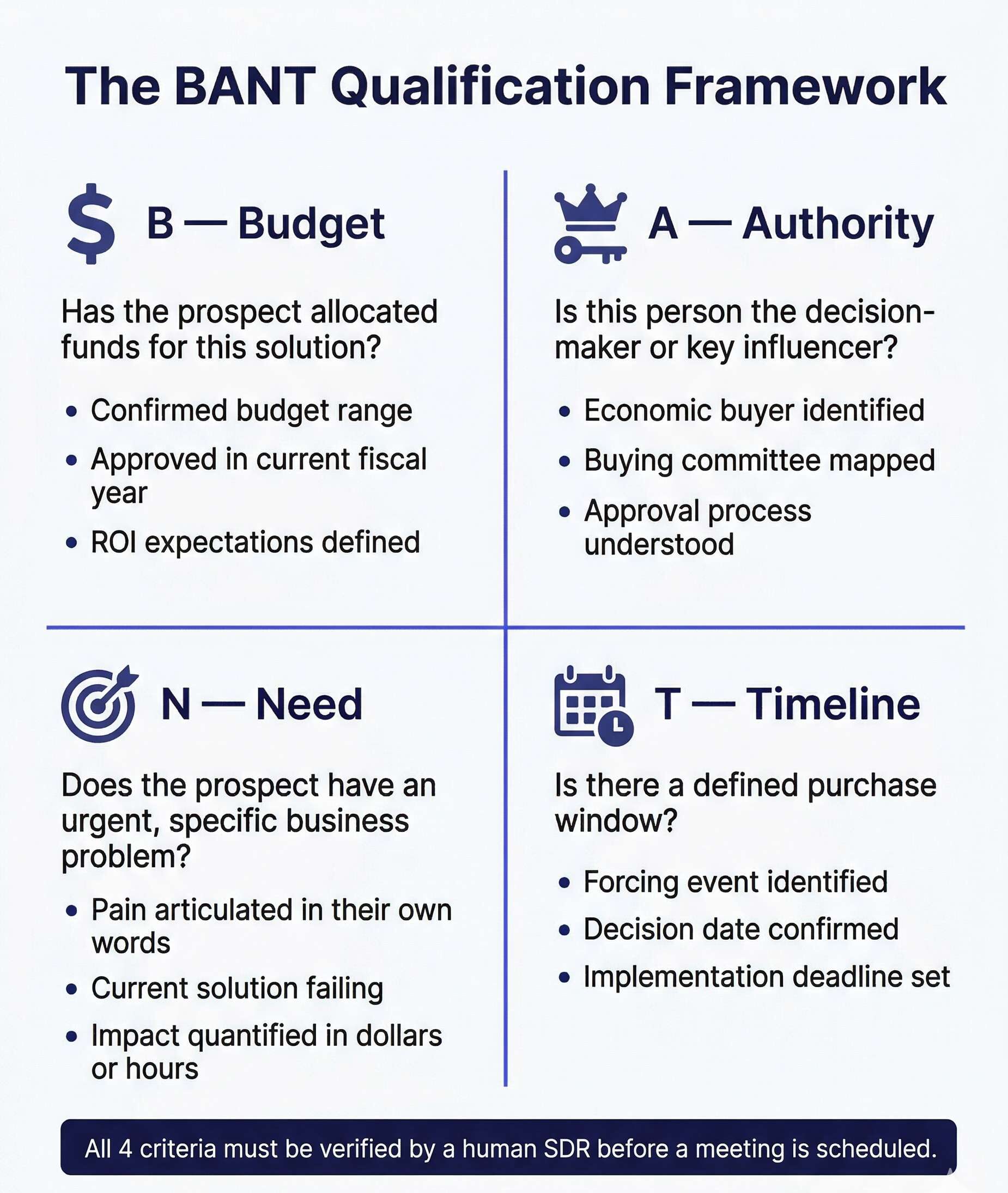
Once the prospect is engaged, work through BANT naturally within the conversation do not ask them in checklist fashion.
For Budget: “When your team evaluates solutions like this, is it typically funded from an existing budget line, or does it require a new allocation?” (This reveals whether budget exists without asking the crude “What is your budget?” question.)
For Authority: “Besides yourself, who else is typically involved in decisions like this at [Company]? I want to make sure if we schedule time, we’re including the right people.” (Maps the buying committee while confirming their role.)
For Need: “You mentioned [pain point they described]. Can you quantify the impact? How many hours per week does your team spend on this? What does that cost the business annually?” (Transforms vague pain into specific, quantified need.)
For Timeline: “Is there a specific event driving the timeline a contract expiration, a board review, a regulatory deadline? Or is this more of a ‘when we get to it’ initiative?” (Separates urgent buyers from researchers.)
For a complete qualification methodology, see our in-depth guide to qualified appointment setting.
Objection Handling
The four most common objections in appointment setting calls and frameworks for addressing each:
“Send me an email” This is usually a polite dismissal, not a genuine request. Response: “Happy to. So I send something relevant, can I ask is [specific pain point] something your team is actively working on, or is it more of a future priority?” (This either re-engages them in conversation or confirms they are not a fit.)
“We already have a solution” Response: “That makes sense. Most companies I talk to already have something in place. The conversations that tend to be most valuable are when teams are seeing gaps [specific gap related to their likely pain]. Is that something you have experienced?” (Positions the meeting as evaluating improvement, not replacing what works.)
“I am not the right person” Response: “Understood. Who on your team typically handles [specific area]? I want to make sure I reach the right person rather than creating noise.” (Turns a rejection into a referral.)
“We do not have budget” Response: “Totally fair. Most of the companies we work with did not have allocated budget until they saw the ROI case. Would it be valuable to see how [similar company] justified the investment internally? It is a 20-minute conversation, no commitment.” (Reframes the meeting as helping them build a business case, not asking them to spend money.)
For more objection handling in cold outreach contexts, see our article on dealing with cold calling rejection.
Cold Email Appointment Setting Templates
The Trigger-Based First Email
Subject: [Trigger event] + [specific implication]
Template: “Hi [Name], I saw that [Company] recently [trigger: launched a new product / expanded into X market / posted a role for Y]. Companies in a similar position often face [specific challenge related to trigger] [Company A] told us they were losing [quantified impact] before they addressed it. Would a 20-minute conversation to see if this is relevant be worth your time this week? [Your name]”
Keep it under 100 words. One specific trigger. One quantified pain point. One clear ask. For more on crafting cold emails that get responses, see our guide on what cold emailing is and how to do it effectively, plus our article on the best times to send cold emails.
The Follow-Up Sequence
Most meetings are booked on the third or fourth touchpoint, not the first. A five-email sequence over 14 days is standard:
Email 1 (Day 1): Trigger-based opening (above template). Email 2 (Day 3): Value-add with a relevant case study or benchmark stat. Email 3 (Day 7): Different angle address a second pain point. Email 4 (Day 10): Social proof mention a peer company or competitor. Email 5 (Day 14): Breakup email “I will not reach out again, but if [pain point] becomes a priority, here is how to reach me.”
The breakup email consistently generates the highest response rate in the sequence (15-25% open-to-reply) because it creates urgency without pressure. For a full guide on sequencing, see our article on building effective B2B sales cadences.
LinkedIn Appointment Setting Framework
LinkedIn outreach follows a different cadence than email because the platform penalizes aggressive automation. The framework: Day 1, send a connection request with a brief, relevant note (no pitch). Day 3 (after connection accepted), send a short message referencing their recent content, activity, or company news. Day 5, share a relevant resource (article, benchmark, case study) with a brief insight. Day 8, make the ask: “Based on what you shared about [topic], I think a quick conversation about [specific value] would be worthwhile. Open to 20 minutes this week?”
LinkedIn works best as a complement to email and phone not a standalone channel. Use it to warm prospects before cold calls and to follow up after emails. For companies building their LinkedIn outreach strategy, our guide to LinkedIn lead generation provides the complete playbook.
FAQs
Do appointment setting scripts actually work in B2B?
Frameworks work. Rigid scripts do not. Decision-makers can tell when someone is reading verbatim from a screen, and they disengage immediately. Use structured frameworks that guide the conversation flow while allowing natural adaptation based on the prospect's responses.
What is the best opening line for an appointment setting cold call?
The best openers reference a specific trigger relevant to the prospect — a recent company event, a piece of content they published, or a challenge common to their role. Pattern-interrupt openers outperform traditional introductions by 2-3x in engagement rate.
How many touchpoints does it take to book a B2B appointment?
Average is 8-12 touchpoints across 14-21 days using a multi-channel cadence (email, phone, LinkedIn). Most meetings are booked on the third to fifth touchpoint. Giving up after two attempts leaves significant pipeline on the table.
Should I use the same script for every prospect?
No. Use the same framework but customize the trigger, pain point, and value proposition for each prospect's specific situation. Personalization at the trigger and pain-point level is the single biggest driver of response rates.
How do I handle gatekeepers when setting appointments?
Treat gatekeepers as allies, not obstacles. Be direct about who you are calling for and why, reference a specific trigger or referral if possible, and ask for help rather than trying to bypass them. Gatekeepers who understand the value of your call often become internal advocates.