
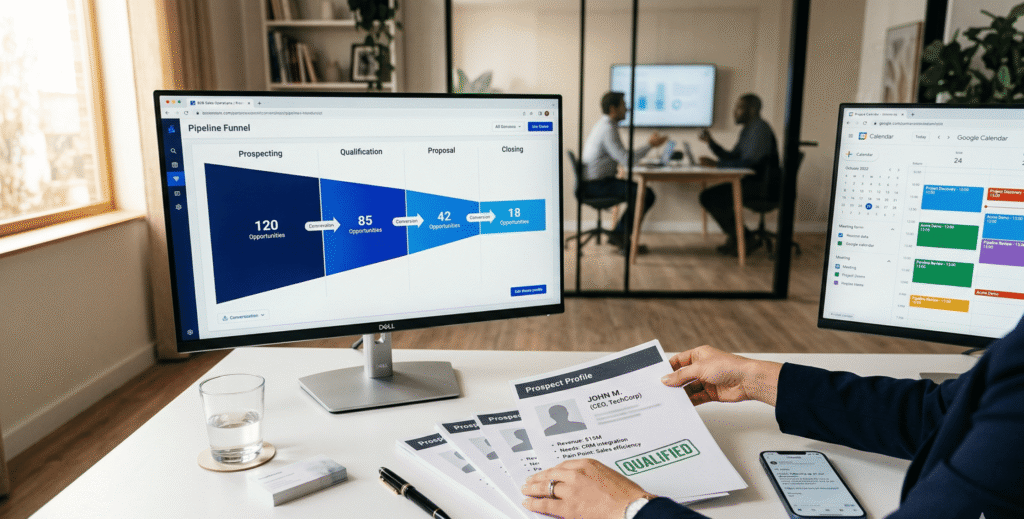


Where lead generation captures interest, appointment generation converts that interest into a committed conversation. Where appointment setting describes the act of scheduling a meeting, appointment generation encompasses the entire end-to-end workflow: identifying target accounts, capturing intent signals, engaging prospects through multi-channel outreach, qualifying them against specific criteria, and scheduling a meeting where your AE is positioned to close.

Most B2B teams lose 40–60% of qualified prospects to broken handoffs and weak qualification. Take our 2-minute diagnostic to find out where your pipeline is bleeding — and how to fix it.
Start the Quiz → Takes 2 minutes. No email required to start.The distinction matters because it shifts the success metric from volume (how many leads?) to outcome (how many revenue-ready meetings?). And in a market where 87% of MQLs never convert to opportunities, that shift is the difference between a pipeline that produces revenue and one that produces activity reports.
How Appointment Generation Fits in the B2B Revenue Workflow
Think of the B2B revenue workflow as a four-stage process. Stage one is demand generation creating awareness and interest among your target audience through content, advertising, events, and community engagement. Stage two is lead generation capturing contact information from interested prospects through gated content, form fills, and outbound list building. Stage three is appointment generation qualifying captured leads and converting them into scheduled, verified meetings. Stage four is deal closure your AEs conduct discovery, present solutions, negotiate, and close.

Most B2B organizations over-invest in stages one and two (generating awareness and capturing leads) and under-invest in stage three (converting leads to qualified meetings). The result is a marketing team that celebrates lead volume while the sales team complains about lead quality. Appointment generation bridges this gap by inserting a qualification layer between lead capture and AE engagement.
For a comprehensive view of how demand generation and lead generation feed into this workflow, see our guide to what demand generation is and our comparison of demand generation vs. lead generation.

The Appointment Generation Process
Account Identification and Intent Monitoring
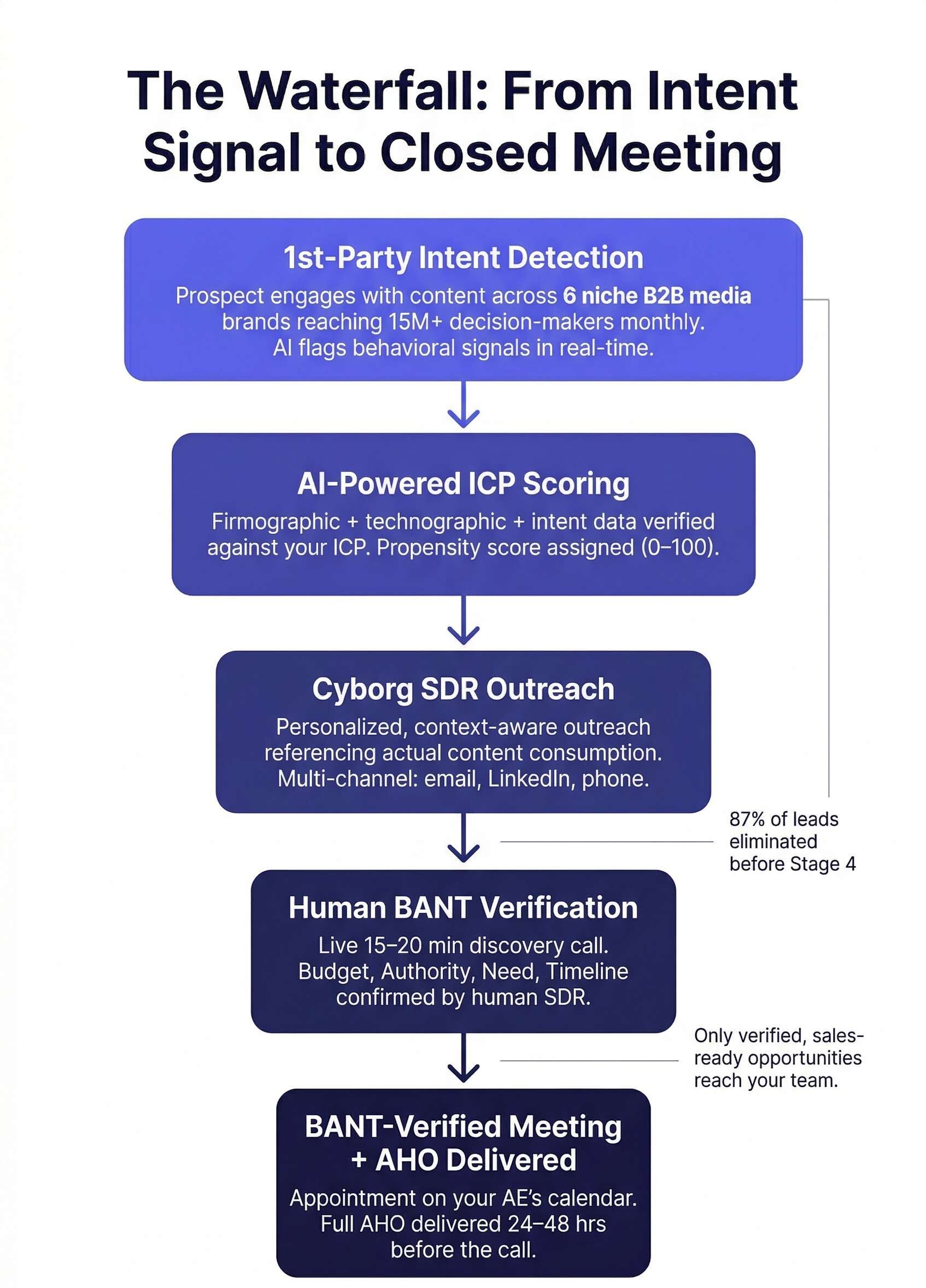
Appointment generation starts with identifying which accounts are most likely to be in-market. This goes beyond static ICP matching (company size, industry, geography) to include dynamic intent signals: what content are they consuming, what technology are they evaluating, what roles are they hiring for, what events are they attending?
First-party intent data signals captured from audiences you own or control is dramatically more valuable than third-party intent data purchased from aggregators. Third-party signals are anonymized, delayed, and sold to every competitor. First-party signals are identified, real-time, and proprietary.
DemandNexus captures first-party intent through six owned B2B media brands (AITechTrend, MarTechTrend, FinTechFilter, HRTechTrend, DevTechTrend, LegalTechTrend) reaching 15M+ monthly decision-makers. When a prospect engages with specific content reading articles about compliance automation on FinTechFilter or downloading a whitepaper about sales enablement on MarTechTrend that behavior generates a verified, real-time intent signal that feeds directly into the appointment generation workflow. For more on how intent data powers pipeline, see our guide to ABM intent data.
Multi-Channel Engagement
Once high-intent accounts are identified, appointment generation teams engage prospects through coordinated multi-channel outreach. Email delivers personalized value propositions. Phone creates direct human conversation. LinkedIn provides professional context and social proof. Content syndication nurtures prospects through the education phase.
The multi-channel approach is essential because different decision-makers prefer different channels, and prospects who receive touchpoints across multiple channels convert at 3x the rate of those contacted through a single channel. For specific outreach tactics, see our guides on sales prospecting techniques and the outbound sales lead generation strategy.
Qualification and Verification
The qualification stage is what separates appointment generation from lead generation. In lead generation, the output is a contact. In appointment generation, the output is a verified meeting one where the prospect’s Budget, Authority, Need, and Timeline have been confirmed through a live human conversation.
This verification step is non-negotiable. Without it, appointment generation degenerates into meeting-setting booking calls with anyone who agrees, regardless of their readiness to buy. The cost of unqualified meetings is staggering: each wasted meeting consumes 30-60 minutes of AE time, the follow-up effort for a dead opportunity, and the opportunity cost of meetings that could have been held with genuine buyers.
For a detailed walkthrough of BANT qualification methodology, see our guide to qualified appointment setting.
AE Handoff and Meeting Preparation
The final stage of appointment generation is the handoff to your AE. This is not just a calendar invite it is a comprehensive intelligence package that prepares your AE to have a productive, closing-oriented conversation from minute one.
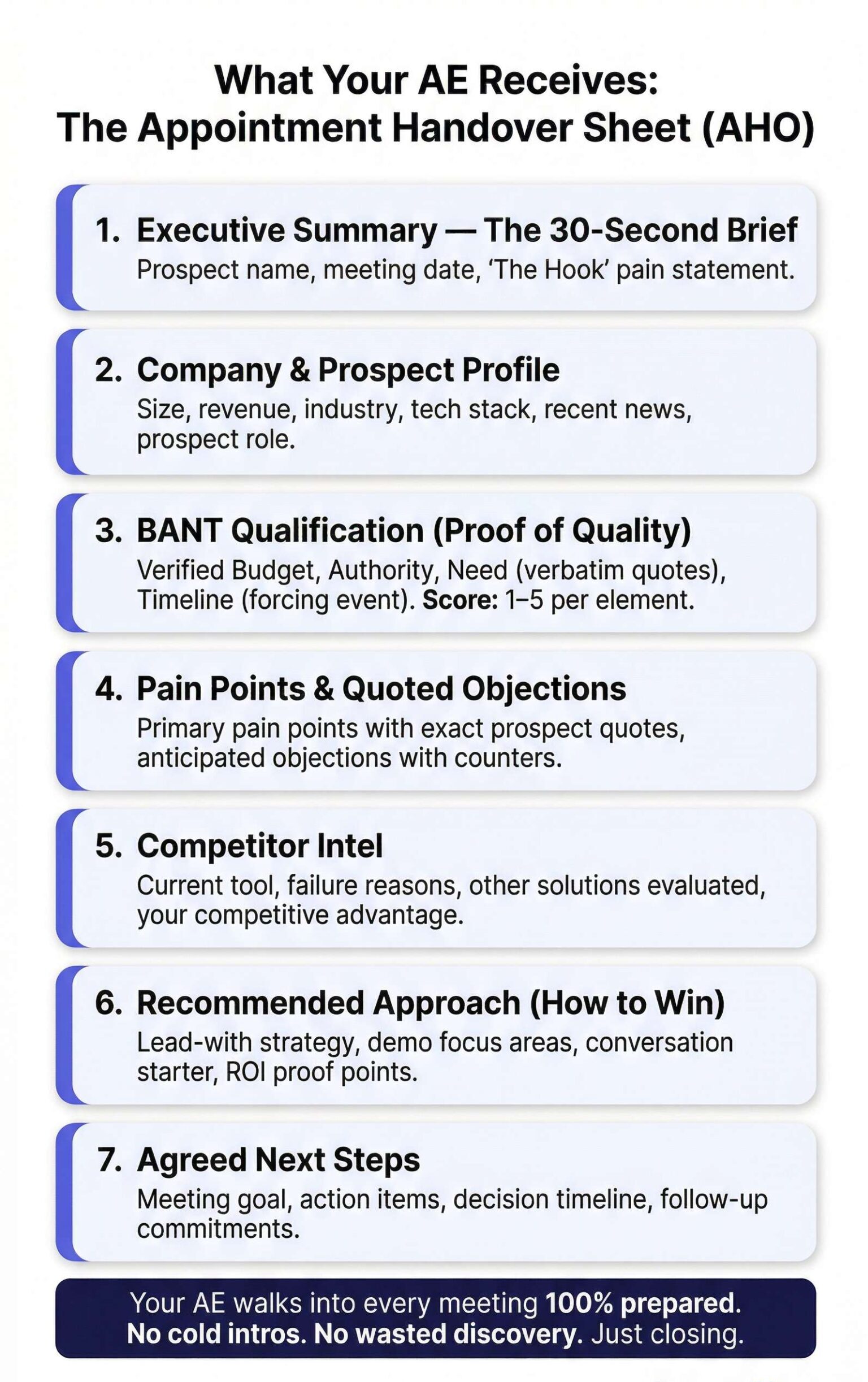
The most effective handoff includes an executive summary of the prospect and opportunity, verified BANT details with verbatim evidence, conversation history and rapport-building insights, competitive intelligence, and a recommended meeting structure. This level of preparation transforms the meeting from a discovery call (where the AE starts from zero) into a consultative conversation (where the AE builds on verified intelligence). The impact on conversion rates is substantial meetings backed by comprehensive handover documentation convert at 2-3x the rate of cold meetings. To understand how meeting preparation impacts your sales cycle, see our article on how to shorten the B2B sales cycle.
Appointment Generation Cost Benchmarks
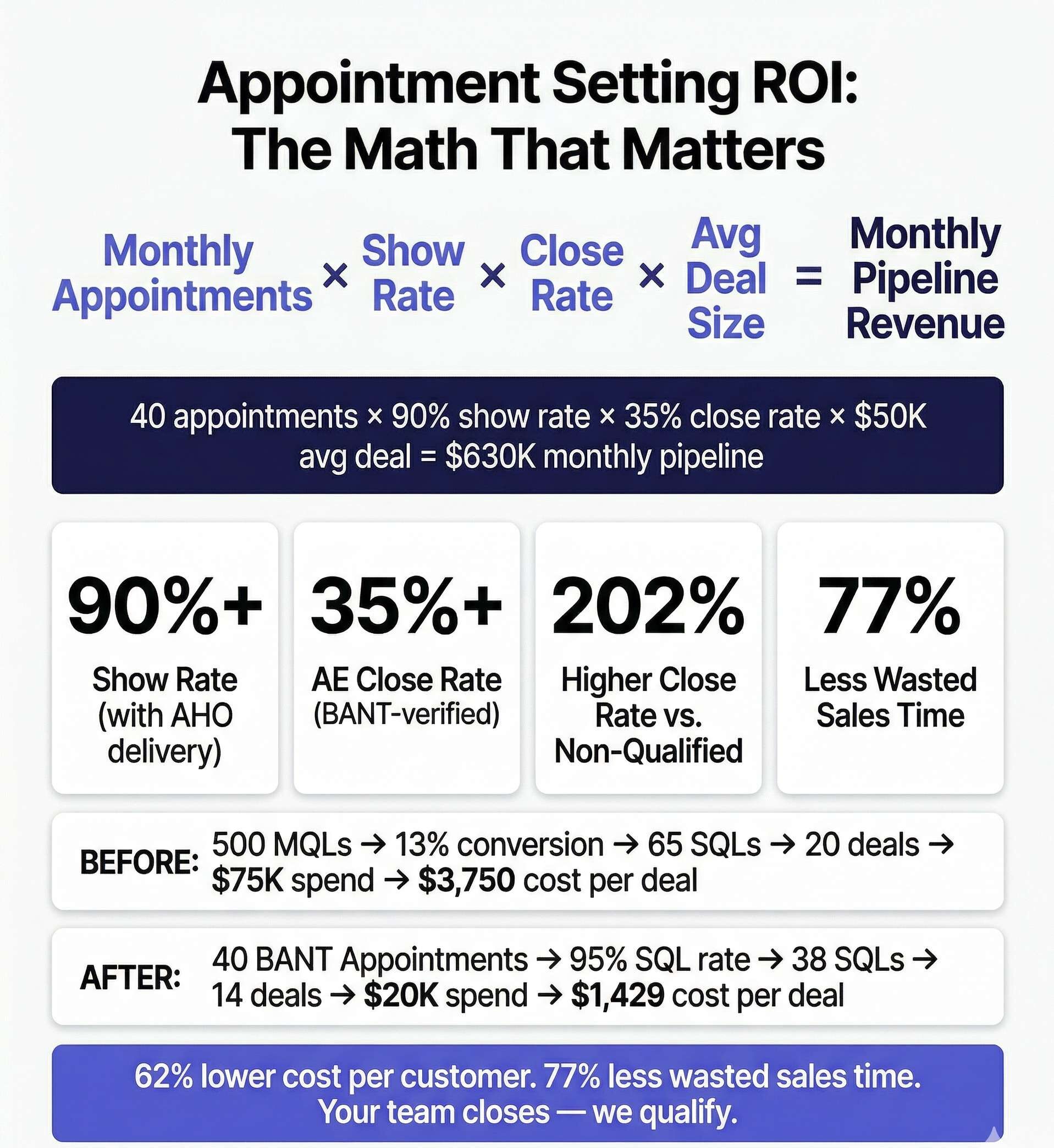
Appointment generation costs vary by model and market. For in-house teams, the fully loaded cost per meeting (including SDR salary, tools, data, management overhead, and ramp time) typically runs $800-$1,500 per meeting. For outsourced providers using retainer models, the effective cost per meeting runs $300-$800 depending on volume and qualification depth. For pay-per-appointment providers with BANT verification, costs run $400-$750 per meeting with the advantage of paying only for meetings that actually occur.
The critical comparison is not cost per meeting but cost per closed deal. A $500 BANT-qualified meeting converting at 35% produces a cost per deal of approximately $1,430. An $800 unqualified meeting converting at 10% produces a cost per deal of $8,000. For detailed pricing analysis, see our comprehensive guide to appointment setting costs.
FAQs
What is the difference between appointment generation and lead generation?
Lead generation captures potential buyer contact information. Appointment generation converts those contacts into qualified, scheduled meetings. Appointment generation includes the qualification step that lead generation typically does not — ensuring each meeting is with a prospect who has verified budget, authority, need, and timeline.
How much does appointment generation cost per meeting?
Costs range from $300-$1,500 per meeting depending on whether you use in-house teams, retainer-based outsourcing, or pay-per-appointment providers. The most cost-effective model on a per-deal basis is typically BANT-qualified PPA, which runs $400-$750 per meeting with 30-35% conversion rates.
What industries benefit most from appointment generation services?
Any B2B industry with deal sizes above $25,000 and sales cycles longer than 30 days. SaaS, professional services, financial technology, managed IT, and enterprise software are the most common. Higher deal values make the per-meeting investment easier to justify.
How is appointment generation different from appointment setting?
Appointment setting describes the act of scheduling meetings. Appointment generation describes the end-to-end process of identifying target accounts, capturing intent signals, engaging prospects, qualifying them, and scheduling verified meetings. Appointment generation is a broader strategic function; appointment setting is one operational component within it.
How long does it take to see results from an appointment generation program?
Most programs begin delivering meetings within 30-45 days of launch. Full optimization typically takes 60-90 days as messaging, targeting, and qualification criteria are refined based on initial performance data.