
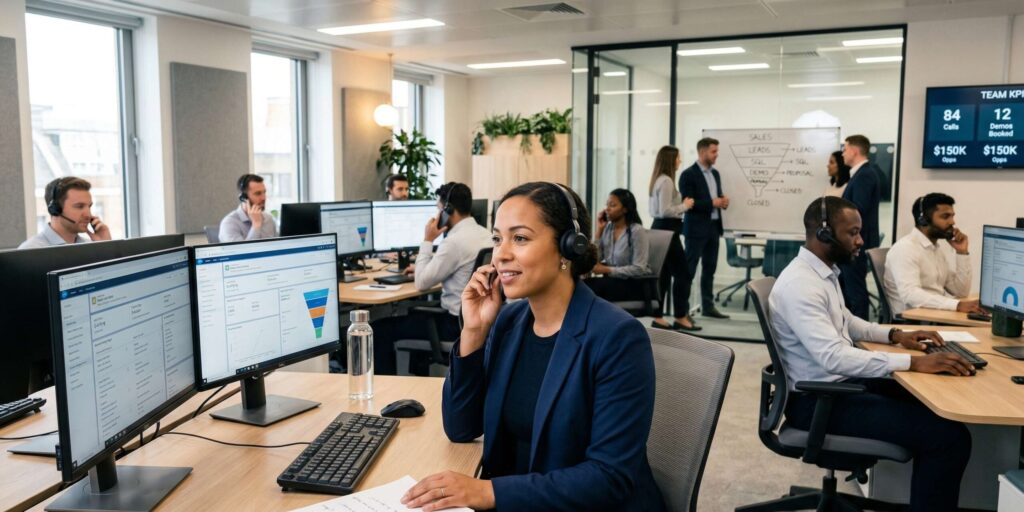


But the call center model has also earned a reputation for low quality: poorly trained agents reading scripts to unqualified contacts, booking meetings that waste AE time and damage brand reputation. The gap between the best call center partners and the worst is enormous.

Most B2B teams lose 40–60% of qualified prospects to broken handoffs and weak qualification. Take our 2-minute diagnostic to find out where your pipeline is bleeding — and how to fix it.
Start the Quiz → Takes 2 minutes. No email required to start.This guide helps you navigate that gap. It covers when call center-based appointment setting makes sense, how to evaluate providers, the qualification standards you must require, and the management practices that ensure outsourced calling teams deliver pipeline rather than noise.
When Call Center Appointment Setting Makes Sense
Call center-based appointment setting is best suited for four scenarios. First, high-volume initial contact: when you need to reach thousands of prospects per week to identify the subset worth pursuing, a calling team provides the throughput that email alone cannot match. Second, phone-responsive markets: industries where decision-makers prefer or expect phone outreach (construction, manufacturing, local services) respond better to calls than email sequences. Third, geographic expansion: entering a new market where you lack brand awareness requires proactive outreach that phone facilitates more directly than digital channels. Fourth, qualification at scale: when you have large databases of leads from events, content downloads, or purchased lists that need rapid qualification to identify the genuinely interested contacts.
Call center appointment setting is less effective when targeting senior executives at enterprise companies (who screen calls aggressively), when selling complex technical solutions that require nuanced discovery conversations, or when your market is small enough that every contact must be treated as a high-value relationship. For these situations, SDR-led or hybrid models deliver better results. For a broader perspective on whether cold calling fits your sales strategy, see our article on whether cold calling is dead in 2026.
How to Evaluate Appointment Setting Call Centers
Agent Quality and Training
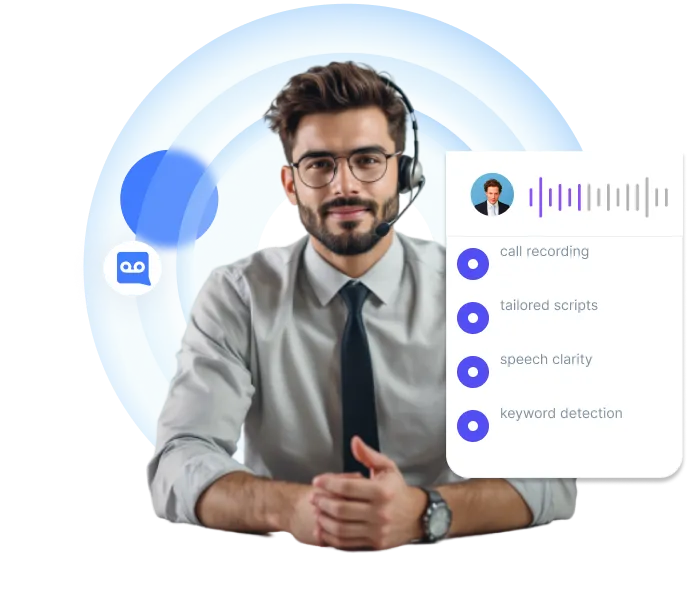
The single biggest differentiator between call centers is agent quality. Ask to hear live call recordings (not cherry-picked highlights). Evaluate whether agents can adapt to prospect responses or just read scripts, whether they can handle objections naturally, and whether they sound like professionals or telemarketers.
Training programs matter enormously. How long is the onboarding process for new agents? Do they receive industry-specific training or just product training? Are they trained on qualification methodology (BANT) or just call completion metrics? The best call centers invest 2-4 weeks in agent training before going live on your campaign.

Qualification Methodology
This is where most call centers fail. Traditional telemarketing measures success by calls completed and appointments booked not meeting quality. Agents incentivized by booking volume will schedule anyone who agrees to a call, regardless of qualification.
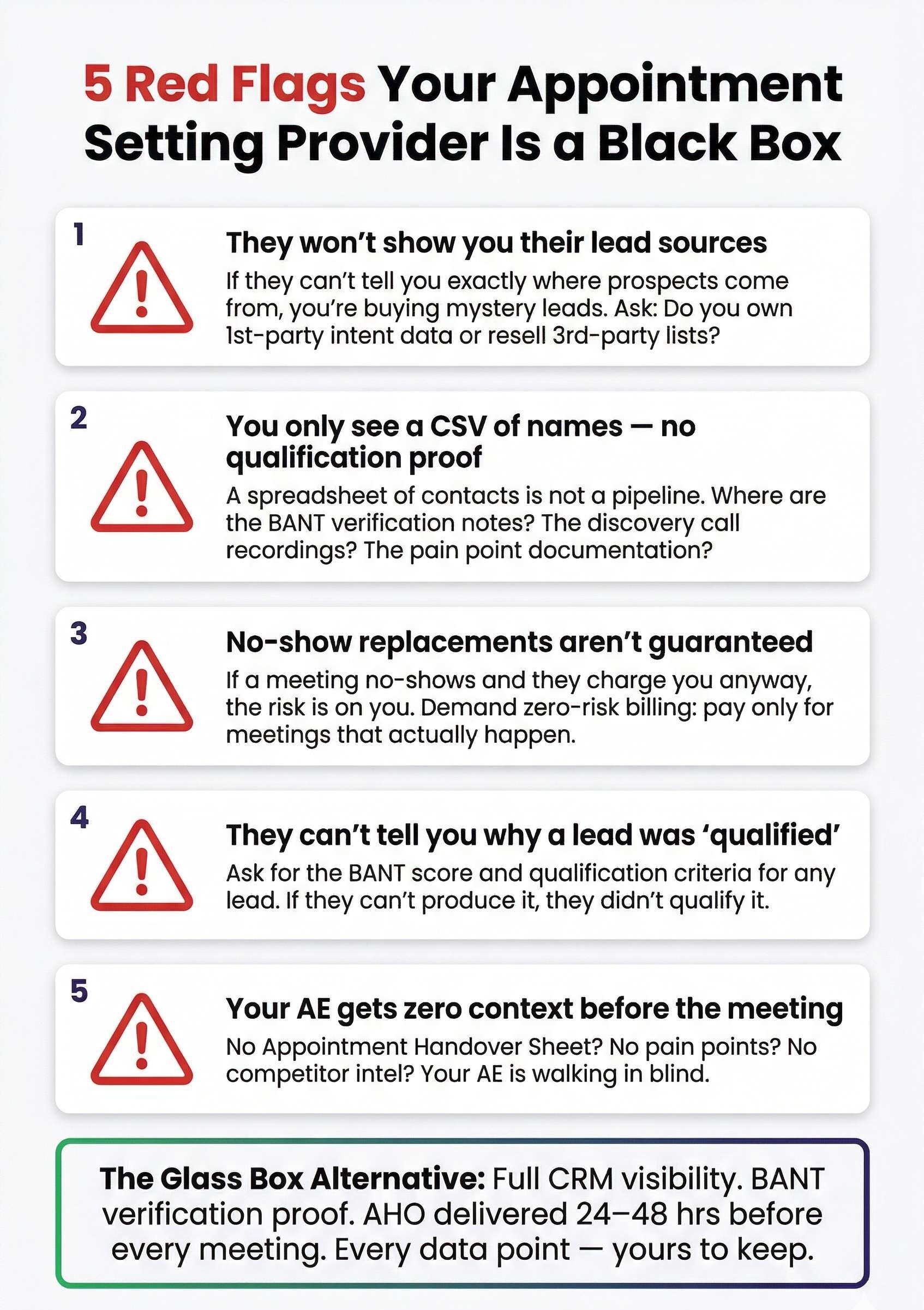
Require a documented qualification methodology with specific criteria that must be verified before any meeting is scheduled. At minimum, this should include BANT verification: confirmed budget allocation, verified decision-making authority, documented pain point with business impact, and active purchase timeline with a forcing event. Without these standards, your call center will produce a calendar full of meetings that waste your AEs’ time. See our comprehensive guide to qualified appointment setting for the full BANT framework.
Technology and Compliance
Call centers must operate compliant technology stacks: TCPA-compliant dialing (no auto-dialed calls to mobile numbers without consent), DNC list scrubbing, call recording with proper disclosure, and CRM integration that provides full visibility into call activity and outcomes.
Ask about their technology infrastructure: What dialer do they use? How do they manage DNC compliance? Can call recordings be reviewed on demand? Does their system integrate with your CRM? Compliance failures expose your company to significant legal liability do not accept “we handle compliance” as a sufficient answer. Demand specifics.
Pricing and Performance Guarantees
Call center pricing typically follows one of three models: hourly rates ($25-$50 per agent hour), cost per call ($5-$15 per completed call), or pay per appointment ($150-$500 per scheduled meeting). Each model creates different incentive alignments.
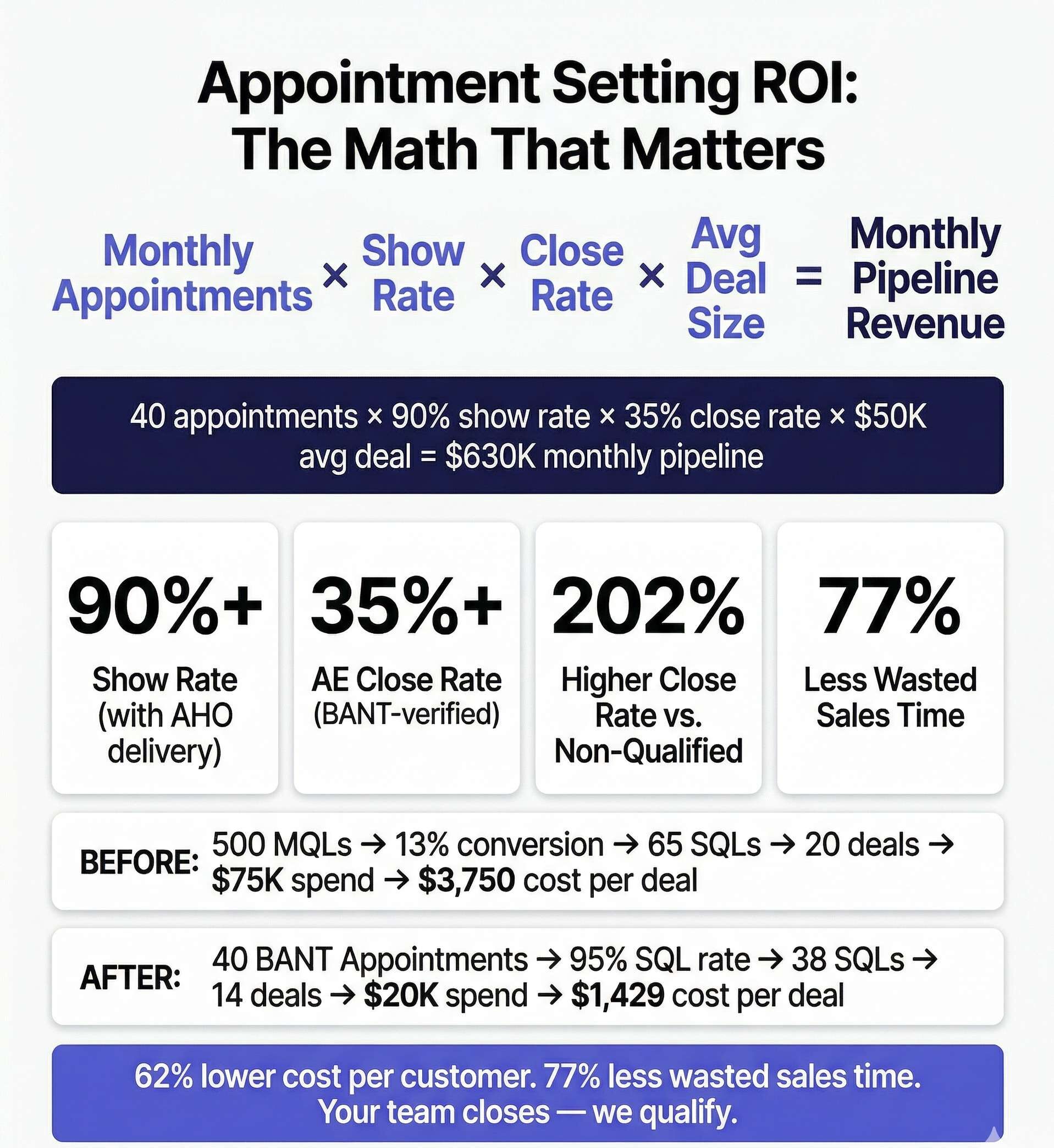
Hourly rates incentivize time-on-phones but not outcomes. Cost-per-call incentivizes call volume but not quality. Pay-per-appointment aligns incentives most closely with your goals but requires strong qualification standards to prevent low-quality bookings.
The best call center arrangements combine pay-per-appointment pricing with documented BANT qualification requirements and a no-show replacement guarantee. This ensures you pay only for meetings that happen with prospects who meet your criteria. For detailed pricing analysis across models, see our guide to appointment setting costs.
Managing an Outsourced Calling Team
Outsourcing does not mean abdicating management. The most successful call center partnerships include weekly performance reviews covering call volume, contact rate, qualification rate, and meeting conversion. They include regular call monitoring where you or your sales manager listen to recorded calls and provide feedback on qualification depth and messaging accuracy. They include script iteration based on objection patterns, competitive intelligence, and market feedback. And they include quarterly strategy reviews that adjust targeting, messaging, and qualification criteria based on pipeline outcomes.
Treat your call center partner as an extension of your sales team, not a vendor you check in with monthly. The more engaged you are in the management rhythm, the better the results.
For companies using call centers alongside other outbound channels, our guide to building an outbound sales lead generation strategy covers how to integrate phone, email, and LinkedIn into a coordinated multi-channel cadence, and our article on how to find the right call center provides the complete evaluation framework.
FAQs
How much does an appointment setting call center cost?
Pricing ranges from $25-$50 per agent hour, $5-$15 per completed call, or $150-$500 per scheduled appointment. Total monthly investment typically runs $3,000-$15,000 depending on volume and model. Pay-per-appointment with BANT qualification offers the best risk-adjusted ROI.
What is the difference between a call center and an SDR team for appointment setting?
Call centers prioritize volume — high call counts across large databases. SDR teams prioritize quality — personalized, multi-channel outreach to targeted accounts with deeper qualification conversations. Call centers work best for initial contact at scale; SDR teams work best for engaging specific decision-makers at named accounts.
How do I ensure quality from an appointment setting call center?
Implement three controls: documented BANT qualification criteria that agents must verify before scheduling, regular call recording reviews to audit qualification depth, and a quality-based compensation structure that rewards meeting conversion rate rather than meeting volume.
Can I use a call center for both B2B and B2C appointment setting?
Yes, but the agent skills and qualification criteria differ significantly. B2B requires deeper discovery conversations and multi-stakeholder engagement. B2C requires higher volume throughput and simpler qualification. Choose a call center with proven experience in your specific model.
Is telemarketing still effective for B2B appointment setting?
Phone outreach remains effective for mid-market B2B when combined with other channels and backed by intent-based targeting. As a standalone, untargeted channel, its effectiveness has declined significantly. The modern approach integrates calling into a multi-channel cadence with email and LinkedIn for maximum impact.