
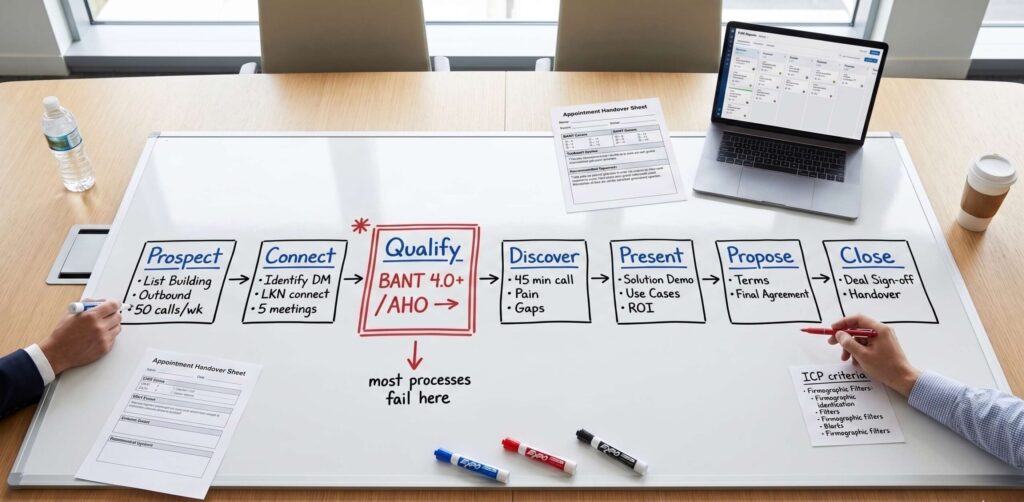


This guide separates the real from the hype, maps seven categories of AI sales tools, explains where AI wins and where it loses, and introduces the Cyborg SDR model as the synthesis that avoids both extremes of the AI sales debate.
Most B2B teams lose 40–60% of qualified prospects to broken handoffs and weak qualification. Take our 2-minute diagnostic to find out where your pipeline is bleeding — and how to fix it.
Start the Quiz → Takes 2 minutes. No email required to start.The AI SDR Fallacy
The market is flooded with “AI SDR” tools promising to automate the entire sales development function. The pitch is appealing: replace expensive, high-turnover human SDRs with an AI that prospects, writes personalized emails, handles objections, and books meetings autonomously. Pricing is typically $500–$3,000 per month—a fraction of a human SDR’s salary.
The problem is that fully autonomous AI SDRs cannot do the three things that matter most in B2B sales development: build genuine trust with C-suite buyers, handle nuanced objections that require empathy and business context, and verify qualification data through probing human conversation. An AI can generate a grammatically correct email that references a prospect’s LinkedIn activity. It cannot listen to a VP describe a budget constraint and probe whether there’s a path to secure funding through a different budget line—which is exactly the kind of verification that separates qualified pipeline from wishful thinking.
The result of full AI automation in sales outreach is predictable: higher volume of lower-quality touches that train prospects to ignore automated outreach, erode brand trust, and generate meetings that AEs find unqualified. This is what DemandNexus calls “The AI SDR Fallacy”—the belief that technology can replace the human judgment that qualification requires.
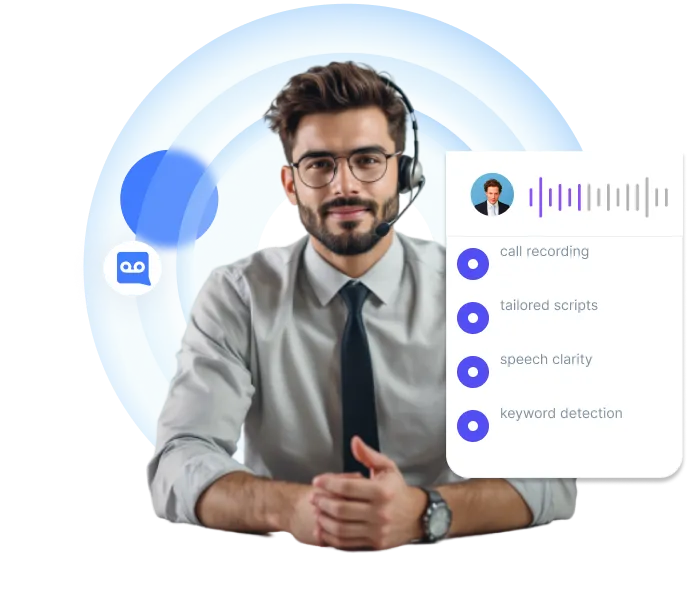
Where AI Actually Wins in B2B Sales
1. Research at Scale
AI excels at monitoring thousands of intent signals simultaneously: tracking which companies are hiring for specific roles, reading specific content topics, visiting competitor websites, or posting job requisitions that suggest technology evaluations. This research task is perfectly suited for AI because it requires processing massive data volumes quickly and flagging patterns that humans would miss. DemandNexus uses AI to monitor 10,000+ intent signals from six owned media brands, identifying which accounts are showing active buying behavior.
2. Personalization at Scale
Generative AI can draft personalized email templates that reference a prospect’s specific situation, recent company news, or content consumption patterns. This saves SDRs 15–20 minutes per prospect in manual research and writing time. The key is that a human reviews and approves the output before sending—AI-generated personalization without human oversight produces “personalization theater” that feels automated despite referencing specific details.

3. Message Testing and Optimization
AI can A/B test subject lines, email copy, and outreach sequences at a scale no human team can match. Testing 10 subject line variants across 1,000 prospects simultaneously produces statistically significant data within days rather than weeks. This accelerates the messaging optimization cycle from quarterly to weekly.
4. Call Analysis and Coaching
Conversation intelligence tools (Gong, Chorus) use AI to analyze sales calls: talk-to-listen ratio, question frequency, objection patterns, competitive mentions, and next-step commitment rates. This data identifies coaching opportunities at scale—a manager coaching 10 reps cannot listen to every call, but AI can surface the specific moments that need attention.
5. Signal Detection and Prioritization
AI-powered lead scoring and account prioritization models process dozens of variables (firmographic fit, technographic match, intent velocity, engagement recency, competitive displacement signals) to rank accounts by conversion probability. This replaces subjective “gut feel” prioritization with data-driven targeting.
See how AI-powered research combines with human qualification in the Cyborg SDR model.
Where AI Fails in B2B Sales
Qualification Conversations
Verifying BANT criteria requires probing questions, empathetic listening, and the judgment to distinguish between a genuine buying signal and a polite deflection. An AI cannot tell the difference between a prospect saying “We have budget” enthusiastically and saying “We have budget” dismissively. Human SDRs can—and that distinction determines whether a meeting is qualified or wasted.
Relationship Building
B2B enterprise sales is fundamentally relationship-driven. C-suite buyers make multi-hundred-thousand-dollar decisions partly based on trust in the vendor’s people. AI cannot build trust. It can facilitate the research and preparation that enables humans to build trust faster—but the trust itself must be human.
Complex Objection Handling
When a prospect says “We tried a similar solution two years ago and it failed,” the response requires understanding the specific failure, empathizing with the prospect’s experience, and articulating why this time would be different—in real-time, with nuance. AI-generated objection responses sound scripted precisely when they need to sound genuine.
The Cyborg SDR: AI for Research, Humans for Relationships
The future of AI in B2B sales is not full automation or full manual operation. It is the Cyborg SDR—an AI-amplified human expert who uses technology for research, testing, and signal detection while applying human judgment for qualification, relationship building, and brand representation.
DemandNexus’s 8-person Instant Pod embodies this model: AI monitors intent signals from six owned media brands, identifies in-market accounts, assists with list building, and tests messaging variants. Human SDRs conduct BANT qualification calls, build rapport, handle objections, and produce Appointment Handover Sheets. Human copywriters craft brand-safe outreach that sounds like a person, not a bot. A human team lead coaches SDRs and manages quality assurance.
The result is AI’s scale combined with human’s judgment: 60+ qualified meetings per month from an 8-person pod, with 90%+ show rates and 60%+ SQL conversion rates. Neither full AI nor full human could achieve these numbers alone.
Seven Categories of AI Sales Tools
- AI SDR platforms: Artisan, 11x, Regie.ai. Automate outreach at scale. Use cautiously—volume without qualification damages brand.
- Conversation intelligence: Gong, Chorus, Clari Copilot. Analyze calls and surface coaching insights. High value for teams with call volume.
- AI-powered prospecting: Apollo AI, Clay, Ocean.io. Enrich contacts and generate personalized outreach. Best combined with human review.
- Predictive intelligence: 6sense, Demandbase. Predict which accounts are in-market. Best for ABM motions.
- Generative AI for content: Copy.ai, Jasper, ChatGPT/Claude for drafting. Best for first-draft generation; always human-edit before sending.
- AI coaching: Second Nature, Quantified. AI-powered role-play and practice tools. Supplements, does not replace, manager coaching.
- AI-powered CRM: Salesforce Einstein, HubSpot AI. Predictive deal scoring and activity recommendations within CRM workflows.
Ready to see AI-amplified human qualification in action?
FAQs
How is AI used in B2B sales?
AI is used across five primary functions: research at scale (intent monitoring, account identification), personalization (generating tailored outreach), message optimization (A/B testing at scale), conversation analysis (call coaching and deal inspection), and signal detection (predictive account scoring and prioritization). The most effective implementations use AI for these tasks while keeping human judgment in the qualification and relationship-building loop.
Can AI replace B2B sales reps?
AI can automate specific tasks (research, first-draft writing, data analysis, scheduling) but cannot replace the human judgment required for qualification conversations, relationship building, complex objection handling, and trust development with C-suite buyers. The most effective model is the Cyborg SDR: AI for scale and data processing, humans for judgment and trust.
What are the best AI tools for B2B sales?
Leading tools by category: conversation intelligence (Gong), predictive account intelligence (6sense), AI prospecting (Apollo AI, Clay), generative content (Copy.ai, Jasper), and AI coaching (Second Nature). For teams that want AI-powered research combined with human qualification and appointment delivery, DemandNexus’s Cyborg SDR pod bundles the technology with the human execution layer.
Does AI actually work for B2B sales outreach?
AI improves outreach efficiency (faster research, more personalization variants, better testing) but degrades outreach quality when used autonomously without human oversight. AI-generated emails that sound like AI-generated emails train prospects to ignore them. The sweet spot is AI drafting + human editing + intent-triggered timing.
What is a Cyborg SDR?
A Cyborg SDR is an AI-amplified human sales development representative who uses artificial intelligence for research, signal detection, list building, and message testing while applying human judgment for qualification conversations, objection handling, and relationship building. The term was coined by DemandNexus to describe their 8-person Instant Pod model where AI and human expertise work in a continuous feedback loop.