


The traditional SDR model is under pressure. Average SDR tenure is 14–18 months. Quota attainment hovers around 25–40%. The fully loaded cost of an in-house SDR (salary, benefits, tools, management, office) is $120K–$150K per year. And the output—meetings booked—varies wildly based on the SDR’s skill, the quality of their target list, and the rigor of their qualification methodology.

Most B2B teams lose 40–60% of qualified prospects to broken handoffs and weak qualification. Take our 2-minute diagnostic to find out where your pipeline is bleeding — and how to fix it.
Start the Quiz → Takes 2 minutes. No email required to start.This guide examines why the traditional model is breaking, three redesign options that are gaining traction, and the metrics that actually measure SDR effectiveness.
Why the Traditional SDR Model Is Breaking
High turnover destroys institutional knowledge. With average tenure under 18 months, most SDR teams are perpetually in ramp mode. By the time an SDR becomes proficient—understands the ICP, masters the qualification framework, builds rapport with the AE team—they are looking for their next role. The knowledge walks out the door, and the cycle restarts.
Volume-based quotas incentivize bad behavior. When SDRs are measured on meetings booked (quantity) rather than meetings qualified (quality), the rational behavior is to book as many meetings as possible regardless of qualification rigor. The result: AEs receive a calendar full of meetings with prospects who are not ready to buy, waste time on unqualified conversations, and lose trust in the SDR function.

The cost doesn’t justify the output. An SDR at $150K all-in cost producing 8 qualified meetings per month has a cost-per-meeting of approximately $18,750. An outsourced partner delivering 25 qualified meetings per month at $1,200 per meeting has a cost-per-meeting of $1,200—with zero ramp time, zero turnover risk, and zero management overhead.
Technology without process creates noise. SDR teams have access to more tools than ever—engagement platforms, contact databases, intent data, AI assistants—but tools without a structured qualification process just accelerate bad outreach. More emails sent to unqualified accounts faster is not a competitive advantage.

Is your SDR function delivering the right cost-per-qualified-meeting? Find out.
Three Redesign Options for 2026
Option 1: In-House Cyborg Pods
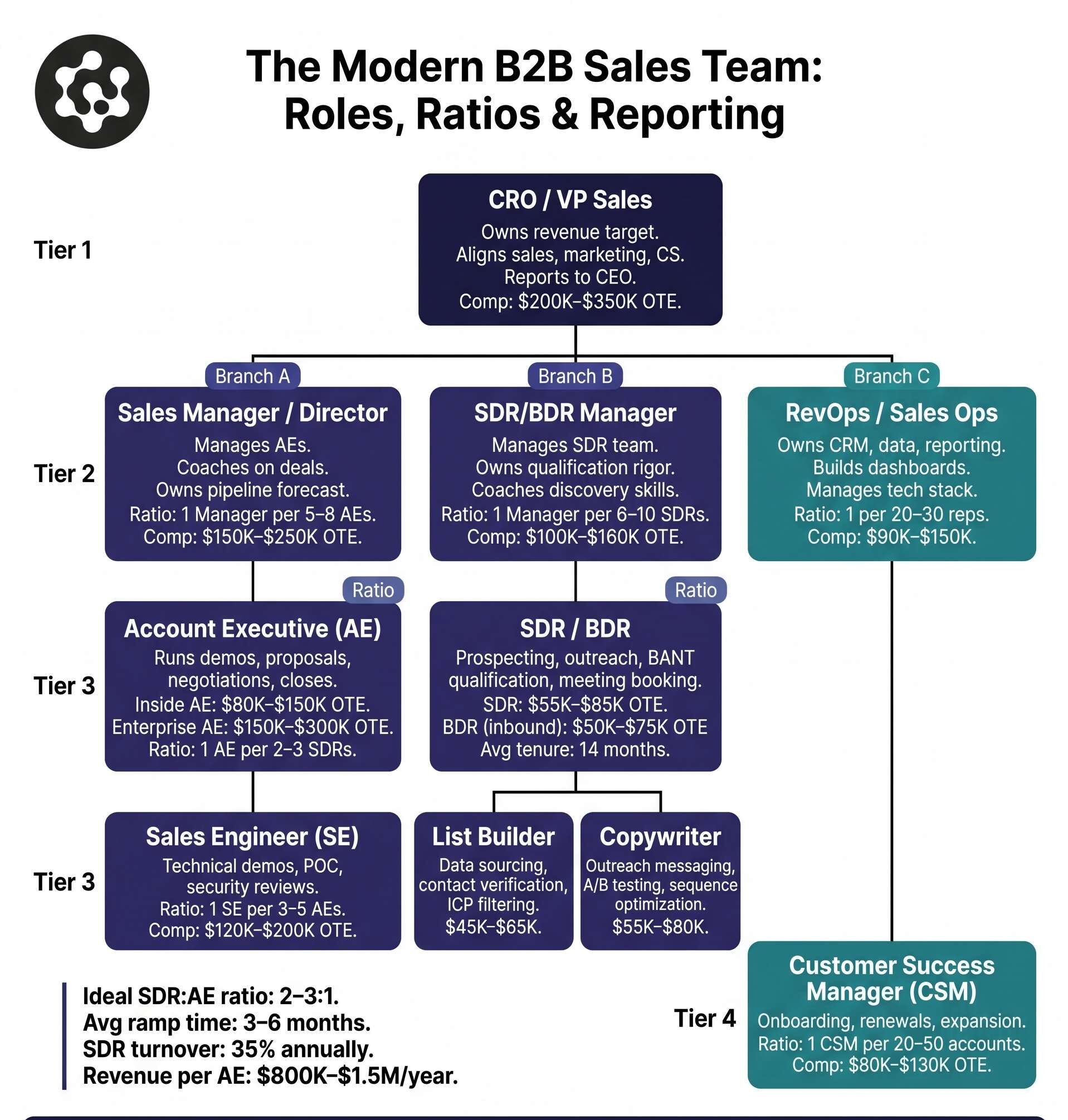
Restructure your SDR team into pods that pair AI research capabilities with human qualification expertise. Each pod consists of 5 SDRs, a dedicated list builder, a copywriter, and a team lead. AI monitors intent signals, builds prioritized account lists, and assists with message personalization. SDRs focus exclusively on human-led qualification conversations and handover documentation.
This model works when you have the management capacity to build and maintain the AI infrastructure, the coaching capacity to develop SDR skills continuously, and the sales process discipline to enforce qualification standards. It requires significant upfront investment but produces a sustainable competitive advantage.
Option 2: Outsourced SDR-as-a-Service
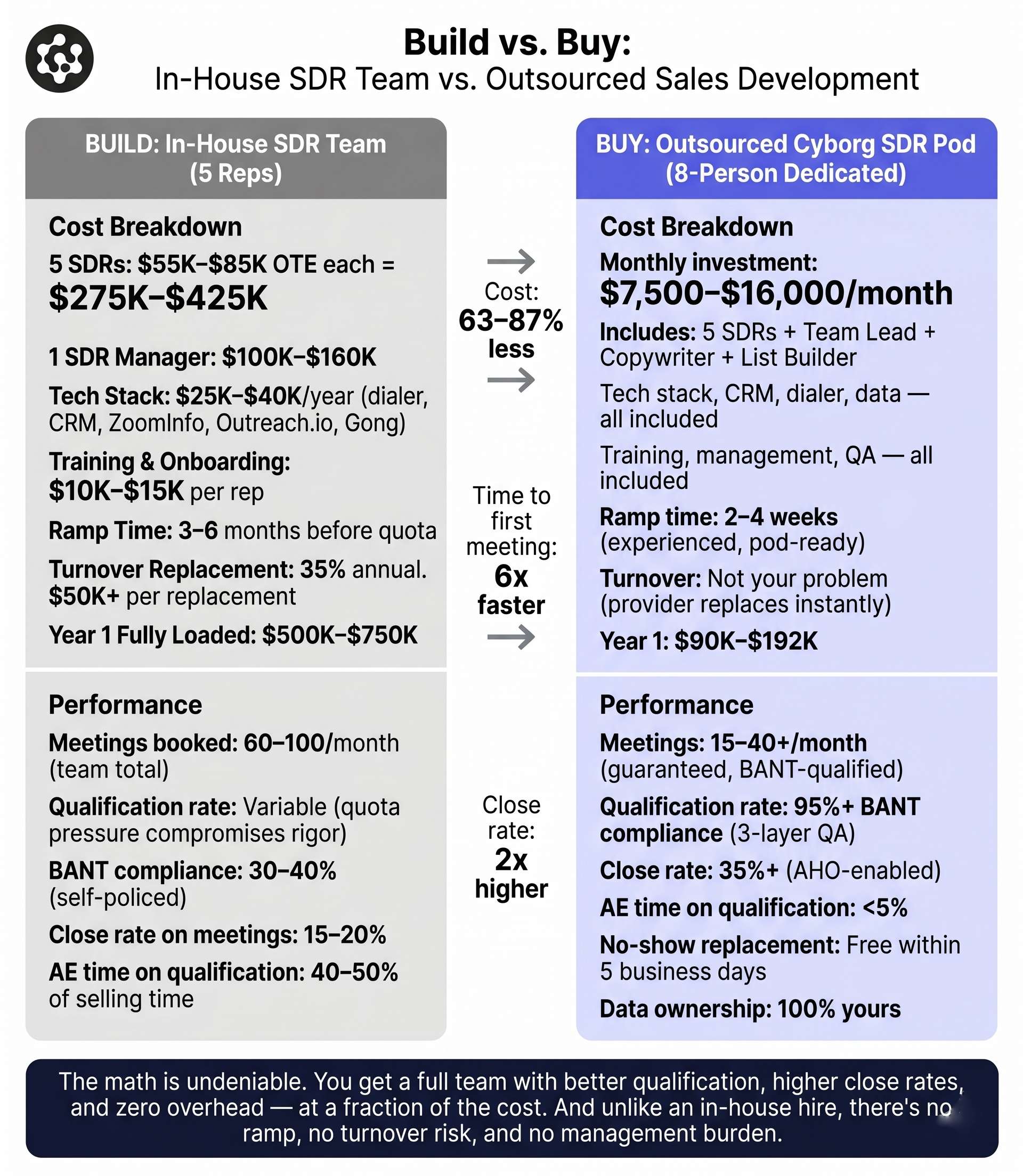
Engage an external partner that provides the pod model as a managed service. DemandNexus’s Cyborg SDR pods deliver this model on a pay-for-performance basis: AI-powered research from six owned media brands identifies in-market accounts, human SDRs conduct BANT-verified qualification calls, and every meeting is delivered with an Appointment Handover Sheet (AHO) that prepares the AE for a productive conversation.
This model works when you need pipeline faster than you can hire, when the cost-per-qualified-meeting from an outsourced partner is lower than your in-house cost, or when you want a performance benchmark against which to measure your internal team. The performance-based pricing (three tiers: Essentials, Growth, Enterprise) means you pay for outcomes, not headcount.
Option 3: RevOps-Embedded SDRs
Move the SDR function out of sales and into Revenue Operations, where it operates as a shared resource across sales, marketing, and CS. SDRs in this model don’t report to a sales manager—they report to a RevOps leader who manages the entire lead lifecycle. This structural change aligns SDR incentives with pipeline quality rather than meeting volume, because RevOps measures revenue outcomes, not activity metrics.
SDR Metrics That Matter (and Those That Don’t)
Measure: SQLs generated. A meeting that passes BANT verification and is accepted by the AE as qualified. This is the only metric that directly connects SDR activity to pipeline value.
Measure: SQL conversion rate. The percentage of SDR-booked meetings that the AE accepts as qualified. Target: 60%+ with structured qualification. Below 40% indicates a qualification rigor problem.
Measure: Cost-per-qualified-meeting. Total SDR function cost (salary + tools + management + overhead) divided by SQLs generated. Compare this to outsourced alternatives to evaluate build-vs-buy decisions.
Measure: Show rate. Percentage of booked meetings where the prospect actually attends. Target: 85%+ with proper expectation-setting and AHO delivery. Below 70% indicates a qualification or confirmation process problem.
Don’t measure: Dials per day. Activity metrics measure effort, not output. An SDR making 200 dials to unqualified accounts produces less value than one making 30 calls to intent-qualified accounts.
Don’t measure: Emails sent. Email volume without engagement and conversion context is noise. 5,000 emails sent that produce 2 qualified meetings is worse than 200 intent-triggered emails that produce 10.
SDR Compensation and Career Path
Effective SDR compensation aligns pay with qualified outcomes:
Base salary: $45K–$65K depending on market and experience level.
Variable: $20K–$40K tied to SQL production (not meetings booked). Structure variable pay so that hitting quota produces OTE, and overperformance includes accelerators that make the role financially competitive with AE junior reps.
Career path: SDR → Senior SDR → AE (most common), SDR → SDR Team Lead → SDR Manager, or SDR → Revenue Operations. Clear career progression reduces turnover. Teams that promote SDRs to AE roles within 12–18 months report 30–40% lower attrition than those without a defined path.
See what outsourced SDR execution with 90%+ show rates looks like.
FAQs
What is a B2B SDR?
A B2B SDR (Sales Development Representative) is a sales professional responsible for outbound prospecting: identifying target accounts, conducting multi-channel outreach, qualifying prospects through structured conversations, and booking meetings for account executives. SDRs operate at the top of the sales funnel and are the primary drivers of new pipeline generation in most B2B organizations.
What’s the difference between an SDR and a BDR?
The terms are often used interchangeably, but the most common distinction is: SDRs handle outbound prospecting (proactively reaching out to target accounts), while BDRs handle inbound lead qualification (engaging prospects who have expressed interest through marketing channels). Some organizations use “BDR” for strategic or enterprise-focused development roles.
What is B2B sales development?
B2B sales development is the function that sits between marketing and sales, responsible for converting target accounts and marketing leads into qualified sales opportunities. It encompasses prospecting, outreach, qualification, and meeting booking—all activities that happen before an AE engages with a prospect.
What does an SDR do all day?
A typical SDR day includes: reviewing intent signals and account research (30 min), executing outreach cadences—emails, calls, LinkedIn (3–4 hours), conducting qualification calls with engaged prospects (1–2 hours), documenting qualification data and updating CRM (30 min–1 hour), and team meetings or coaching sessions (30 min). The ratio of outreach to qualification shifts as the SDR builds pipeline—early-stage SDRs spend 80% on outreach, experienced SDRs spend 50%+ on qualification conversations.
Is the SDR role dying?
The role is not dying but it is evolving. The traditional model of high-volume, low-skill dialing is being replaced by models that combine AI-powered research with human qualification expertise. SDRs who can conduct consultative qualification conversations and produce structured handover documentation are more valuable than ever. SDRs who can only dial phones are being displaced by technology.