


Generic demand generation advice gets you to position 50 on Google and 30 percent SQL conversion rates. Industry-specific demand gen playbooks, built around the actual buying dynamics of each vertical, are what produce 60 percent plus SQL conversion and predictable enterprise pipeline.

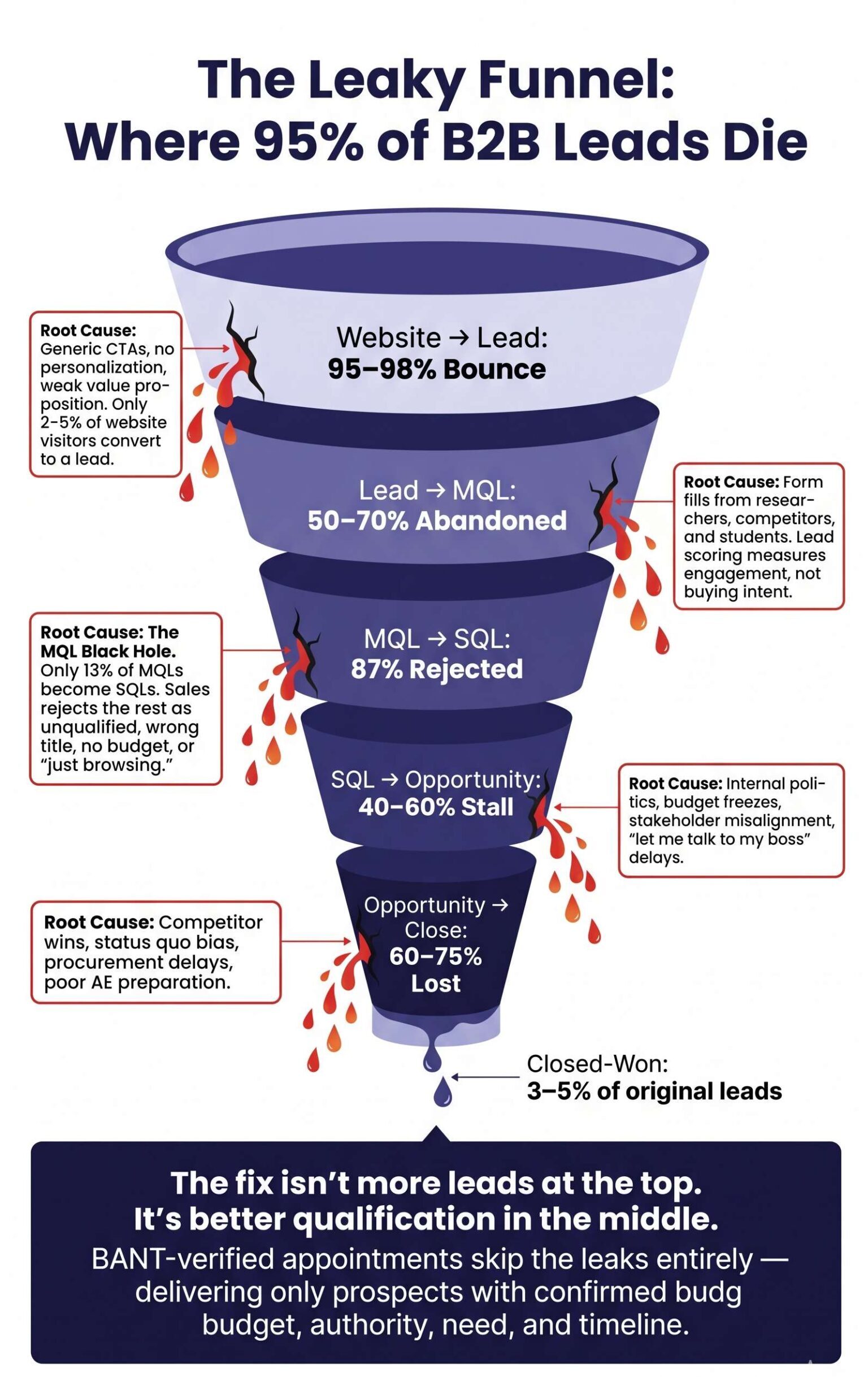
Most B2B teams lose 40–60% of qualified prospects to broken handoffs and weak qualification. Take our 2-minute diagnostic to find out where your pipeline is bleeding — and how to fix it.
Start the Quiz → Takes 2 minutes. No email required to start.SaaS Demand Generation
SaaS demand generation must balance acquisition CAC against multi-year LTV.
The structural advantage: recurring revenue supports longer payback periods.
The structural trap: churn turns pipeline into a leaky bucket.
SaaS ICP Patterns
- Employee count range aligned with pricing tier
- Tech stack signals indicating product compatibility
- Growth signals (recent funding, hiring velocity)
- Current tooling showing awareness of the category
SaaS Channel Mix
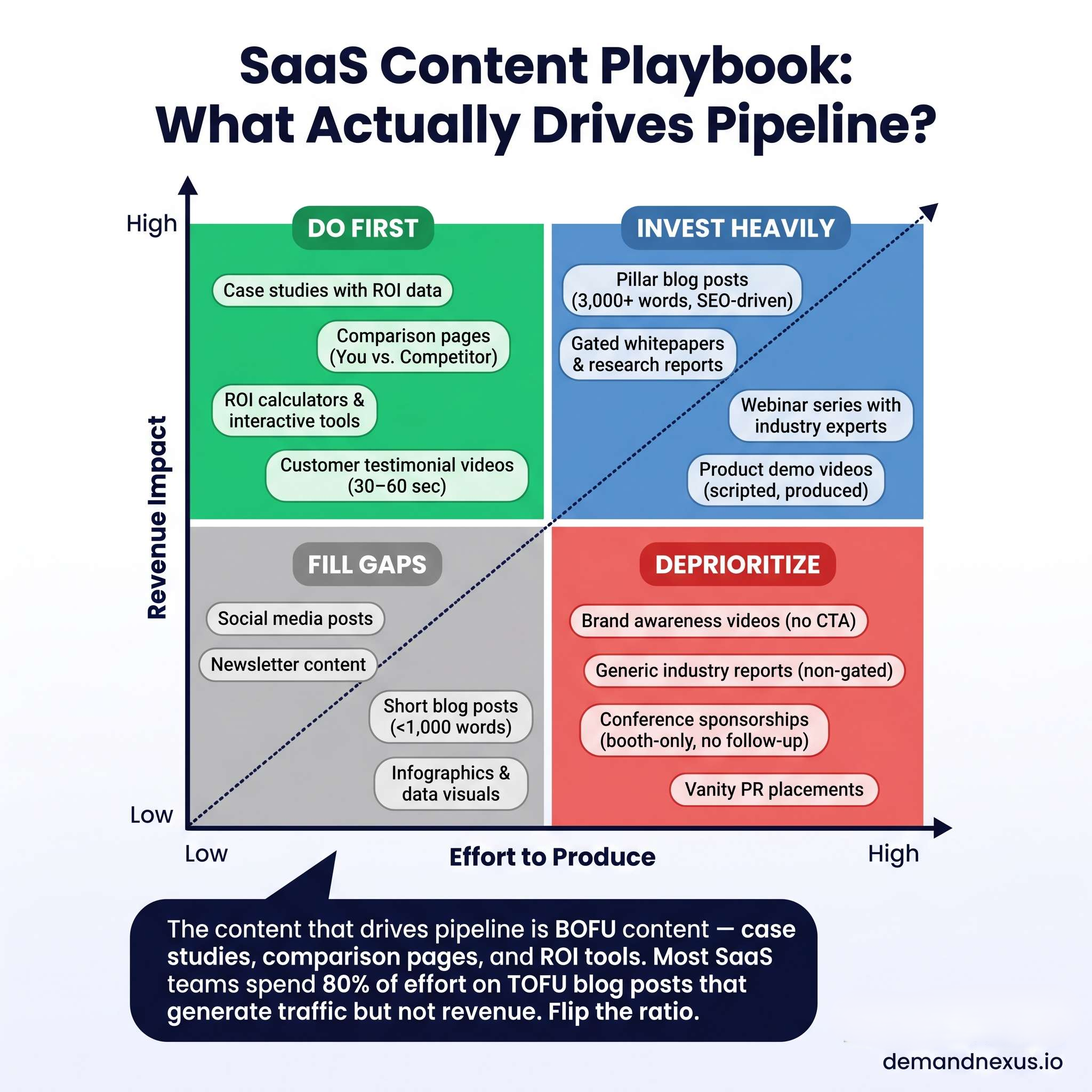
- Content and SEO: highest compounding value, 6 to 12 month payoff
- Product-led acquisition: free trials and freemium where applicable
- Paid search on branded and high-intent category terms
- ABM for enterprise deals above $50K ACV
- Community and ecosystem marketing

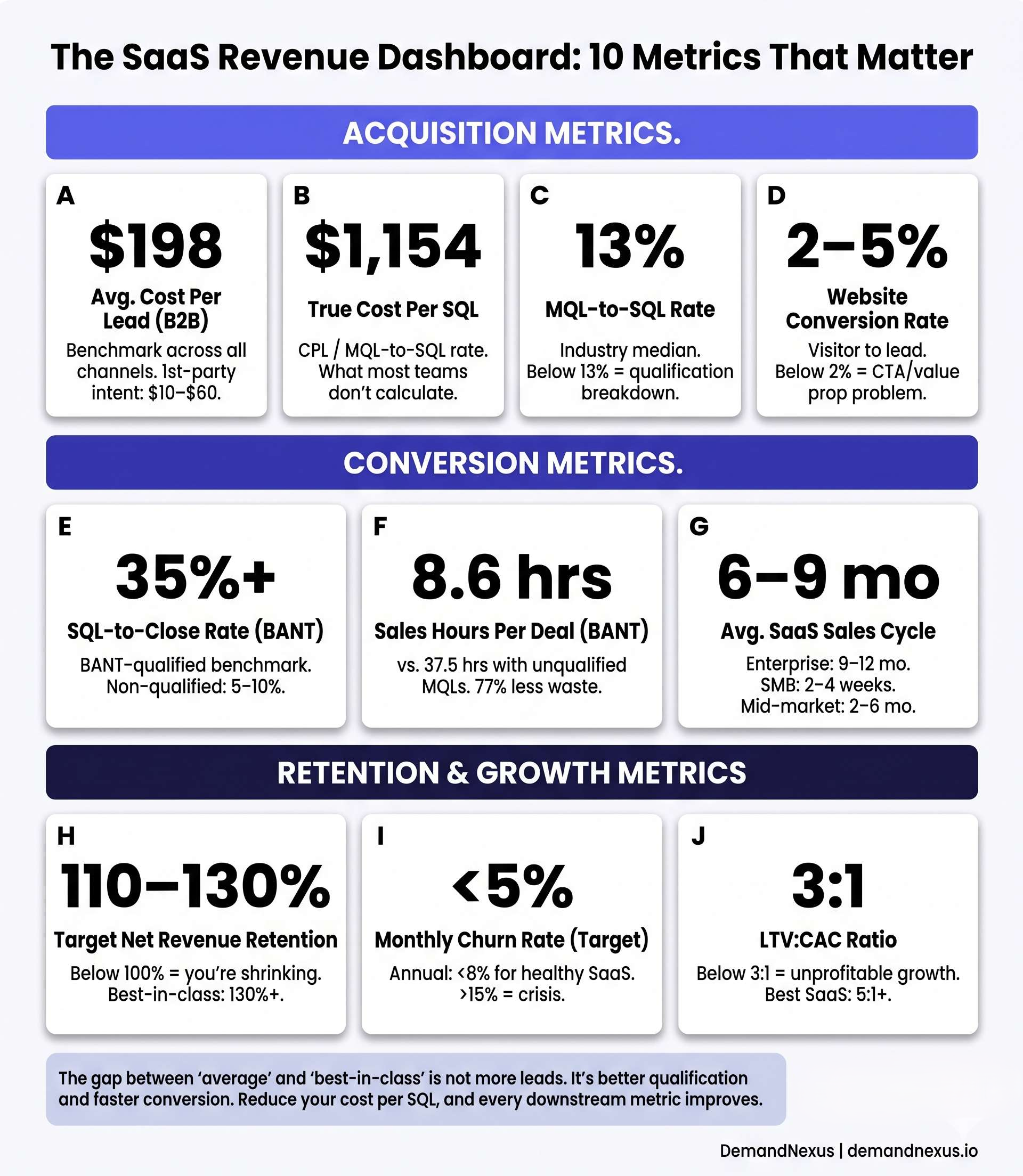
SaaS Benchmarks
CAC payback under 18 months. Net revenue retention 110 percent plus for growth-stage. SQL conversion 20 to 30 percent for healthy mid-market programs. Demo-to-closed-won 10 to 20 percent.
AI and Machine Learning Demand Generation
The AI category is the fastest-growing B2B software segment in 2026, which means the most crowded and the most noisy. Differentiation through clear use-case positioning matters more than ever. Generic AI pitches get ignored; specific-use-case pitches get meetings.
AI Vertical ICP Patterns
- Data maturity signals (data warehouse, MLOps tooling already in place)
- Technical decision-makers involved in buying committee (CTO, VP Engineering, Head of Data)
- Proof-of-concept willingness (typically 30 to 90 day pilots)
- Regulatory context (AI governance increasingly matters)
AI Channel Mix
- Technical content (benchmarks, model comparisons, implementation guides)
- First-party intent on AI-specific media (AITechTrend, specialized publications)
- Practitioner communities (technical forums, open-source ecosystems)
- Podcasts with technical decision-makers
- Events (NeurIPS, AI Summit, enterprise AI conferences)
MarTech Demand Generation
MarTech buyers are marketing professionals, which means they see through generic demand gen tactics immediately. The winning pattern: demonstrate the product in the demand gen execution itself. If your MarTech company runs unimpressive campaigns, your prospects notice.
MarTech ICP Patterns
- Marketing team size and structure (signals budget authority)
- Current MarTech stack (signals integration compatibility)
- Recent VP Marketing or CMO changes (new leaders reshape stacks)
- Marketing ops maturity (signals buying sophistication)
MarTech Channel Mix
- Thought leadership from marketing practitioners
- MarTech-specific media (MarTechTrend, category publications)
- LinkedIn paid targeting marketing titles with creative execution
- Webinars featuring marketer-to-marketer conversations
- Review sites (G2 is particularly influential for MarTech)
FinTech Demand Generation
FinTech sales cycles are long, compliance requirements are heavy, and stakeholders span CFO, CTO, CISO, and Compliance. Demand generation has to educate across all four stakeholders simultaneously.
FinTech ICP Patterns
- Regulatory context (bank, credit union, fintech, insurance)
- AUM or transaction volume (signals pricing tier)
- Risk management sophistication
- Current core system compatibility
FinTech Channel Mix
- Compliance and security content (often the first stakeholder gate)
- Industry media (FinTechFilter, vertical publications)
- Industry events (FinTech Connect, AFP Annual Conference)
- Analyst relations (Gartner, Forrester influence enterprise finance buyers)
- ABM for enterprise financial institutions
HR Technology Demand Generation
HR tech buyers are CHROs, VP People, and HR operations leaders who rarely have deep software evaluation experience. Demand generation has to educate on both the category and the evaluation process itself.
HR Tech ICP Patterns
- Employee count (the primary pricing signal)
- HRIS platform in place
- Recent leadership changes in People function
- Growth mode or transformation signals
HR Tech Channel Mix
- HR practitioner communities and associations (SHRM, HR Brew audiences)
- Industry publications (HRTechTrend, HR Executive)
- Events (HR Technology Conference, UNLEASH)
- Peer review content and customer advocacy programs
- LinkedIn paid targeting HR titles
Legal Technology Demand Generation
LegalTech has the longest B2B sales cycles of any software category, frequently 12 to 18 months, because law firms and in-house legal teams change tools extremely slowly. Demand generation must build category awareness over years, not quarters.
LegalTech ICP Patterns
- Firm size or legal team size
- Practice area (impacts relevant features dramatically)
- Current document management and practice management systems
- Billable hour model vs fixed-fee model
LegalTech Channel Mix
- Specialized legal media (LegalTechTrend, Above the Law, Law360)
- Bar association events and CLE programs
- Practitioner-focused content (legal operations, general counsel)
- ABM for AmLaw 200 firms
- Long-horizon nurture (12 to 24 months)
Developer Tools (DevTools) Demand Generation
Developer tools demand generation is the most anti-traditional category in B2B. Developers reject corporate marketing and respond to authentic technical content, community participation, and bottoms-up adoption. Traditional SDR outbound often backfires.
DevTools ICP Patterns
- Engineering team size
- Programming languages and frameworks in use
- DevOps maturity (CI/CD sophistication)
- Open-source contribution patterns
DevTools Channel Mix
- Technical content (tutorials, benchmarks, code examples)
- Developer communities (GitHub, Stack Overflow, specialized forums)
- Specialized media (DevTechTrend, Hacker News, dev.to)
- Conference sponsorships (KubeCon, re:Invent, QCon)
- Product-led growth with free tiers for individual developers
Healthcare Technology Demand Generation
Demand generation tactics for healthcare tech companies must navigate some of the heaviest compliance requirements in B2B (HIPAA, HITECH, state-level regulations), long procurement cycles, and risk-averse buying committees. Generic SaaS playbooks rarely translate.
Healthcare Tech ICP Patterns
- Organization type (health system, payer, physician practice, digital health)
- EMR platform in place (Epic, Cerner, others each reshape the stack)
- Patient volume or covered lives
- Value-based care vs fee-for-service model
Healthcare Tech Channel Mix
- Clinical and operational content (different content for different stakeholder types)
- Healthcare industry events (HIMSS, ViVE, JP Morgan Healthcare)
- Industry publications (Healthcare IT News, Fierce Healthcare)
- KOL programs with clinical opinion leaders
- ABM targeting specific health systems or payers
Healthcare Tech Demand Generation Tactics
- Case studies with documented clinical outcomes (not just operational metrics)
- Compliance content (HIPAA, SOC 2, HITRUST) as a gate for stakeholder buy-in
- Peer-reviewed research when claims are clinical
- Long nurture cycles aligned to fiscal year budget planning
How DemandNexus Runs Industry-Specific Demand Generation
Our six owned B2B media brands each serve a specific vertical: AITechTrend for AI, MarTechTrend for MarTech, HRTechTrend for HR tech, FinTechFilter for FinTech, LegalTechTrend for legal tech, and DevTechTrend for DevTools. Collectively they reach 15 million decision-makers monthly across the highest-value B2B technology categories.
This is why our first-party intent data is sharper than third-party alternatives in these verticals. When an AI buyer researches on AITechTrend, the signal is first-party and category-specific. When a FinTech buyer researches on FinTechFilter, the signal is first-party and category-specific. Third-party intent networks blend signals across categories; first-party intent stays clean.
For healthcare tech and other verticals outside our owned media portfolio, we combine third-party intent with Cyborg SDR research to deliver the same BANT-verified appointment quality. The framework is identical; the signal sources adapt to the vertical.
FAQs
How does demand generation differ across industries?
Demand generation differs by industry across buying committee composition, sales cycle length, compliance requirements, content expectations, and channel mix. Healthcare tech and FinTech have heavier compliance gates. DevTools reject traditional marketing. LegalTech has the longest cycles. SaaS lives and dies by CAC payback. Generic playbooks miss all of these nuances.
What demand generation strategies work for technology companies?
Healthcare tech demand generation should lead with compliance and security content (HIPAA, SOC 2, HITRUST), include documented clinical or operational outcomes in case studies, sponsor industry events (HIMSS, ViVE), and run long nurture cycles aligned to healthcare fiscal year budgeting. ABM targeting specific health systems typically outperforms broad demand gen for enterprise deals.
What is B2B tech demand gen?
B2B tech demand gen refers to demand generation specifically for B2B technology companies: SaaS, AI, MarTech, FinTech, HR tech, LegalTech, DevTools, healthcare tech, cybersecurity, and adjacent categories. These industries share complex multi-stakeholder buying committees and longer sales cycles than transactional B2B, making rigorous qualification frameworks essential.
Which industries have the best demand generation benchmarks?
Benchmark quality varies widely. SaaS has the most mature metrics because CAC payback and NRR are standardized. AI benchmarks are still forming because the category is young. FinTech and healthcare benchmarks are harder to surface publicly because enterprise deals are confidential. DemandNexus publishes category-specific benchmarks across the six verticals our media brands cover.
Does DemandNexus specialize in specific industries?
DemandNexus specializes in B2B technology verticals with complex buying committees and six-figure-plus ACVs. Our first-party intent data is strongest across AI, MarTech, FinTech, HR tech, LegalTech, and DevTools (the six categories our owned media brands cover). We also run programs in adjacent B2B categories including cybersecurity, enterprise software, data infrastructure, and B2B healthcare technology.