

This buyer’s guide defines the category, compares the top eight platforms, explains what SEPs can and cannot do, and addresses the qualification gap that no SEP alone can fill.

Most B2B teams lose 40–60% of qualified prospects to broken handoffs and weak qualification. Take our 2-minute diagnostic to find out where your pipeline is bleeding — and how to fix it.
Start the Quiz → Takes 2 minutes. No email required to start.What Sales Engagement Software Actually Does
A modern SEP provides four core functions:
- Cadence orchestration: Design and automate multi-step, multi-channel outreach sequences (e.g., email on day 1, LinkedIn on day 3, phone on day 5, email on day 8). Cadences are triggered manually or automatically based on CRM events.
- Activity tracking: Log every touchpoint (emails sent, calls made, LinkedIn messages, opens, clicks, replies) to the CRM automatically. This eliminates manual data entry and ensures complete activity visibility for managers.
- Content management: Store, share, and track email templates, snippets, and attachments so SDRs use approved messaging rather than improvising. Analytics show which templates produce the highest reply rates.
- Performance analytics: Dashboard reporting on cadence completion rates, reply rates, booking rates, and SDR productivity. Identifies which sequences, templates, and channels produce the best outcomes.
Top 8 Sales Engagement Platforms Compared
Outreach ($100–$150/user/mo): Market leader with the deepest feature set. Best for teams with 10+ SDRs who need enterprise-grade cadence management, deal intelligence, and manager analytics. Weakness: steep learning curve and requires a dedicated admin for configuration and optimization.
Salesloft ($75–$125/user/mo): Strong competitor to Outreach with slightly better UX and built-in conversation intelligence (via Drift acquisition). Best for teams that value coaching features alongside engagement. Weakness: fewer third-party integrations than Outreach.
Apollo ($49–$99/user/mo): Contact database + sequencing + dialer in one platform. Best for smaller teams that want prospecting and engagement consolidated without managing multiple tools. Weakness: engagement features are less sophisticated than pure-play SEPs.
Instantly ($30–$80/user/mo): Email-focused with inbox warmup, rotation, and deliverability management. Best for teams running high-volume email-only campaigns. Weakness: no phone or LinkedIn integration—email only.

Groove/Clari ($65–$100/user/mo): Deeply integrated with Salesforce. Best for Salesforce-native organizations that want engagement data seamlessly inside their CRM. Weakness: less useful outside the Salesforce ecosystem.
Lemlist ($59–$99/user/mo): Email personalization with image and video personalization features. Best for teams that want visual personalization in outreach. Weakness: limited beyond email personalization—not a full multi-channel platform.
Reply.io ($60–$90/user/mo): Multi-channel sequences with AI-powered email generation. Best for mid-size teams wanting AI assistance with outreach at a moderate price point. Weakness: AI-generated copy still requires human review for quality.
Mixmax ($34–$69/user/mo): Lightweight engagement tool embedded in Gmail. Best for individuals or small teams who live in Gmail and want scheduling, tracking, and simple sequences without a heavy platform. Weakness: limited reporting and team management features.
Not sure if you need a better platform or better pipeline feeding it?
What SEPs Cannot Do: The Qualification Gap
Sales engagement platforms amplify whatever you point them at. If you point them at a well-researched, intent-qualified target list with personalized messaging, they accelerate your team’s effectiveness. If you point them at a purchased contact list with generic templates, they accelerate your team’s ability to send spam.
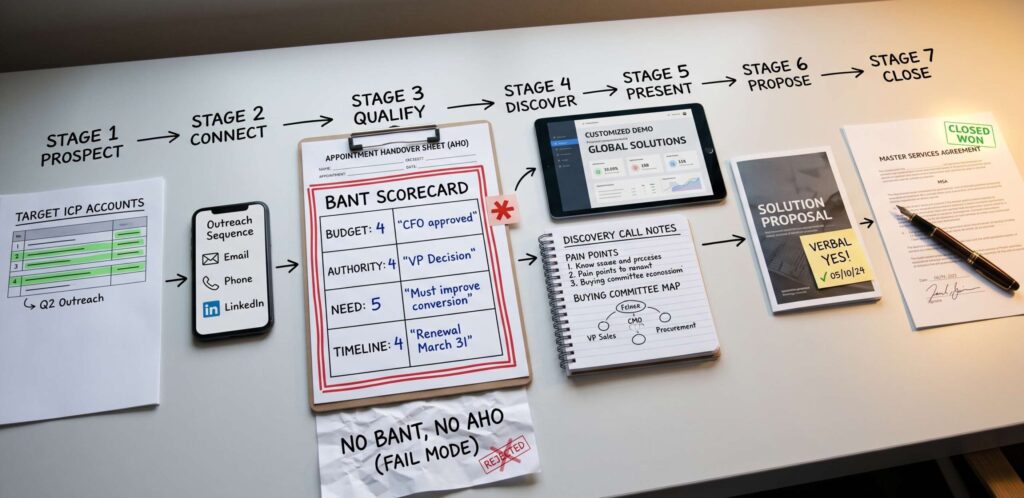
The critical gap that no SEP fills is qualification. SEPs orchestrate outreach and track responses—they do not verify whether a prospect has the Budget, Authority, Need, and Timeline to buy. A prospect who replies “Sure, let’s chat” to an automated email sequence is not a qualified opportunity. They are an interested contact who has not yet been verified against any qualification framework.
This is why the highest-performing sales organizations pair their SEP with a structured qualification methodology and either in-house SDRs trained on that methodology or an outsourced partner that executes it. The SEP handles the outreach. Human judgment handles the qualification. Neither can replace the other.
DemandNexus’s Cyborg SDR pods operate the full sequence: AI-powered intent data identifies which accounts to target, the SEP-equivalent outreach system reaches them across multiple channels, and human SDRs conduct structured BANT qualification calls to verify readiness before any meeting reaches your AE. The output is not just engagement—it is verified, documented, AHO-backed appointments.
How to Choose the Right SEP
Team size: Solo SDRs or small teams (under 5) should consider Apollo or Mixmax for simplicity. Teams of 5–20 should evaluate Salesloft or Reply.io. Teams above 20 should evaluate Outreach for enterprise features.
Channel mix: If your outreach is email-only, Instantly or Lemlist may suffice. If you need email + phone + LinkedIn in one cadence, Outreach or Salesloft are the stronger options.
CRM integration: If your team lives in Salesforce, Groove’s native integration eliminates sync issues. If you use HubSpot, their built-in sequences may be sufficient before adding a third-party SEP.
Budget: SEP costs range from $30/user/mo to $150/user/mo. For a 10-person SDR team, that’s $3,600–$18,000/year. Compare this to the cost of the meetings the team produces—if the SEP doesn’t improve meetings-per-SDR, it’s a cost, not an investment.
AI features: Newer platforms integrate generative AI for email drafting and sequence optimization. Evaluate whether your team will actually use AI features or whether they add complexity without adoption. AI in sales works best when it augments human workflow, not when it replaces human judgment.
Calculate whether a better SEP or outsourced pipeline would move more revenue.
FAQs
What is B2B sales engagement software?
Sales engagement software (SEP) is a platform that orchestrates multi-channel outreach sequences (email, phone, LinkedIn, SMS), tracks prospect interactions, manages email templates and content, and provides analytics on cadence performance. It is the execution layer between your CRM and your SDR team’s daily outreach activity.
What’s the difference between a CRM and a sales engagement platform?
A CRM (Salesforce, HubSpot) is a system of record that stores pipeline data, deal history, and customer information. A sales engagement platform is an execution tool that automates and tracks the outreach activity that creates pipeline. The CRM manages deals; the SEP generates the activity that produces them. They are complementary—most organizations need both.
How much does sales engagement software cost?
Pricing ranges from $30/user/month for lightweight email tools (Mixmax, Instantly) to $150/user/month for enterprise platforms (Outreach). For a 10-person SDR team, annual costs range from $3,600 to $18,000. Enterprise contracts with premium features and support can exceed $50,000/year.
What are the best sales engagement platforms?
For enterprise teams: Outreach (market leader, deepest features). For mid-market teams valuing coaching: Salesloft. For all-in-one prospecting + engagement: Apollo. For email-focused outreach: Instantly. For Salesforce-native teams: Groove/Clari. The best choice depends on team size, channel mix, CRM ecosystem, and budget.
Is Outreach or Salesloft better?
Both are strong enterprise SEPs. Outreach has a deeper feature set, more integrations, and stronger analytics. Salesloft has better UX, built-in conversation intelligence, and is slightly easier to implement. For teams prioritizing breadth and scale: Outreach. For teams prioritizing usability and coaching: Salesloft. Both require admin time to configure and maintain.