


The market for outsourced B2B sales is growing because the economics of building and maintaining an in-house SDR team have become increasingly challenging. Between hiring costs, ramp time, turnover (average SDR tenure is 14–18 months), management overhead, and the technology stack required, the fully loaded cost of a single in-house SDR is approximately $120,000–$150,000 per year. Many companies are finding that outsourced sales partners deliver more qualified meetings at a lower cost-per-appointment—but only if you pick the right partner.

Most B2B teams lose 40–60% of qualified prospects to broken handoffs and weak qualification. Take our 2-minute diagnostic to find out where your pipeline is bleeding — and how to fix it.
Start the Quiz → Takes 2 minutes. No email required to start.This guide provides a decision framework for when outsourcing works, the different outsourcing models available, what to look for in an RFP, and how to avoid the red flags that separate quality providers from call-center operations.
When B2B Sales Outsourcing Works
You Need Pipeline Faster Than You Can Hire
Building an in-house SDR team takes three to six months from job posting to productive output. Recruiting, onboarding, training, and ramp time all add up. If you have a near-term pipeline target—a product launch, a new market entry, or a board mandate to accelerate growth—outsourcing can deliver meetings within 30–60 days while you build the long-term team.
Your In-House Team Can’t Scale Efficiently
Scaling from 2 SDRs to 10 SDRs is not a linear process. It requires new management layers, more tooling, updated compensation plans, and a hiring pipeline that consistently produces quality candidates in a tight labor market. Outsourcing provides elastic capacity: you can scale up for a product launch and scale down when the campaign ends, without the fixed costs of permanent headcount.
You Need to Test a New Market Before Committing
Entering a new vertical, geography, or buyer persona is risky with in-house resources. If the market doesn’t respond, you’ve invested six months of salary and management time in a failed experiment. An outsourced partner can run a 90-day pilot in the new segment, deliver data on response rates and conversion, and help you make an informed build-or-not-build decision.
Your SDR Metrics Are Underperforming
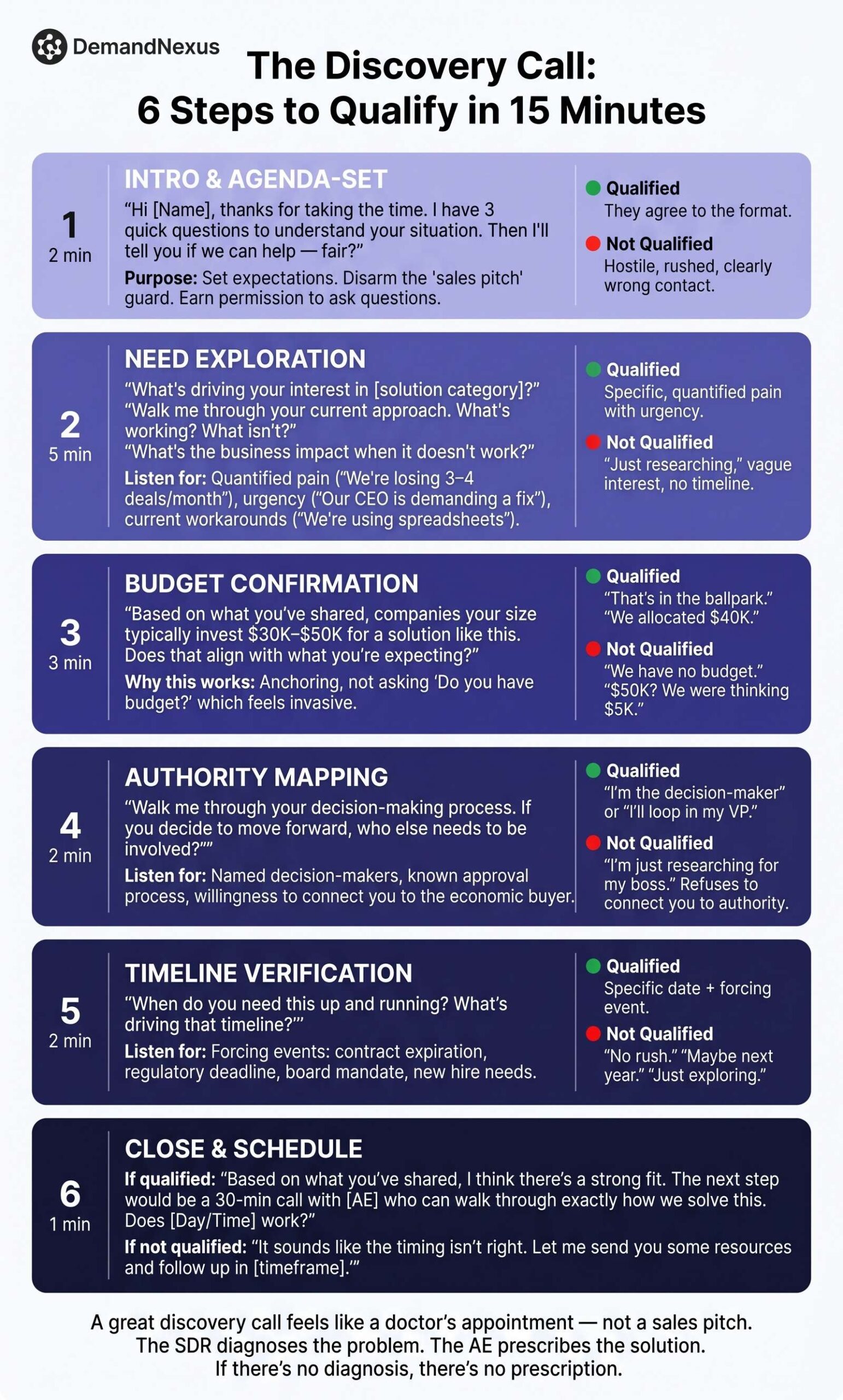
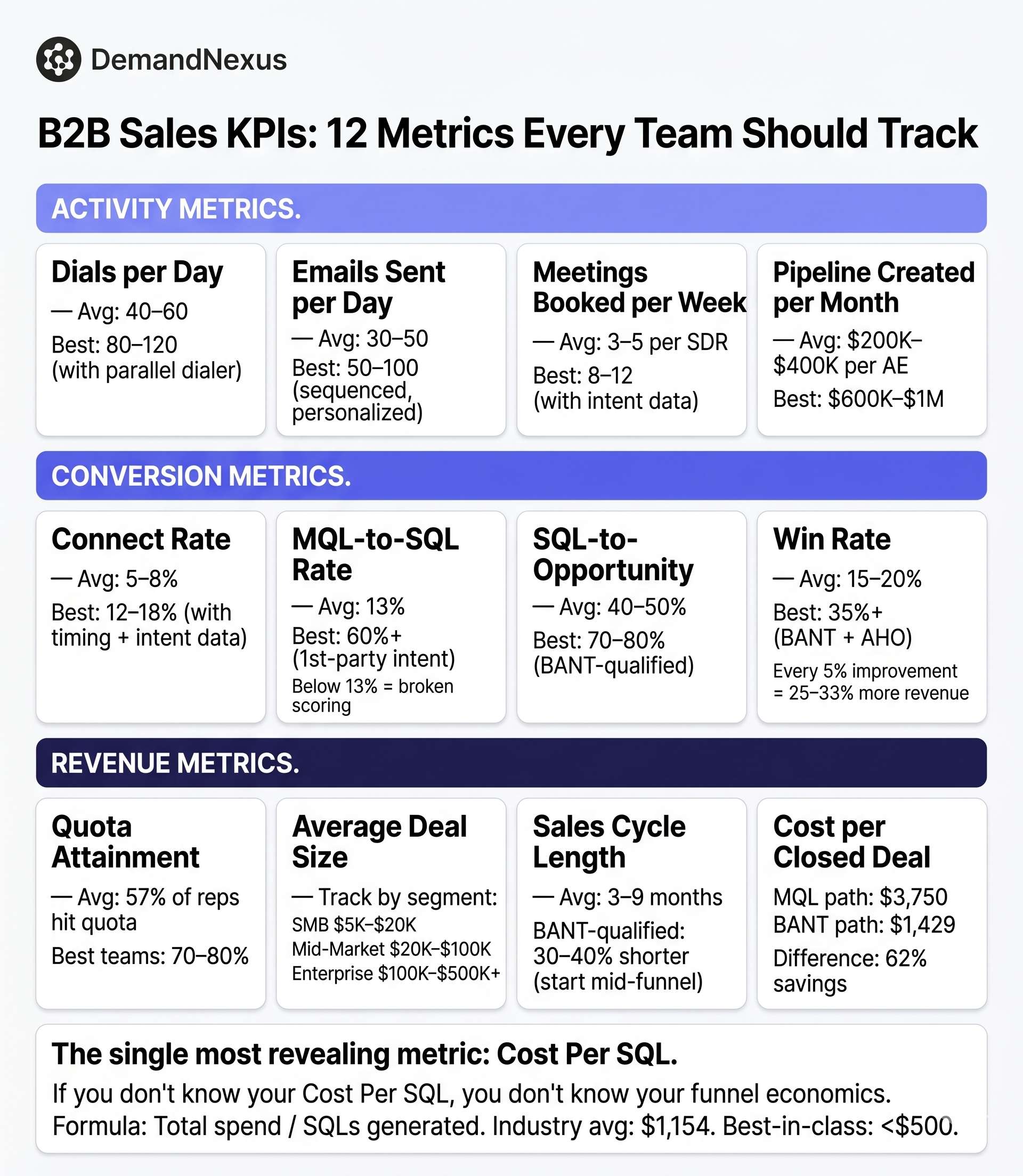
If your current SDR team’s qualification rates, show rates, or SQL conversion rates are below benchmark—and coaching and process improvements haven’t moved the needle—an outsourced partner with a proven methodology can serve as both a performance benchmark and a supplementary pipeline source. Tracking the right sales KPIs makes it possible to compare in-house and outsourced performance objectively.

When B2B Sales Outsourcing Fails
When You Pick Based on Price Alone
The cheapest outsourced sales providers are almost always the worst. Low-cost providers typically operate high-volume call centers with poorly trained agents who follow rigid scripts, generate low-quality meetings, and damage your brand in the process. If a provider is charging $500 per meeting with no qualification framework, the meetings will reflect that price point.
When There’s No Intent Data Behind the Outreach
Outsourced sales teams that work from purchased contact lists and generic email templates produce the same results as your in-house team working the same lists—minus the brand familiarity. The differentiator for high-performing outsourced teams is access to intent data that identifies which accounts are actively researching your solution category. Without intent data, outsourced outreach is just another form of cold prospecting with marginally better scale.
When You Expect Outsourcing to Fix a Product-Market Fit Problem
If your product doesn’t resonate with your target market, no amount of outsourced SDR activity will produce qualified pipeline. Outsourcing amplifies what already works—it doesn’t create demand where none exists. Before outsourcing, make sure you have validated ICP scoring criteria and at least a handful of closed deals that prove the value proposition.
Not sure if outsourcing is the right move for your team? Take the DemandNexus Pipeline Assessment Quiz.
The Three Models of B2B Sales Outsourcing
Model 1: Dialer Farms (Volume-First)
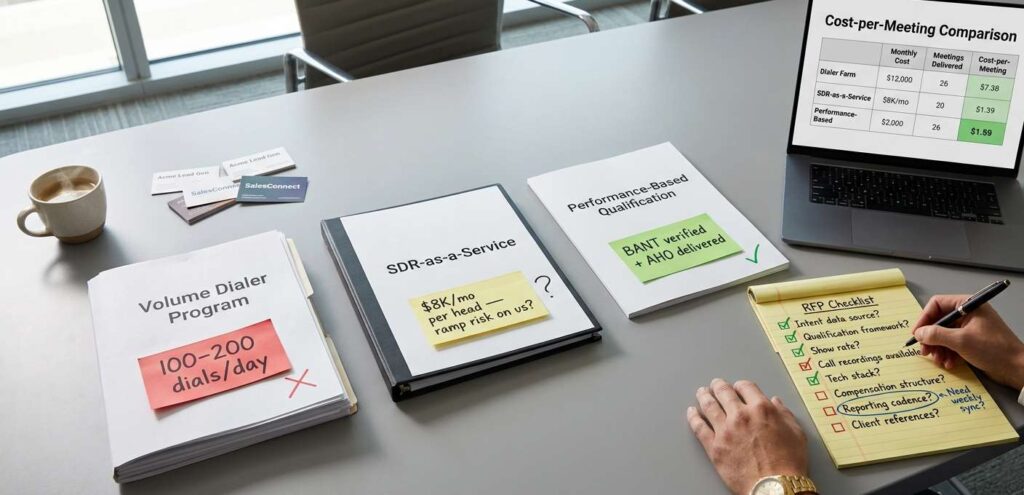
Dialer farms prioritize call volume over conversation quality. Agents follow rigid scripts, typically make 100–200 dials per day, and set meetings based on weak qualification criteria (often just “Did the prospect agree to a meeting?” with no BANT verification). Pricing is usually per-meeting or per-lead at a low price point.
When it works: High-volume, low-ACV products where meeting quantity matters more than meeting quality. When it fails: Enterprise, mid-market, or any sale where the AE’s time is expensive and unqualified meetings waste it.
Model 2: Traditional SDR-as-a-Service (Headcount-Based)
SDR-as-a-service providers assign dedicated SDRs to your account. You pay a monthly retainer per SDR (typically $6,000–$10,000 per month) plus a management fee. The SDRs follow your messaging, use your tools, and report to a team lead at the outsourced firm.
When it works: When you need dedicated capacity and have a strong playbook the SDRs can execute. When it fails: When you’re paying for headcount rather than outcomes—you absorb the risk of ramp time, turnover, and underperformance. If the SDR doesn’t produce, you’re still paying the retainer.
Model 3: Performance-Based Qualification (Outcome-First)
Performance-based providers charge for qualified outcomes—verified appointments, SQL conversions, or pipeline generated—rather than headcount or raw meeting volume. This model shifts the risk from the buyer to the provider: if the meetings don’t happen, you don’t pay.
DemandNexus operates on this model with three pricing tiers (Essentials, Growth, Enterprise) where every appointment is BANT-verified through a human-led qualification call and delivered with an Appointment Handover Sheet (AHO) that arms your AE with budget signals, authority mapping, specific pain points (in the prospect’s own words), timeline and urgency indicators, and a recommended conversation approach. The Cyborg SDR pod model—pairing AI-powered research with human-led qualification—ensures that intent data drives targeting while human judgment drives the conversation.
When it works: When you care about pipeline quality more than pipeline volume, and when your AE’s time is valuable enough that unqualified meetings represent a material cost. When it fails: When your ACV is so low that pay-per-qualified-appointment pricing doesn’t make economic sense relative to high-volume approaches.
What to Ask in an Outsourced Sales RFP
- How do you source target accounts? Are they using bought lists, your existing CRM data, or their own intent data? First-party intent data is the strongest signal; recycled purchased lists are the weakest.
- What is your qualification framework? If they can’t describe a structured qualification methodology (BANT, MEDDIC, or a proprietary equivalent) with specific scoring criteria, their “qualification” is subjective.
- What deliverable does my AE receive? A calendar invite with the prospect’s name is not a deliverable. A structured handover document with BANT verification, verbatim quotes, competitor intel, and a recommended approach is a deliverable.
- What is your show rate? Industry average for outsourced meetings is 60–70%. Providers using intent-driven targeting and expectation-setting with prospects consistently achieve 85–90%+. If they can’t cite their show rate, they don’t track it.
- What is your pricing model? Retainer, per-meeting, per-qualified-appointment, or hybrid? Understand what you’re paying for and where the risk sits. Pay-for-performance models align incentives; retainer models don’t.
- What happens if a meeting is unqualified? Quality providers offer replacements for meetings that don’t meet the agreed qualification criteria. If a provider won’t stand behind their meeting quality, that tells you everything about their confidence in it.
- What is your QA process? Peer call reviews, manager audits, AE feedback loops, and recorded calls are hallmarks of a serious operation. “We trust our reps” is not a QA process.
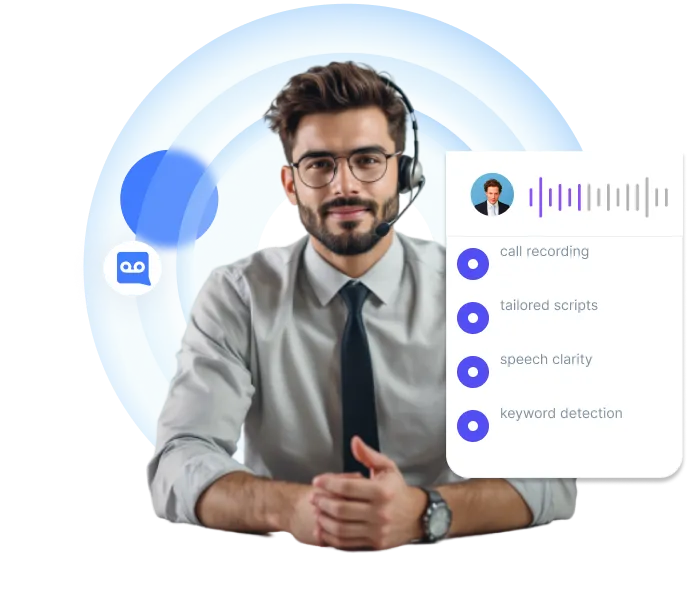
- Can I hear recorded qualification calls? Transparency about the actual conversation quality is the single strongest signal of a legitimate provider. Providers who won’t share call recordings are hiding something.
Ready to compare outsourced pipeline economics with your current cost-per-meeting? Calculate it now.
Ten Red Flags in Outsourced Sales Proposals
Watch for these warning signs when evaluating providers:
- They guarantee specific meeting counts before understanding your ICP.
- They can’t explain their qualification methodology beyond “we book meetings with interested prospects.”
- Their pricing is dramatically lower than market rate (you get what you pay for).
- They require 12-month contracts with no performance exit clause.
- They use the same messaging templates for every client regardless of vertical.
- They measure success by dials-per-day or emails-sent rather than qualified outcomes.
- They have no call recording or QA process you can audit.
- They can’t provide references from companies in your ACV range.
- They position their service as a replacement for strategy, not an execution layer.
- They dismiss the importance of intent data or claim their “diallers” don’t need it.
Outsourced Sales vs. Hiring In-House: The Real Comparison
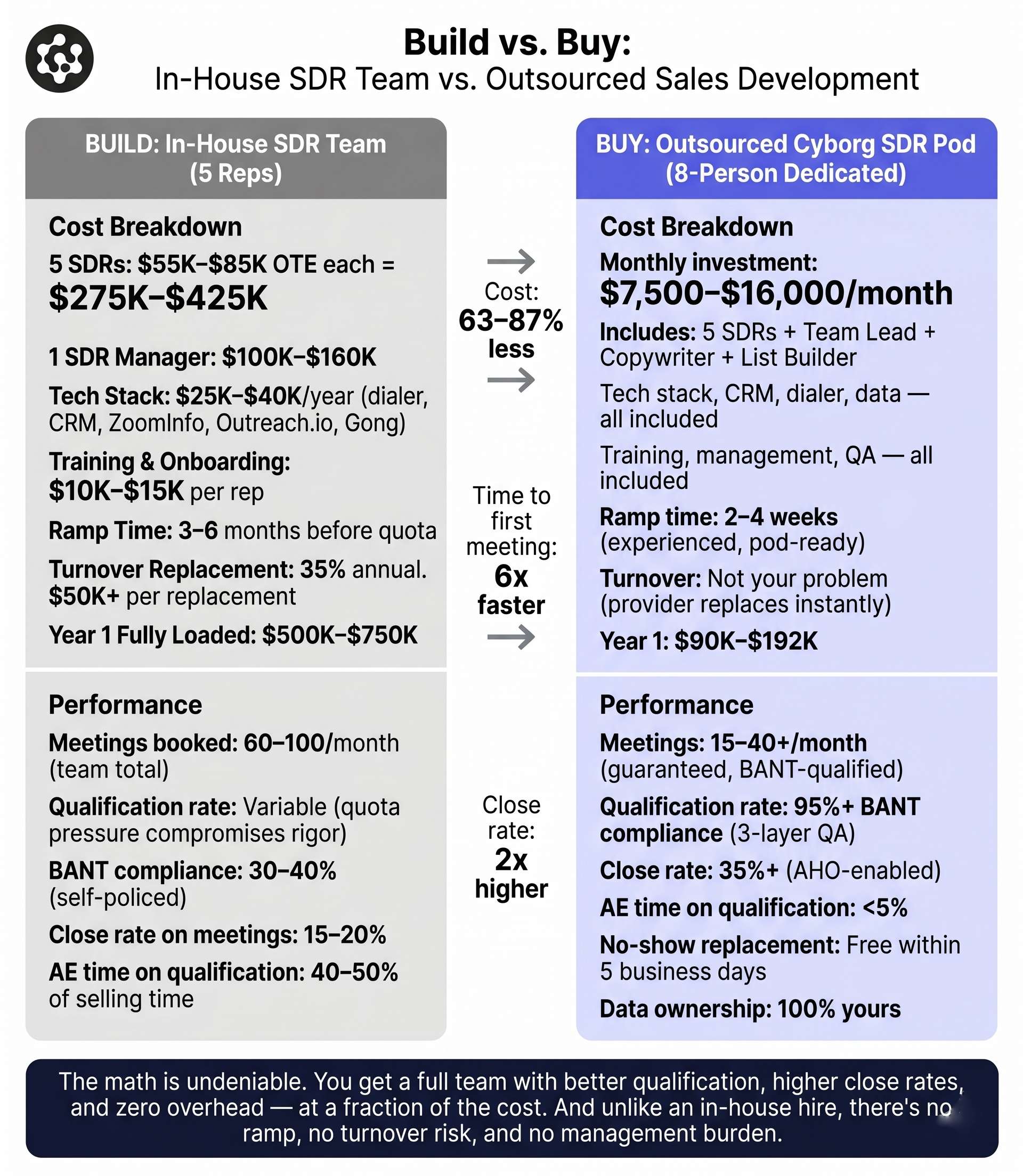
The outsource-vs-hire decision is not binary. Most mature B2B sales organizations use a hybrid model: an in-house sales development team that owns strategic accounts and high-touch engagement, supplemented by an outsourced partner that provides scale, market testing capacity, and a performance benchmark.
The comparison should be cost-per-qualified-meeting, not cost-per-headcount. An in-house SDR at $150K all-in cost who produces 8 qualified meetings per month has a cost-per-meeting of approximately $18,750. An outsourced partner who delivers 25 qualified meetings per month at $1,200 per meeting has a cost-per-meeting of $1,200—with zero ramp time, zero turnover risk, and zero management overhead.
The trade-off is control. In-house SDRs are fully embedded in your culture, use your tools natively, and develop deep product knowledge over time. Outsourced SDRs bring process discipline, intent data, and scalability—but require strong onboarding and ongoing communication to represent your brand accurately.
See what BANT-verified, AHO-backed appointments look like in practice.
FAQs
What is B2B sales outsourcing?
B2B sales outsourcing is the practice of hiring an external partner to handle sales development activities—prospecting, lead qualification, and appointment setting—on behalf of your company. The outsourced team operates as an extension of your sales organization, engaging prospects and delivering qualified meetings to your account executives.
When should you outsource B2B sales?
Outsourcing makes the most sense when you need pipeline faster than you can hire, when scaling in-house is inefficient, when you want to test a new market before committing permanent headcount, or when your current SDR team’s metrics are below benchmark despite coaching investments.
How much does B2B sales outsourcing cost?
Costs vary by model. Retainer-based SDR-as-a-service typically runs $6,000–$10,000 per SDR per month. Performance-based providers charge per qualified appointment, typically ranging from $800–$2,500 depending on target market, ACV, and qualification rigor. Volume-oriented dialer farms may charge $300–$600 per meeting but with significantly lower qualification standards.
What should I look for in a B2B sales outsourcing company?
Evaluate five areas: (1) their lead sourcing approach (intent data vs. purchased lists), (2) their qualification framework (structured BANT scoring vs. subjective judgment), (3) their deliverable to your AE (structured handover document vs. calendar invite), (4) their show rate and SQL conversion metrics, and (5) their pricing model and quality guarantee (replacement policy for unqualified meetings).
Is outsourced sales better than hiring SDRs?
Neither is categorically better—they serve different functions. Outsourced sales provides speed, scale, and a performance benchmark with lower fixed costs. In-house SDRs offer deeper product knowledge, cultural alignment, and strategic account coverage. Most high-performing B2B sales organizations use a hybrid model, combining in-house SDRs for strategic accounts with outsourced partners for scalable, intent-driven pipeline generation.