


This guide cuts through the noise. These are the 12 most relevant tools across five categories, what each actually does, where it fits in a B2B sales stack, and the honest limitations that vendors won’t highlight in their pricing pages.

Most B2B teams lose 40–60% of qualified prospects to broken handoffs and weak qualification. Take our 2-minute diagnostic to find out where your pipeline is bleeding — and how to fix it.
Start the Quiz → Takes 2 minutes. No email required to start.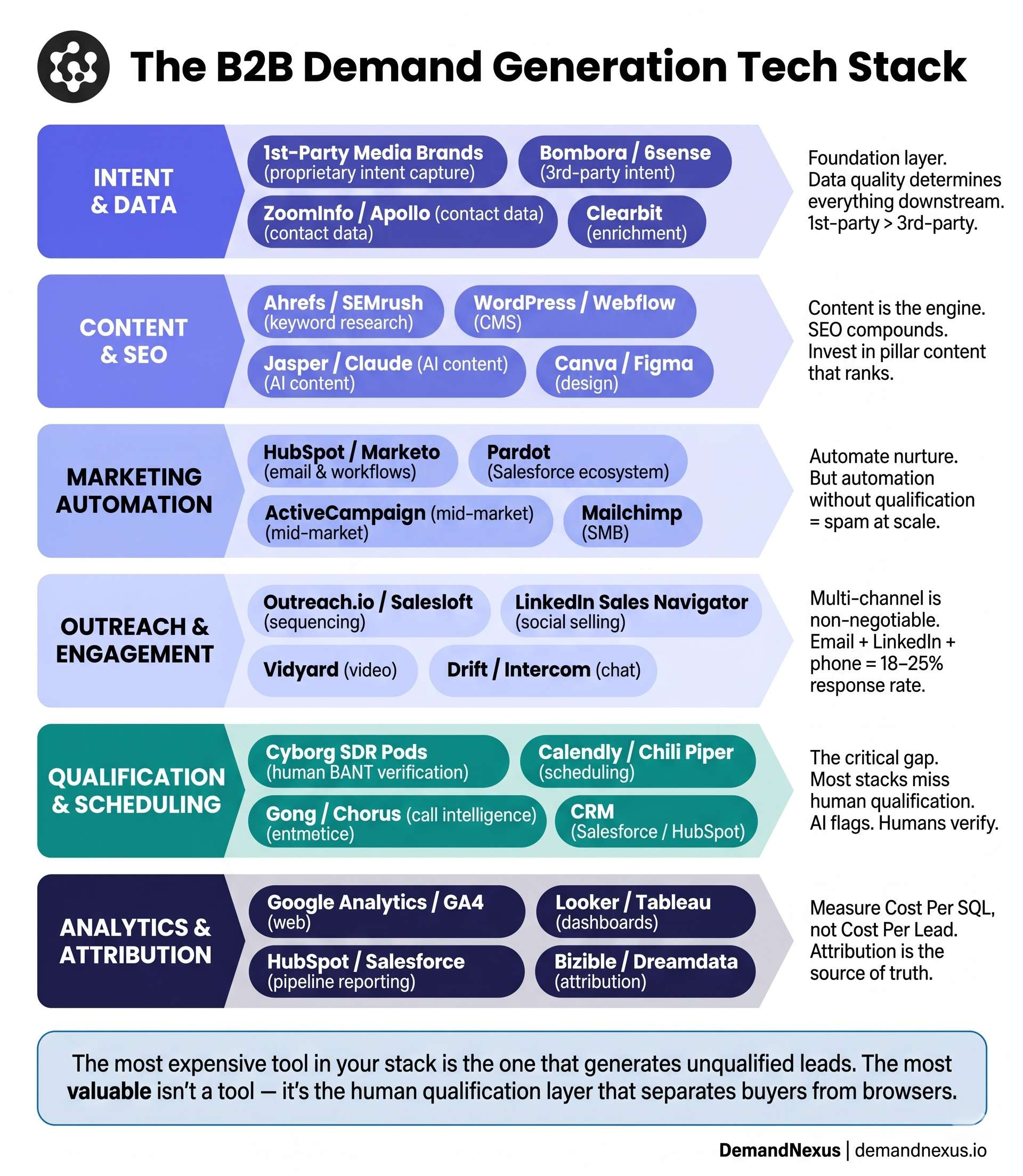
Note: High-KD comparison keywords reward genuinely helpful, unbiased content. This guide prioritises utility over rankings.
Category 1: Prospecting Databases and Contact Intelligence
These tools help you build targeted prospect lists from company and contact databases — the raw material for outbound lead generation.

1. Apollo.io
What it does: Provides access to 275M+ contacts with email, phone, LinkedIn, and firmographic data. Includes built-in email sequencing and basic intent signals.
Best for: High-volume outbound SDR teams that need an all-in-one prospecting and sequencing platform at a competitive price point.

Limitations: Data accuracy varies by segment and geography. Intent signals are relatively basic compared to dedicated intent platforms. Email sequencing is functional but less sophisticated than specialist tools.
Pricing: Free tier available; paid plans from ~$49/user/month.
2. ZoomInfo
What it does: The enterprise-grade B2B contact database — extensive firmographic, technographic, and intent data. Scoops.io (competitive intelligence) included in higher tiers.
Best for: Enterprise sales teams needing deep account intelligence, technographic filtering, and integration with Salesforce/HubSpot.
Limitations: Premium pricing creates access challenges for smaller teams. Intent data accuracy debates persist. Annual contract commitments. Pricing from $10,000+/year.
Pricing: Enterprise pricing only; typically $10,000–$40,000+/year.
3. Lusha
What it does: Browser extension and database for contact enrichment and prospecting, with strong focus on direct dials and verified mobile numbers.
Best for: SDR teams that prioritise phone outreach and need high-quality direct dial numbers alongside email.
Limitations: Database smaller than ZoomInfo or Apollo. Better for targeted list enrichment than large-scale prospecting.
Pricing: Free tier; paid plans from ~$29/user/month.
Category 2: Email Outreach and Sequencing
These tools manage the operational delivery of outbound email sequences — deliverability, personalisation, and tracking.
4. Outreach.io
What it does: Enterprise-grade sales engagement platform covering multi-channel sequences (email, phone, LinkedIn), AI-powered coaching, conversation intelligence, and pipeline forecasting.
Best for: Enterprise B2B sales teams with dedicated operations who need end-to-end sales engagement infrastructure.
Limitations: Significant implementation complexity and cost. Overkill for smaller teams. Requires clean CRM data to function optimally.
Pricing: Custom enterprise pricing; typically $100–$150+/user/month.
5. Salesloft
What it does: Sales engagement platform comparable to Outreach, with strong rhythm/cadence features, Deals pipeline management, and conversation intelligence (Drift acquisition).
Best for: Mid-market to enterprise B2B sales teams prioritising sales cadence management and conversation coaching.
Limitations: Similar complexity and cost to Outreach. Best suited to teams with RevOps support for platform management.
Pricing: Custom; comparable to Outreach.
6. Instantly.ai
What it does: High-volume cold email platform built for deliverability at scale — unlimited email accounts, warmup infrastructure, and basic AI personalisation.
Best for: Outbound teams running high-volume cold email campaigns who need to manage deliverability across multiple sending domains.
Limitations: Limited CRM integration. Primarily email-only — no native phone or LinkedIn sequencing. Best as a specialised tool alongside a broader stack.
Pricing: From ~$37/month.
For cold email sequencing frameworks, see our cold email platform guide and best time to send cold emails research.
Category 3: Intent Data Platforms
Intent data tells you which companies are actively researching solutions in your category — the most valuable signal layer for outbound prioritisation.
7. Bombora
What it does: The market leader in B2B intent data — aggregates behavioural signals from a network of 5,000+ B2B publisher sites to identify companies researching specific topics.
Best for: ABM-focused revenue teams that need account-level intent signals to prioritise outbound targeting and personalise messaging.
Limitations: Third-party aggregated data — accuracy depends on the publisher network, and signals are modelled rather than direct. Integration with CRM/MAP required for full value.
Pricing: Enterprise pricing; typically part of ZoomInfo or Demandbase bundles.
8. 6sense
What it does: AI-powered revenue platform that combines intent data, predictive scoring, and account-level advertising to identify in-market buyers before they self-identify.
Best for: Enterprise B2B companies running coordinated ABM programs across marketing and sales — intent signals feed both ad targeting and SDR prioritisation.
Limitations: High cost and complexity. Requires substantial data infrastructure and team capacity to operationalise effectively.
Pricing: Enterprise; typically $60,000+/year.
The First-Party Intent Data Alternative: The fundamental limitation of third-party intent platforms (Bombora, 6sense, G2 Intent) is that intent signals are modelled from aggregated third-party data — not direct engagement. First-party intent data, generated by owned media properties serving your target audience, provides a fundamentally different signal quality.
DemandNexus generates first-party intent from six owned niche B2B media brands (AITechTrend, MarTechTrend, FinTechFilter, HRTechTrend, DevTechTrend, LegalTechTrend) reaching 15M+ active decision-makers. When a VP of HR reads HR tech buyer content, that is direct engagement — not a modelled score. This proprietary intent layer feeds the DemandNexus Waterfall qualification process and is the core differentiator that third-party platforms cannot replicate. See intent-based marketing for a full comparison.
Category 4: LinkedIn Outreach Tools
9. LinkedIn Sales Navigator
What it does: LinkedIn’s premium sales tool — advanced search and filtering (seniority, function, company growth, job changes), saved lead and account lists, and InMail credits.
Best for: Any B2B sales team doing LinkedIn-based outreach. Essential for SDRs targeting senior decision-makers at enterprise accounts.
Limitations: InMail limits, connection request quotas, and LinkedIn’s anti-automation policies restrict high-volume outreach. Works best as a supplemental channel alongside email and phone. See our dedicated post on LinkedIn lead generation.
Pricing: ~$99/user/month (Core); $179+/user/month (Advanced).
10. Dripify / Expandi (LinkedIn Automation)
What it does: LinkedIn automation tools that manage connection campaigns, message sequences, and profile visits at scale — within LinkedIn’s usage limits.
Best for: SDRs who need to run structured LinkedIn outreach campaigns without manual execution of each touchpoint.
Limitations: Risk of LinkedIn account restrictions if usage patterns trigger detection. Always operate within platform limits. Not a replacement for genuine personalisation.
Pricing: $39–$99/user/month.
Category 5: CRM and Pipeline Management
11. Salesforce Sales Cloud
What it does: The enterprise CRM standard — lead management, opportunity tracking, pipeline forecasting, and an extensive integration ecosystem.
Best for: Enterprise sales organisations that need customisation, complex approval workflows, and deep analytics.
Limitations: High cost, implementation complexity, and ongoing admin burden. Requires dedicated RevOps/admin to operate effectively.
Pricing: $25–$300+/user/month.
12. HubSpot CRM + Sales Hub
What it does: Integrated CRM and sales engagement platform — contact management, email sequences, meeting scheduling, and pipeline tracking. Free CRM with paid Sales Hub tiers.
Best for: Mid-market B2B teams that want an integrated marketing + sales platform without Salesforce complexity.
Limitations: Enterprise customisation limitations. Large databases can become expensive. Best for companies under ~500 employees.
Pricing: Free CRM; Sales Hub from $45/user/month.
See our B2B sales tools guide and prospecting tools comparison for more detailed platform breakdowns.
The Tool Stack vs. The Execution Gap
Here is the uncomfortable truth about sales lead generation software: tools do not generate pipeline. Execution does.
Most B2B companies that struggle with pipeline generation do not have a tooling problem. They have an execution problem — specifically, the gap between generating leads and converting them into qualified sales conversations. Tools provide data and automation; they cannot substitute for a skilled qualification process.
The most sophisticated tech stack in the world still produces MQLs that require human qualification before they become pipeline. The question is: who qualifies them, using what methodology, and at what cost?
This is where companies evaluate the build vs. buy decision for SDR capacity. Building an in-house SDR team with a full tech stack costs $75,000–$120,000+ per rep per year plus tooling. A pay-for-performance appointment generation model like DemandNexus delivers BANT-verified, calendar-booked meetings without the fixed infrastructure cost — at $300–$500 per qualified appointment.
See B2B sales enablement service and sales development services for how an outsourced appointment generation model complements your existing tooling.
FAQs
What is the best software for B2B sales lead generation?
There is no single “best” tool — the right stack depends on team size, deal size, and go-to-market model. Most B2B sales teams need: a contact database (Apollo, ZoomInfo), an outreach platform (Outreach, Salesloft, Instantly), and a CRM (HubSpot, Salesforce). Intent data (Bombora, 6sense) adds a quality layer. For teams that want to skip the tool-and-team build entirely, appointment generation services deliver pipeline without the infrastructure overhead.
Is LinkedIn Sales Navigator worth it for B2B lead generation?
Yes — for most B2B teams targeting senior decision-makers, LinkedIn Sales Navigator is one of the most cost-effective tools in the stack at ~$99/user/month. Its value comes from search precision and account monitoring, not automation.
What is the difference between a CRM and a lead generation tool?
A CRM (Salesforce, HubSpot) manages existing pipeline — contacts, deals, activities, and forecasting. Lead generation tools (Apollo, ZoomInfo, Bombora) identify and engage new prospects who are not yet in your CRM. Both categories are necessary; they serve different parts of the pipeline generation process.