
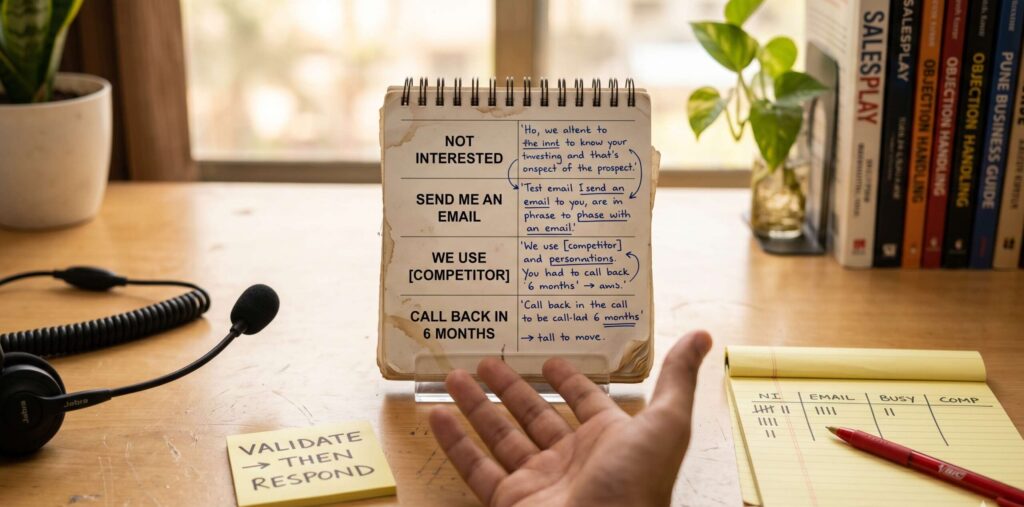


This guide covers the 20 most common cold calling objections you will hear, with the exact language to handle each one. Group them by type (disinterest, timing, budget, competitor, authority, gatekeeper) and drill the responses until they are automatic.

Most B2B teams lose 40–60% of qualified prospects to broken handoffs and weak qualification. Take our 2-minute diagnostic to find out where your pipeline is bleeding — and how to fix it.
Start the Quiz → Takes 2 minutes. No email required to start.The Universal Rule of Objection Handling
Every objection gets validated before it gets answered. One sentence of acknowledgment, then the response. Skip this and your rebuttal lands on defensive ears. “That makes sense.” “I hear that a lot.” “Totally fair.” These three phrases handle 80 percent of acknowledgments.
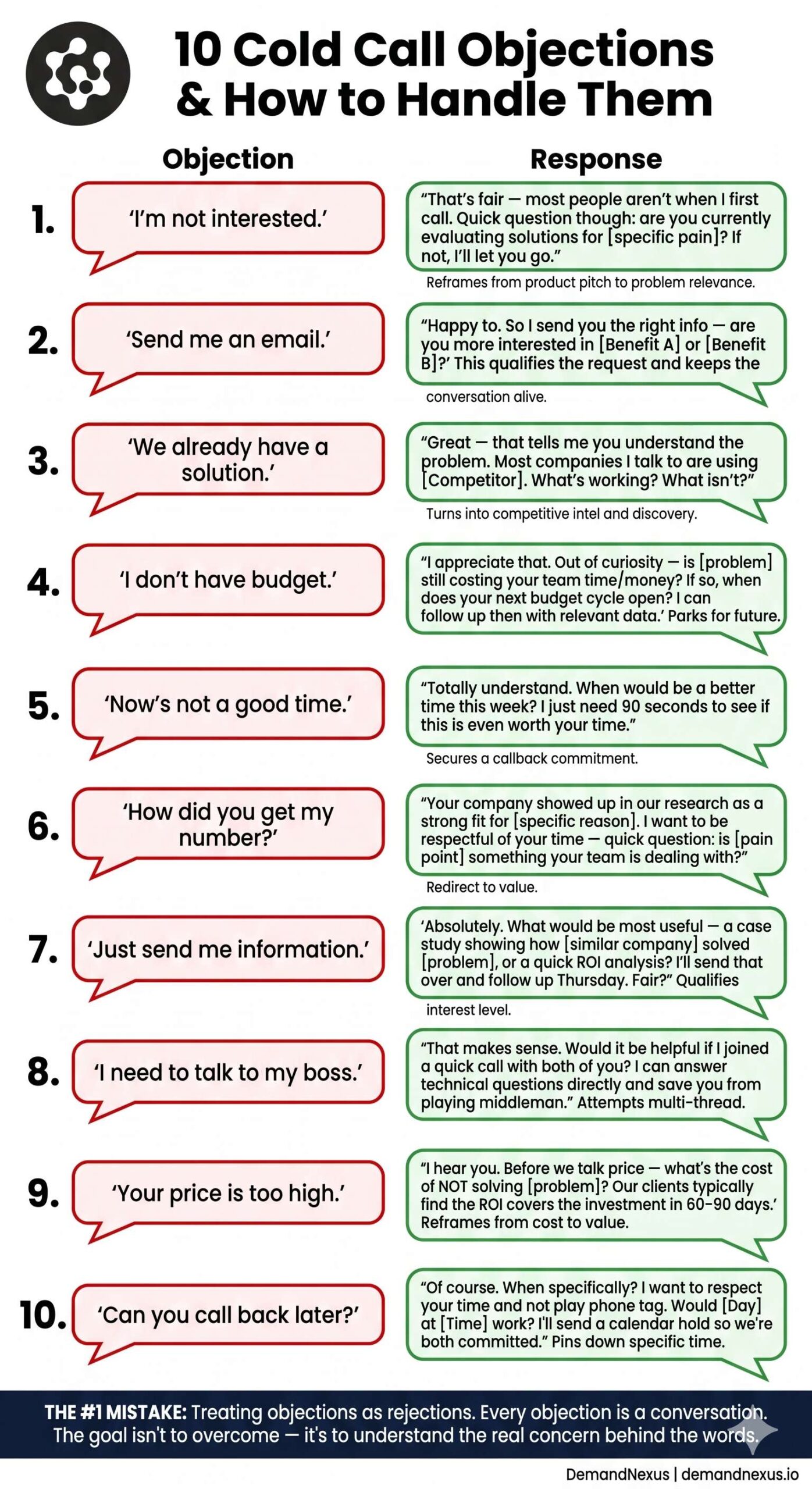

Disinterest Objections (5 Responses)
Objection 1: “I’m not interested.”
Response: “Totally fair. You have no reason to be, I just called out of nowhere. The reason I am calling is not to pitch. It is to find out whether [specific problem] is something you are dealing with. If it is not, I will leave you alone. If it is, it might be worth 15 minutes. Which is it?”
Objection 2: “Take me off your list.”
Response: “Absolutely, I will do that right now. Before I go, can I ask, is this a never-call situation or a wrong-time one? Just so I know whether to remove you entirely or check back in 6 months.”

Objection 3: “How did you get my number?”
Response: “Fair question. Your direct number is listed on [data provider / company directory]. If you would prefer to be removed I will do it right now. Or, since I have you, would you mind if I asked one quick question about [area]?”
Objection 4: “I don’t take cold calls.”
Response: “I respect that, and I will make it quick. I am not trying to sell you anything today. I am trying to find out if a problem I solve is something you are dealing with. One question: are you currently [specific situation]? If no, I am off your phone.”
Objection 5: “Stop calling me.”
Response: “Understood. You are on my internal do-not-call list as of right now. Have a good day.”
When someone is this clear, honor it immediately. Trying to recover this call damages your reputation and breaks compliance rules.
Timing Objections (4 Responses)
Objection 6: “Call me back in six months.”
Response: “I will absolutely do that. Before I put the reminder in my calendar, can I ask what would need to be true in six months for this to be worth your time? That way I come back with something relevant instead of another generic call.”
Objection 7: “I am busy right now.”
Response: “Understood, I will be quick. Two sentences and a yes/no question. We help [similar companies] [specific outcome]. Is that a problem worth 15 minutes of your time next week?”
Objection 8: “I am in a meeting.”
Response: “Sorry to interrupt. What would be a better time to try you again? I can call back in an hour or tomorrow morning, your choice.”
Objection 9: “Not a priority right now.”
Response: “Makes sense, most people have five things above this on their list. If [specific problem] was costing you [specific impact], would that move it up? If yes, I would love 15 minutes to show you what the gap looks like for your company.”
Budget Objections (3 Responses)
Objection 10: “We don’t have budget.”
Response: “I hear that a lot, and I am not calling to sell you anything today. Budgets are usually set around [quarter]. What I am trying to figure out is whether there is a problem worth budgeting for. Can I ask one question about [area] to find out?”
Objection 11: “We are in a spending freeze.”
Response: “Understood. When does the freeze lift? And in the meantime, are there projects that will get greenlit the day it does? I would rather be on your radar for that conversation than pitch you now.”
Objection 12: “You are too expensive.”
Response: “I have not mentioned price, so you must be comparing to someone. Who are you comparing us to? That will help me figure out if we are actually too expensive or just positioned differently.”
Competitor Objections (2 Responses)
Objection 13: “We already use [competitor].”
Response: “Makes sense, they are a solid choice. Most of our current clients came from [competitor] actually. Usually it was one of three reasons. Would it be helpful if I told you what those reasons were, so you can decide whether any of them apply to you?”
Objection 14: “We are happy with our current vendor.”
Response: “That is good to hear, seriously. The question I would ask is: if a better option came along, would you even evaluate it, or are you locked in? Because I am only looking to get on your radar for the next time you evaluate.”
Authority Objections (2 Responses)
Objection 15: “I am not the right person.”
Response: “Totally fair. Who owns [specific area] in your organization? And would you feel comfortable making an introduction, or should I reach out directly and mention you said to call?”
Objection 16: “I need to talk to my team.”
Response: “That makes sense. What I usually do in this case is send you a one-page summary you can share with the team. What is the best email for that? And if it is worth exploring after the team reviews, can we set a 15-minute follow-up for next week?”
Deflection Objections (2 Responses)
Objection 17: “Just send me an email.”
Response: “Happy to. Quick question so I send you something relevant: is your priority right now [option A] or [option B]? That way I send you something useful instead of a generic deck.”
Objection 18: “Send me a proposal.”
Response: “I will, but proposals built without 10 minutes of conversation usually miss the mark. Can I ask you three quick questions first? Takes five minutes, then my proposal is actually relevant.”
Gatekeeper Responses (2 Approaches)
Approach 19: The Honest Request
Response: “Hi, I am [Your Name] from [Company]. I need your help. I am trying to reach [Target’s Name] about [specific topic]. Is she expecting my call? No? Then you are doing your job. Can I ask her assistant to book 10 minutes, or would it be easier for me to email her directly?”
Approach 20: The Peer Approach
Response: “Hi, this is [Your Name]. I am trying to reach [Target]. Is he in?” Spoken with the confidence of a peer, not a supplicant. Tone matters as much as words here.
How to Practice Objection Handling
- Rehearse each response out loud 20 times.
- Have a colleague throw objections at you rapid-fire. Goal: respond in under 5 seconds.
- Record yourself and listen for filler words and defensive tone.
- In real calls, notice which objections trip you up and drill those specifically.
- Update your responses quarterly as new objection patterns emerge.
When to Give Up Gracefully
Not every call is winnable. If a prospect says the same no three times in slightly different ways, or if they are genuinely hostile, respect it. “Sounds like this is not the right fit right now. Appreciate the time, have a good one.” A graceful exit protects your mental state and sometimes earns a call-back later when their situation changes.
FAQs
What is the most common cold calling objection?
"I am not interested" or "send me an email" are the two most common. Drill these two first.
How many objections should I try to overcome per call?
Two, maximum three. After that you are bulldozing and will damage the relationship even if you book the meeting.
Is it rude to push back on objections?
Not if you validate first and push back with curiosity, not combat. "I hear that a lot. Can I ask one question?" is not rude. "Well actually..." is.