


It’s because they’re spending half their day chasing leads that were never going to buy contacts who clicked an ad, downloaded a whitepaper, or filled out a form with zero buying intent. The traditional model calls these “leads.” Your AEs call them a waste of time.

Most B2B teams lose 40–60% of qualified prospects to broken handoffs and weak qualification. Take our 2-minute diagnostic to find out where your pipeline is bleeding — and how to fix it.
Start the Quiz → Takes 2 minutes. No email required to start.Pay per appointment lead generation solves this problem at the root. Instead of paying for contact submissions and hoping a fraction convert, you pay only for scheduled, BANT-verified meetings with real decision-makers who have confirmed budget, authority, a specific need, and a purchase timeline.
This guide explains exactly how the pay per appointment model works, what it costs, what separates a real PPA vendor from a glorified booking service, and why Demand Nexus’s Waterfall system delivers the highest-quality B2B appointments in the market.

| 95%+
Appointment-to-SQL conversion with BANT |
35%+ AE close rate on Demand Nexus meetings |
120-180%
Annual ROI vs. traditional lead gen |
<5 hrs
AE qualification time per month |

1. What Is Pay Per Appointment Lead Generation?
Pay per appointment lead generation is a B2B revenue model in which you pay a fixed fee for each qualified sales meeting delivered not for leads, not for clicks, not for impressions, and not for retainer hours spent on activity that may or may not produce results.
The payment trigger is the meeting itself: BANT-verified, confirmed on your AE’s calendar, and attended by a genuine decision-maker.
This stands in direct contrast to the Pay-Per-Lead (PPL) model that has dominated B2B marketing budgets for two decades a model that charges you for contact form submissions, content downloads, and demographic matches with no verification of buying intent whatsoever.
Pay Per Lead vs. Pay Per Appointment: The Fundamental Difference
| Factor | Pay-Per-Lead (PPL) | Pay Per Appointment (PPA) |
| Payment trigger | Contact form submission / MQL | BANT-verified meeting held on calendar |
| What you get | Unverified list of demographic matches | Scheduled, confirmed appointment with decision-maker |
| Risk borne by | You (wasted budget regardless of quality) | Vendor (no-show = replacement, free) |
| Lead quality | Low-intent, activity-based, generic | High-intent, pre-qualified, engaged |
| AE time required | 50% qualifying and chasing | 100% closing, zero re-qualification |
| Guaranteed outcome | Lead volume (quality unknown) | 15+ qualified meetings/month (SLA-backed) |
| No-show protection | You already paid; you get nothing | Automatic replacement within 5 business days |
| Transparency | Black box, you don’t know why leads failed | Full CRM visibility: funnel stage, BANT status, notes |
The economic reality is stark. Traditional PPL might deliver 200 leads per month at $300 each for a $60,000 investment converting at ~5%, yielding 10 opportunities at $6,000 per opportunity, with your team spending 50+ hours re-qualifying. Demand Nexus’s PPA model delivers 15+ BANT-qualified meetings for a fraction of that cost-per-opportunity, with your team spending fewer than 5 hours on context because qualification is done for them.
2. Why the Traditional Lead Generation Model Is Broken for B2B Tech
The traditional B2B funnel looks clean on a whiteboard:
- Traffic → Lead → MQL → SAL → SQL → Opportunity → Closed Won
In practice, it is a graveyard. Here is what actually happens at each stage:
The MQL Black Hole
Marketing generates MQLs based on activity someone downloaded a whitepaper, attended a webinar, or clicked a LinkedIn ad. The lead scoring model assigns points. The lead crosses a threshold. Marketing hands it to sales as “qualified.”
Sales reps know the truth: 80% of those MQLs have no budget, no authority, and no immediate need. They’re researchers, students, competitors, and curious browsers. Your AE burns 1-2 hours per contact chasing someone who was never going to buy.
Scale that across 200 MQLs per month and you’ve just consumed 300 hours of selling time producing 26 real opportunities. That’s $1,154 per SQL before your AE has even said hello.
The Cost Per Lead Crisis
Google Ads CPL has increased 70% since 2021. LinkedIn CPL now averages $408, with many B2B companies paying $800 or more for a single contact form submission. Platforms that used to be efficient acquisition channels have become expensive monopolies where demand consistently exceeds supply.
Third-party intent data the signals purchased from B2B data aggregators offers marginal improvements at best. You’re buying signals about anonymous IP addresses that “seem interested” in your category. The accuracy hovers around 40-50%, and the data is sold to your competitors simultaneously.
The Booked-But-Worthless Appointment Problem
Traditional appointment setting vendors are incentivized to book meetings, not qualify buyers. An SDR paid on meeting volume will book any “yes” they can get a low-level researcher who was polite, someone with no budget who was curious, a prospect with no timeline who wanted to network. You pay. Your AE shows up. The meeting is worthless.
| The Two No-Win Scenarios
Scenario A No-Show: The prospect had no real pain, no budget, and no intention of buying. They ghost the meeting. The vendor sends the invoice anyway. You pay for nothing.Scenario B Junk Meeting: The prospect shows up. Your $120/hr AE spends five minutes realizing there’s no budget, no authority, and no need. You pay for nothing and waste your AE’s time.Both scenarios are symptoms of the same disease: paying for meetings instead of qualified appointments. |
3. How Pay Per Appointment Lead Generation Actually Works: The Demand Nexus Waterfall
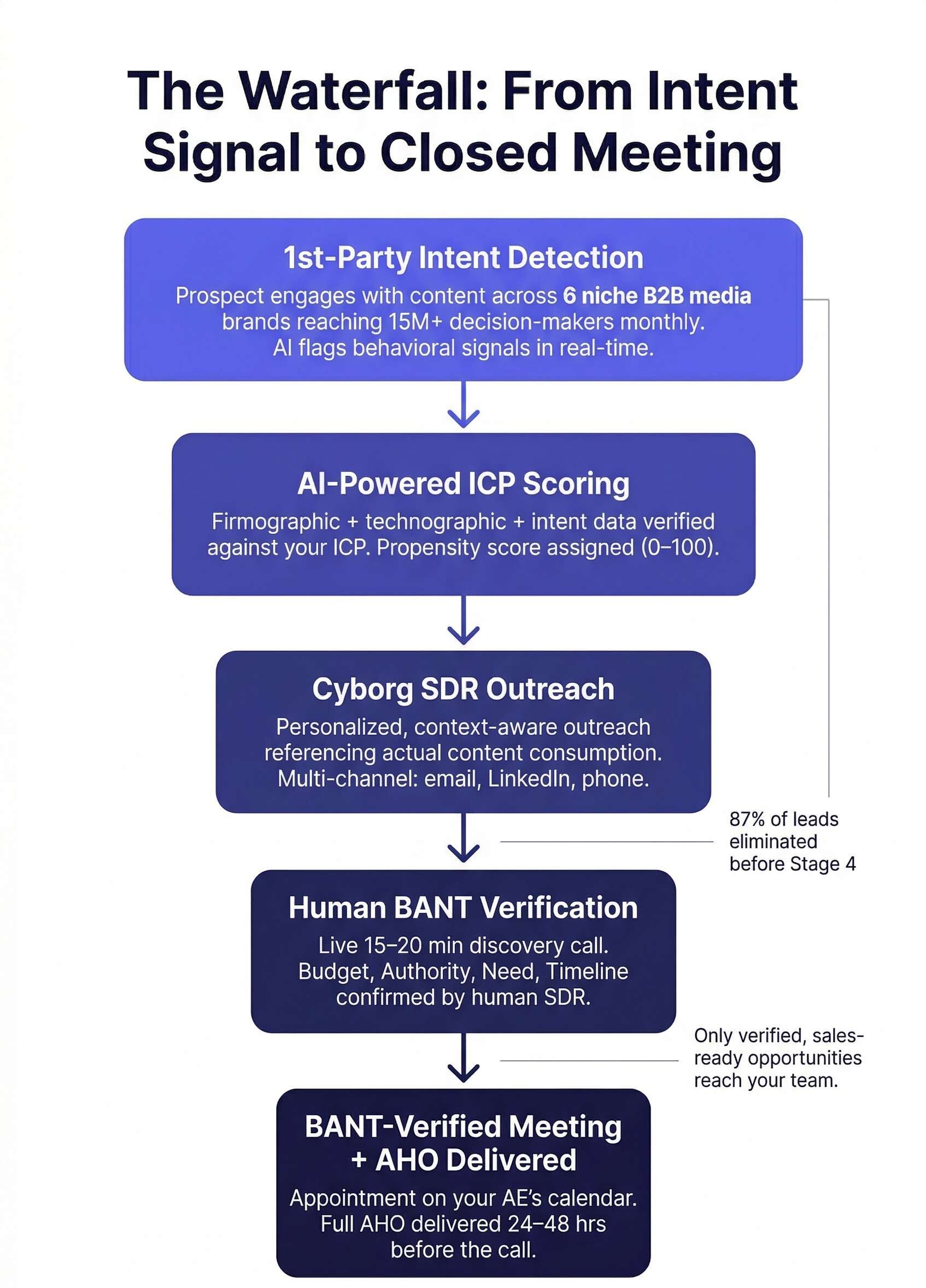
Demand Nexus’s Waterfall model is a Pay-for-Performance Appointment (PPA) system built on four sequential stages, each designed to eliminate unqualified prospects before they reach your AE’s calendar.
Stage 1: Proprietary First-Party Intent Data The Intent Engine
The Waterfall begins with a fundamentally different data asset: proprietary first-party intent signals from six owned B2B media brands.
| Brand | Vertical | Monthly Audience | Key Insight |
| AITechTrend | AI & Machine Learning | 4.7M decision-makers | Tracks real-time AI adoption trends |
| MarTechTrend | Marketing Technology | 3.2M marketing leaders | Monitors martech buying signals |
| DevTechTrend | Developer Tools | 1.8M engineering leaders | Identifies infrastructure spending |
| HRTechTrend | HR Technology | 2.1M HR/talent executives | Captures talent tech initiatives |
| FinTechFilter | Financial Technology | 1.7M finance/fintech leaders | Tracks regulatory/tech changes |
| LegalTechTrend | Legal Technology | 1.5M legal/compliance leaders | Monitors legal tech adoption |
Total reach: 15M+ monthly engaged business decision-makers all first-party, all identified, all real-time.
When a VP of Risk at Acme Bank reads three articles on FinTechFilter about AML fraud automation, that is not a demographic inference. That is a named individual demonstrating active research behavior in your solution category. We know who they are, what they’re reading, and how recently they engaged. Your competitors don’t have this signal. They can’t buy it. It’s proprietary.
The advantage over purchased lists: 70-80% of prospects sourced from our media brands show genuine intent, compared to 30-50% from traditional syndication.
Stage 2: Context-Aware Human Outreach
The intent signal is the fuel. An 8-person Instant Pod including a dedicated copywriter embedded in the media brand’s vertical crafts outreach that references what the prospect actually read.
| What Context-Aware Outreach Looks Like
“Hi Jane,I saw on FinTechFilter that you were researching AML automation and the FedNow implications. Our clients at similar banks faced the same urgency they implemented automated AML detection in 6 weeks and cut false positives by 73%.Want to see how they did it? 15 minutes?”This is not a cold call. It is a context-aware consultation with someone who has already demonstrated interest in solving a specific problem. Result: 40-50% engagement rates vs. 90% hang-up rates on traditional cold outreach. |
Stage 3: BANT Qualification – The Human Verification Layer
Every prospect who engages is taken through a rigorous 15-20 minute qualification call conducted by a trained SDR. This is not a checkbox exercise. It is a diagnostic conversation designed to verify four criteria that determine whether a prospect belongs on your AE’s calendar.
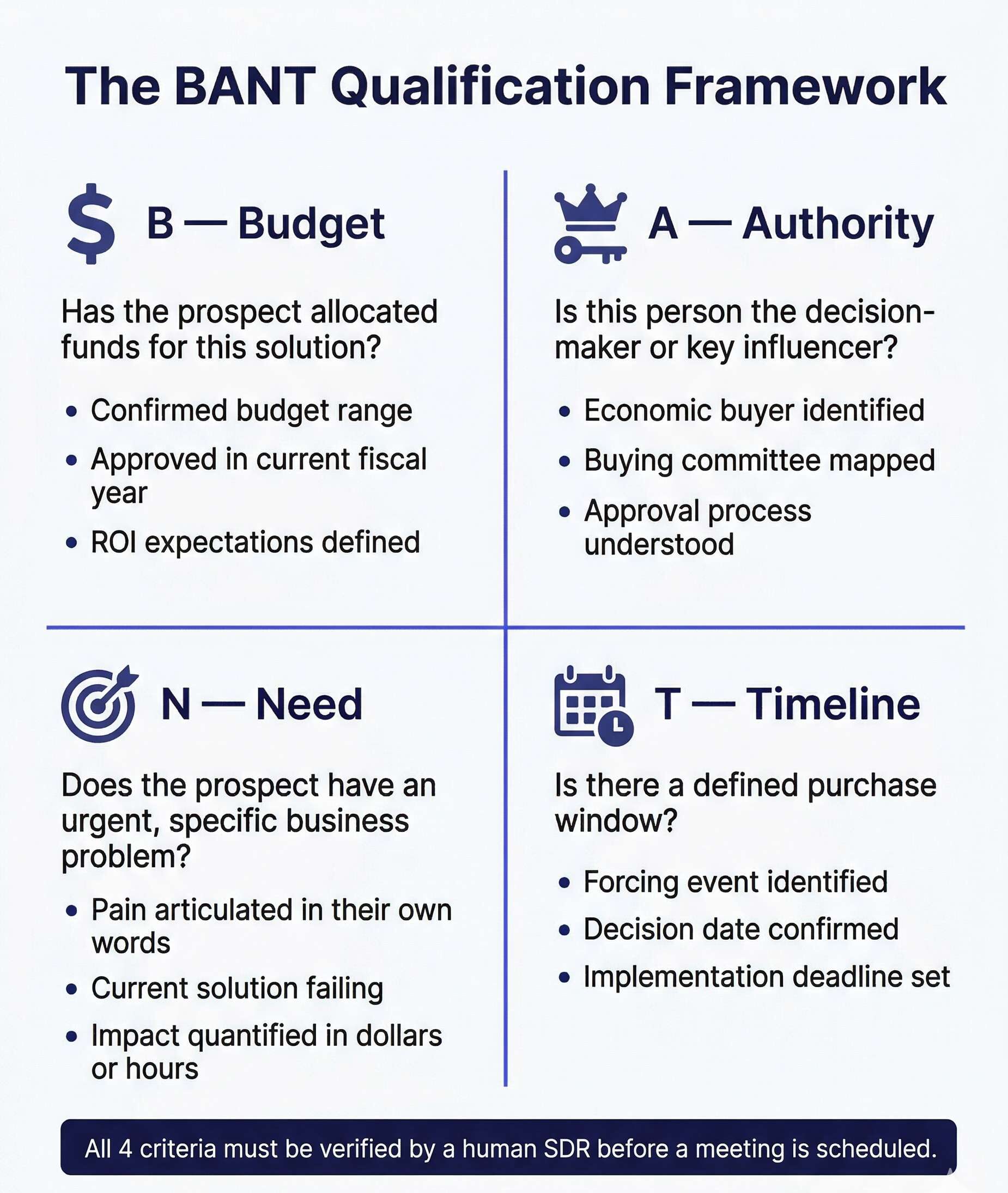
| BANT Criterion | What We Verify | Red Flags That Disqualify |
| Budget | Funds are allocated or actively under consideration for this category | “We might have budget someday” / vague non-answers |
| Authority | Prospect is the economic buyer or key influencer with CFO access | “I’m just researching for someone else” |
| Need | Specific, documented business problem with measurable impact | “We’re generally interested” / no articulated pain |
| Timeline | Purchase decision expected within 1-6 months, with a forcing event | “No specific timeline” / “someday, maybe” |
Our QA system adds three layers of verification: peer review of 10% of all qualification calls, weekly manager certification, and a compliance scoring framework that disqualifies any prospect scoring below 4.0 out of 5.0. SDRs under quota pressure cannot self-report a “yes” to hit their numbers the system catches it.
Stage 4: The Appointment Handover Sheet (AHO) – Your AE’s Blueprint
Most appointment handoffs are a calendar invite with a name and company. That is not a handoff it is an abdication. Demand Nexus delivers a comprehensive Appointment Handover Sheet for every meeting, 24-48 hours before the call.
The AHO contains:
- Executive summary (what your AE reads 5 minutes before the call)
- Complete company and prospect profile including recent funding news, tech stack, and role tenure
- Full BANT verification with verbatim prospect quotes for each criterion
- Primary pain points in the prospect’s own words
- Competitor intel what they’re currently using and why it’s failing
- Anticipated objections with recommended responses
- Agreed next steps and recommended demo focus areas
The result: your AE opens the call with “Based on what you shared with our team, I understand you’re losing 3-4 deals per month because contract cycles take 8 weeks, your current tool has no Salesforce integration, and you need this live before April 1 to support your Q2 expansion. Let me show you how we’ve solved this exact problem for similar companies.” That is the difference between a 35% close rate and a 5% close rate.
4. B2B Appointment Setting Cost: What Does Pay Per Appointment Actually Cost?
One of the most-searched questions in this space is “b2b appointment setting cost” and for good reason. Pricing structures vary wildly, and most vendors obscure total cost by separating setup fees, retainers, and per-meeting charges.
Here is a transparent breakdown of the Demand Nexus Waterfall pricing and how it compares to alternatives.
Waterfall Pod Pricing (2026)
| Package | Monthly | Annual | Guaranteed Meetings/Year | Cost Per Meeting | Est. Closed Deals (35%) | Pipeline Value (est. $50K deals) |
| Essentials | $7,500 | $90,000 | 200 | $500 | 63 deals | $3.15M |
| Growth | $12,500 | $150,000 | 350 | $500 | 105 deals | $5.25M |
| Enterprise | $16,000 | $192,000 | 550 | $400 | 168 deals | $8.4M |
True Cost Comparison Across Models
| Model | Monthly Cost | Meetings/Month | AE Close Rate | Cost Per Closed Deal | Annual ROI |
| In-House SDR Hire | $62,500+ | ~60 | ~20% | $5,208+ | 40-60% |
| Traditional PPL Vendor | $5,000 | ~10 | ~5% | $10,000+ | 10-20% |
| Demand Nexus Waterfall | $7,500–$16,000 | 15–40+ | 35%+ | $1,220–$1,500 | 120-180%+ |
The math is not subtle. At 35% close rate on 200 meetings per year, the Essentials package generates an estimated 63 closed deals. At a $50K average deal size, that is $3.15M in pipeline from a $90,000 investment a 35:1 return on pipeline generated, before factoring in deal close probability.
What’s Always Included (No Hidden Fees)
Every Demand Nexus package includes zero-risk billing (pay only for meetings that happen and meet your BANT criteria), complete data ownership (all leads, conversations, and BANT notes are yours forever, even after contract end), direct calendar scheduling, CRM integration with Salesforce and HubSpot, a dedicated pod team exclusive to your account, live dashboards, weekly business reviews, and no-show replacement within 5 business days at no cost.
5. The Economics of Qualified Appointments vs. MQL Volume
Let’s run the actual numbers side by side.
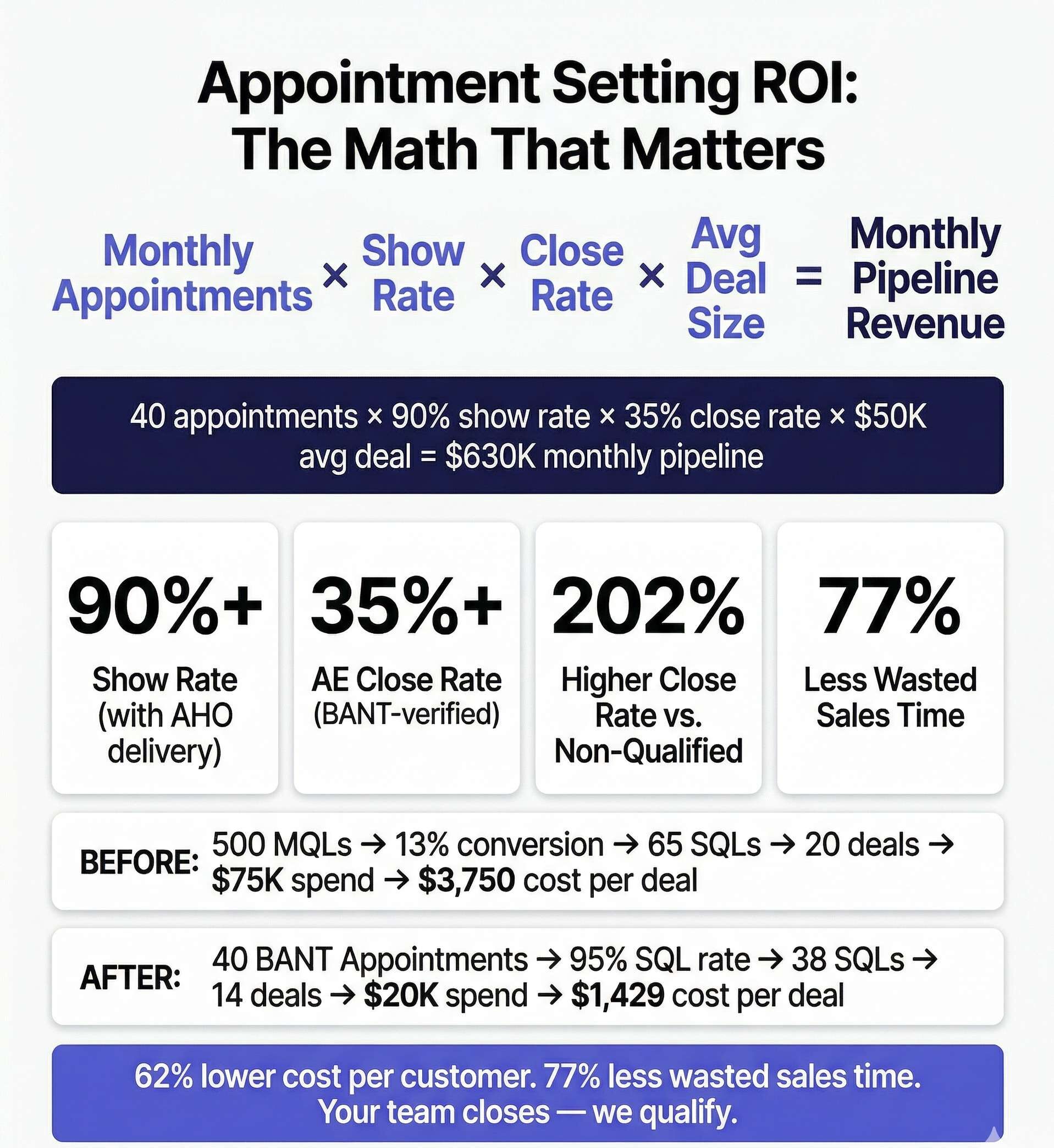
Scenario A: Traditional MQL Model
- 200 MQLs per month at $150 each = $30,000 investment
- MQL-to-SQL conversion: 13% = 26 SQLs
- Cost per SQL: $1,154
- Sales hours consumed: 300 hours (200 leads × 1.5 hrs qualifying each)
- AE close rate: 5% on SQLs → ~1 closed deal per month
Scenario B: BANT-Qualified PPA Model (Demand Nexus Essentials)
- 40 BANT-qualified appointments per month at $500 each = $20,000 investment
- Appointment-to-SQL conversion: 95%+ = 38 SQLs
- Cost per SQL: $526
- Sales hours consumed: 80 hours (40 meetings × 2 hrs each)
- AE close rate: 35% on qualified meetings → ~14 closed deals per month
| 46%
More SQLs |
33%
Less investment |
220 hrs
Selling time saved monthly |
14x
More closed deals |
The qualified appointment model doesn’t just deliver better unit economics it transforms how your entire sales team operates. When AEs spend 100% of their time on genuine opportunities, close rates compound, quota attainment improves, and SDR morale (and retention) follows.
6. How to Choose a Pay Per Appointment Lead Generation Vendor
Not all pay per appointment vendors are created equal. Here are the five questions every B2B revenue leader should ask before signing a contract.
Question 1: What is the actual payment trigger?
Many vendors claim “pay per appointment” but bill for “booked” meetings including ones that cancel, no-show, or turn out to be unqualified. The payment trigger should be a meeting that was held, attended by the right person, and verified against your BANT criteria. Anything short of that is still a lead in disguise.
Question 2: How is BANT verified?
Budget, Authority, Need, and Timeline verification requires human conversation not form fields, not AI chatbots, not behavioral inference. Ask the vendor to walk you through their qualification call framework, show you a sample AHO, and demonstrate how they handle edge cases (prospects who claim budget that isn’t allocated, decision-makers who turn out to be influencers, timelines that slip).
Question 3: Where does the prospect data come from?
Cold purchased lists produce cold leads. First-party intent data from owned media brands produces warm, research-active prospects. Ask: do you own the data source, or do you buy lists from third parties? If the answer is the latter, you are paying for a glorified cold calling service.
Question 4: What happens when a meeting no-shows?
Zero-risk billing is the baseline. Any vendor that charges for no-shows is shifting qualification risk onto you. The standard should be automatic replacement within 5 business days at no additional cost. If the vendor hesitates on this question, walk away.
Question 5: Who owns the data after the contract ends?
Many vendors retain lead data as leverage for contract renewals. Your BANT conversation notes, contact records, and intent signals should be yours permanently regardless of whether you continue the engagement. Demand Nexus guarantees this in writing.
7. Scalable B2B Appointment Setting: How to Book More B2B Meetings Without Adding Headcount
One of the most common questions from VP Sales and CROs scaling into new markets: “How do I book more B2B meetings without hiring five more SDRs?”
The answer lies in the Instant Pod model a fully managed, 8-person team that operates as an extension of your sales org, deploying on a monthly SLA with no onboarding delay, no headcount overhead, and no severance risk.
The 8-Person Instant Pod Structure
| Role | Headcount | Function |
| List Builder | 1 | Curates prospects from media brand data, applies ICP filters, verifies contacts |
| Copywriter | 1 | Crafts personalized outreach referencing intent signals; A/B tests subject lines |
| Team Lead | 1 | Manages pod quality, coaches SDRs, monitors BANT rigor |
| SDRs | 5 | Multi-channel outreach (email, LinkedIn, phone), BANT discovery, meeting scheduling |
Every pod is exclusive to your account no shared agents, no overlapping campaigns, no conflicts of interest. Your dedicated pod learns your ICP, messaging, and competitive landscape over time. Month-over-month performance compounds as the team becomes embedded in your vertical.
Scalability Without the Hiring Risk
Building an in-house SDR team costs $750,000+ per year including salary, benefits, tools, management, and training and takes 3-6 months to hire and ramp. Attrition in SDR roles runs at 34% annually. The math on SDR headcount is brutal for most B2B companies outside of well-funded growth stages.
The Instant Pod model gives you a fully operational outbound team in week one, with month-one SLA guarantees, no long-term contract risk, and the flexibility to scale from 15 to 40+ meetings per month as your sales capacity expands.
8. AI and Automation in Pay Per Appointment: What Works and What Doesn’t
AI-powered SDR tools have generated significant hype in the B2B sales community and some of that hype is justified. But the limits of automation in appointment setting are real and frequently understated by vendors selling AI-first solutions.
What AI Does Well in PPA Lead Generation
- Analyzing first-party intent signals at scale across millions of content interactions
- Scoring prospect accounts against ICP criteria (company size, industry, tech stack, geography)
- Automating meeting scheduling, confirmation reminders, and calendar sync
- Flagging high-priority prospects based on recency and depth of content engagement
- Streamlining post-call documentation and CRM data entry
What AI Cannot Do in Pay Per Appointment Lead Generation
Genuine BANT qualification requires human judgment. An AI system can ask “Do you have budget?” and log the response. A human expert can hear the hesitation behind “yes, we think so” and probe: “Is that budget already approved, or does it require a board vote?” That distinction is the difference between a qualified opportunity and an expensive no-show.
AI cannot navigate buying committee dynamics in real time, pick up on competitive intelligence revealed mid-conversation, adjust its qualification approach when a prospect reveals an unexpected forcing event, or build the human credibility that a context-aware expert SDR establishes when referencing a prospect’s specific research history.
| The Cyborg Pod Model
Demand Nexus uses AI to identify who is actively researching and humans to verify who is actually buying. AI flags intent; humans verify qualification. This combination produces the highest BANT compliance rate in the industry without the cold, robotic experience that AI-only systems create for prospects. |
9. Performance-Based Appointment Setting: The SLA Guarantee
Performance-based appointment setting means the vendor has skin in the game. Here is exactly what Demand Nexus guarantees in writing.
Monthly Meeting SLA
- Essentials: 15+ BANT-qualified meetings per month
- Growth: 25+ BANT-qualified meetings per month
- Enterprise: 40+ BANT-qualified meetings per month
If the monthly SLA is not met, the shortfall is credited forward. You never pay for a commitment that wasn’t delivered.
Zero-Risk Billing Guarantee
- You only pay for meetings that happen and meet your BANT criteria
- No-shows are not billed and are replaced within 5 business days
- Wrong-person attendance (not your ICP) is not billed
- Last-minute cancellations are not billed
Data Ownership Guarantee
All leads touched, BANT qualification notes, conversation history, and intent signals are your permanent property. This data belongs to you not your vendor regardless of whether you continue the engagement. Most lead gen vendors use data ownership as a retention lever. We don’t.
10. Common B2B Appointment Setting Problems – Solved
| Problem | Typical “Solution” | The Right Solution |
| Low appointment rates | More cold outreach volume | Source from first-party intent data; reach prospects already researching |
| High no-show rates | More reminder emails | Only book meetings with confirmed BANT – prospect has genuine urgency |
| AEs complaining about lead quality | Better lead scoring model | Deliver AHOs with complete context so AEs walk in prepared to close |
| Unpredictable pipeline | Book more meetings | Guarantee minimum meetings per month with SLA-backed delivery |
| High cost per acquisition | Negotiate vendor rates | Pay only for meetings that meet your criteria and actually happen |
| Wasted AE time on qualification | Hire more SDRs | Pre-qualify all prospects via BANT before any meeting hits the calendar |
| Black-box vendor transparency | Ask for more reporting | Demand full CRM visibility and Glass Box access to the pipeline |
Ready to Replace Lead Generation with Pipeline-Ready Appointments?
Demand Nexus delivers 15–40+ BANT-verified appointments per month, guaranteed by SLA, with zero risk billing and full data ownership. In 45 minutes, we’ll review your ICP and BANT criteria, identify which of our six media brands align with your buyers, map your sales team structure for maximum close rates, and show you exactly what 15+ qualified appointments per month will do to your revenue forecast.
www.demandnexus.io | Book a Strategy Alignment Call
Month 1 Guarantee: 15+ BANT-verified appointments – or you pay nothing for the difference.
FAQs
What is a good appointment setting rate?
A strong B2B program books fewer but better meetings, with show rates above 90% when prospects are BANT-qualified before booking. Raw booking volume matters less than the share of meetings that are attended and convert.
How much does B2B appointment setting cost?
B2B appointment setting typically costs $400–$600 per qualified meeting, or about $5,000–$16,000 per month depending on the model. In-house SDR teams cost the most per meeting once salaries and tooling are included.
Is in-house or outsourced appointment setting cheaper?
Outsourced appointment setting is usually cheaper per qualified meeting than building an in-house SDR team, because a loaded in-house team costs $60,000+ per month before tooling, while outsourced pay-per-meeting models charge only for meetings delivered.
What is the cost per qualified meeting?
The cost per qualified meeting in a pay-per-meeting-held model is typically $400–$500. Because billing applies only to BANT-verified, attended meetings, the cost per closed deal is far lower than the cost per raw lead.
How do you increase appointment show rates?
Show rates rise when meetings are booked only with BANT-qualified prospects, confirmed and reminded ahead of time, and protected by a process that replaces no-shows quickly rather than leaving gaps in the calendar.
How many touches does it take to book a meeting?
Most B2B meetings are booked after multiple touches across email, phone, and LinkedIn rather than on a single attempt, which is why a disciplined multichannel cadence outperforms one-off outreach.
How does first-party intent data improve B2B appointment quality?
Most appointment setting agencies source prospects from cold purchased lists — demographic matches with no behavioral signal. Demand Nexus operates six proprietary B2B media brands (AITechTrend, MarTechTrend, FinTechFilter, and three others) reaching 15M+ decision-makers monthly. When a prospect engages with content on those platforms, we capture real-time behavioral signals confirming they're actively researching your solution category. Outreach based on this data achieves 40-50% engagement rates vs. single-digit response rates on cold list outreach.
Can AI fully automate BANT qualification in pay per appointment lead generation?
No. AI excels at identifying intent signals, scoring prospects, and automating scheduling. But genuine BANT verification requires human judgment — an expert SDR who can hear hesitation in a prospect's answer, probe past a rehearsed "yes," and uncover that an "approved budget" is actually contingent on a board vote. Demand Nexus uses a Cyborg Pod model: AI identifies who is actively researching, humans verify who is actually buying.
How scalable is pay per appointment lead generation?
Highly scalable. Demand Nexus's Instant Pod model deploys a fully operational 8-person outbound team within days — no hiring, no ramp time, no overhead. Packages scale from 15 meetings per month (Essentials) to 40+ meetings per month (Enterprise) to custom volumes for high-growth teams, with month-one SLA guarantees and no long-term contract risk.
Who owns the lead data after the contract ends?
You do — permanently. All leads touched, BANT qualification notes, conversation history, and intent signals are your property regardless of whether you continue the engagement. Demand Nexus guarantees this in writing. Many lead gen vendors retain data as a retention lever; we do not.