


Launching a SaaS product in the competitive B2B landscape requires more than a great idea it demands a go-to-market (GTM) strategy that prioritizes qualified pipeline over vanity metrics. While most SaaS companies obsess over lead volume, the winning approach focuses on one question: How do you get your sales team in front of buyers who have Budget, Authority, Need, and Timeline?
This guide covers the essential components of a high-converting SaaS GTM strategy, including the critical shift from MQL-chasing to qualified appointment generation and why that distinction determines whether your launch succeeds or stalls.

Most B2B teams lose 40–60% of qualified prospects to broken handoffs and weak qualification. Take our 2-minute diagnostic to find out where your pipeline is bleeding — and how to fix it.
Start the Quiz → Takes 2 minutes. No email required to start.What Is a SaaS GTM Strategy?
A SaaS go-to-market strategy is a comprehensive plan that outlines how a company will launch its product, reach its target audience, and generate predictable revenue. Unlike traditional software sales, SaaS GTM must balance customer acquisition with retention and scalability your subscription model depends on both.
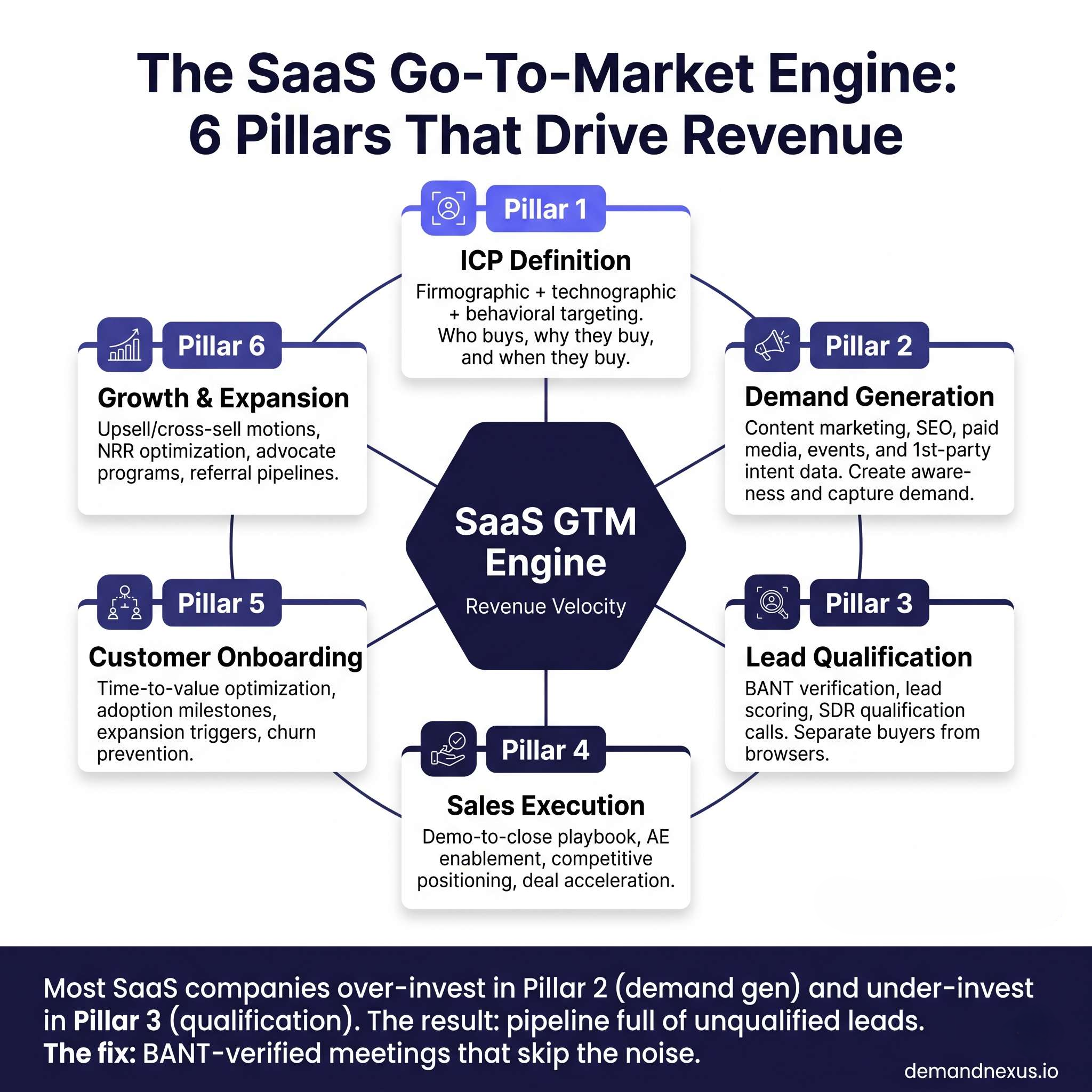
The most effective B2B SaaS GTM strategies integrate four pillars: product development, marketing, sales execution, and customer success. However, the critical differentiator between struggling and thriving SaaS companies isn’t which pillars they use it’s whether their pipeline consists of qualified opportunities or unqualified leads that waste sales time.

Why Traditional GTM Approaches Fail
Most SaaS GTM strategies follow a familiar playbook: generate MQLs through content syndication, paid advertising, and inbound marketing, then hand those leads to sales for qualification. The problem? This model is fundamentally broken.
Consider the economics: B2B companies pay an average of $198 per lead, yet MQL-to-SQL conversion rates hover around just 13%. That means 87% of marketing leads never become sales opportunities. Your SDRs spend their days qualifying tire-kickers instead of closing deals.

The issue isn’t lead generation it’s lead quality. Traditional “black box” vendors deliver spreadsheets of contacts with no verified intent, outdated job titles, and zero brand awareness. Your Account Executives become expensive re-qualifiers instead of revenue generators.
The alternative: GTM strategies built on qualified appointment generation, where every meeting your sales team takes involves prospects who have confirmed budget, decision-making authority, genuine need, and an active buying timeline.
Core Components of a High-Converting SaaS GTM Strategy
1. Define Your Ideal Customer Profile With Precision
Your ICP determines everything downstream. Go beyond basic firmographics to identify:
- Company size and revenue thresholds that match your ACV
- Specific pain points your product addresses (in the buyer’s language)
- Technology stack indicators that signal good fit
- Buying committee composition and decision-making dynamics
- Trigger events that create urgency (contract renewals, funding rounds, leadership changes)
The more precisely you define your ICP, the more effectively you can target prospects already in a buying window not just people who might be interested someday.
2. Choose Your GTM Motion: Product-Led vs. Sales-Led
SaaS GTM strategies typically follow one of two primary motions:
Product-Led Growth (PLG) drives adoption through free or freemium products. Users experience value before purchasing. This works well for self-serve products with low complexity and price points under $10K. Examples include Slack’s free tier, Notion’s workspace model, and Calendly’s scheduling tool.
Sales-Led Growth relies on sales teams to close high-value deals through personalized outreach and demos. This approach suits enterprise SaaS with complex implementations, longer sales cycles, and deal sizes above $25K. Examples include Salesforce’s enterprise motion and Workday’s consultative sales process.
The hybrid approach combines both: PLG attracts and qualifies users at scale, while sales teams focus on expansion and enterprise deals. Zoom pioneered this model free users self-onboard, then sales engages qualified accounts ready for enterprise licensing.
For most B2B SaaS companies selling to mid-market and enterprise buyers, the sales-led or hybrid motion delivers better economics but only when sales meetings involve genuinely qualified prospects.
3. Build Pipeline Through Qualified Appointments, Not MQL Volume
The most significant shift in modern SaaS GTM is moving from lead-based metrics to appointment-based outcomes. Instead of measuring success by how many leads marketing generates, measure by how many qualified meetings sales takes.
What qualifies as a qualified appointment? Every meeting should involve a prospect who has been verified on four criteria:
- Budget: Confirmed allocated funds or approved spending authority
- Authority: Direct decision-maker or proven influence over the purchase
- Need: Articulated pain points that match your solution capabilities
- Timeline: Active evaluation window with a defined decision date
When you shift to qualified appointments, your economics transform. Instead of paying $150-200 per lead with 13% conversion, you pay more per appointment but achieve 35%+ close rates. Your cost per customer drops 60-70%, and sales hours per closed deal decrease dramatically because reps stop chasing unqualified prospects.
4. Leverage First-Party Intent Data Over Third-Party Signals
Traditional GTM strategies rely on third-party intent data from providers like Bombora, 6sense, or ZoomInfo. The problem: this data is commoditized, delayed by weeks, and available to your competitors.
First-party intent data behavioral signals captured from owned or partnered media properties delivers fundamentally different results:
| Dimension | Third-Party Intent | First-Party Intent |
|---|---|---|
| Identity | Anonymous IP addresses | Known individuals with titles |
| Timing | Weeks old, aggregated | Real-time engagement |
| Exclusivity | Sold to competitors | Proprietary to you |
| Specificity | Vague topic interest | Specific content engagement |
| Accuracy | 40-50% false positives | 85%+ signal accuracy |
When you know that “Jane Doe, VP of Operations at Acme Corp” just read a detailed guide on the exact problem your product solves, that’s actionable intelligence. When you only know “someone at an IP address associated with Acme seems interested in your category,” that’s a guess.
5. Align Sales and Marketing Around Revenue Metrics
Effective SaaS GTM requires tight alignment between marketing and sales not just in messaging, but in accountability. Both teams should share ownership of:
- Qualified appointments generated per month
- Appointment-to-opportunity conversion rate
- Pipeline velocity (time from first meeting to closed deal)
- Cost per qualified meeting
- Cost per closed customer
When marketing is measured on qualified appointments instead of MQL volume, incentives align. Marketing focuses on reaching buyers who are actually ready to purchase, not just anyone willing to download content.
Key Metrics for SaaS GTM Success
Track these metrics to gauge your GTM strategy effectiveness:
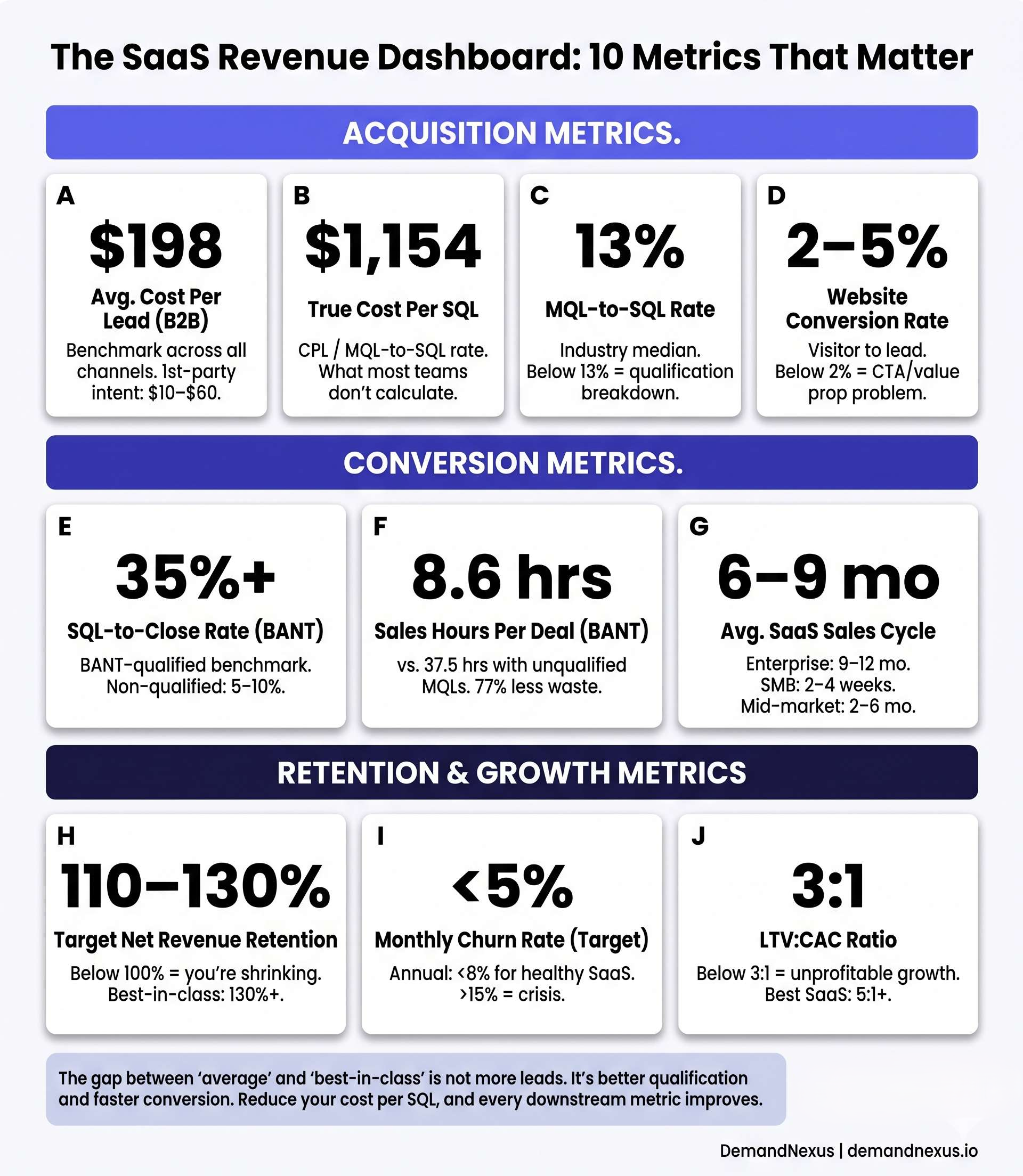
| Metric | What It Measures | Benchmark |
|---|---|---|
| Qualified Appointment Rate | Percentage of meetings that meet BANT criteria | Target 90%+ |
| Appointment-to-Close Rate | Percentage of qualified meetings that become customers | 30-40% |
| Sales Hours Per Closed Deal | Time investment required per customer | Target under 15 hours |
| Cost Per Qualified Meeting | Total spend divided by qualified appointments | $400-600 |
| Cost Per Customer | Total acquisition cost per closed deal | Track against LTV |
| Pipeline Velocity | Average days from first meeting to closed deal | Varies by ACV |
The shift from MQL-focused metrics to appointment-focused metrics changes how you evaluate performance. A high MQL volume with low conversion represents waste; fewer qualified appointments with high conversion represents efficiency.
Phase 1: Foundation (Weeks 1-4)
Start by validating your ICP through customer interviews and closed-deal analysis. Identify the characteristics that distinguish customers who close quickly and retain well. Document the pain points, trigger events, and buying criteria that matter most.
Build your qualification framework the specific questions and criteria that determine whether a prospect is genuinely qualified. This framework becomes your standard for every sales conversation.
Phase 2: Channel Activation (Weeks 5-8)
Activate channels aligned with your GTM motion. For sales-led approaches, prioritize channels that generate qualified conversations:
- Targeted outreach to prospects showing intent signals
- Industry-specific content that attracts buyers in evaluation mode
- Executive events and roundtables that convene decision-makers
- Strategic partnerships that provide access to qualified audiences
Avoid the temptation to spray marketing budget across broad awareness channels. Focus on reaching buyers who are already researching solutions like yours.
Phase 3: Sales Enablement (Weeks 9-12)
Equip your sales team with everything they need to convert qualified appointments:
- Detailed prospect briefings before every meeting (pain points, timeline, competitive context)
- Case studies and proof points matched to specific buyer personas
- Demo environments customized to common use cases
- Clear handoff processes that preserve qualification context
The goal: every AE walks into every meeting fully prepared, with complete context on the prospect’s situation, priorities, and buying criteria.
Phase 4: Optimization (Ongoing)
Monitor your qualified appointment metrics weekly. Identify patterns in meetings that convert versus those that stall. Refine your qualification criteria based on what actually predicts closed deals.
Common optimizations include:
- Tightening ICP criteria when appointment quality drops
- Adjusting messaging when specific objections recur
- Expanding into adjacent verticals when core segments saturate
- Scaling appointment volume when conversion rates stabilize
Case Study: SaaS Collaboration Platform Transforms GTM Results
A mid-sized SaaS company launching a collaboration platform struggled with their initial GTM approach. Traditional lead generation delivered high volume but poor conversion only 15% of marketing leads progressed to trials, and sales reps spent most of their time on unqualified conversations.
The shift: The company moved from MQL-based pipeline generation to qualified appointment generation, implementing rigorous BANT verification before any meeting hit a sales calendar.
The approach: Every prospect received human qualification calls that verified budget allocation, decision-making authority, specific pain points, and active timelines. Only prospects meeting all criteria were scheduled for sales conversations. Each meeting included detailed briefing documents with verbatim quotes, competitive intelligence, and recommended approaches.
The results over six months:
- Trial sign-ups increased 40% (better qualified prospects convert more readily)
- Appointment-to-close rate rose from 15% to 35%
- Sales hours per closed deal dropped from 37 hours to under 12 hours
- Cost per customer decreased 62%
- MRR grew 35% while marketing spend remained flat
The transformation didn’t come from generating more leads it came from generating better meetings.
Common SaaS GTM Mistakes to Avoid
Mistake 1: Optimizing for lead volume over lead quality. More MQLs feel productive but often represent wasted spend. Measure success by qualified appointments and closed revenue, not top-of-funnel metrics.
Mistake 2: Using third-party data without first-party validation. Intent data loses value when it’s commoditized and delayed. Prioritize signals you can verify in real-time through actual prospect engagement.
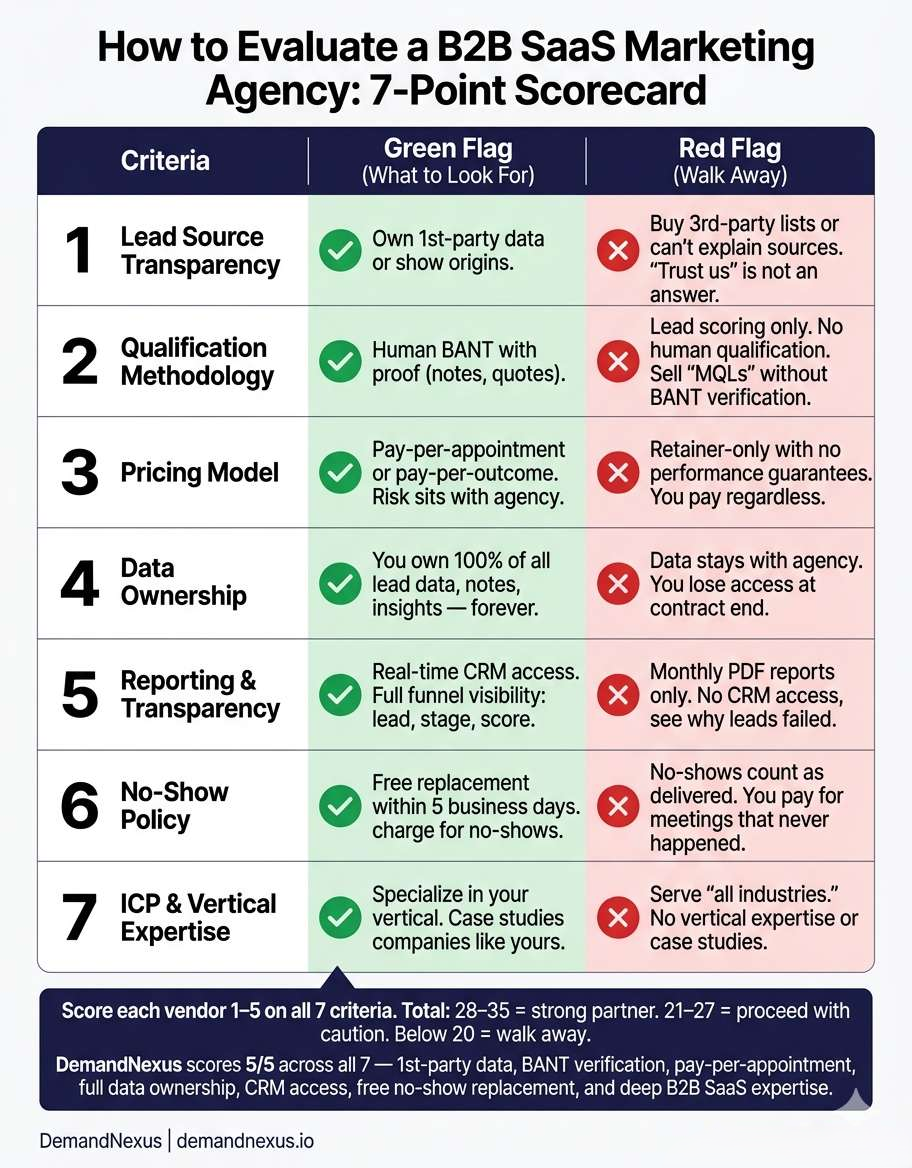
Mistake 3: Treating SDRs as appointment schedulers, not qualifiers. The SDR role should focus on rigorous qualification, not just meeting volume. Invest in training that builds genuine sales acumen, not just scripted outreach.
Mistake 4: Handing off leads without context. When sales receives a name and email, they start from zero. When sales receives detailed qualification notes, pain points in the prospect’s own words, and competitive intelligence, they start ready to close.
Mistake 5: Scaling channels before proving unit economics. Don’t increase spend on lead generation until you’ve proven that leads convert profitably. Scale what works; cut what doesn’t.
The Future of SaaS GTM: From Leads to Revenue
The SaaS GTM landscape is shifting. Companies that continue chasing MQL volume will face rising costs and declining conversion. Companies that focus on qualified pipeline generation will capture market share with more efficient sales motions.
The winning formula combines several elements: precise ICP definition, first-party intent data that reveals real buyers, rigorous qualification that protects sales time, and seamless handoffs that preserve context. When these elements align, sales teams stop wasting time on tire-kickers and start closing deals with prepared, qualified buyers.
Your GTM strategy determines more than your launch trajectory it determines your sustainable growth economics. Invest in pipeline quality, and revenue follows.
Frequently Asked Questions
What is a SaaS GTM strategy? A SaaS go-to-market strategy is a comprehensive plan for launching and scaling a software product, including target market definition, channel selection, pricing, and sales motion. Effective SaaS GTM strategies prioritize qualified pipeline generation over raw lead volume.
What is the difference between product-led and sales-led growth? Product-led growth (PLG) drives adoption through free or freemium products where users experience value before purchasing. Sales-led growth relies on sales teams to close deals through personalized outreach. Most enterprise B2B SaaS companies use sales-led or hybrid approaches.
How do you measure SaaS GTM success? Key metrics include qualified appointment rate, appointment-to-close rate, cost per qualified meeting, cost per customer, and pipeline velocity. Avoid optimizing for vanity metrics like MQL volume that don’t correlate with revenue.
What is BANT qualification? BANT stands for Budget, Authority, Need, and Timeline. BANT qualification verifies that prospects have allocated budget, decision-making authority, genuine pain points your product addresses, and an active buying timeline before sales engagement.
How long does SaaS GTM implementation take? Initial GTM implementation typically takes 12-16 weeks, including ICP validation, channel activation, sales enablement, and initial optimization. Ongoing refinement continues based on conversion data and market feedback.
What is first-party intent data? First-party intent data consists of behavioral signals captured directly from owned or partnered properties (websites, content platforms, events). Unlike third-party intent data that’s commoditized and delayed, first-party signals are real-time, specific, and proprietary.