

Introduction
SaaS sales is one of the most data-rich, process-intensive disciplines in modern B2B. Subscription models, recurring revenue economics, multi-stakeholder buying committees, and 84-day average sales cycles create a selling environment where process quality is the primary driver of win rate.
Yet despite all this data, most SaaS sales teams are operating with a fundamental disadvantage: they’re receiving leads from marketing that haven’t been properly qualified. 87% of MQLs never convert. SDRs spend 30–50% of their time re-qualifying prospects. AEs walk into discovery calls knowing little about the prospect’s actual budget, authority, or urgency.
This guide covers SaaS sales from the ground up: what it is, how the process works, what metrics predict success, and how qualifying your pipeline before your AEs touch it transforms close rates.
What Is SaaS Sales?
SaaS sales is the process of selling software-as-a-service products to business customers — typically involving subscription pricing, recurring contracts, and multi-stakeholder purchase decisions. Unlike traditional software sales (one-time perpetual licenses), SaaS sales must optimize for customer acquisition cost (CAC), lifetime value (LTV), and net revenue retention (NRR) as the primary economic drivers.
Key characteristics that distinguish SaaS sales from other B2B sales:
- Subscription model: Revenue is recurring; the sale doesn’t end at contract signing
- Trial and freemium dynamics: Product-led growth models create parallel sales motions
- Multi-stakeholder decisions: Enterprise SaaS deals involve 6–10 decision-makers on average
- Technical evaluation: IT, security, and integration requirements add evaluation stages
- Long sales cycles: Mid-market and enterprise SaaS deals average 84 days from first meeting to close
SaaS Sales Models: Which Applies to You?
Self-Serve / Product-Led Growth (PLG)
In PLG models, the product itself drives acquisition — users discover, trial, and adopt without requiring a sales conversation. Sales in PLG environments focuses on expansion: converting self-service users to enterprise contracts, managing upsell and cross-sell, and handling complex deals that exceed self-serve capacity.
Inside Sales (High-Velocity)
High-velocity inside sales suits SMB and mid-market SaaS — short sales cycles (14–30 days), lower ACV ($5K–$50K/year), and high volume. AEs handle the full sales cycle from discovery to close. Success depends on lead quality and call efficiency.
Enterprise Sales (Complex, Committee-Based)
Enterprise SaaS sales involves longer cycles (90–180 days), higher ACV ($50K–$500K+), procurement processes, legal review, security audits, and buying committees with multiple influencers. Account-based approaches, multi-threaded outreach, and executive alignment are essential.
Outbound SDR + AE Motion
Most mid-market and enterprise SaaS companies use an outbound model where SDRs prospect and qualify, then hand BANT-qualified opportunities to AEs who run discovery, demo, proposal, and close. The efficiency of this model depends almost entirely on the quality of the SDR qualification layer.
The SaaS Sales Process: Stage by Stage
Stage 1: Prospecting and Intent Signal Identification
Modern SaaS sales prospecting begins with intent signals, not cold contact lists. The highest-quality prospects are those already researching your category — visiting competitor sites, consuming industry content, attending webinars, requesting demos. First-party behavioral data from owned media brands is the most reliable signal source.
Stage 2: Outreach and Initial Engagement
Context-aware outreach — referencing the specific problem the prospect was researching — generates 40–50% engagement rates versus under 5% for generic sequences. The single biggest improvement most SaaS SDR programs can make is replacing template-driven cold outreach with personalized sequences built on behavioral context.
Stage 3: BANT Qualification
Before any appointment reaches an AE’s calendar, Budget, Authority, Need, and Timeline should be confirmed through a direct qualification conversation. This is the stage where most SaaS sales processes leak: either qualification is skipped entirely (leading to low-quality meetings), or it’s conducted by the AE during discovery (wasting selling time).
The BANT conversation should establish: whether budget has been allocated or can be accessed, who has final decision authority and who else is involved, what specific pain the prospect acknowledges, and whether there is a defined timeline with urgency drivers.
Stage 4: Discovery and Needs Analysis
When qualification is completed before the meeting, discovery shifts from ‘find out if there’s a fit’ to ‘deepen the understanding of fit.’ The AE who enters a discovery call with BANT answers already documented can skip generic qualification questions and go straight to pain mapping, solution alignment, and ROI framing.
This is why the Appointment Handover Sheet (AHO) changes close rates. AEs who receive full BANT documentation and behavioral context before every meeting are having substantively different — and more productive — conversations than AEs walking into cold discovery.
Stage 5: Demo and Proof of Value
SaaS demos should be tailored to the specific pain points uncovered in the BANT conversation, not a product tour. A demo built around ‘here’s how we solve your AML reporting problem’ outconverts ‘here’s everything our product can do’ by 2–3x. Use the BANT and AHO data to personalize every demo to the prospect’s specific situation.
Stage 6: Proposal and Negotiation
Proposals for BANT-qualified prospects should reference the specific pain articulated by the prospect, the ROI framing built in discovery, and the decision criteria the buying committee has shared. Generic proposals that don’t reference the prospect’s specific situation lose to competitors who personalize.
Stage 7: Close and Handoff to Customer Success
The close is rarely a single event in SaaS. It involves contract negotiation, legal review, security questionnaires, and procurement. The AE who has built multi-threaded relationships across the buying committee — champion, economic buyer, technical evaluator — closes faster and at lower discounting rates.
SaaS Sales Metrics: What Predicts Revenue
Pipeline Quality Metrics
- Pipeline coverage ratio: Pipeline value / revenue target (benchmark: 3–4x coverage)
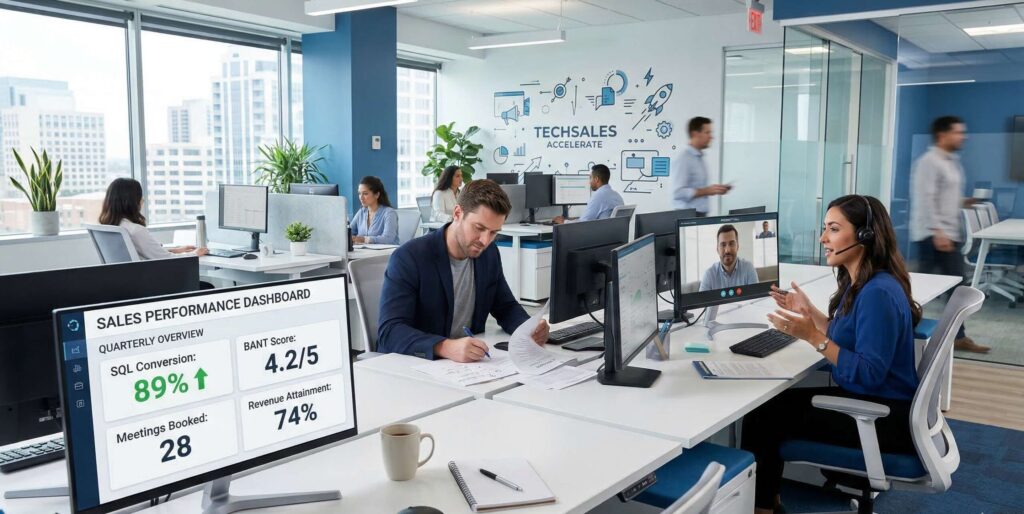
- SQL conversion rate: Target 30%+ from qualified programs; 90%+ with pre-BANT appointments
- Win rate by lead source: Tracks which sources produce closeable pipeline
- Average sales cycle length: Shorter cycles indicate better qualification and stronger need
Efficiency Metrics
- AE quota attainment: The ultimate efficiency metric
- Meetings per week per AE: Too many → qualification gap; too few → prospecting gap
- AE qualification time per week: Target under 5 hours with pre-qualified appointments
- Deal slippage rate: Deals that miss close date often signal qualification gaps
SaaS Sales Outsourcing: When It Makes Sense
SaaS sales outsourcing — specifically outsourcing the SDR and appointment setting function — makes sense when:
- You need to scale pipeline faster than in-house hiring allows
- Your AEs are spending more than 20% of their time on re-qualification
- Your MQL-to-SQL conversion rate is below 20%
- You’re entering a new market vertical or ICP segment
- You want to test demand generation economics before building a permanent SDR team
DemandNexus’s Instant Pod model deploys an 8-person dedicated team within 30 days — 5 SDRs, a copywriter, a data analyst, and an account manager — running the full qualification cycle and delivering BANT-verified appointments directly to your AEs. At $7,500/month for 15+ guaranteed meetings, the cost per closed deal runs $1,220–$1,500 at a 35% close rate.
FAQs
No schema found.Author