


Introduction: The Sales Funnel Is Broken – Here’s Why
Your sales funnel is supposed to be a revenue engine. Leads enter at the top. Deals close at the bottom. That’s the promise.
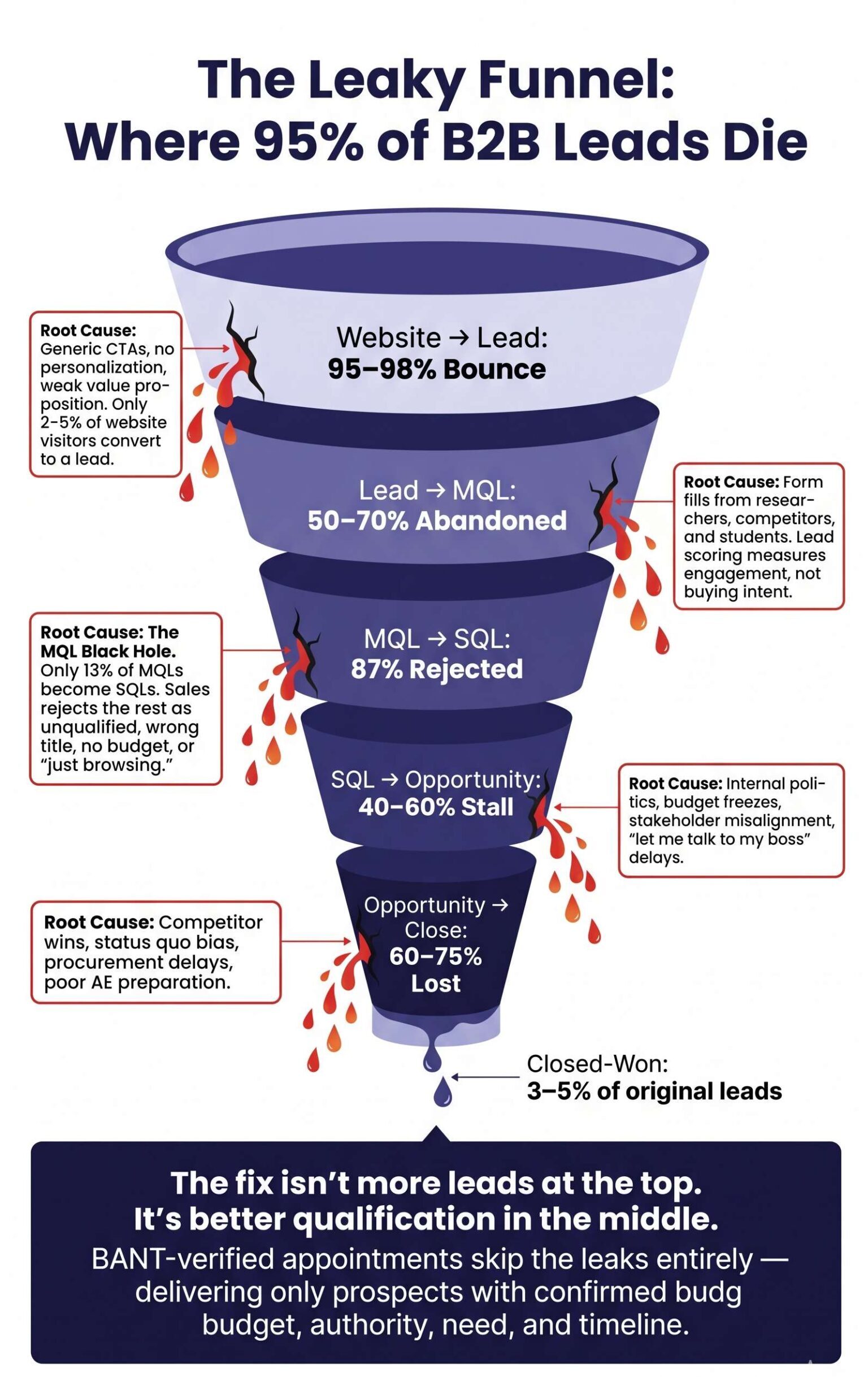
Here’s what’s actually happening: the median MQL-to-SQL conversion rate sits at just 13%. For every 100 leads marketing sends to sales, 87 are rejected or abandoned. Your funnel isn’t a funnel it’s a sieve.

Most B2B teams lose 40–60% of qualified prospects to broken handoffs and weak qualification. Take our 2-minute diagnostic to find out where your pipeline is bleeding — and how to fix it.
Start the Quiz → Takes 2 minutes. No email required to start.The standard advice better nurture sequences, faster follow-up, tighter CRM hygiene addresses symptoms, not the disease. You can patch individual holes all day. The funnel will keep leaking because it’s being filled with the wrong leads in the first place.
This guide examines exactly where B2B sales funnels lose revenue, why traditional qualification guarantees leakage, and how replacing MQL-based lead generation with BANT-qualified appointments eliminates the problem at its source.
What Is a Sales Funnel – and What Should It Actually Deliver?
A sales funnel maps the journey a prospect takes from first awareness to closed deal. In B2B, the classic model looks like this:

- Awareness: Prospect learns your brand or solution exists
- Interest: Prospect engages with content or outreach
- Consideration: Prospect evaluates options, requests more information
- Intent: Prospect signals buying readiness
- Evaluation: Prospect compares vendors
- Decision: Prospect commits to a purchase
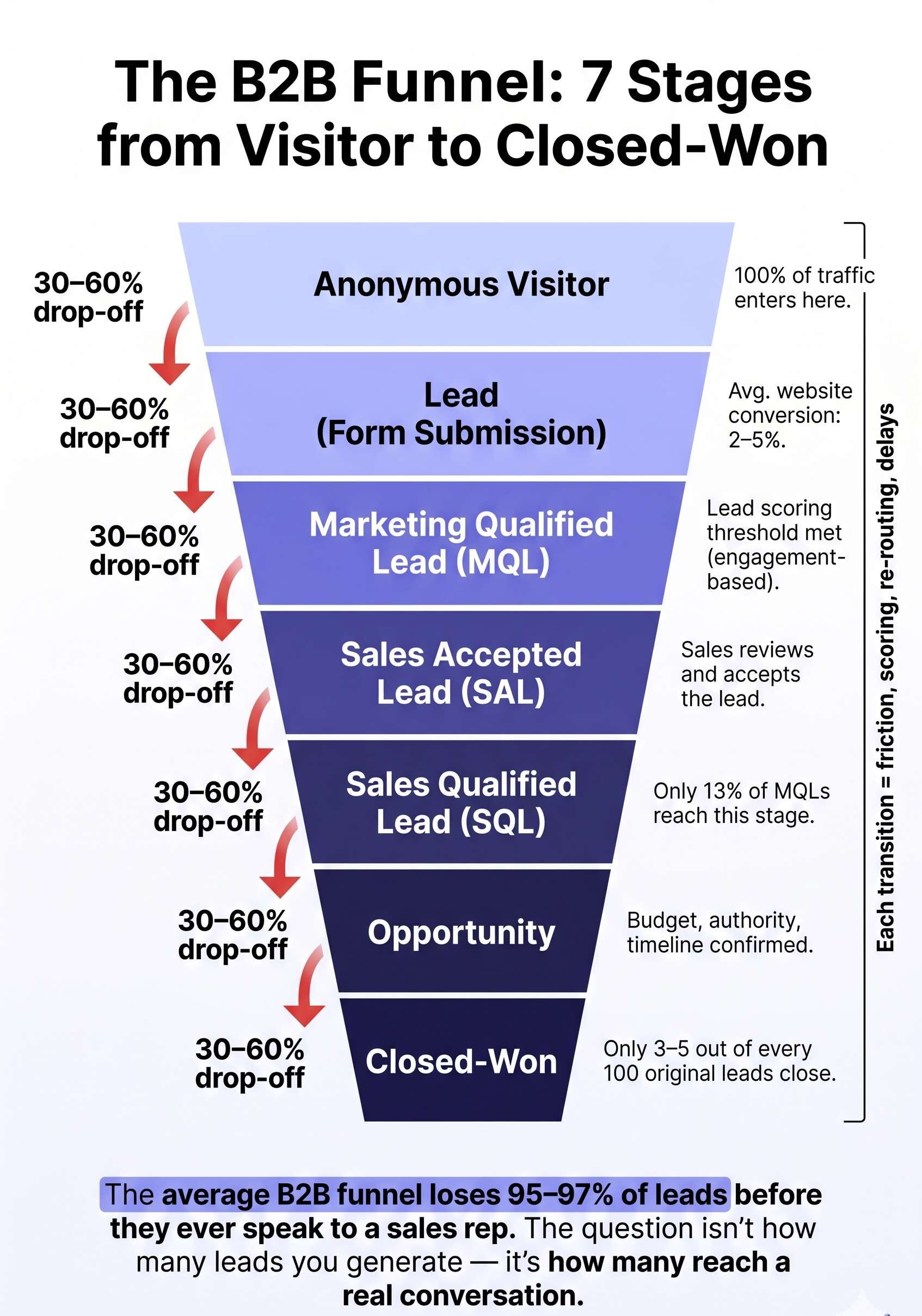
Each stage narrows the pool. That’s expected. The problem is when narrowing happens in the wrong places when leads that were never qualified clog the middle of the funnel, consuming sales time and marketing budget while converting at near-zero rates.

A healthy B2B sales funnel delivers three things:
- Efficiency: Qualified opportunities not raw contacts reaching your sales team
- Predictability: Consistent, measurable conversion rates at each stage
- Scalability: More pipeline when you increase investment, not just more volume
Most B2B sales funnels produce volume and mistake it for value.
Where B2B Sales Funnels Leak – Stage by Stage
The Top-of-Funnel Illusion
TOFU metrics look great on dashboards. Thousands of website visitors. Hundreds of content downloads. Dozens of webinar registrants. Marketing celebrates. Sales waits.
The issue: most top-of-funnel activity comes from people who will never buy. Competitors researching your messaging. Students doing coursework. Junior analysts with no budget or authority doing exploratory research. Every one of them scores points in your lead scoring system and eventually crosses the MQL threshold. Your pipeline fills with contacts who match no real buying criteria disguised as opportunities because they downloaded a PDF.
The MQL Black Hole: Where Funnels Disappear
The Marketing Qualified Lead is the most dangerous concept in B2B revenue operations. It creates the illusion of qualification while measuring nothing that predicts purchase.
| Activity That Creates an MQL | What It Actually Tells You |
| Webinar attendance (+15 pts) | They had 45 minutes free on their calendar |
| Email click (+5 pts) | They were momentarily curious or accidentally clicked |
| Pricing page visit (+20 pts) | A junior analyst was researching for their boss |
| Whitepaper download (+10 pts) | They wanted the content, not a sales conversation |
| 50-point threshold reached | They’ve been active online not that they can buy |
None of these behaviors answer the questions that actually predict revenue: Do they have budget? Do they have authority to buy? Is there an active need? Is there a real timeline? Without verifying these four criteria, every MQL is a guess. At a 13% conversion rate, it’s a bad one.
The Mid-Funnel Swamp: Sales Funnel Leakage in Slow Motion
Leads that survive the MQL filter don’t convert cleanly into opportunities. They get stuck. Sales reps call them. Voicemails go unreturned. Follow-up emails are ignored. “They’ll circle back after the quarter.” The mid-funnel becomes a swamp where leads sit for months consuming calendar time and CRM space.
This is sales funnel leakage in its most expensive form: not a dramatic drop-off at one stage, but a slow hemorrhage across every touchpoint between initial engagement and discovery call. The diagnosis is always the same: these leads were never qualified. They should never have reached sales.
The Discovery Call Dead End
Leads that do reach a discovery call often reveal the problem immediately. “We don’t have budget until next year.” “I’m just doing research for my boss.” “I’d need to loop in our VP before we could move forward.” “We’re not actively evaluating anything right now.”
These are not objections they are qualification failures. The prospect was never ready. The discovery call was wasted AE time that a 10-minute upfront qualification conversation would have prevented entirely.
The Real Cost of a Leaky Sales Funnel
| Cost Category | Impact |
| MQL-to-SQL conversion rate | 13% (87% of leads rejected or abandoned) |
| Sales rep hours wasted per year (per rep) | 550 hours |
| Productivity cost per rep annually | $32,000 |
| Total annual waste (enterprise sales team) | $4 million |
| Discovery calls with no buying criteria confirmed | 70%+ of all first meetings |
The compounding effects extend beyond direct costs:
- Sales morale deteriorates when reps spend the majority of their time chasing dead leads
- Revenue forecasting becomes unreliable because pipeline quality is unknown
- Marketing and sales alignment breaks down as sales blames marketing for bad leads
- Customer acquisition cost inflates because it includes all wasted qualification effort
| The Waste Tax Calculation
200 MQLs at $150 each = $30,000 spend → 26 SQLs at $1,154 each, requiring 300 sales hours.40 BANT-qualified appointments at $500 each = $20,000 spend → 38 SQLs at $526 each, requiring 80 sales hours.Result: 46% more qualified pipeline, 33% lower spend, 220 sales hours returned to your team every month. |
The BANT Framework: Qualification That Stops Funnel Leakage
BANT – Budget, Authority, Need, Timeline – is the qualification framework developed by IBM that remains the most reliable predictor of sales readiness in B2B. Not because it’s complex, but because it answers the only questions that matter before committing sales resources to a prospect.
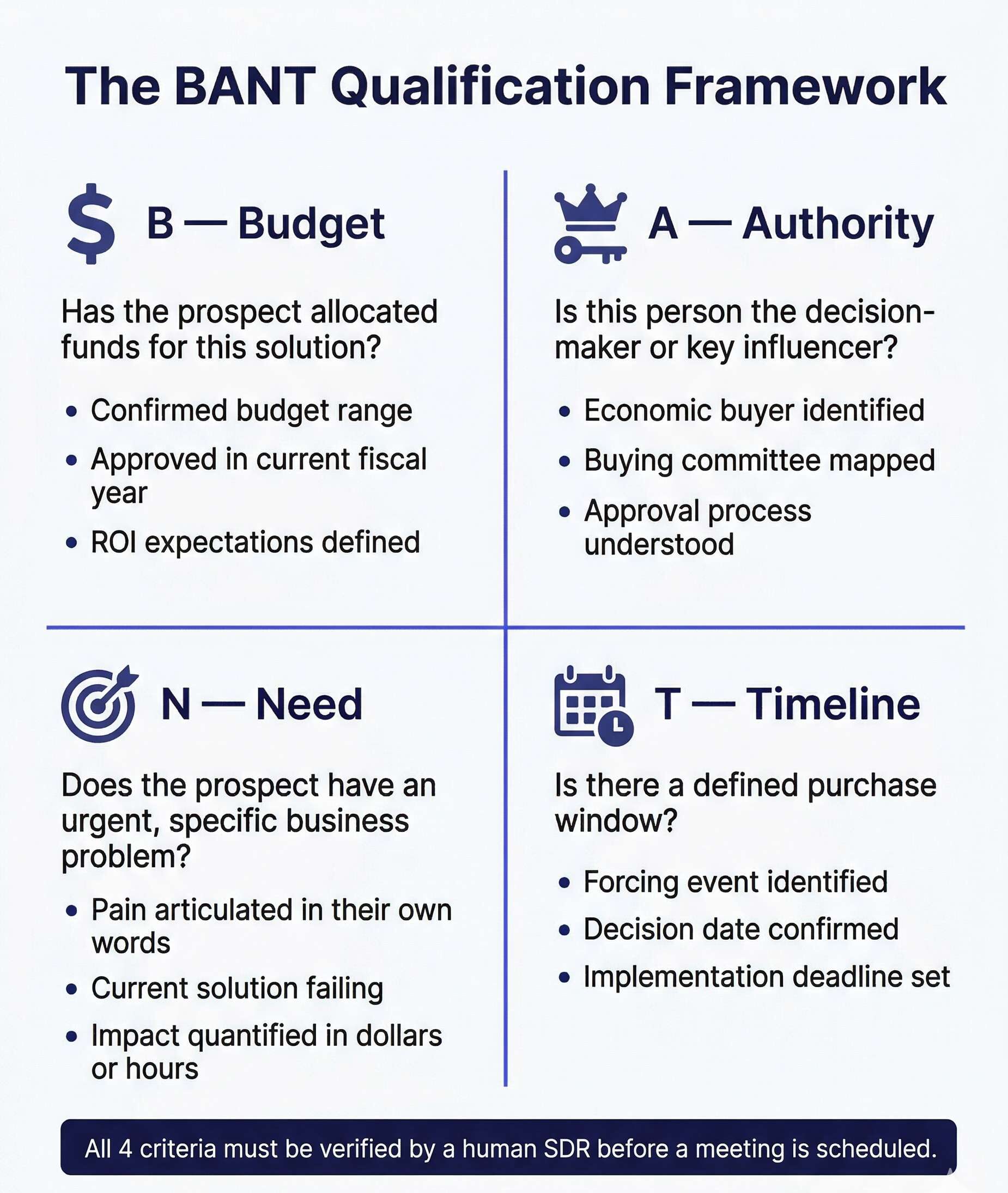
B – Budget
Has the prospect allocated funds, or can they realistically secure budget?
- “What budget have you allocated for this initiative?”
- “How is this type of purchase typically funded at your company?”
- “Is this in your current fiscal year budget?”
A – Authority
Is the prospect a decision-maker, or do they have meaningful influence over the person who is?
- “Who else is involved in this decision?”
- “Who has final sign-off on a purchase like this?”
- “Are you the primary evaluator, or will others be part of the process?”
N – Need
Does the prospect have a genuine business problem your solution specifically addresses?
- “What’s driving your interest in this right now?”
- “What’s the business impact if this problem isn’t solved?”
- “What have you already tried?”
T – Timeline
Is there an active buying window, or is this theoretical future interest?
- “When do you need this live?”
- “What’s driving your timeline?”
- “Are you actively evaluating vendors now, or still in research mode?”
| Traditional Lead Scoring | BANT Qualification |
| Measures digital behavior | Measures buying readiness |
| Automated and passive | Human-verified |
| No budget validation | Budget confirmed |
| No authority check | Decision-maker identified |
| Inferred interest | Explicit need articulated |
| Assumed timeline | Purchase window confirmed |
| 13% SQL conversion rate | 90%+ are sales-ready at meeting time |
How to Fix a Leaky Sales Funnel: The BANT-Qualified Appointment Model
The traditional funnel forces prospects through multiple stages where attrition is inevitable. The BANT-qualified appointment model collapses this into three steps:
First-party intent signal → Human BANT verification → Scheduled meeting with a confirmed decision-maker
Your sales team never sees a lead that hasn’t confirmed budget, authority, need, and timeline. The stages where leads disappear are eliminated – not patched.
Step 1: First-Party Intent Signals
The model begins with proprietary first-party intent data – behavioral signals captured from known decision-makers actively consuming content on niche industry media brands.
| Third-Party Intent Data | First-Party Intent Data |
| Anonymous (IP addresses only) | Known (named individual with title and company) |
| Delayed (weeks-old aggregated signals) | Real-time (engaged today) |
| Shared (sold to 5–10 competitors simultaneously) | Proprietary (exclusive access) |
| Broad (‘Interested in AI’) | Specific (‘Read 3 articles on AML compliance automation’) |
| 40–50% signal accuracy | 85%+ signal accuracy |
DemandNexus captures first-party intent through six owned niche B2B media brands – AITechTrend, MarTechTrend, FinTechFilter, HRTechTrend, DevTechTrend, and LegalTechTrend – reaching 15M+ monthly engaged business decision-makers. When a VP of Risk reads three articles about AML fraud automation on FinTechFilter, that’s a verified, real-time buying signal – not an inferred guess.
Step 2: Human BANT Verification
A trained SDR contacts high-intent prospects and runs a 10–15 minute qualification call that explicitly verifies all four BANT criteria before any meeting is ever scheduled. No automated scoring. No threshold assumptions. Human verification.
Prospects who don’t confirm budget, authority, need, and timeline are filtered out. They never reach your sales team. They never waste calendar time. They never inflate your pipeline with false opportunities.
Step 3: The Appointment Handover Sheet (AHO)
Every BANT-qualified meeting includes a comprehensive Appointment Handover Sheet delivered to your Account Executive 24–48 hours before the call:
- Full BANT verification summary with proof points for all four criteria
- The prospect’s pain points in their own words from the qualification conversation
- Competitive intelligence – what vendors they’re currently evaluating
- Anticipated objections with recommended responses
- Suggested opening strategy for maximum call impact
Without an AHO, your AE spends the first 15 minutes of every call re-asking questions the SDR already answered. With an AHO, they open with: “I understand you’re solving [specific problem], you have [budget] allocated, and you need this live by [date]. Let me show you exactly how we address that.”
The DemandNexus Waterfall: A Leak-Proof Sales Pipeline
The Demand Nexus Waterfall is a Pay-for-Performance Appointment (PPA) system – the structural opposite of traditional lead generation.
| Traditional PPL / MQL Model | DemandNexus Waterfall (PPA) |
| Payment trigger: Contact form submission | Payment trigger: Meeting held and attended |
| Deliverable: Unverified list of names | Deliverable: BANT-verified scheduled appointment |
| Risk borne by: You (wasted budget regardless) | Risk borne by: DemandNexus (no-shows replaced free) |
| Team role: Re-qualify and chase leads | Team role: 100% selling time – close deals |
| Transparency: Black box (no visibility into failures) | Transparency: Full CRM visibility at every stage |
| Data: Lost when contract ends | Data: Permanently yours – every lead, every conversation |
What the Monthly SLA Guarantees
- 15+ BANT-qualified meetings per month (Essentials Pod) – SLA-backed minimum
- 25+ BANT-qualified meetings per month (Growth Pod)
- 40+ BANT-qualified meetings per month (Enterprise Pod)
- Zero-risk billing: pay only for meetings that actually take place
- No-show protection: automatic replacement within 5 business days at no cost
- AHO for every appointment – every AE enters every call fully briefed
- Permanent data ownership: all leads, qualifications, and conversations stay with you
The Financial Reality
| Model | Monthly Cost | Meetings/Mo | AE Close Rate | Estimated ROI |
| In-house SDR team | $62,500+ | 60 | 20% | 40–60% |
| Traditional PPL vendor | $5,000 | 10 | 5% | 10–20% |
| DemandNexus Essentials | $7,500 | 15+ | 35%+ | 3,400%+ |
| DemandNexus Growth | $12,500 | 25+ | 35%+ | 3,400%+ |
| DemandNexus Enterprise | $16,000 | 40+ | 35%+ | 4,375%+ |
How to Diagnose Sales Funnel Leakage in Your Pipeline
Funnel Stage Conversion Audit
Pull your last 90 days of pipeline data and calculate conversion rates at each stage:
| Stage Transition | Healthy Rate | Warning Sign |
| Visitor → Lead | 2–5% | Under 1% |
| Lead → MQL | 20–30% | Over 50% (scoring too permissive) |
| MQL → SQL | 25–40% | Under 15% (leads unqualified) |
| SQL → Opportunity | 50–70% | Under 30% |
| Opportunity → Closed-Won | 25–35% | Under 15% |
Tips for Identifying Sales Funnel Leaks
- Shadow SDR calls: Are qualification questions actually being asked, or just meetings being booked to hit activity metrics?
- Audit closed-lost deals: What percentage failed because of unqualified discovery calls vs. genuine competitive losses?
- Survey your AEs: What percentage of meetings would they describe as “worth their time”? Anything below 6 out of 10 is a signal.
- Map mid-funnel velocity: How long do leads spend between MQL and SQL? Healthy pipelines move in days – not months.
- Calculate your waste tax: Multiply total marketing spend by your MQL-to-SQL rejection rate. That’s budget going directly into the leak.
Glass Box vs. Black Box: Why Transparency Fixes the Funnel
Most lead generation vendors are black boxes. You pay. You receive a list. You hope. When leads don’t convert, you get no visibility into why – just a new batch of contacts and another invoice.
| Factor | Black Box Vendor | DemandNexus Glass Box |
| Payment trigger | Contact form submission | Meeting held and attended |
| What you get | Unverified list of demographic matches | BANT-verified appointment |
| Risk | You absorb cost of failures | DemandNexus (no-shows replaced free) |
| Visibility | None | Full CRM: stage, BANT, conversation notes |
| No-show handling | You already paid | Replacement within 5 business days |
| Data at end of contract | Gone | 100% yours permanently |
Your Permanent Data AssetAfter 12 months with DemandNexus, you own:
| Data Asset | 12-Month Value |
| Prospects who engaged with your messaging | 1,200+ |
| Prospects who had discovery conversations | 600+ |
| BANT-verified, fully qualified prospects | 180+ |
| Competitive intelligence (what they’re evaluating) | Complete |
| Budget and timeline data by account | Available for re-engagement |
20–30% of Year 1 engaged prospects re-enter buying cycles organically in Year 2. You’re not rebuilding from scratch each year — you’re building on a compounding asset you own.
Sales Funnel KPIs: What to Measure When You Stop Counting Leads
| Metric | Formula | Target |
| BANT-Qualified Rate | Qualified appointments / Total meetings | 90%+ |
| Cost per SQL | Total spend / Sales Qualified Leads | Under $700 |
| Show Rate | Attended meetings / Scheduled meetings | 85%+ |
| AE Close Rate | Closed deals / Qualified appointments | 35%+ |
| Sales Hours per Closed Deal | Total AE hours / Closed deals | Under 10 hours |
| AE Satisfaction Score | Post-meeting quality survey (1–10) | 8+ |
Conclusion: Stop Patching the Funnel. Fix the Input.
The leaky sales funnel is not primarily a process problem. It’s a qualification problem. The reason 80% of leads never convert isn’t because your nurture sequences are poorly designed or your CRM workflows need optimization. It’s because the leads entering your funnel were never qualified to buy.
BANT-qualified appointments solve this at the root. By verifying budget, authority, need, and timeline before any meeting is scheduled, you eliminate the funnel stages where leads disappear. Your sales team spends 100% of their time with prospects who can buy – not chasing contacts who never could.
The DemandNexus Waterfall operationalizes this at scale: proprietary first-party intent data from six niche media brands, human BANT verification, guaranteed monthly meeting SLAs, full Appointment Handover Sheets for every AE, and permanent data ownership.
| Ready to See What a Zero-Waste Pipeline Looks Like?
Book a 45-minute Pipeline Waste Audit with DemandNexus. We’ll analyze where your funnel is leaking, calculate your actual waste tax, walk through our BANT-filtration process, and model what a leak-proof pipeline delivers for your revenue target.sales@demandnexus.io | www.demandnexus.io |
Stop paying for activity. Start investing in accountability.
FAQs
What causes a sales funnel to leak, and why do 80% of leads fail to convert?
Sales funnel leakage is primarily caused by a qualification problem, not a volume problem. Traditional marketing automation uses engagement-based lead scoring — awarding points for email clicks, webinar attendance, and page visits — to produce MQLs. But engagement doesn't equal buying readiness. The median MQL-to-SQL conversion rate is just 13%, meaning 87% of leads passed to sales are rejected or abandoned. The funnel leaks because it's filled with prospects who have never confirmed budget, authority, need, or timeline — the four pillars of genuine purchase intent.
What is BANT qualification, and how does it fix a leaky sales funnel?
BANT is a lead qualification framework developed by IBM that verifies four criteria before any meeting is scheduled: Budget (does the prospect have allocated funds?), Authority (are they a decision-maker?), Need (do they have a genuine business problem your solution solves?), and Timeline (is there an active buying window?). Unlike automated lead scoring, BANT is human-verified through a 10–15 minute SDR discovery call. The result: BANT-qualified appointments convert at 90%+ to SQL, compared to 13% for traditional MQLs — effectively eliminating the stages of the funnel where leads disappear.
How much does a leaky sales funnel cost in wasted sales time and budget?
For an enterprise sales team, pipeline leakage from unqualified leads wastes approximately $4 million annually. Each sales rep loses an estimated 550 hours per year — roughly $32,000 in productivity — chasing prospects who never had budget, authority, or intent to buy. When you model the economics directly: 200 MQLs at $150 each ($30,000 spend) produces only 26 SQLs at a cost of $1,154 each, while 40 BANT-qualified appointments at $500 each ($20,000 spend) produces 38 SQLs at $526 each. That's 46% more SQLs, 33% less spend, and 220 sales hours saved per month.
What is an Appointment Handover Sheet (AHO) and why does it matter for closing rates?
An Appointment Handover Sheet (AHO) is a comprehensive pre-meeting intelligence briefing delivered to your Account Executive 24–48 hours before every BANT-qualified appointment. It includes a full BANT verification summary, the prospect's pain points in their own words, competitive intelligence on vendors they're evaluating, anticipated objections with recommended responses, and a suggested opening strategy. Without an AHO, AEs enter calls blind and spend the first 15 minutes on discovery. With an AHO, they open with the prospect's specific problem, confirmed budget, and hard deadline — accelerating the path to close and contributing directly to the 35%+ close rates associated with BANT-qualified appointments.
What is the difference between a "glass box" and "black box" approach to lead generation?
A black box lead generation vendor delivers a CSV of contacts — you pay regardless of quality, have no visibility into how leads were sourced or qualified, and absorb the cost of no-shows and unqualified meetings. A glass box approach, like the Demand Nexus Waterfall model, provides complete transparency: you pay only for meetings that actually take place, every lead includes full BANT verification and conversation notes in your CRM, and no-shows are replaced automatically within five days at no cost. The distinction matters because black box vendors are accountable for activity (meetings booked), while a glass box model is accountable for outcomes (pipeline generated).