


In the dynamic world of B2B sales, navigating the various job titles and their responsibilities can feel like decoding a complex puzzle. Terms like SDR, Inside Sales, and BDR are often used interchangeably, yet each role serves a distinct purpose in driving revenue and growth. For recruiters, sales managers, and business leaders, understanding the differences between these roles is critical for building effective sales teams and optimizing lead generation strategy.

Most B2B teams lose 40–60% of qualified prospects to broken handoffs and weak qualification. Take our 2-minute diagnostic to find out where your pipeline is bleeding — and how to fix it.
Start the Quiz → Takes 2 minutes. No email required to start.But here’s what most companies miss: knowing the difference between these roles is only half the battle. The real question is whether these roles are actually delivering qualified pipeline—or just filling your calendar with meetings that waste your AEs’ time.
This article dives deep into the nuances of SDR vs. Inside Sales vs. BDR, clarifying their roles, responsibilities, and how they contribute to the sales funnel. More importantly, we’ll show you why traditional approaches to these roles are failing—and how a BANT-qualified appointment model changes everything.
What Is an SDR (Sales Development Representative)?
A Sales Development Representative (SDR) is a sales professional focused on the early stages of the sales process, primarily handling inbound lead qualification. SDRs act as gatekeepers, ensuring that only high-potential leads are passed to senior sales reps, such as Account Executives (AEs). Their core tasks include qualifying inbound leads from marketing campaigns, webinars, or website forms, engaging prospects through emails, phone calls, and social media outreach, and scheduling meetings or demos for AEs to pursue.

SDRs are often measured by metrics like the number of sales-accepted leads (SALs), email response rates, and meeting bookings. Their role is pivotal in streamlining the sales pipeline by filtering out unqualified prospects.
In most B2B companies, an SDR handles leads generated by marketing: form fills, webinar signups, content downloads, or demo requests. Their job is to evaluate whether that inbound interest represents a genuine sales opportunity — and if it does, to schedule a discovery meeting with an Account Executive (AE).

The Problem Most Companies Face: Internal SDRs face a fundamental conflict—quota pressure vs. quality standards. When the month-end deadline approaches, volume wins. SDRs skip qualification steps, book marginal meetings, and hope the AE figures it out. The result? 60-80% of appointments are unqualified, and your AEs spend more time re-qualifying than closing.
What Is Inside Sales?
Inside Sales refers to sales professionals who conduct their work remotely, typically via phone, email, or video conferencing, rather than in-person. Unlike SDRs, Inside Sales reps often have broader responsibilities, which may include both lead qualification and deal-closing activities. They are commonly found in roles like Inbound Sales Reps (ISRs) who handle incoming leads and guide them through the sales process, and Account Executives (AEs) who focus on closing deals with qualified leads.
Inside Sales teams leverage tools like CRMs (e.g., Salesforce, HubSpot) and sales automation platforms to engage prospects efficiently. Their success is measured by metrics such as revenue generated, deal close rates, and customer retention.
The Hidden Cost: When Inside Sales reps—especially AEs—receive unqualified appointments, they waste 50% or more of their selling time on discovery calls with prospects who have no budget, no authority, or no real timeline. That’s not a sales problem. That’s a qualification problem.
What Is a BDR (Business Development Representative)?
A BDR (Business Development Representative) is a B2B sales role focused on outbound prospecting — identifying and engaging cold or warm prospects who haven’t yet raised their hand. Where SDRs respond to inbound interest, BDRs create interest from scratch.
BDRs are hunters. They research target accounts, build prospect lists, execute cold outreach via email, phone, and LinkedIn, and work to convert unfamiliar contacts into qualified sales conversations. In most organizations, a BDR hands off a qualified opportunity to an AE once a prospect has shown genuine interest and passed initial qualification criteria.
The confusion between SDRs and BDRs is common — and expensive. Companies that blur these roles often end up with inbound leads going unworked and outbound targets going uncontacted, because no one owns the distinction clearly.
Where BDRs Fail: Traditional BDR programs measure activity—dials made, emails sent, meetings booked. But activity metrics don’t correlate with revenue. A BDR can book 40 meetings a month, but if 70% are unqualified, your AEs are drowning in wasted calls while real opportunities slip away.
SDR vs. BDR: What’s the Difference?
The single most searched question about these roles — and the one most articles bury in a footnote. Here’s the direct answer:
The core difference between an SDR and a BDR is lead direction: SDRs work inbound, BDRs work outbound.
A BDR starts with no signal at all. They build their own lists, identify companies that match the ideal customer profile, and initiate the conversation cold. Their job is prospecting: can I generate enough interest and qualify this cold contact to create a pipeline opportunity?
| SDR | BDR | |
|---|---|---|
| Lead source | Inbound (marketing-generated) | Outbound (cold prospecting) |
| Starting point | Warm — prospect already engaged | Cold — no prior contact |
| Primary activity | Qualify, respond, book meetings | Research, outreach, create interest |
| Key success metric | Sales-Accepted Leads (SALs), meetings booked | Pipeline created, opportunities qualified |
| Works closely with | Marketing (to receive leads) | Sales leadership (to define target accounts) |
| Typical experience level | Entry-level (0–2 years) | Entry to mid-level (1–3 years) |
| Failure mode | Accepting unqualified inbound to hit quota | Burning through lists without qualification rigor |
When to hire an SDR: Your marketing engine is generating inbound volume that isn’t being followed up on quickly or consistently. Leads are going cold. AEs are wasting time on early-stage discovery that a junior rep could handle.
When to hire a BDR: You need to break into new markets, expand into new accounts, or build pipeline from scratch in segments where marketing hasn’t generated demand yet.
When to hire both: You have a healthy inbound flow and an outbound motion, and the two pipelines are significant enough to warrant dedicated owners for each.
The hidden risk with both roles: Whether inbound or outbound, the quality of what gets passed to your AE depends entirely on how rigorously each rep qualifies before booking. An SDR who accepts every warm lead as a “yes” and a BDR who books meetings to hit activity targets both create the same outcome: your AE’s calendar is full of conversations that go nowhere.
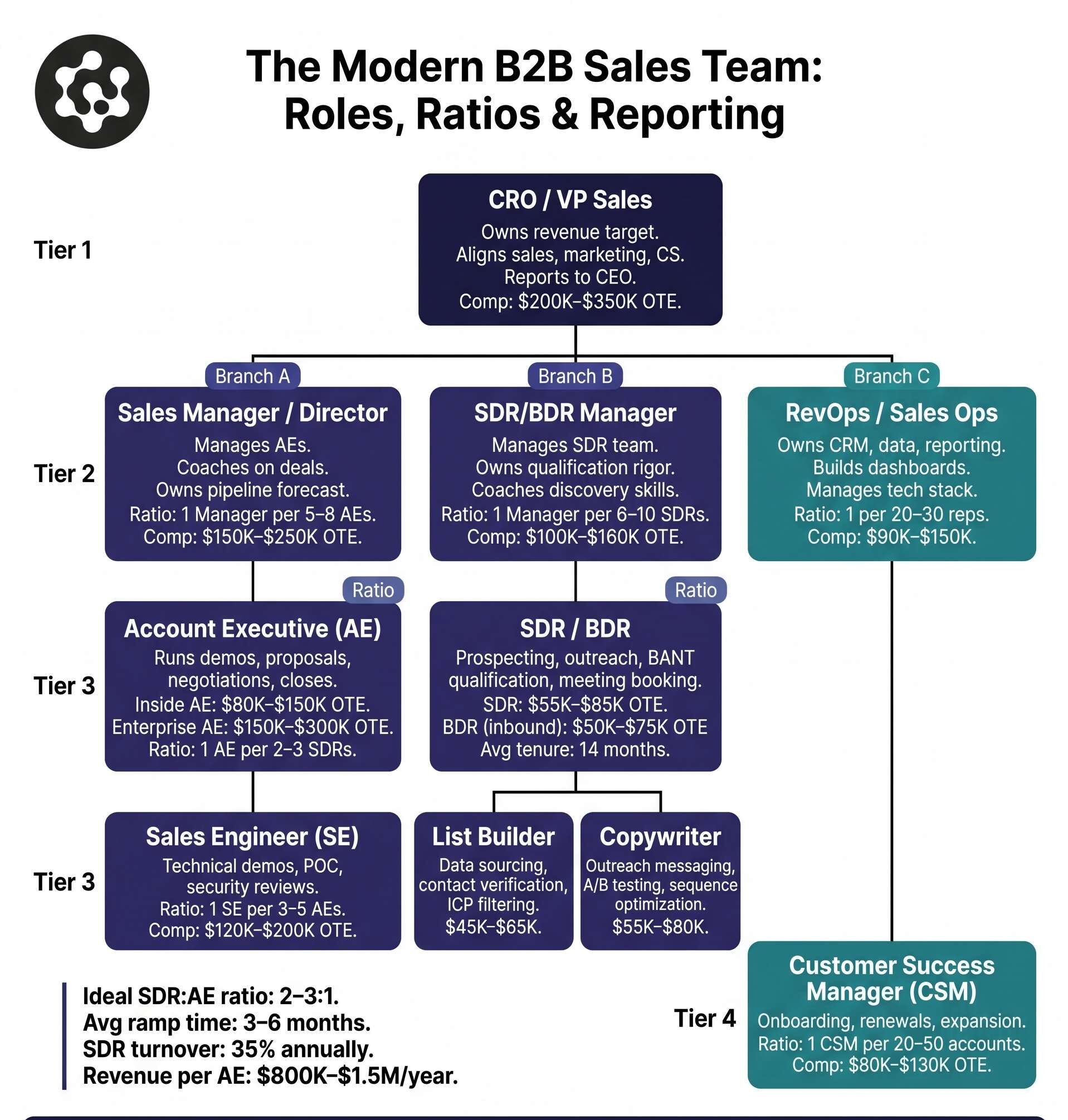
SDR vs. Inside Sales vs. BDR: Key Differences
While SDR, Inside Sales, and BDR roles overlap in some areas, their focus, approach, and objectives set them apart:
| Aspect | SDR | Inside Sales | BDR |
|---|---|---|---|
| Primary Focus | Qualifying inbound leads | Lead qualification and deal closing | Generating outbound leads |
| Lead Source | Inbound (marketing-driven) | Inbound and outbound | Outbound (cold outreach) |
| Key Activities | Email outreach, call scheduling, lead filtering | Lead nurturing, deal negotiation, closing | Cold calling, social selling, relationship building |
| Success Metrics | SALs, meeting bookings | Revenue, close rates | Lead quality, pipeline growth |
| Experience Level | Entry-level (1-2 years) | Mid to senior-level | Entry to mid-level |
Understanding these distinctions helps recruiters and managers assign the right roles to the right candidates, ensuring alignment with business needs.
SDR, BDR, and Inside Sales KPIs: How to Measure Each Role
The Real Problem: Why Traditional SDR/BDR Models Are Failing
Knowing the roles is one thing. Knowing what to measure — and what not to measure — is what determines whether your sales development investment generates pipeline or generates noise.
Most companies make the same mistake: they measure activity. Dials per day. Emails sent. Meetings booked. These metrics are easy to track and easy to game. A rep who knows they’re measured on volume will optimise for volume, not quality — booking soft meetings, accepting vague qualification answers, and passing half-interested prospects to AEs who have to re-qualify from scratch.
The KPIs that actually correlate with revenue look different.
| Role | Primary KPIs (Revenue-Correlated) | Activity KPIs (Context Only) |
|---|---|---|
| SDR | Sales-Accepted Lead (SAL) rate, BANT compliance rate, meeting-to-SQL conversion | Inbound response time, email reply rate, meetings booked |
| BDR | Pipeline value created, opportunity-to-close rate, ICP match rate | Outreach volume, connect rate, meetings booked |
| Inside Sales / AE | Revenue closed, close rate, average contract value (ACV), sales cycle length | Demo-to-proposal rate, follow-up cadence |
The metric that matters most across all three roles: the percentage of meetings booked that convert to a qualified sales opportunity (SQL). If your SDRs and BDRs are booking 40 meetings a month but only 8 become real opportunities, you have a qualification problem — regardless of how impressive the activity numbers look.
The BANT compliance rate is the most underused SDR/BDR metric in B2B sales. It measures the percentage of booked meetings where Budget, Authority, Need, and Timeline were all verified before the meeting was scheduled — with specifics, not vague answers. Teams that track and enforce this metric consistently report 30–50% fewer wasted AE hours within 90 days.
Here’s what the industry doesn’t talk about: 87% of marketing-generated leads are rejected by sales teams. The traditional MQL-to-SQL funnel is fundamentally broken.
The Root Causes:
- Conflicting Incentives: Internal SDRs and BDRs are paid for activity (meetings booked), not outcomes (deals closed). When quota pressure hits, quality disappears.
- Checkbox BANT: Most teams claim to qualify on Budget, Authority, Need, and Timeline—but in practice, they accept vague answers like “they said they’re interested” or “they’ll let us know.”
- No Accountability: When an appointment is unqualified, who pays? Your AE wastes an hour. Your pipeline suffers. But the SDR already hit their number.
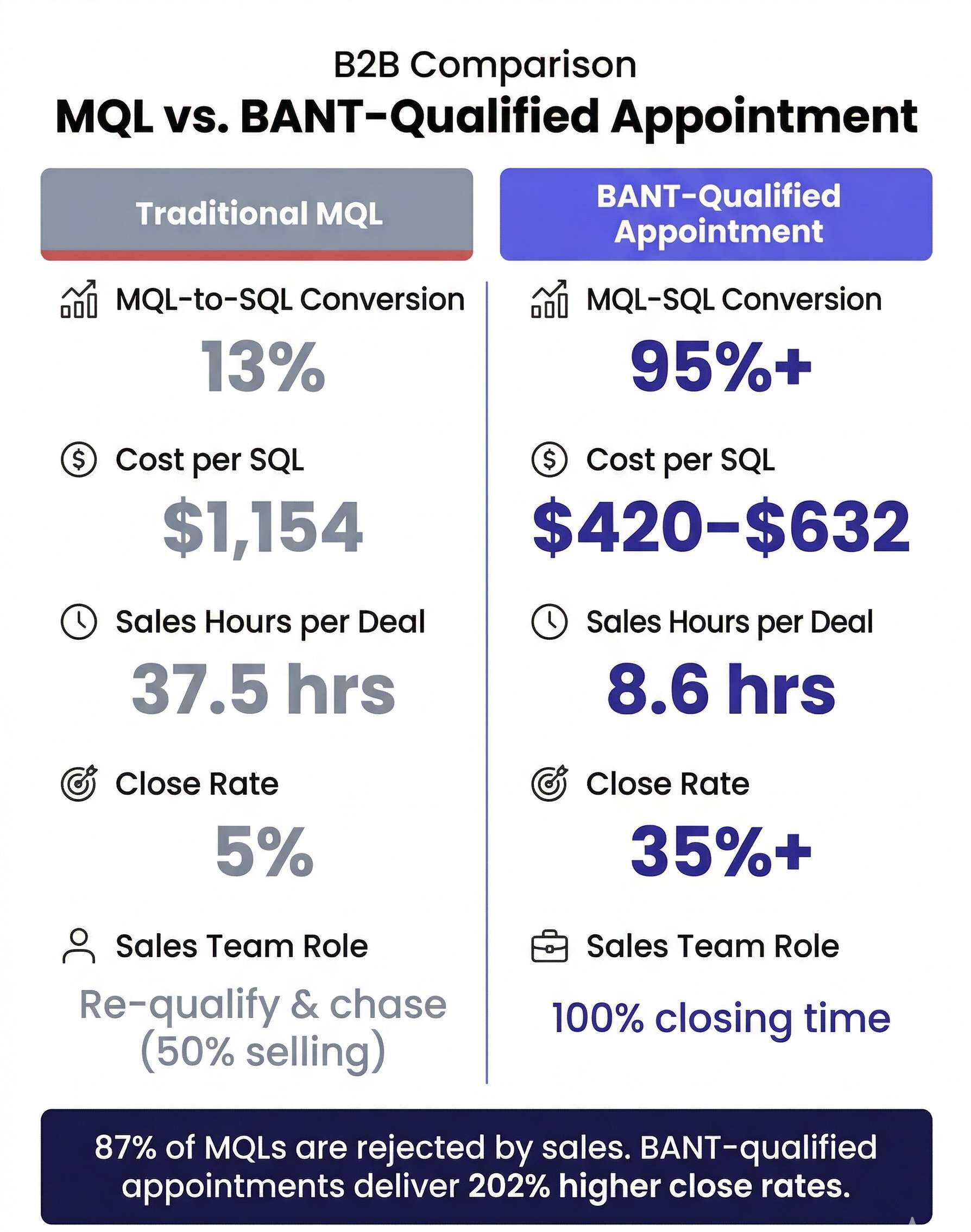
The Data is Brutal:
- Traditional MQL-to-SQL conversion: 13%
- Cost per SQL with MQL model: $1,154
- Hours wasted per SQL: 8-12 hours of AE time chasing, re-qualifying, and following up with tire-kickers
The Solution: BANT-Qualified Appointments That Actually Convert
What if you could bypass the MQL black hole entirely and deliver only prospects who have confirmed budget, decision-making authority, active business need, and a purchase timeline of 1-6 months?
That’s the difference between paying for leads and paying for outcomes.
The Economics of BANT-Qualified Appointments:
| Metric | Traditional MQL Model | BANT-Qualified Appointment Model |
|---|---|---|
| Cost per lead/appointment | $150/MQL | $400-600/appointment |
| Conversion to SQL | 13% | 95%+ |
| Cost per SQL | $1,154 | $420-632 |
| Sales hours wasted | 8-12 hours per SQL | <1 hour (pre-qualified) |
| AE satisfaction | 3.8/10 | 9.2/10 |
With BANT-qualified appointments, your sales team stops wasting time on tire-kickers and starts closing deals with buyers who are ready to purchase.
The “Cyborg” SDR Model: AI for Research, Humans for Relationships
The future of sales development isn’t 100% AI or 100% human. It’s the hybrid “Cyborg” model that combines the speed and data capabilities of AI with the trust-building and diagnostic expertise of human professionals.
How It Works:
AI Handles Scale:
- Scores prospects by propensity to buy
- Identifies real-time intent signals (content consumption, job changes, hiring patterns)
- Prioritizes outreach based on data, not guesswork
- Tests and optimizes messaging at scale
Humans Handle Value:
- Conduct consultative discovery conversations (Beyond BANT)
- Build trust through empathy and expertise
- Uncover buying committee dynamics and budget processes
- Capture objections and competitive intelligence
The Result: The AI-Amplified Appointment Handover (AHO)
Every qualified appointment includes a comprehensive intelligence brief so your AE walks in 100% prepared to close—not wasting 15 minutes on discovery questions the SDR already covered.
A typical AHO includes human-verified BANT confirmation, AI-verified intent data (content consumed, propensity score, company signals), key frustrations and success criteria captured verbatim, buying committee mapping with budget owner identified, competitive intelligence (what else they’re evaluating), and recommended talk tracks with pre-mapped objection handling.
How DemandNexus Transforms SDR, BDR, and Inside Sales Performance
At DemandNexus, we don’t measure success by leads generated, emails sent, or dials made. We measure success by appointments scheduled on your calendar—appointments that have been BANT-verified by humans who understand your business.
| Attribute | SDR | BDR | Inside Sales |
|---|---|---|---|
| Primary focus | Qualifying inbound leads | Generating outbound pipeline | Closing deals remotely |
| Lead source | Marketing / inbound | Self-sourced outbound | Qualified opportunities |
| Core KPI | Qualified meetings, response time | Outbound meetings, pipeline created | Win rate, quota, ACV |
| Typical tools | CRM, lead routing, dialer | Sequencer, intent data, dialer | CRM, demo, e-signature |
| Reports to | Sales or marketing | Sales | Sales |
| Hire first when | Inbound volume exceeds follow-up | Need net-new outbound pipeline | Repeatable remote close motion |
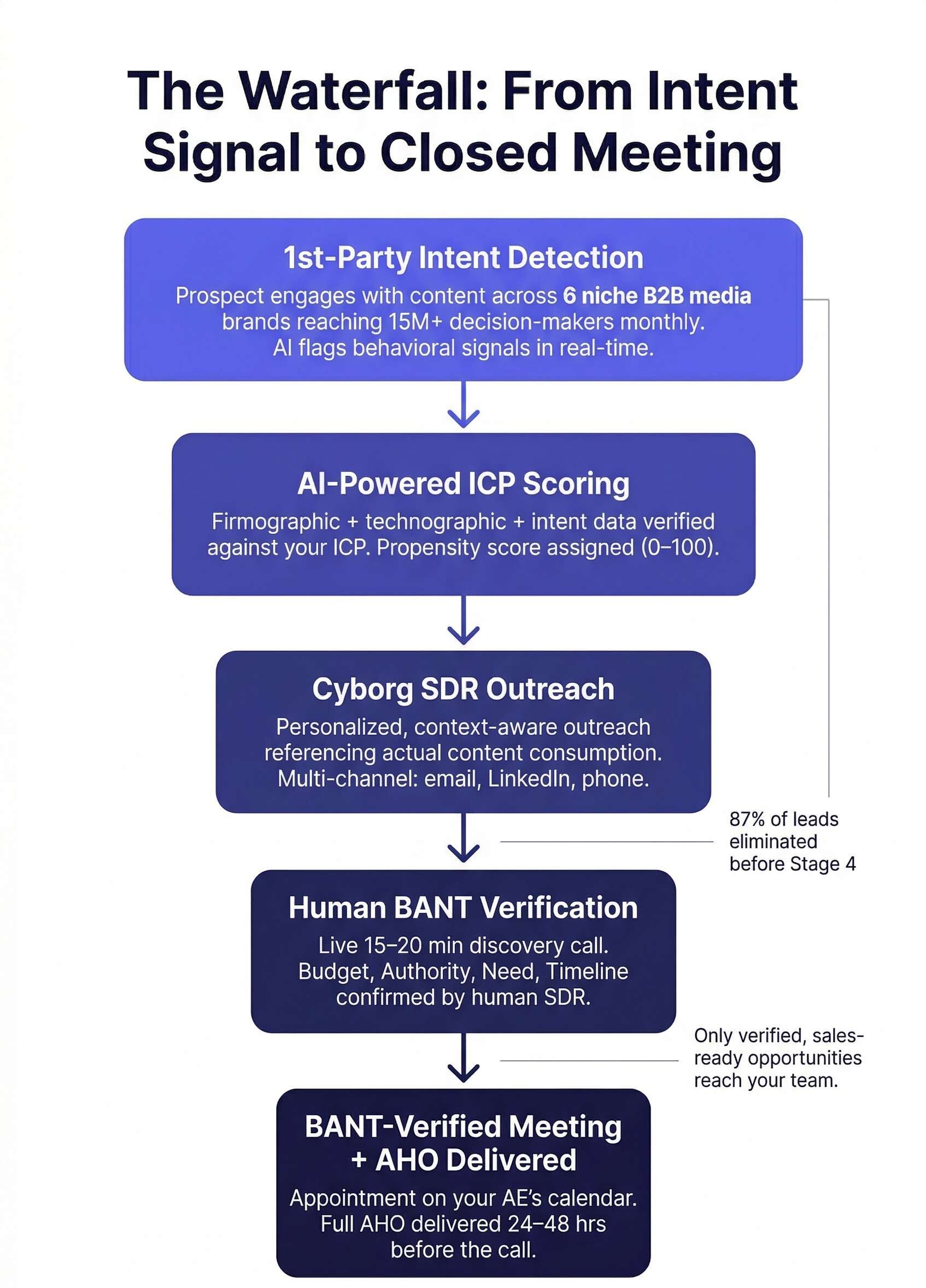
Our 8-Person “Instant Pod” Delivers:
- 90% Appointment Conversion Rate (vs. 50-70% for in-house teams)
- 95% BANT Compliance Rate (vs. 50-60% in-house under quota pressure)
- <5% Disqualification Rate after AE meetings (vs. 25-30% in-house)
- 35%+ Close Rate on qualified appointments
The Guarantee: If we deliver fewer than 15 BANT-qualified appointments in any month, you don’t pay for the shortfall—and we make up the difference the following month at no charge. If a prospect no-shows, we replace them within 5 days at no cost.
Which Model Is Right for Your Business?
Choosing between building internal SDR/BDR teams or leveraging a BANT-qualified appointment model depends on your company’s size, goals, and sales strategy:
Build Internal Teams When:
- You have 12+ months to ramp and optimize
- You have dedicated sales management bandwidth
- You’re willing to accept 50-70% of meetings being unqualified during the learning curve
- You have budget for $75K+/year fully loaded cost per SDR
Partner for BANT-Qualified Appointments When:
- You need pipeline now, not in 6 months
- Your AEs are wasting time on unqualified calls
- You want guaranteed outcomes, not activity metrics
- You need to scale without adding headcount and management overhead
The ROI Math:
| Model | Annual Cost | Meetings/Year | Qualified Rate | SQLs | Close Rate | Deals |
|---|---|---|---|---|---|---|
| In-House SDR | $75K+ | 480 | 30% | 144 | 20% | 29 |
| Traditional PPL | $60K | 120 | 13% | 16 | 18% | 3 |
| DemandNexus Waterfall | $66K | 180+ | 95%+ | 171+ | 35%+ | 60+ |
Should You Hire an Internal SDR/BDR Team or Outsource Sales Development?
This is the real question for most VP of Sales and CROs reading this article — and the honest answer depends on where you are in your growth cycle.
The case for building internally:
An internal SDR or BDR team gives you full control over messaging, culture, and institutional knowledge. Over time, reps who know your product deeply can have more sophisticated qualification conversations. If you’re in a highly technical or regulated space where deep domain expertise is a prerequisite for credibility, internal often wins.
The catch: it takes 6–12 months to see meaningful ROI from an internal hire. You need to recruit, onboard, ramp, and manage — and during that period, you’re still responsible for quota. The fully loaded cost of a single SDR (salary, benefits, tools, management overhead, training) typically runs $75,000–$95,000 per year before they’ve booked their first qualified meeting.
The case for outsourcing:
The catch: not all outsourced SDR providers are equal. Most sell leads or “meetings booked” — volume metrics with no accountability for quality. The question to ask any outsourced partner isn’t “how many meetings do you book?” It’s “what percentage of your meetings convert to SQLs, and what happens when they don’t?”
The decision framework:
| Build Internal When | Outsource When |
|---|---|
| You have 12+ months to ramp | You need pipeline in 30–60 days |
| You have dedicated SDR management capacity | Your sales leadership bandwidth is fully committed |
| Your product requires deep domain expertise to qualify | Your ICP is well-defined and your BANT criteria are clear |
| You’re willing to absorb 50–70% unqualified meetings during ramp | You want accountability for meeting quality, not just volume |
| Budget: $75K+ per head, per year | Budget: pay-per-meeting with performance guarantees |
Building and managing these roles in-house is slow and expensive, and most teams discover that volume-based incentives push reps to book unqualified meetings. An outsourced Cyborg SDR pod replaces that model with a dedicated eight-person team – five SDRs, a team lead, a copywriter, and a list builder — that books BANT-qualified meetings on a pay-per-meeting-held basis, with a 90% show rate and any no-show replaced within five business days.
What DemandNexus does differently:
Most outsourced SDR providers hand you a list or a “meeting booked” notification and move on. DemandNexus delivers a BANT-verified appointment with a full Appointment Handover Sheet (AHO) — a structured intelligence brief that includes the prospect’s confirmed budget, authority mapping, specific pain points in their own words, timeline drivers, competitive context, and a recommended opening for your AE.
Your AE doesn’t walk into a discovery call. They walk into a closing conversation.
Every engagement is backed by a monthly meeting SLA guarantee: if we deliver fewer than the agreed number of BANT-qualified appointments in any month, you don’t pay for the shortfall — and we make it up the following month at no charge.
Best Practices for Maximizing Sales Development ROI
Whether you build internally or partner externally, these principles drive results:
1. Measure What Matters: Stop tracking activity metrics (dials, emails, meetings booked). Start tracking revenue-correlated metrics: BANT compliance rate, SQL conversion rate, close rate, and cost per closed deal.
2. Eliminate Conflicting Incentives: If your SDRs/BDRs are paid for volume, they’ll deliver volume. If they’re paid for quality, they’ll deliver quality. Align compensation with outcomes, not activity.
3. Demand Full Qualification Before Handoff: Every meeting should have verified Budget, Authority, Need, and Timeline—with specifics, not vague answers. “They said they’re interested” is not qualification.
4. Arm Your AEs with Intelligence: Don’t hand off a calendar invite with a name and company. Provide comprehensive context: pain points, budget process, timeline drivers, buying committee, competitive landscape, and recommended talk tracks.
5. Create Accountability Loops: If an appointment is unqualified, someone should feel it. Whether that’s a replacement guarantee from a partner or internal consequences for SDRs who skip qualification, accountability drives quality.
Conclusion: Stop Paying for Activity. Start Investing in Accountability.
Understanding the differences between SDR vs. Inside Sales vs. BDR is essential for building a robust B2B sales strategy. SDRs qualify inbound leads, BDRs generate outbound opportunities, and Inside Sales reps focus on closing deals—each playing a unique role in the sales funnel.
But knowing the roles isn’t enough. The real differentiator is quality—delivering BANT-qualified appointments that your AEs are eager to work because they convert.
The choice is yours:
- Continue feeding the MQL black hole and watching 80% of your leads evaporate
- Or embrace BANT qualification and start delivering meetings that actually convert
Ready to transform your pipeline?
Stop paying for leads. Start paying for appointments. Stop paying for activity. Start paying for accountability.
Contact DemandNexus at sales@demandnexus.io for a Strategy Alignment Call where we’ll cover your ICP & BANT criteria, your sales team structure, and your 90-day roadmap to 15+ guaranteed qualified appointments per month.
FAQs
What does SDR stand for in sales?
SDR stands for Sales Development Representative. An SDR is a B2B sales role focused on qualifying inbound leads and booking meetings for Account Executives. SDRs typically do not close deals — their job is to ensure that only sales-ready prospects reach the AE's calendar.
What does BDR stand for in sales?
BDR stands for Business Development Representative. A BDR focuses on outbound prospecting — identifying cold or warm prospects, initiating contact, and qualifying them before passing opportunities to Account Executives. BDRs generate new pipeline from scratch rather than responding to inbound interest
What is the difference between an SDR and a BDR?
The core difference is lead direction. SDRs work inbound — qualifying leads that marketing has already generated. BDRs work outbound — prospecting cold accounts with no prior engagement. SDRs respond to interest; BDRs create it.
What is inside sales?
Inside sales refers to sales professionals who conduct their work remotely — via phone, email, or video — rather than in face-to-face meetings. Inside sales is a broad category that can include SDRs, BDRs, and Account Executives, depending on how a company structures its team. In common usage, "inside sales rep" often refers to a more senior role that both qualifies leads and closes deals.
What is an inbound SDR?
An inbound SDR is a Sales Development Representative whose primary focus is responding to and qualifying inbound leads — prospects who have engaged with marketing content, filled out a form, requested a demo, or otherwise raised their hand. Inbound SDRs are distinct from BDRs, who initiate outbound prospecting with no prior engagement from the prospect.
What KPIs should I use to measure SDR and BDR performance?
The most revenue-correlated KPIs for SDRs are: Sales-Accepted Lead (SAL) rate, BANT compliance rate, and meeting-to-SQL conversion rate. For BDRs: pipeline value created, ICP match rate, and opportunity-to-close rate. Activity metrics (dials, emails, meetings booked) provide context but should not be primary performance drivers — they incentivise volume over quality.
Should I hire an internal SDR team or use an outsourced sales development agency?
It depends on your timeline and management capacity. Build internally if you have 12+ months to ramp, dedicated SDR management, and budget for $75K–$95K per head fully loaded. Outsource if you need qualified pipeline in 30–60 days, your leadership bandwidth is committed elsewhere, or you want performance accountability (paying per qualified meeting, not per activity). The key question for any outsourced partner: what is their meeting-to-SQL conversion rate, and what is their no-show/replacement policy?
How should SDRs and BDRs be aligned within a sales team?
SDR/BDR alignment works best when both roles share a common qualification standard (such as BANT), use a shared CRM with consistent handoff documentation, and are accountable to the same downstream metric — meeting-to-SQL conversion rate. Misalignment typically occurs when SDRs optimise for inbound volume and BDRs optimise for outbound activity, while AEs are left re-qualifying both. Introducing a structured handoff process — such as an Appointment Handover Sheet (AHO) — that documents qualification findings before each meeting is one of the most effective ways to eliminate this gap.
Is an SDR the same as a BDR?
No. An SDR typically qualifies inbound leads generated by marketing, while a BDR sources outbound pipeline by prospecting cold accounts. The roles overlap in skills but differ in lead source and primary metric.
Which should you hire first, an SDR or a BDR?
Hire SDRs first when inbound lead volume is outpacing reps’ ability to follow up. Hire BDRs first when there is little inbound and the team needs to manufacture net-new pipeline through outbound prospecting.
What is the difference between inside sales and an SDR?
Inside sales reps own the full remote sales cycle through to close and carry a revenue quota. SDRs handle the earlier qualification stage and are measured on qualified meetings booked, not closed revenue.
Do SDRs and BDRs report to sales or marketing?
SDRs may report to either sales or marketing depending on whether the motion is inbound-led, while BDRs almost always report to sales because their outbound pipeline work is tied directly to revenue targets.