



In B2B sales, first impressions are everything. But here’s a truth most sales leaders don’t want to hear: the problem isn’t how your team handles meetings it’s which meetings they’re taking in the first place.
The traditional appointment-setting model is broken. Your SDRs are booking meetings with anyone who shows a pulse, your AEs are wasting 30+ hours a week re-qualifying “leads” that should never have made it to their calendar, and your close rates hover somewhere between disappointing and dismal.

Most B2B teams lose 40–60% of qualified prospects to broken handoffs and weak qualification. Take our 2-minute diagnostic to find out where your pipeline is bleeding — and how to fix it.
Start the Quiz → Takes 2 minutes. No email required to start.That’s where BANT-qualified appointment generation changes everything. At DemandNexus, we don’t just set appointments we deliver BANT-verified, sales-ready opportunities backed by proprietary first-party intent data and comprehensive handover documentation that prepares your AEs to win.
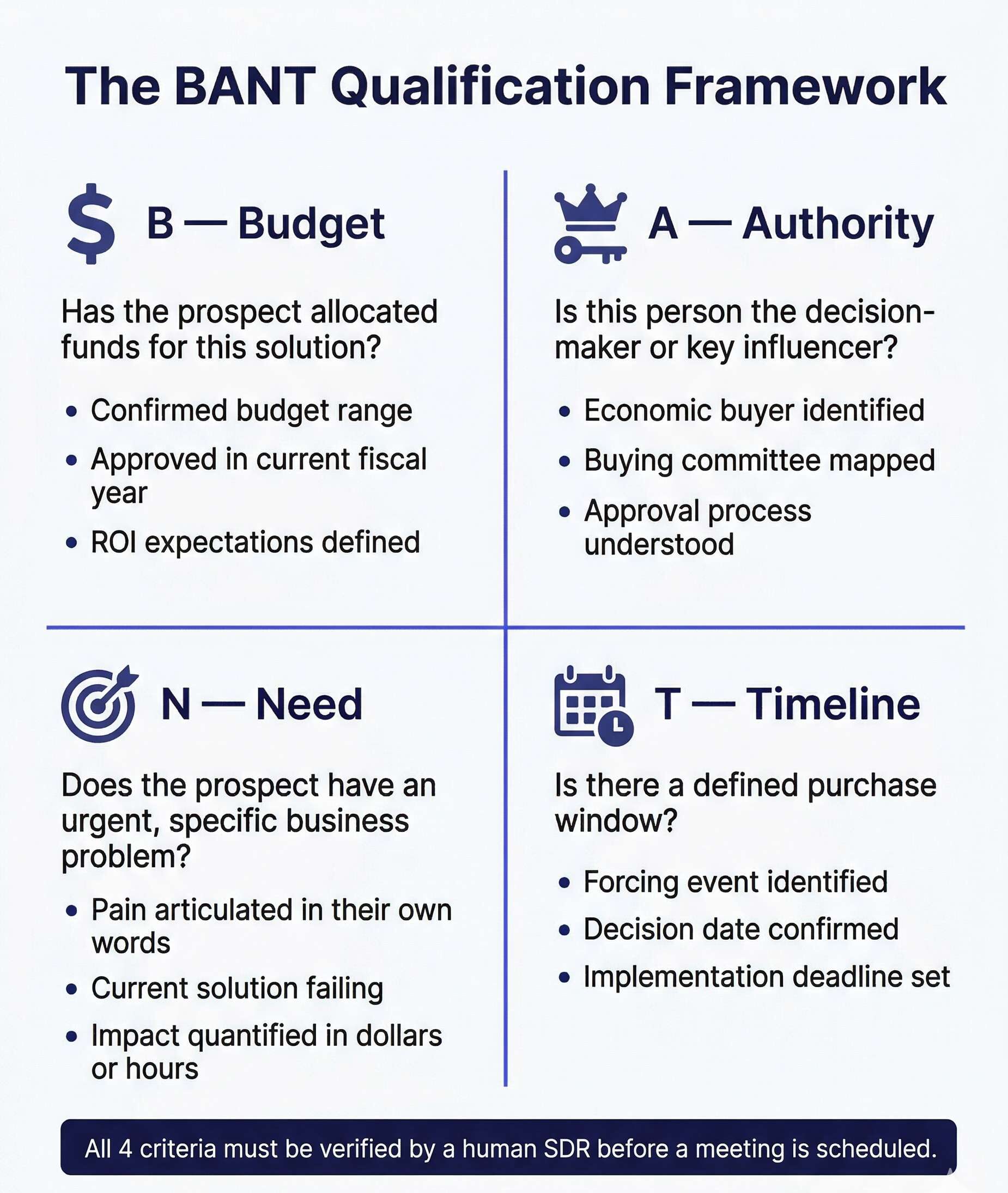
This guide explains why the traditional appointment-setting model fails, how BANT qualification transforms your pipeline, and why DemandNexus’s Waterfall model delivers 90%+ qualified appointments that convert at 3X the rate of typical marketing leads.

What Does an Appointment Setter Do? Key Duties & Responsibilities
An appointment setter is a sales development professional responsible for one specific outcome: getting a qualified prospect onto a sales call with a closing representative. But the day-to-day work behind that outcome is more rigorous than most people realize.
Here’s what a high-performance appointment setter does and what separates a genuine revenue contributor from a calendar-filler.

Core Appointment Setter Duties
- Prospect Research & List Building
Before a single outreach attempt is made, appointment setters identify and profile target accounts. This means verifying company size, industry, tech stack, recent news (funding rounds, leadership changes, product launches), and in intent-driven models flagging accounts showing active buying signals. The quality of this research directly determines the quality of every conversation that follows.
- Outbound Outreach (Cold Calling & Cold Email)
Appointment setters are the first human touchpoint in your sales process. Their job is to initiate contact with decision-makers via phone, email, and LinkedIn and to earn a conversation, not just a reply. This requires a sharp understanding of the prospect’s pain points and a message that leads with relevance, not pitch mechanics.
- BANT Qualification
This is where elite appointment setters separate themselves from average ones. Booking a meeting is easy. Booking the right meeting with a prospect who has confirmed Budget, Authority, Need, and Timeline requires structured qualification, the ability to ask probing follow-up questions, and the discipline to disqualify prospects who aren’t ready to buy. An appointment setter who can’t do this costs your AEs more time than they save.
- Objection Handling
Prospects don’t say yes on the first call. Appointment setters encounter gatekeepers, “we’re not interested,” “send me some information,” and “call me next quarter” dozens of times per day. Handling these objections without being pushy while staying in control of the conversation is a core competency, not a bonus skill.
- CRM Documentation
Every qualified prospect must be documented in full. Verbatim quotes, BANT scores, decision-making process, competitive context, and any objections raised all need to be captured immediately after the call. Poor documentation leads to poor handoffs. Poor handoffs lead to lost deals.
- Appointment Handover Preparation
In a high-quality appointment generation model, the setter’s job doesn’t end when the meeting is booked. They’re responsible for preparing a comprehensive briefing covering the prospect’s pain points, qualification proof, competitive landscape, and recommended opening so the AE walks in prepared to close, not to discover.
- Follow-Up & No-Show Recovery
Prospects go cold. Calendar conflicts arise. Appointment setters manage the entire pre-meeting lifecycle: confirmation reminders, rescheduling no-shows, and re-engaging prospects who fall out of contact after initial interest. Meeting hold rate is a key performance indicator for any appointment setter worth hiring.
Appointment Setter Job Description: What to Expect
If you’re evaluating a job description for an appointment setter role or building one the core responsibilities should include:
- Conducting 50–80 outbound touchpoints per day (calls + emails)
- Achieving a BANT qualification rate of 80%+ on booked meetings
- Maintaining CRM hygiene with same-day documentation
- Delivering pre-meeting handover documentation within 24–48 hours of booking
- Hitting a monthly meeting quota with defined quality standards not just volume
The difference between a good appointment setter job description and a bad one is the presence of quality metrics. If the only KPI listed is “meetings booked per month,” you’ll get calendar filler, not pipeline.
The Problem with Traditional Appointment Setting
Most appointment setters operate on a simple but flawed premise: book as many meetings as possible and hope some convert. This volume-over-quality approach creates three critical problems.
First, there’s the qualification gap. Traditional SDRs are incentivized by meeting volume, not meeting quality. Under quota pressure, “they seemed interested” becomes good enough. The result? 70% of meetings are unqualified, according to sales leaders we work with.
Second, your AEs become expensive qualifiers. When AEs spend the first 15 minutes of every call asking basic discovery questions. Do you have budget? Are you the decision-maker? What’s your timeline? they’re doing work that should have been completed before the meeting was booked. That’s not selling time; that’s wasted time.
Third, there’s the data black hole. Most appointment-setting services deliver a calendar invite with a name and company. That’s it. Your AE walks in blind, delivers a generic pitch, and wonders why the prospect goes cold.
How Does Appointment Setting Work? The Step-by-Step Process
Appointment setting sounds simple in theory: find prospects, call them, book meetings. In practice, the process that separates a 10% meeting-to-close rate from a 35%+ rate is far more structured. Here’s how a rigorous appointment setting campaign actually works, from start to finish.
Step 1: Ideal Customer Profile (ICP) Definition
Before any outreach begins, the appointment setter or the agency running the campaign needs to define exactly who qualifies as a target. This includes firmographic criteria (company size, industry, revenue, geography), technographic criteria (current tools in use, integrations needed), and behavioral criteria (growth signals, hiring patterns, recent funding). A vague ICP produces a burned-out list. A precise ICP produces a pipeline.
Step 2: Intent Signal Identification
The best appointment setting operations don’t start with cold lists they start with warm signals. First-party intent data (content consumption, event attendance, direct engagement with owned media properties) identifies prospects who are actively researching solutions in your category before they’ve ever heard of you. This shifts the opening conversation from interruption to relevance.
At DemandNexus, this is powered by six proprietary B2B media brands AITechTrend, MarTechTrend, DevTechTrend, HRTechTrend, FinTechFilter, and LegalTechTrend that capture real-time buying signals from 15M+ monthly decision-makers. When our SDRs reach out, they’re following up on demonstrated interest, not guessing.
Step 3: Outreach Sequencing
Once targets are identified, the setter executes a multi-touch outreach sequence typically a combination of cold calls, personalized emails, and LinkedIn touchpoints across 10–15 days. The sequence is designed to earn a response, not just deliver volume. Each touchpoint should reference something specific to the prospect’s situation, not a generic value proposition.
Step 4: Discovery & BANT Qualification Call
When a prospect engages, the setter conducts a structured qualification conversation. This is the most critical step in the entire process. The setter’s job is to verify all four BANT elements Budget, Authority, Need, and Timeline through direct questions, probing follow-ups, and active listening. This call typically runs 15–20 minutes. Vague or unconfirmed answers on any element should result in a soft disqualification or a nurture handoff, not a forced booking.
Step 5: Meeting Booking & Expectation-Setting
Once BANT is confirmed, the setter books the meeting with a clear agenda. Critically, the setter also sets expectations with the prospect: what the meeting will cover, who will be on the call, and what the logical next step will be. This reduces no-show rates and ensures the prospect shows up prepared for a substantive conversation.
Step 6: Documentation & Handover
Post-qualification, the setter documents the full conversation in the CRM verbatim quotes, BANT scores, competitive context, objections raised, and buying committee structure. This data feeds directly into the Appointment Handover Sheet (AHO): the briefing document delivered to the AE 24–48 hours before the meeting.
Step 7: Quality Assurance Review
In a well-run appointment generation program, not every booked meeting goes straight to the AE’s calendar. A QA review peer review, manager audit, or AI-assisted call analysis verifies BANT compliance before the meeting is confirmed as billable. This step is the difference between a 60% qualification rate and a 90%+ qualification rate.
Step 8: AE Meeting & Feedback Loop
The setter’s accountability doesn’t end at the handover. Post-meeting AE feedback did the prospect match the qualification notes? did the meeting advance? closes the loop and directly informs setter coaching. In a pay-for-performance model, this feedback loop is what drives continuous improvement in meeting quality over time.
B2B Appointment Setting: Why It’s Different (and Harder)
Appointment setting in a B2B context operates under fundamentally different constraints than consumer sales or transactional outreach. If you’ve tried to apply high-volume, low-qualification tactics to enterprise or mid-market B2B targets, you already know this the hard way.
Here’s what makes B2B appointment setting structurally more complex and what it actually takes to do it well.
Multiple Decision-Makers, Not One
B2B purchases above a certain deal size rarely involve a single buyer. A typical mid-market software deal involves 6–10 stakeholders: an economic buyer (usually a C-suite executive), a technical evaluator, an end-user champion, and sometimes a procurement or legal gatekeeper. An appointment setter who books a meeting with the wrong person someone doing research for their manager, or a technical evaluator with no budget authority wastes an AE’s time and inflates meeting volume with zero pipeline impact.
Effective B2B appointment setting means identifying exactly where in the buying committee the prospect sits, and either booking with the right person directly or mapping a clear path to them.
Longer Sales Cycles Demand Higher Qualification Standards
A consumer purchase takes minutes. A B2B SaaS deal with a six-figure ACV takes 3–9 months and involves legal review, security assessments, procurement processes, and budget cycles. Booking a meeting with a prospect who has a vague 12-month timeline and no confirmed budget allocation doesn’t generate pipeline it generates noise.
This is why BANT qualification is non-negotiable in B2B appointment setting. A prospect without a confirmed timeline or an accessible economic buyer is not a qualified appointment. They’re a lead. And there’s a critical difference between the two.
Personalization at Scale Is a Core Competency
B2B decision-makers receive dozens of outreach attempts every week. The bar for earning a response has risen sharply. Generic value propositions, “just checking in” follow-ups, and spray-and-pray email sequences produce diminishing returns. B2B appointment setters who consistently book quality meetings do so because they lead every touchpoint with prospect-specific context: a recent company announcement, a role-specific pain point, or a signal indicating active evaluation.
This is where first-party intent data creates a structural advantage. Instead of guessing at what a prospect might care about, intent-driven appointment setting starts from demonstrated buying behavior allowing setters to open conversations with context that immediately establishes credibility and earns the right to a meeting.
The Setter and Closer Model in B2B Sales
In B2B sales organizations, roles are increasingly separated between setters (SDRs or BDRs) and closers (Account Executives). The setter’s job is to fill the AE’s calendar with qualified, sales-ready conversations. The AE’s job is to run those conversations and close deals. When this division of labor works correctly, AEs spend 80%+ of their time in revenue-generating conversations rather than prospecting and qualifying.
When it breaks down usually because setters aren’t held to quality standards AEs become expensive qualifiers who spend the first 20 minutes of every call doing work that should have been completed before the meeting was booked.
The fix isn’t better AEs. It’s better appointment setters.
What a Qualified B2B Appointment Actually Looks Like
A qualified B2B appointment is not a calendar invite. It’s a verified commitment from a prospect who:
- Has confirmed budget allocation (or a clear, documented path to securing it)
- Is the economic buyer or a direct influencer with decision-making access
- Has articulated a specific, quantified pain point that your solution addresses
- Has a defined buying timeline within 1–6 months, anchored to a real forcing event (contract renewal, product launch, compliance deadline)
Anything short of this is a lead, not an appointment. Treating the two as equivalent is the root cause of the pipeline quality problem most B2B sales teams are dealing with right now.
What BANT Qualification Actually Means
BANT – Budget, Authority, Need, Timeline is the gold standard for B2B lead qualification, developed by IBM and still used by elite sales organizations worldwide. But here’s what most companies get wrong: they treat BANT as a checklist rather than a rigorous verification process.
At DemandNexus, we score each BANT element on a 1-5 scale with specific verification criteria.
For Budget, we verify that funds are allocated or securable within 90 days. We ask questions like “What budget have you allocated for this initiative?” and “How is this type of purchase typically funded at your company?” Vague answers like “I’ll need to check with finance” trigger disqualification.
For Authority, we confirm the prospect is the economic buyer or a direct influencer with C-suite access. We map the entire buying committee and decision-making process. If someone is “just doing research for their boss,” they don’t qualify.
For Need, we document specific, quantified pain points in the prospect’s own words. We ask “What happens if you don’t solve this problem?” and “What’s this costing you today?” General curiosity isn’t a need active, urgent pain is.
For Timeline, we verify a specific buying window within 1-6 months with a forcing event like a contract renewal, budget cycle, product launch, or compliance deadline. “Sometime next year” or “no specific timeline” means they’re not ready to buy.
Our minimum qualification threshold is a 4.0 average across all four elements. Anything below that doesn’t get passed to your sales team.
The DemandNexus Waterfall: Pay for Appointments, Not Activity
The traditional pay-per-lead model is fundamentally broken. You pay for lists of contacts who clicked a link or downloaded a whitepaper people who have shown activity, not buying intent. Then your team spends weeks chasing prospects who were never qualified to begin with.
Our Waterfall model flips this entirely. You only pay for BANT-verified, scheduled meetings that appear on your sales team’s calendar. If a prospect no-shows, we replace the meeting within 5 business days at no charge. If a meeting doesn’t meet your BANT criteria after the fact, we don’t bill you.
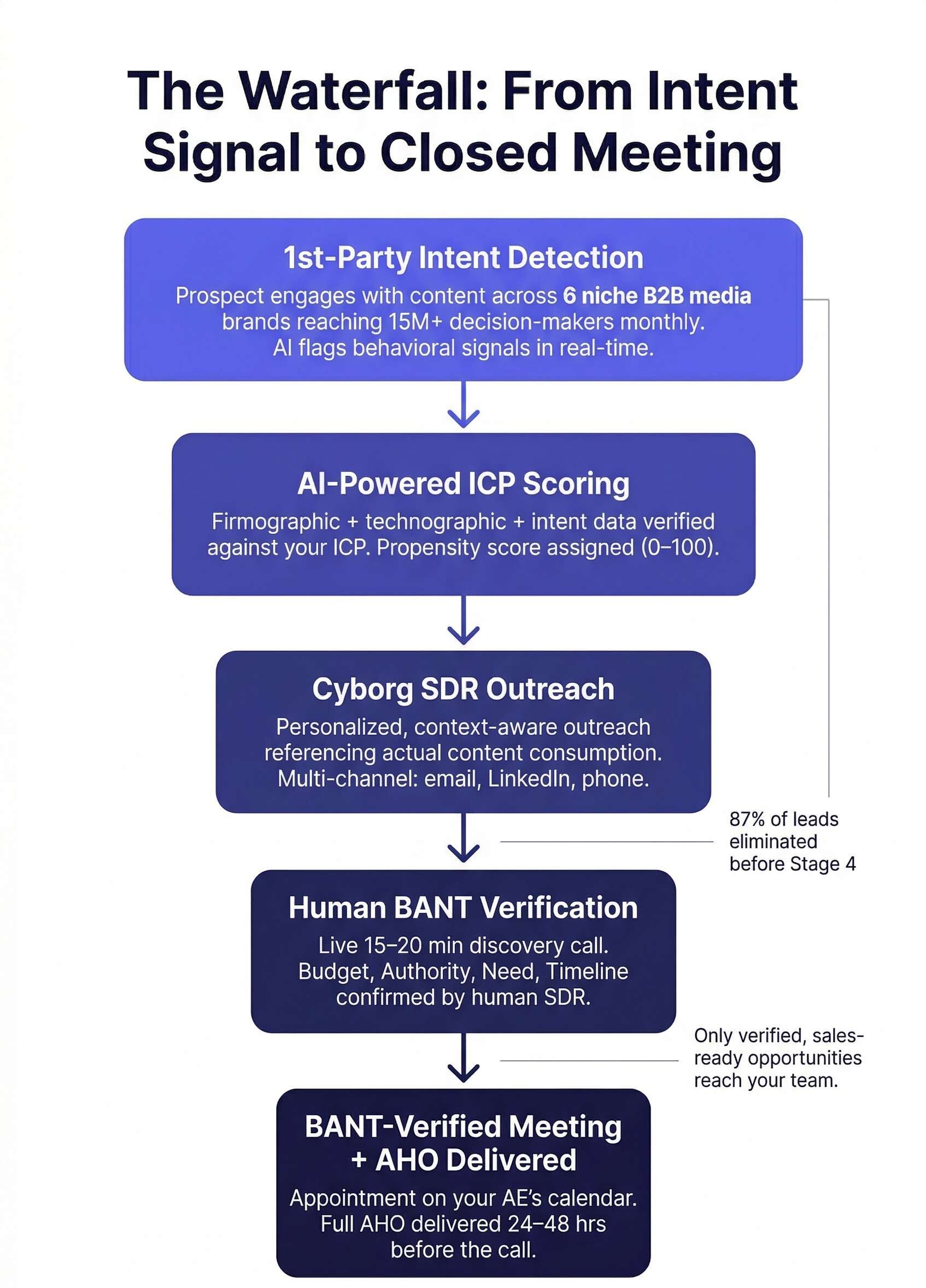
This isn’t incremental improvement it’s a fundamentally different accountability structure. We bear the qualification risk, not you.
Here’s how the numbers compare:
| Factor | In-House SDR Team | Traditional PPL Vendor | DemandNexus Waterfall |
|---|---|---|---|
| Monthly Cost | $62,500+ | $5,000 | $7,500-$16,000 |
| Meetings/Month | ~60 | ~10 | 15-40+ |
| Meeting Quality | Unverified | Low-intent | BANT-verified |
| AE Qualification Time | 30 hrs/week | 20 hrs/week | <5 hrs/week |
| Close Rate | ~20% | ~5% | ~35%+ |
| Cost Per Closed Deal | $5,208+ | $10,000 | $1,220-$1,500 |
| Annual ROI | 40-60% | 10-20% | 120-180%+ |
The Intent Engine: How First-Party Data Changes Everything
Traditional appointment-setting services buy cold lists or use generic syndication networks. The result is low-intent leads from burned-out databases that have been sold to dozens of competitors.
DemandNexus operates six proprietary B2B media brands that serve as intent-capture engines: AITechTrend, MarTechTrend, DevTechTrend, HRTechTrend, FinTechFilter, and LegalTechTrend. Together, these platforms reach 15M+ monthly engaged business decision-makers.
This first-party intent data is fundamentally different from third-party intent signals. Instead of “an anonymous IP from Acme Bank seems interested in AI,” we know that “Jane Doe, VP of Risk at Acme Bank, just read three articles on our FinTechFilter media brand about AML fraud automation.”
This signal is known (not anonymous), real-time (not weeks old), proprietary (not sold to competitors), and specific (not vague). It forms the foundation of every outreach we conduct.
When our SDRs reach out, they’re not cold-calling they’re following up on demonstrated buying behavior with context-aware messaging that achieves 40-50% engagement rates versus the 90% hang-up rate of traditional cold calling.
The Appointment Handover Sheet: Your AE’s Secret Weapon
The handoff is where most appointment-setting services fail. They book a meeting and send a calendar invite. Done.
At DemandNexus, every qualified appointment includes a comprehensive Appointment Handover Sheet (AHO) a detailed briefing document delivered to your AE 24-48 hours before the meeting.
The AHO includes a 30-second executive summary with the prospect’s name, title, company, and the key hook (“Current CLM tool takes 8 weeks to negotiate contracts. Losing 3-4 deals/month. Contract expires March 31 needs replacement by then.”).
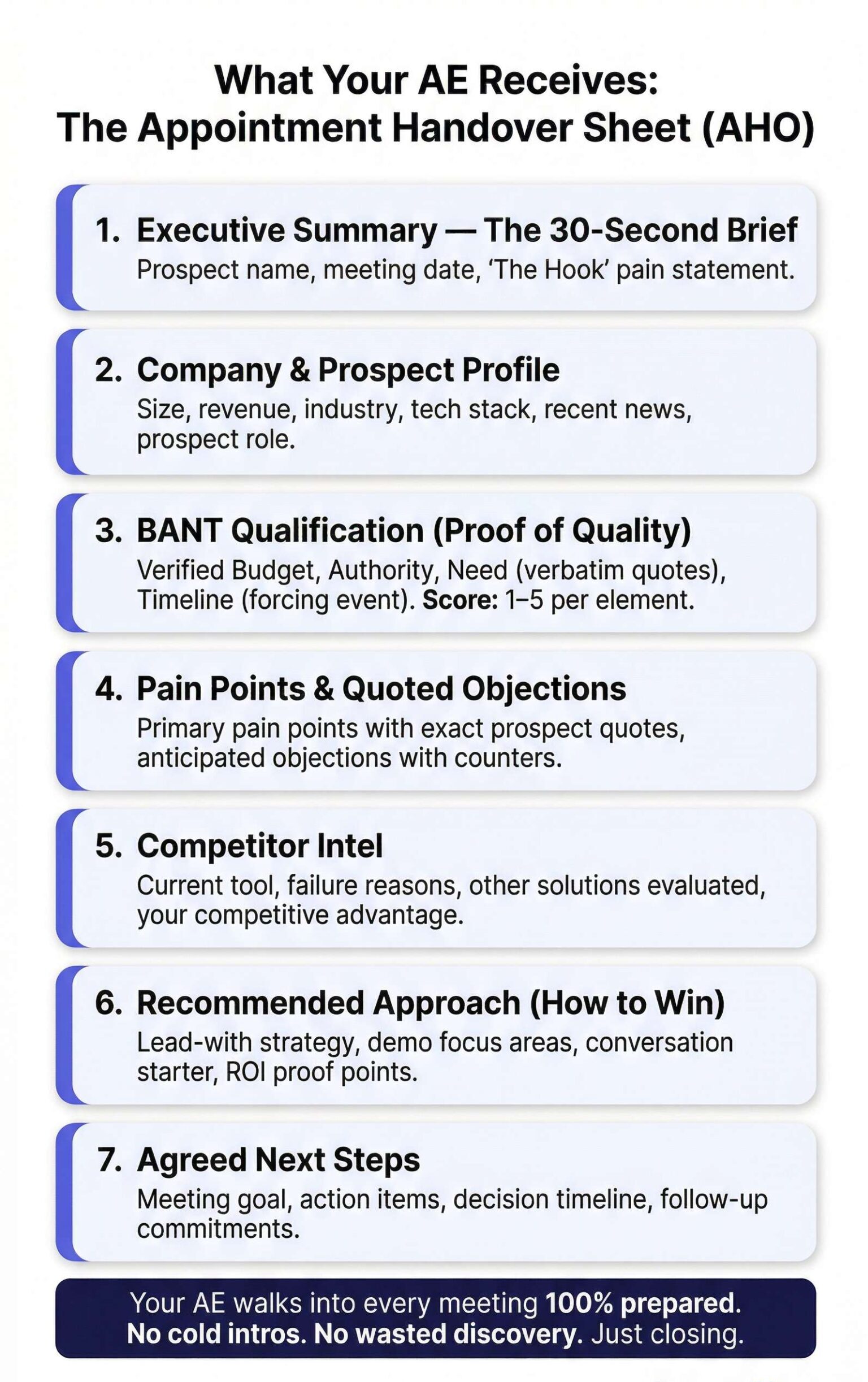
It includes complete BANT verification with verbatim quotes proving each element: the exact budget amount and source, the decision-making process and all stakeholders involved, the specific pain points and their quantified business impact, and the timeline with forcing events.
It includes conversation intelligence with key hooks to mention, hot buttons to emphasize, anticipated objections with recommended responses, and competitive intelligence on what they’re currently using and why it’s failing.
And it includes recommended next steps with meeting objectives, success metrics, and close criteria.
Your AE doesn’t spend the first 15 minutes on discovery. They open with: “Based on our conversation, I understand you’re losing 3-4 deals per month because contract cycles are taking 8 weeks. You mentioned your team is expanding and you need this fixed by April 1. Let me show you exactly how we’ve solved this for companies like yours.”
That’s the difference between a generic demo and a meeting that closes.
Should You Hire Appointment Setters In-House or Outsource?
If you’re evaluating whether to build an internal appointment setting function or partner with a specialist, the honest answer is: it depends on where you are in your growth stage but the economics and quality data favor outsourcing more often than most sales leaders expect.
Here’s how to think through the decision clearly.
The Case for Building In-House
Building your own appointment setting team makes sense when you have a highly complex, technical product that requires deep domain expertise to discuss credibly, a mature sales enablement function capable of building BANT frameworks from scratch, the runway to absorb a 6–9 month ramp period, and a stable enough ICP that you’re not constantly adjusting targeting mid-campaign.
For most B2B companies – especially those scaling from $5M toward $20–50M ARR – these conditions don’t fully apply. But when they do, in-house setters can develop product expertise and cultural alignment that’s harder to replicate externally.
The real costs of in-house, however, are consistently underestimated. A fully loaded SDR runs $80,000–$100,000+ annually when salary, tools, training, and management overhead are included. Turnover in SDR roles is historically high – 34% annually in SaaS meaning ramp costs hit repeatedly. And without a dedicated QA infrastructure, setters will trend toward volume over quality under quota pressure. That’s not a management failure. It’s a structural incentive problem.
The Case for Outsourcing
Outsourced appointment generation makes sense for companies that need pipeline now rather than in six months, want a proven qualification methodology without building it from scratch, need to eliminate the volume-over-quality incentive problem, and prefer a pay-for-performance model where they bear no risk for unqualified meetings.
The misconception most sales leaders carry into this conversation: “Will outsourced setters understand our product well enough to qualify correctly?” The better question is: “Can my in-house setters achieve 90%+ BANT compliance with documented handover quality across 40+ meetings per month?” For most companies, the honest answer is no, not because their people aren’t capable, but because the infrastructure, QA processes, and continuous training required to sustain that standard at scale don’t exist in-house.
The DemandNexus Approach: Specialist Quality at Outsourced Scale
At DemandNexus, our appointment setters are not generalist SDRs running high-volume sequences. They’re BANT qualification specialists operating within a 3-layer QA system – peer review, manager certification, and AE post-meeting feedback that enforces 95%+ qualification compliance across every campaign.
You don’t get a meeting. You get a BANT-verified, AHO-documented conversation with a decision-maker who has confirmed budget, authority, a specific pain point, and a real buying timeline. And if a meeting doesn’t hold or doesn’t meet your qualification criteria after the fact we replace it within 5 business days at no charge.
The risk sits with us. The pipeline sits with you.
Appointment Setter Skills: What Separates Good from Elite
Appointment setting looks deceptively simple from the outside. In practice, the gap between a setter who books meetings and a setter who books meetings that actually close is enormous and it comes down to a specific set of skills that take deliberate development to build.
- BANT Verification – Knowing What “Qualified” Actually Means
The most critical skill in appointment setting isn’t the ability to get someone on the phone. It’s knowing exactly what to do once you have them. Elite setters use BANT as a rigorous qualification framework, not a checkbox. They know how to ask budget questions without triggering defensiveness, how to confirm authority without accepting an automatic yes, and how to identify a forcing event that makes a timeline real rather than theoretical. They score each BANT element on a defined scale and disqualify prospects who don’t meet threshold – even under quota pressure to book more meetings.
- Active Listening and Probing
Most setters ask questions. Elite setters listen to the answers. When a prospect says “we’ve been looking at this for a while,” most setters hear “interested.” An elite setter hears a potential red flag – no urgency, no forcing event, likely still in research mode – and probes accordingly: “What’s driven the timing to look at it now? Is there a specific deadline making this a priority?” This follow-up is what separates a calendar appointment from a sales-ready meeting.
- Objection Handling Without Pressure
B2B prospects have well-developed defenses against salespeople. “We’re not interested,” “send me some information,” “we already have a solution,” and “not the right time” are not rejections – they’re automatic responses. Elite setters reframe these reflexes by acknowledging the response, pivoting to something specific, and giving the prospect a reason to keep talking. What they never do is push, pressure, or guilt a prospect into booking. A meeting booked under pressure is a meeting that no-shows.
- Concise, Relevant Messaging
Every touchpoint needs to earn the prospect’s attention in under 10 seconds. That means leading with something specific to their situation before saying anything about your solution. The biggest mistake most setters make is leading with features and benefits rather than pain. Research skills, pattern recognition, and the discipline to cut everything that isn’t immediately relevant are what make this work consistently at scale.
- CRM Discipline and Documentation Accuracy
A great qualification call that’s poorly documented is a wasted qualification call. Elite setters capture verbatim quotes, BANT scores, decision-making structure, tech stack details, competitive context, and objections immediately after every call – before anything is forgotten. In appointment generation programs where the AHO is a deliverable, the quality of documentation directly determines the quality of that document and, ultimately, the quality of the AE’s meeting.
- Resilience and Consistency Under Rejection
Outbound appointment setting involves a structural reality: the overwhelming majority of contacts will not convert on any given outreach. Elite setters have internalized this without being worn down by it. They treat each call as a clean slate, maintain tone and energy across call 80 of the day the same as call 1, and use rejection data productively – what objection pattern am I hearing most? what does that tell me about my messaging? – rather than taking it personally.
- Pipeline Thinking, Not Meeting Thinking
The best appointment setters understand that their job isn’t to book meetings – it’s to generate pipeline. This means they care about what happens after the handoff. They track AE feedback. They understand which meetings advanced and which stalled. They use that data to continuously refine their qualification questions. This feedback loop is the difference between a setter who produces high volume of low-quality appointments and one who produces a consistent flow of sales-ready conversations that close.
Measuring What Matters
Traditional appointment-setting metrics focus on volume: calls made, emails sent, meetings booked. These vanity metrics tell you nothing about whether your investment is generating revenue.
The metrics that matter for qualified appointment generation are different.
BANT compliance rate measures the percentage of booked meetings that meet all four qualification criteria. Our target is 95%+.
SQL conversion rate measures the percentage of meetings that convert to sales-qualified opportunities. With BANT-verified appointments, this should exceed 85%.
AE satisfaction score captures whether sales finds the meetings valuable. We track this on a 1-10 scale and replace any meeting rated below 7.
Close rate measures ultimate conversion to customers. BANT-qualified appointments typically close at 25-40% versus 3-5% for unqualified leads.
Cost per closed deal is the metric that matters most. Our clients typically see 58% lower cost per closed deal compared to their previous approach.
The ROI Case for BANT-Qualified Appointments
Consider a real example from a $75M B2B SaaS company we worked with.
Before DemandNexus: Their internal SDR team booked 40 meetings per month. AEs complained that 70% were unqualified. SQL conversion was 28% (only 11 SQLs from 40 meetings). Close rate was 18%, producing 2 deals per month. Pipeline generated was $1.2M monthly.
After implementing our BANT + AHO process: We booked 35 meetings per month (fewer, but all qualified). BANT compliance reached 94%. SQL conversion jumped to 89% (31 SQLs from 35 meetings). Close rate improved to 35%, producing 11 deals per month. Pipeline generated hit $4.8M monthly – a 300% increase.
The counterintuitive insight: booking fewer meetings generated dramatically better results because every meeting was with a real buyer who had budget, authority, and urgency.
Industries That Benefit Most
BANT-qualified appointment generation delivers exceptional results across B2B technology verticals.
SaaS companies use our approach to connect with IT decision-makers evaluating software purchases with active timelines and allocated budgets.
Financial services firms leverage our FinTechFilter media brand to reach finance executives researching compliance, automation, and digital transformation initiatives.
HR technology vendors tap into our HRTechTrend audience of talent and HR leaders actively seeking solutions for workforce challenges.
Marketing technology companies benefit from our MarTechTrend community of CMOs and marketing leaders evaluating their technology stack.
AI and automation vendors find qualified buyers through our AITechTrend platform, which reaches decision-makers actively researching AI implementation.
Getting Started with DemandNexus
Ready to stop paying for activity and start investing in outcomes? Here’s what the partnership looks like.
First, we conduct a 45-minute discovery call to assess fit. We’ll discuss your ICP, your current challenges, and whether our approach aligns with your sales process.
Second, we define your BANT criteria together. What budget threshold qualifies? Which titles have authority? What timeline works for your sales cycle?
Third, we identify which of our six media brands align with your buyers and map your solution to the content your ICP is already consuming.
Fourth, we launch a pilot campaign – typically 10-15 appointments in 30 days. You rate each meeting, and if any falls below a 7/10, we replace it free.
There are no long-term contracts required. Our guarantee is simple: you only pay for meetings that meet your BANT criteria.
The Bottom Line
The question isn’t whether you need appointment setters. It’s whether you need more meetings or better meetings.
If your AEs are drowning in unqualified calls, if your close rates are stuck in single digits, if your cost per acquisition keeps climbing- you don’t have a volume problem. You have a qualification problem.
DemandNexus delivers BANT-verified appointments backed by first-party intent data, documented with comprehensive handover sheets, and guaranteed to meet your criteria or you don’t pay.
Stop feeding the MQL black hole. Start filling your pipeline with buyers who are ready to purchase.
Ready to transform your pipeline? Contact DemandNexus at sales@demandnexus.io or visit www.demandnexus.io to schedule your discovery call.
FAQs
What is an appointment setter?
An appointment setter is a sales development professional responsible for identifying qualified prospects, initiating outreach, verifying buying intent through structured qualification, and booking confirmed meetings for Account Executives. In B2B organizations, appointment setters are typically titled SDRs (Sales Development Representatives) or BDRs (Business Development Representatives). The defining difference between a high-quality appointment setter and a calendar-filler is whether they apply a rigorous qualification process before booking — or simply get anyone willing to take a call onto the calendar.
What does an appointment setter do day-to-day?
On a daily basis, an appointment setter conducts outbound prospecting (cold calls, emails, LinkedIn outreach), qualifies prospects against a BANT framework, handles objections, books and confirms meetings, documents qualification data in the CRM, and prepares handover documentation for the AE. High-performance setters typically execute 50–80 outbound touchpoints per day while maintaining documentation standards and quality metrics alongside volume targets.
What is the difference between appointment setting and lead generation?
Lead generation produces a contact — someone who has shown interest, downloaded an asset, or responded to an ad. Appointment setting produces a confirmed meeting with a qualified buyer. Most lead generation programs deliver contacts at the top of the funnel who still require significant qualification before they're worth an AE's time. Appointment generation does that qualification work upfront and only delivers meetings that meet defined BANT criteria — so your closers spend their time closing, not re-qualifying.
What is a B2B appointment setter?
A B2B appointment setter works specifically within business-to-business sales environments, engaging decision-makers at target companies — typically directors, VPs, and C-suite executives — and qualifying them against criteria relevant to enterprise or mid-market purchase decisions. B2B appointment setting is more complex than consumer or transactional outreach because it involves navigating multi-stakeholder buying committees, longer sales cycles, higher deal values, and the need to confirm budget authority with a specific economic buyer rather than a general end user.
What is BANT qualification in appointment setting?
BANT stands for Budget, Authority, Need, and Timeline — the four criteria that verify a prospect is genuinely sales-ready. In appointment setting, BANT qualification means confirming: (1) the prospect has allocated or securable budget for the solution, (2) they are the economic buyer or a direct influencer with decision-making access, (3) they have a specific, quantified pain point your solution addresses, and (4) they have a defined buying timeline within 1–6 months, anchored to a real forcing event such as a contract renewal, product launch, or compliance deadline. A meeting booked without verified BANT is a meeting that wastes your AE's time.
What is appointment generation vs. appointment setting?
The terms are often used interchangeably, but in a rigorous B2B context, appointment generation implies a higher standard. Appointment setting refers broadly to the practice of booking meetings. Appointment generation refers specifically to the production of pipeline-ready, BANT-qualified appointments backed by documented qualification — meetings designed to advance through the sales cycle, not just occupy calendar slots. DemandNexus uses the term appointment generation deliberately to distinguish our deliverable from the volume-focused model most appointment setting services operate on.
How much does B2B appointment setting cost?
Costs vary significantly by model. A fully loaded in-house SDR runs $80,000–$100,000+ annually when salary, tools, management, and benefits are included. Traditional pay-per-lead vendors typically charge $3,000–$8,000/month but deliver low-intent contacts with no meeting guarantee. Pay-for-performance appointment generation programs like DemandNexus range from $7,500–$16,000/month depending on volume tier, but bill only for BANT-verified meetings that appear on your calendar — making the true cost-per-qualified-meeting significantly lower than either alternative when close rates are factored in.
What is an Appointment Handover Sheet (AHO)?
An Appointment Handover Sheet (AHO) is a structured briefing document delivered to the Account Executive 24–48 hours before a confirmed sales meeting. A complete AHO includes: an executive summary of the prospect's situation, full BANT verification with verbatim quotes from the qualification call, the complete decision-making process and buying committee structure, specific pain points with quantified business impact, competitive context (what they're currently using and why it's failing), anticipated objections with recommended responses, and suggested meeting objectives. The AHO eliminates the need for AEs to spend the first 15–20 minutes of every call on basic discovery — and is the single highest-leverage change most B2B sales teams can make to their meeting-to-close rate.
What skills does an appointment setter need?
The core skills for a high-performance appointment setter are: BANT qualification expertise (verifying each element rigorously, not just checking a box), active listening and probing (following what the prospect actually says rather than running a script), objection handling without pressure tactics, concise and relevant outbound messaging that leads with pain rather than product, CRM documentation discipline, and the resilience to maintain quality across high-volume outbound activity. The best setters also have a pipeline mindset — they track what happens after the handoff and use AE feedback to continuously sharpen their qualification approach.
How do I hire a good appointment setter or appointment setting agency?
Whether hiring in-house or evaluating an outsourced partner, look for four things: a documented qualification framework with specific scoring criteria (not just "we use BANT"), a QA process that operates independently of setter self-reporting, pre-meeting handover documentation that goes beyond a name and calendar invite, and performance accountability tied to quality metrics — show rate, AE rating, pipeline advancement — rather than volume alone. If a provider can't articulate how they verify qualification or what their no-show replacement policy is, they're selling meetings. Not pipeline.