


In the high-stakes world of B2B sales, your team’s success depends not on how many meetings they book, but on the quality of every conversation they walk into. Chasing volume-based appointment targets might look impressive on a dashboard, but it often leads to burnout, wasted AE time, and missed revenue opportunities. The key to sustainable pipeline growth is setting goals that prioritize qualified conversations over calendar volume and having a system that guarantees those conversations actually convert.
At Demand Nexus, we’ve built our entire model around this principle. Our Pay-for-Performance Appointment (PPA) system, called “The Waterfall,” delivers BANT-verified meetings directly to your sales team’s calendar not “interested leads” or CSV files of names that need re-qualification. This article explores the science and strategy behind setting appointment goals that actually drive revenue, and how our methodology eliminates the guesswork from pipeline generation.

Most B2B teams lose 40–60% of qualified prospects to broken handoffs and weak qualification. Take our 2-minute diagnostic to find out where your pipeline is bleeding — and how to fix it.
Start the Quiz → Takes 2 minutes. No email required to start.Why Traditional Appointment Goals Fail
The conventional approach to appointment-setting treats it as a numbers game: more dials, more emails, more meetings. But here’s what the data reveals about this volume-first mindset:
The MQL Black Hole: Studies show that 80% of marketing-qualified leads never convert to sales opportunities. Your AEs spend 50% of their time re-qualifying and chasing low-intent prospects instead of closing deals.
The Burnout Spiral: When SDRs are pressured to hit volume quotas, they schedule meetings with anyone who says “yes” regardless of budget, authority, need, or timeline. The result? AEs walk into conversations with prospects who have no intention or ability to buy.

The Hidden Cost: Traditional appointment-setting models cost $800-1,200 per meeting, with only 5-10% converting to real opportunities. Meanwhile, your sales team wastes 20+ hours per week on meetings that should never have been scheduled.
The solution isn’t setting better volume goals it’s fundamentally redefining what counts as a successful appointment.

The BANT Framework: The Only Qualification Standard That Matters
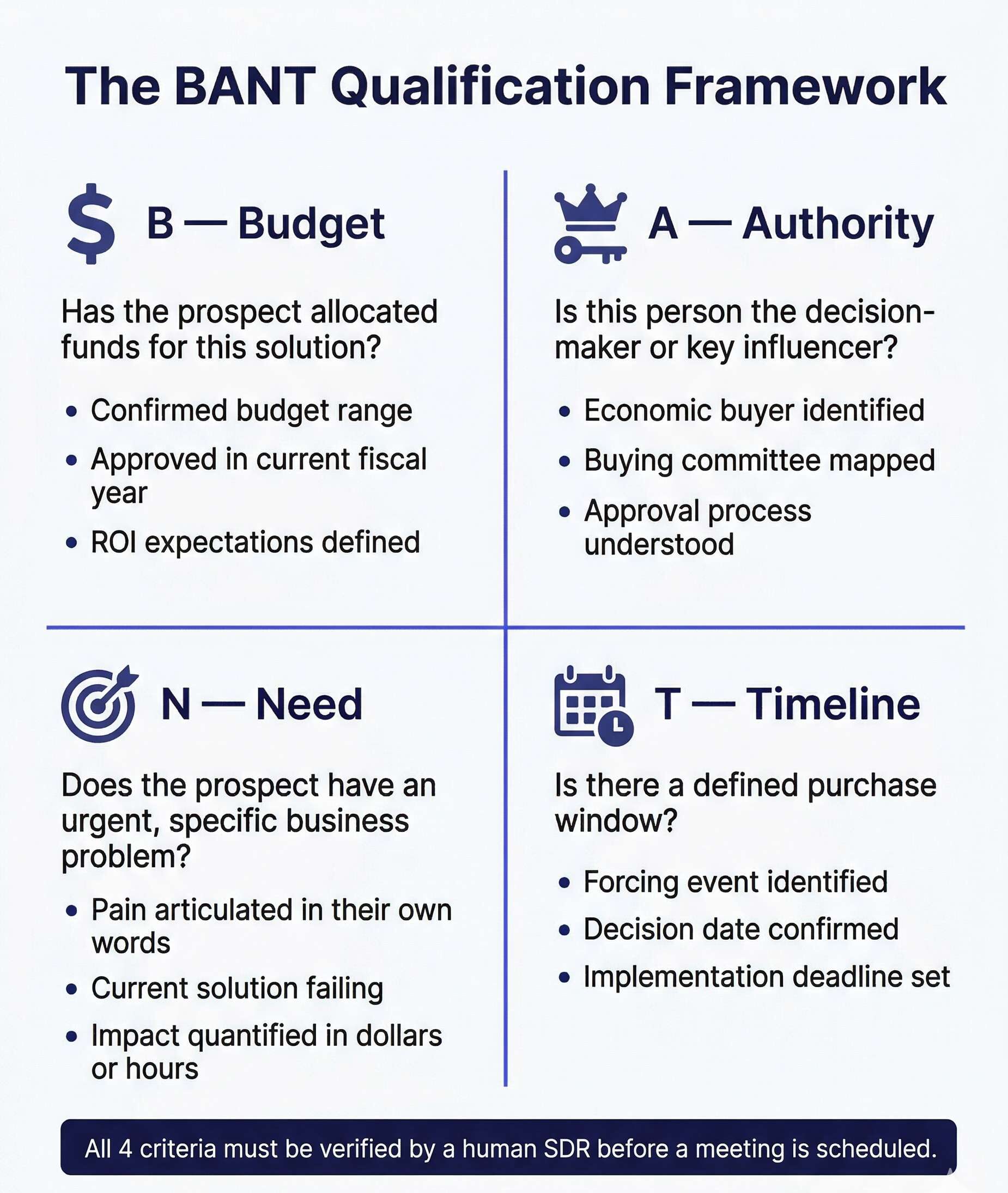
At Demand Nexus, we use BANT (Budget, Authority, Need, Timeline) as the non-negotiable qualification standard for every appointment we deliver. Developed by IBM, BANT remains the gold standard for B2B sales qualification because it answers the only question that matters: “Is this person ready to buy?”
What BANT Qualification Actually Looks Like
Budget: Does the prospect have allocated funds or a clear path to securing budget within 90 days? We verify specific questions like: “What budget have you allocated for this initiative?” and “What’s your expected investment range?”
Authority: Is the prospect a decision-maker or key influencer with C-suite access? We confirm: “Who has final sign-off?” and “What does your typical buying process look like?”
Need: Does the prospect have a genuine, urgent business problem your solution solves? We quantify the pain: “What happens if you don’t address this problem?” and “How much is this costing you?”
Timeline: Is there a specific, active buying window with a forcing event? We look for concrete deadlines: contract renewals, budget cycles, compliance deadlines, or product launches driving urgency.
The BANT Scoring System
Not all qualification elements are binary. We score each on a 1-5 scale:
| Score | Budget | Authority | Need | Timeline |
|---|---|---|---|---|
| 5 | Budget allocated | Economic buyer | Critical pain, quantified impact | <30 days to decision |
| 4 | Budget securable in 30-60 days | Champion with C-suite access | Active pain, exploring solutions | 30-90 days |
| 3 | Budget securable in 90 days | Influencer in buying committee | Pain exists but not urgent | 90-180 days |
| 2 | May have budget in 6 months | Low-level influencer | Aware of problem, low priority | 6-12 months |
| 1 | No budget or path to secure | No decision-making power | No pain, just curious | No timeline |
Our Standard: Minimum 3 out of 5 on each element, with a 4.0+ average overall. Anything below this threshold doesn’t get scheduled.
Setting Goals That Drive Revenue, Not Activity
The difference between good and bad appointment goals comes down to one principle: measure outcomes, not activities.
Bad Goals (Activity-Based)
| Goal | Why It Fails |
|---|---|
| “Book 20 appointments per week” | Volume pressure leads to scheduling unqualified meetings |
| “Increase meeting duration to 45 minutes” | Longer meetings ≠ better qualification |
| “Get every prospect to agree to a demo” | Forces conversations before qualification |
Good Goals (Outcome-Based)
| Goal | Why It Works |
|---|---|
| “Increase BANT-qualified appointments by 15% this quarter” | Focuses on meeting quality, not quantity |
| “Achieve 90%+ appointment-to-opportunity conversion rate” | Measures actual pipeline impact |
| “Reduce AE time spent on unqualified meetings by 50%” | Protects your most valuable resource: seller time |
| “75% of meetings include verified economic buyers” | Ensures decision-maker engagement |
The Demand Nexus Approach to Goal-Setting
We’ve eliminated the conflict between volume and quality by only charging for meetings that meet your BANT criteria. Our Waterfall model guarantees:
- 15+ BANT-qualified appointments per month (minimum)
- 90%+ conversion to qualified pipeline (vs. 50-70% for in-house teams)
- 95% BANT compliance rate (vs. 50-60% in-house under quota pressure)
- <5% disqualification rate after AE meetings (vs. 25-30% in-house)
When you only pay for meetings that actually meet your qualification standards, the incentives align perfectly: we’re motivated to find buyers, not to fill calendars.
The 1st-Party Intent Advantage: Why Our Appointments Convert
Traditional appointment-setting relies on bought lists, generic syndication, and cold outreach to anonymous prospects. Our model is fundamentally different because we own the audience.
Our Media Network: Where Your Buyers Already Gather
Demand Nexus operates six proprietary B2B media brands that serve as intent-capture engines:
| Brand | Vertical | Monthly Audience | VP+ Readership |
|---|---|---|---|
| AITechTrend | AI & Machine Learning | 4.7M decision-makers | 87% |
| MarTechTrend | Marketing Technology | 3.2M marketing leaders | 85% |
| DevTechTrend | Developer Tools | 1.8M engineering leaders | 82% |
| HRTechTrend | HR Technology | 2.1M HR/talent executives | 89% |
| FinTechFilter | Financial Technology | 1.7M finance/fintech | 92% |
| LegalTechTrend | Legal Technology | 1.5M legal/compliance leaders | 91% |
Total Network: 15M+ monthly engaged business decision-makers across 900K+ active, opt-in email subscribers.
From Intent Signal to Qualified Meeting
Here’s how our media network powers appointment generation:
Step 1: 1st-Party Intent Capture When “Jane Doe, VP of Risk at Acme Bank” downloads a whitepaper on AML compliance from FinTechFilter, we don’t just capture a “lead” we capture a known, real-time, proprietary intent signal. We know what other articles she read, how long she engaged, and whether her behavior matches active buying patterns.
Step 2: Context-Aware Outreach Our SDRs reach out with genuine relevance:
“Hi Jane, I noticed on FinTechFilter you were researching AML automation and FedNow implications. Our clients at similar banks faced the same urgency they implemented automated AML detection in 6 weeks and cut false positives by 73%. Want to see how they did it?”
This isn’t a cold call. It’s a 100% brand-safe, human-led consultation based on demonstrated intent.
Step 3: BANT Qualification During the discovery call, our trained SDRs verify all four BANT criteria not with robotic checkbox questions, but with diagnostic conversations that uncover real buying context, political dynamics, and decision timelines.
Step 4: The Appointment Handover Sheet (AHO) Every qualified meeting includes a comprehensive briefing document that prepares your AE to close not just to pitch.
The Appointment Handover Sheet: Your AE’s Secret Weapon
The difference between a “meeting” and a “qualified opportunity” isn’t just BANT verification it’s what happens when your AE walks into that conversation. Our Appointment Handover Sheet (AHO) transforms every meeting into a tailored demo, not a generic pitch.
What Every AHO Includes
1. Executive Summary (The 30-Second Brief) What your AE reads 5 minutes before the call:
- Prospect name, title, company
- The “hook” (the specific pain point driving urgency)
- Meeting context and expected outcome
2. Company & Prospect Profile
- Company size, revenue, industry
- Recent news (funding, expansion, leadership changes)
- Tech stack and current solutions
- Prospect’s role and tenure
3. BANT Verification (Proof of Quality) Documented answers to each qualification element with verbatim quotes:
“Jane confirmed they allocated $40,000 in Q1 budget for CLM replacement. Quote: ‘If it solves the problem, we’ll make it work.'”
4. Pain Points & Quoted Objections Primary frustrations in the prospect’s own words, quantified impact (e.g., “losing 3-4 deals/month = $200K revenue”), and anticipated objections with recommended counters.
5. Competitive Intelligence What they’re currently using, why it’s failing, and what alternatives they’re evaluating.
6. AE Sales Playbook
- “Hot buttons” to emphasize
- Recommended conversation starters
- Success criteria for the meeting
- Logical next steps to propose
The Result: 90% Qualified Appointments
When your AE receives this level of pre-meeting intelligence, they’re not walking into an unknown situation they’re walking into a prepared negotiation. The prospect feels understood, the conversation is relevant, and the path to close is clear.
The Zero-Risk Guarantee: Accountability That Traditional Vendors Can’t Match
Most appointment-setting vendors operate on a black-box model: you pay for activities (emails sent, calls made) or unverified “leads” (names on a spreadsheet). You have no visibility into quality until your AEs waste hours on unqualified conversations.
The Waterfall model inverts this completely:
Our Guarantee
| Scenario | What Happens |
|---|---|
| Prospect contacted but doesn’t qualify | You don’t pay for that contact |
| Prospect schedules but no-shows | We replace within 5 business days at no charge |
| Prospect doesn’t meet your BANT criteria | We don’t bill you; it doesn’t count against your guarantee |
You only pay for meetings that happen AND meet your agreed-upon qualification standards.
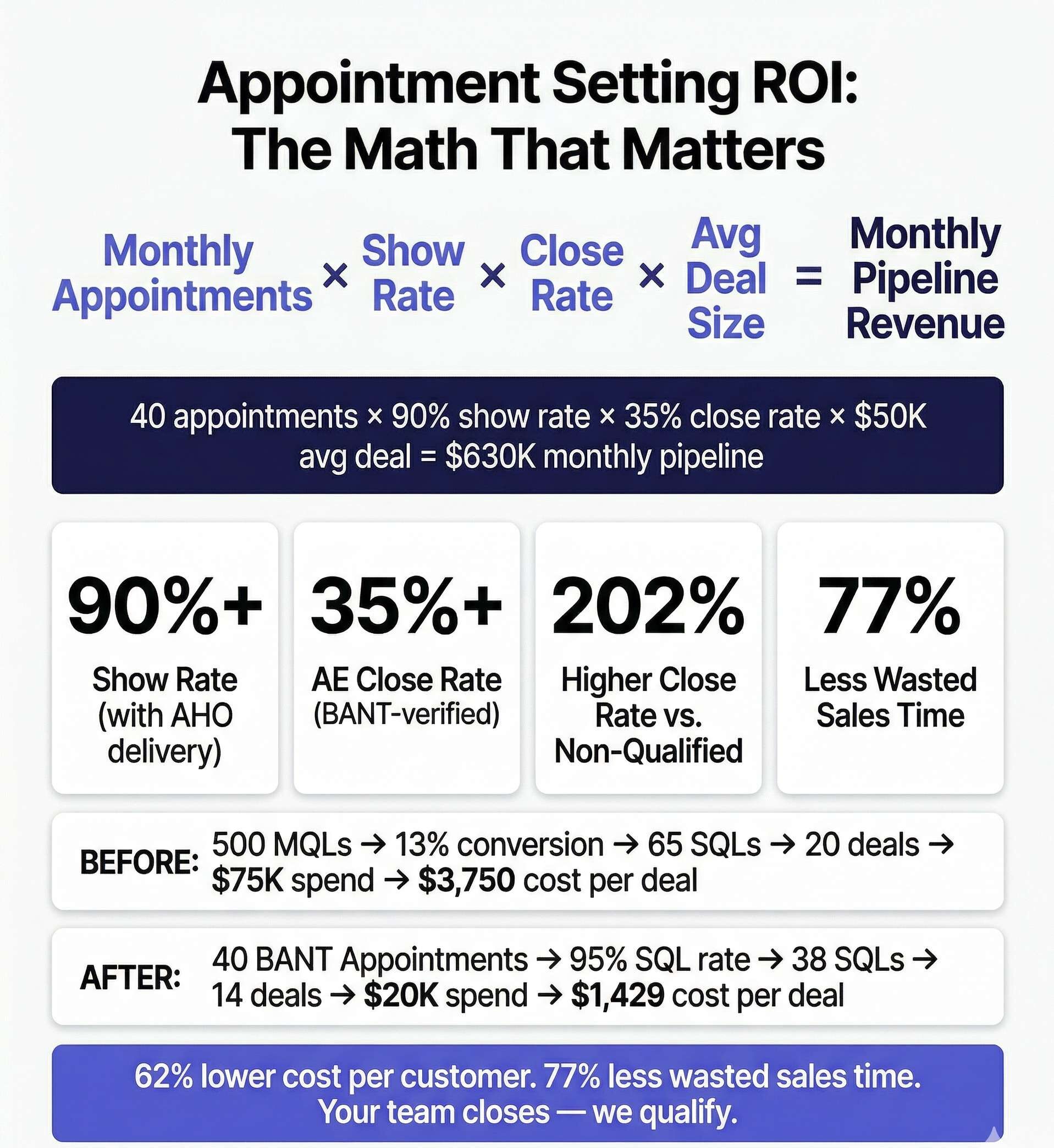
The ROI Comparison
| Model | Annual Cost | Meetings/Year | Cost Per Meeting | AE Close Rate | Pipeline Value |
|---|---|---|---|---|---|
| In-House SDR Hire | $750K+ | 60/month | Variable | 20% | 40-60% ROI |
| Traditional PPL | $60K | ~10 qualified/month | $500+ | 5% | 10-20% ROI |
| Demand Nexus Waterfall | $90K-192K | 200-550/year guaranteed | $400-500 | 35%+ | 120-180% ROI |
Best Practices for Maximizing Your Appointment Investment
Whether you’re working with Demand Nexus or building internal appointment-setting capabilities, these principles will help you achieve better outcomes:
1. Define Your ICP Before You Scale
Get specific about your Ideal Customer Profile: company size, industry, tech stack, budget range, and the specific pain points your solution addresses. Vague targeting leads to vague results.
2. Establish Clear BANT Criteria
Document exactly what “qualified” means for your organization. What budget threshold matters? Which titles have decision-making authority? What timeline indicates genuine urgency?
3. Prioritize Preparation Over Volume
An AE who walks into 10 well-prepared meetings will close more deals than one who takes 30 unprepared ones. Invest in pre-meeting intelligence or partner with someone who provides it.
4. Measure Conversion, Not Activity
Track appointment-to-opportunity conversion rates, average deal size from appointments, and AE time spent per closed deal. These metrics reveal whether your meetings are actually driving revenue.
5. Create Feedback Loops
When AEs rate meetings, that intelligence should flow back to improve qualification criteria. At Demand Nexus, we use 3-layer QA (peer review, manager certification, AE feedback) to continuously optimize quality.
Key Metrics to Track
To ensure your appointment-setting strategy drives revenue, monitor these KPIs:
| Metric | What It Measures | Target |
|---|---|---|
| BANT Compliance Rate | % of meetings that meet all qualification criteria | 90%+ |
| Appointment-to-Opportunity Conversion | % of meetings that become pipeline | 35%+ |
| No-Show Rate | % of scheduled meetings that don’t happen | <10% |
| Cost Per Qualified Meeting | Total investment ÷ qualified meetings delivered | $400-600 |
| AE Time Per Meeting | Hours spent preparing + meeting + follow-up | <3 hours |
| Meeting-to-Close Rate | % of appointments that become won deals | Track trend |
Transform Your Appointment Strategy with The Waterfall
Setting effective appointment goals isn’t about hitting arbitrary numbers it’s about building a system that delivers qualified, prepared conversations with decision-makers who have budget, authority, need, and timeline.
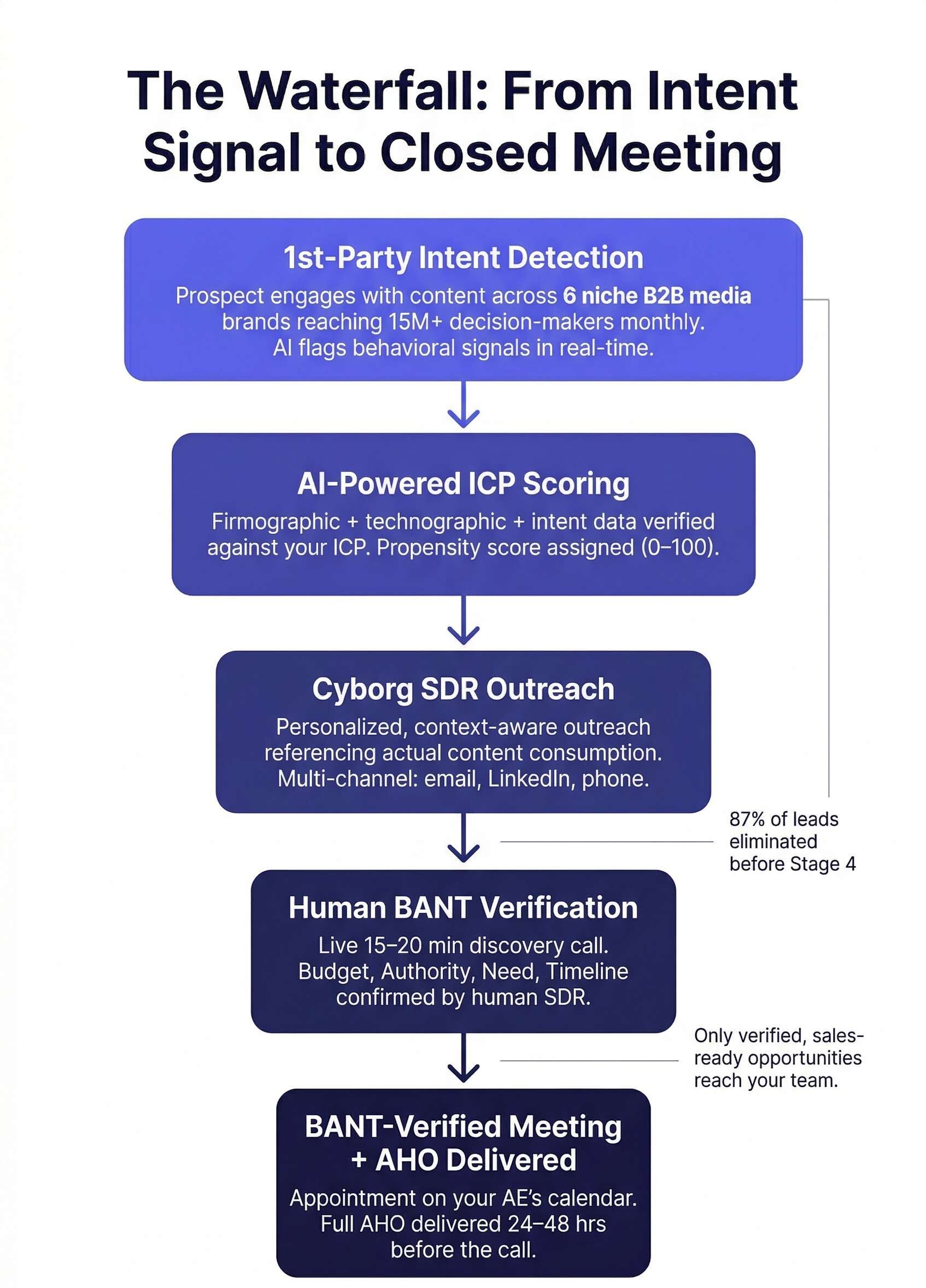
The Waterfall model delivers this through:
- Proprietary 1st-party intent data from 15M+ engaged decision-makers across six niche media brands
- Human-verified BANT qualification on every appointment (95%+ compliance rate)
- Comprehensive AHO briefings that prepare your AEs to close, not just pitch
- Zero-risk billing where you only pay for meetings that meet your criteria
- Guaranteed monthly volume (15-40+ qualified appointments depending on package)
Stop paying for activities. Start investing in outcomes. Stop flooding your pipeline with unqualified leads. Start filling it with BANT-verified conversations.
Ready to Guarantee Your Pipeline?
Schedule a Waterfall Strategy Call to explore how we can deliver 15+ BANT-qualified appointments to your calendar every month backed by our zero-risk guarantee.
What to expect:
- Review your ICP, target markets, and revenue goals
- Align on BANT qualification criteria specific to your solution
- Define your ideal meeting volume and package
- First appointments on your calendar within 30 days
Contact:
- Email: sales@demandnexus.io
- Web: www.demandnexus.io
FAQs
What’s the difference between a “lead” and a BANT-qualified appointment?
A lead is a name with contact information—someone who showed some interest. A BANT-qualified appointment is a confirmed, calendar-locked meeting with a decision-maker who has verified budget, authority, genuine need, and an active buying timeline. Our AHO documents every qualification element with proof points and verbatim quotes.
What happens if a prospect doesn’t meet BANT criteria?
You’re not billed. We only charge for meetings that match your agreed-upon qualification standards. If qualification can’t be verified, we continue prospecting rather than scheduling a meeting that wastes your AE’s time.
What if a prospect no-shows?
We replace them within 5 business days at no charge. Our no-show replacement guarantee is built into every SLA.
How is Demand Nexus different from traditional appointment-setting vendors?
Traditional vendors operate as black boxes—you pay for activities and hope some convert. We’re a media intelligence platform that owns the audience your buyers already engage with. Our 1st-party intent data, BANT verification, and AHO documentation deliver meetings with 90%+ conversion to qualified pipeline—3x the rate of typical marketing leads.
What data do I own?
100% of it. Every prospect touched, every BANT conversation, every lead qualified—all data remains yours. You can export, nurture, or analyze it however you want. This isn’t a one-off service; it’s a data asset you build.
How quickly can I start receiving appointments?
Standard deployment is 30 days from your kickoff call. Enterprise Pod clients can request fast-track options for accelerated launches