



This guide is a buyer’s resource. It covers what B2B cold calling services actually deliver, how pricing models differ, what performance benchmarks to demand, red flags to watch for, and how to evaluate whether outsourcing cold calling is the right move for your team.

Most B2B teams lose 40–60% of qualified prospects to broken handoffs and weak qualification. Take our 2-minute diagnostic to find out where your pipeline is bleeding — and how to fix it.
Start the Quiz → Takes 2 minutes. No email required to start.What B2B Cold Calling Services Actually Deliver
At their best, B2B cold calling services deliver BANT-verified sales meetings with decision-makers who match your ideal customer profile. At their worst, they deliver high-volume dials that produce meetings with unqualified prospects who never show up or never close.
The difference between the two is the qualification standard the provider applies and the accountability structure they operate under. A volume-based provider is incentivized to book as many meetings as possible regardless of quality, because they are paid per meeting booked. A performance-based provider like DemandNexus is incentivized to book meetings that show up and close, because the pricing model ties compensation to delivered, qualified outcomes. Every meeting is BANT-verified on a live call and arrives with a complete Appointment Handover Sheet documenting budget, authority, need, timeline, pain points, competitive context, and buying committee map.
Pricing Models for B2B Cold Calling Services
Three pricing models dominate the B2B cold calling services market. Model one is hourly or retainer-based pricing, where the client pays for SDR time regardless of output. This model has the lowest accountability for the provider and the highest risk for the buyer. Model two is per-meeting pricing, where the client pays per booked meeting. This model is better but creates incentives to book loosely qualified meetings to hit volume targets. Model three is pay-for-performance pricing, where the client pays per BANT-verified, attended, AHO-documented meeting. This model transfers the most risk to the provider and produces the strongest alignment between provider and client interests.

DemandNexus operates on model three. Clients pay per BANT-verified meeting that meets the agreed qualification standard and arrives with a complete Appointment Handover Sheet. There is no retainer for activity, no charge for meetings that do not meet standard, and no volume incentive that degrades quality. For a detailed analysis of cold calling service costs and ROI, see demandnexus.io/appointment-setting-costs/.
Performance Benchmarks to Demand From Your Provider
When evaluating B2B cold calling services, demand transparency on five benchmarks. First is show rate: the percentage of booked meetings where the prospect actually attends. Industry norm is 50-70%. Top-tier providers with BANT verification and AHO documentation deliver above 90%. Second is SQL conversion rate: the percentage of delivered meetings that your sales team accepts as sales-qualified. Ask for historical data; a strong provider will share it. Third is close rate on sourced meetings: what percentage of the provider’s meetings eventually close? BANT-verified meetings should produce close rates above 30%, compared to 10-20% on loosely qualified alternatives.

Fourth is cost per qualified meeting: what is the all-in cost per meeting that actually occurred and met your qualification standard? This should be compared against your fully loaded in-house SDR cost per meeting. Fifth is ramp time: how quickly does the provider deliver the first cohort of qualified meetings? DemandNexus typically delivers first meetings in weeks four to six, with steady-state delivery by weeks eight to twelve. Providers that require longer than 90 days to produce results may have structural issues.
Red Flags When Evaluating B2B Cold Calling Vendors
Watch for seven red flags. First, no willingness to share historical show rate and close rate data. Second, pricing that is per meeting booked rather than per meeting attended or qualified. Third, generic scripts that are not customized to your ICP and industry. Fourth, no mention of BANT or any specific qualification framework. Fifth, reliance on third-party contact databases without verification of direct dial accuracy. Sixth, no Appointment Handover Sheet or equivalent briefing document delivered with meetings. Seventh, long-term contracts with no performance exit clause.
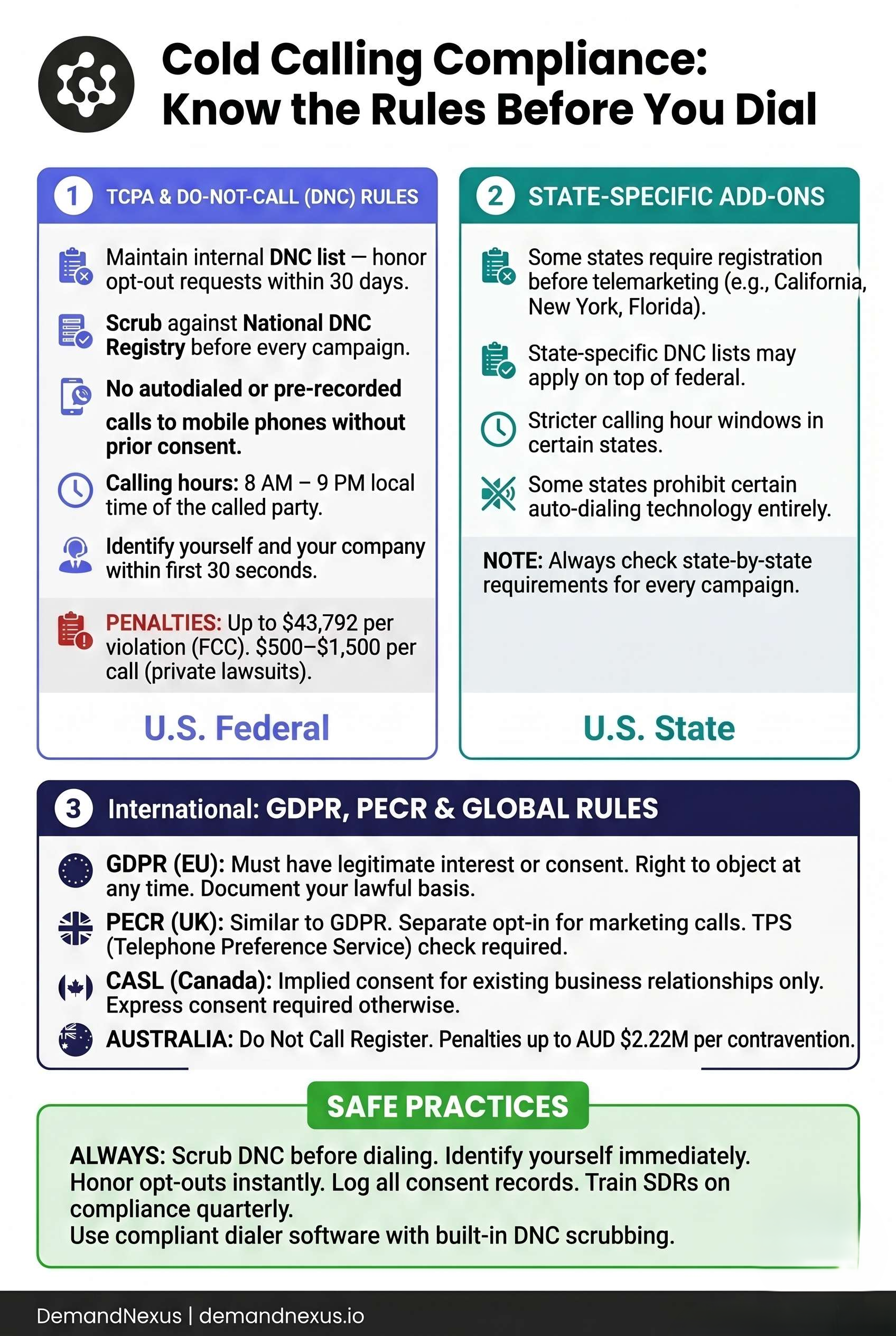
A provider that clears all seven of these checkpoints is worth a pilot engagement. A provider that fails on three or more is likely to produce high volume and low quality, which costs more in wasted AE time than the apparent savings on per-meeting price.
What Makes DemandNexus Different
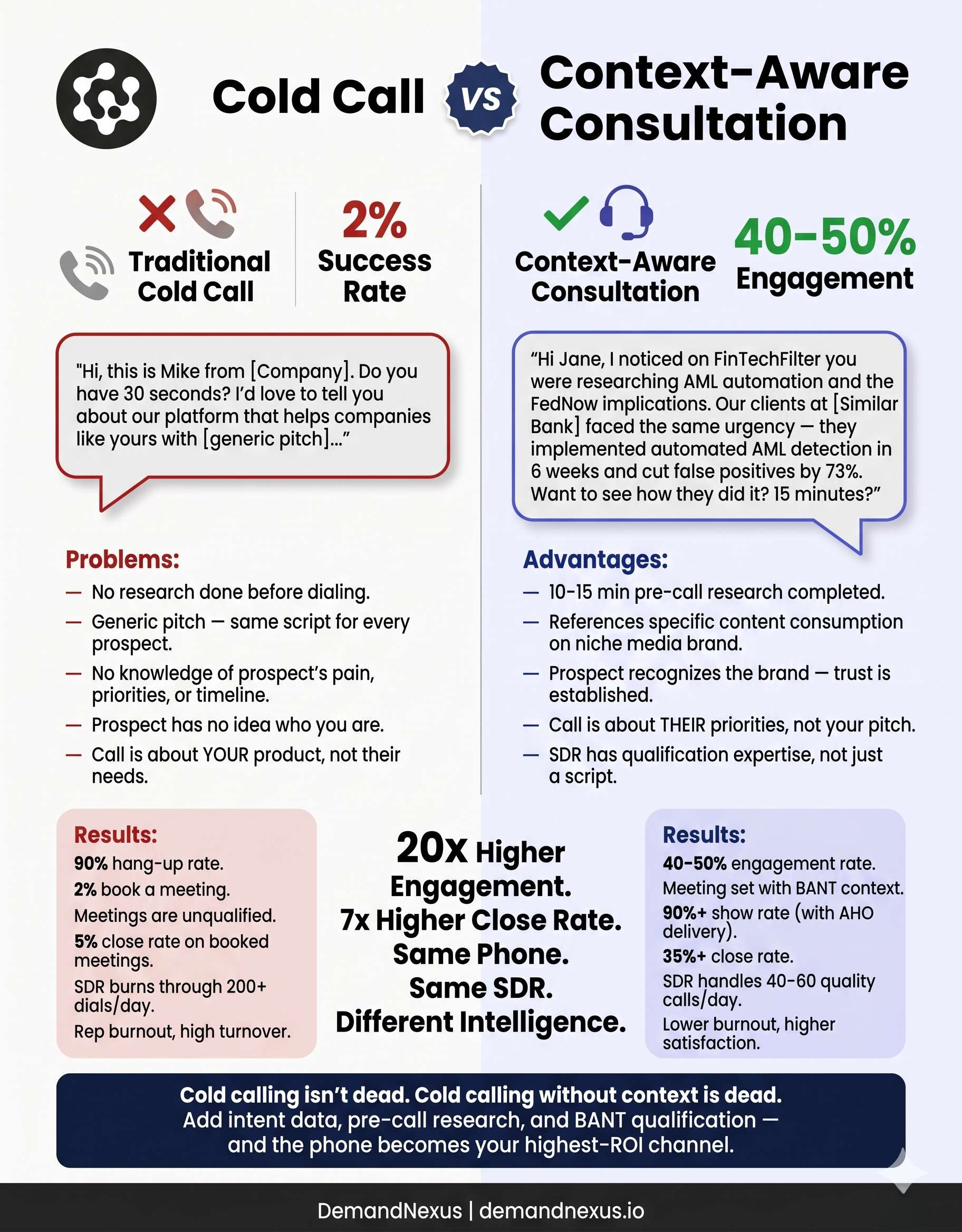
DemandNexus operates B2B cold calling services through the Cyborg SDR pod model: AI-powered research and enrichment paired with human-led BANT qualification calls. Three attributes differentiate us. First, the qualification standard: every meeting is BANT-verified on a live call and documented in a complete Appointment Handover Sheet. This is why our show rates exceed 90% and our clients close at rates more than 200% higher on our meetings than on non-qualified alternatives. Second, the first-party intent advantage: our six owned B2B media brands (AITechTrend, MarTechTrend, HRTechTrend, FinTechFilter, LegalTechTrend, DevTechTrend) generate exclusive research signals that identify in-market accounts before competitors see them. Third, the pay-for-performance economics: clients pay per delivered, qualified outcome, not per hour, per dial, or per loosely booked meeting.
FAQs
How much do B2B cold calling services cost?
Pricing varies by model. Hourly or retainer models run $3,000 to $8,000 per month per SDR equivalent. Per-meeting models run $200 to $500 per booked meeting. Pay-for-performance models like DemandNexus price per BANT-verified, AHO-documented, attended meeting, which is typically 40-60% lower than the fully loaded cost per meeting from an in-house SDR. Exact pricing depends on ICP complexity and target volume.
What is the difference between cold calling services and appointment setting services?
Cold calling services focus specifically on phone-based outbound prospecting. Appointment setting services are broader and may include email, LinkedIn, and multi-channel outreach in addition to phone. DemandNexus provides both under a unified qualification framework, with the cold calling component executed by Cyborg SDR pods that combine AI research with human qualification.
How do I know if outsourced cold calling will work for my company?
Outsourced cold calling typically works when three conditions are met: the fully loaded cost per in-house SDR exceeds the cost per qualified meeting from the provider, the team needs to scale outbound faster than internal hiring allows, and the target ICP is well-defined enough for a trained SDR to qualify effectively. The fastest way to evaluate fit is to book a diagnostic call at demandnexus.io/book-a-call.
Evaluate Whether Pay-for-Performance Cold Calling Fits Your Team
If you are evaluating B2B cold calling services, start with the qualification diagnostic at demandnexus.io/start-quiz/ to benchmark your current approach. Model the ROI of moving a portion of outbound to BANT-verified meetings at demandnexus.io/roi-calculator/. Or book a diagnostic call with a pipeline strategist at demandnexus.io/book-a-call.