



The uncomfortable truth: With average MQL-to-SQL conversion rates hovering at just 13%, 87% of marketing leads are rejected or abandoned by sales teams. Enterprise companies lose approximately $4 million annually to bad leads, with sales representatives wasting 550 hours per year pursuing unqualified prospects.

Most B2B teams lose 40–60% of qualified prospects to broken handoffs and weak qualification. Take our 2-minute diagnostic to find out where your pipeline is bleeding — and how to fix it.
Start the Quiz → Takes 2 minutes. No email required to start.This guide explores why traditional SaaS lead generation fails – and presents a proven alternative that delivers BANT-qualified appointments instead of unverified contact lists.
What Is SaaS Lead Generation?
SaaS lead generation is the process of identifying, attracting, and engaging potential B2B customers interested in your cloud-based software. Unlike traditional lead generation, SaaS focuses on building long-term relationships to drive recurring revenue through subscriptions.
However, there’s a critical distinction between lead generation and appointment generation:

Traditional Lead Generation delivers contact information names, emails, and phone numbers that require extensive qualification before sales engagement.
Appointment Generation delivers scheduled meetings with decision-makers who have already been verified for Budget, Authority, Need, and Timeline (BANT).

For SaaS startups and established businesses, this distinction matters enormously. B2B buyers involve multiple decision-makers and require proof of value. A pipeline filled with unqualified leads costs more than the leads themselves it costs sales productivity, team morale, and revenue predictability.
The Hidden Cost of the Traditional SaaS Lead Funnel
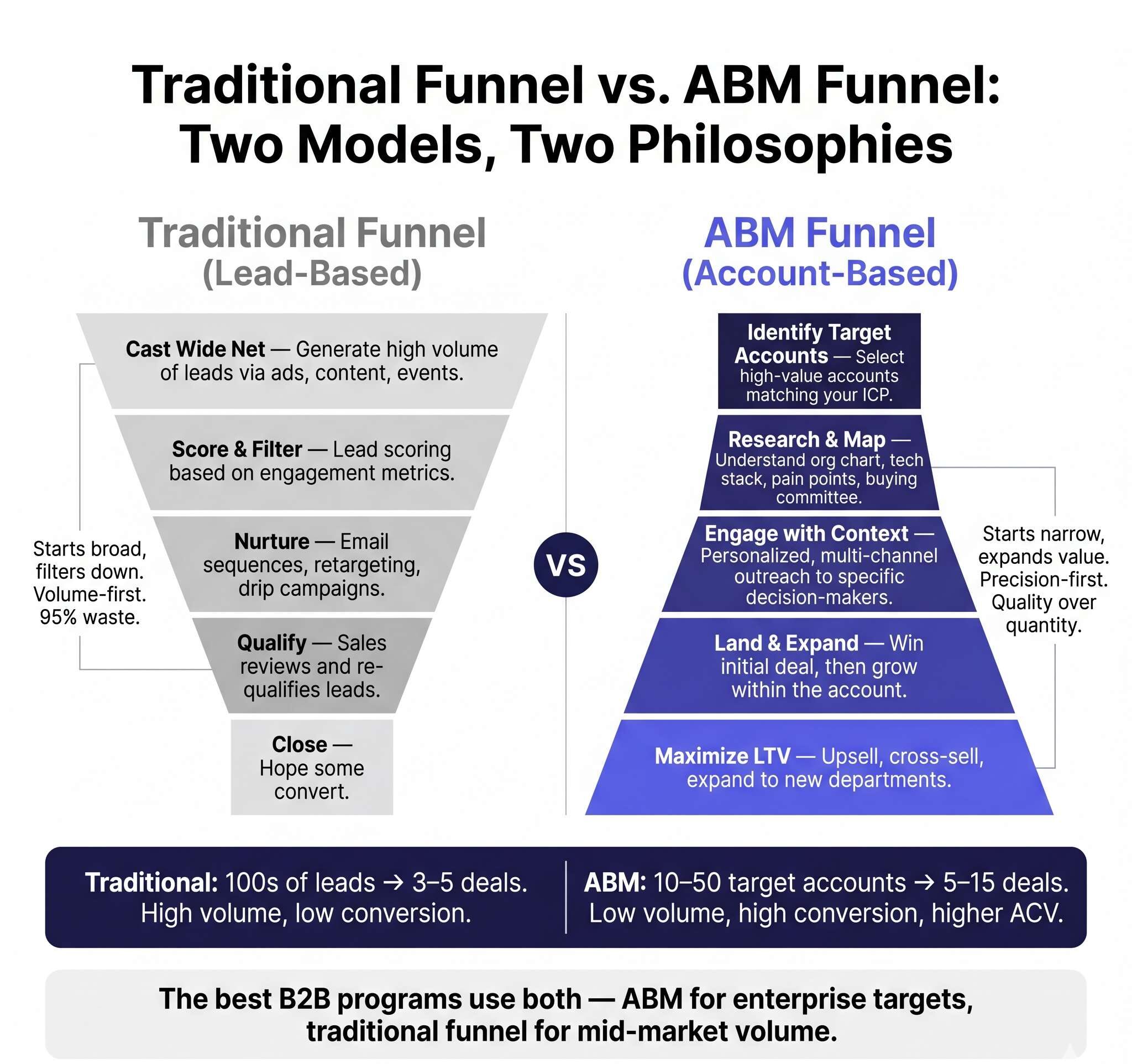
The conventional SaaS lead generation funnel looks straightforward: Awareness → Consideration → Conversion → Retention. But beneath this structure lies a costly inefficiency.
Stage-by-Stage Reality:
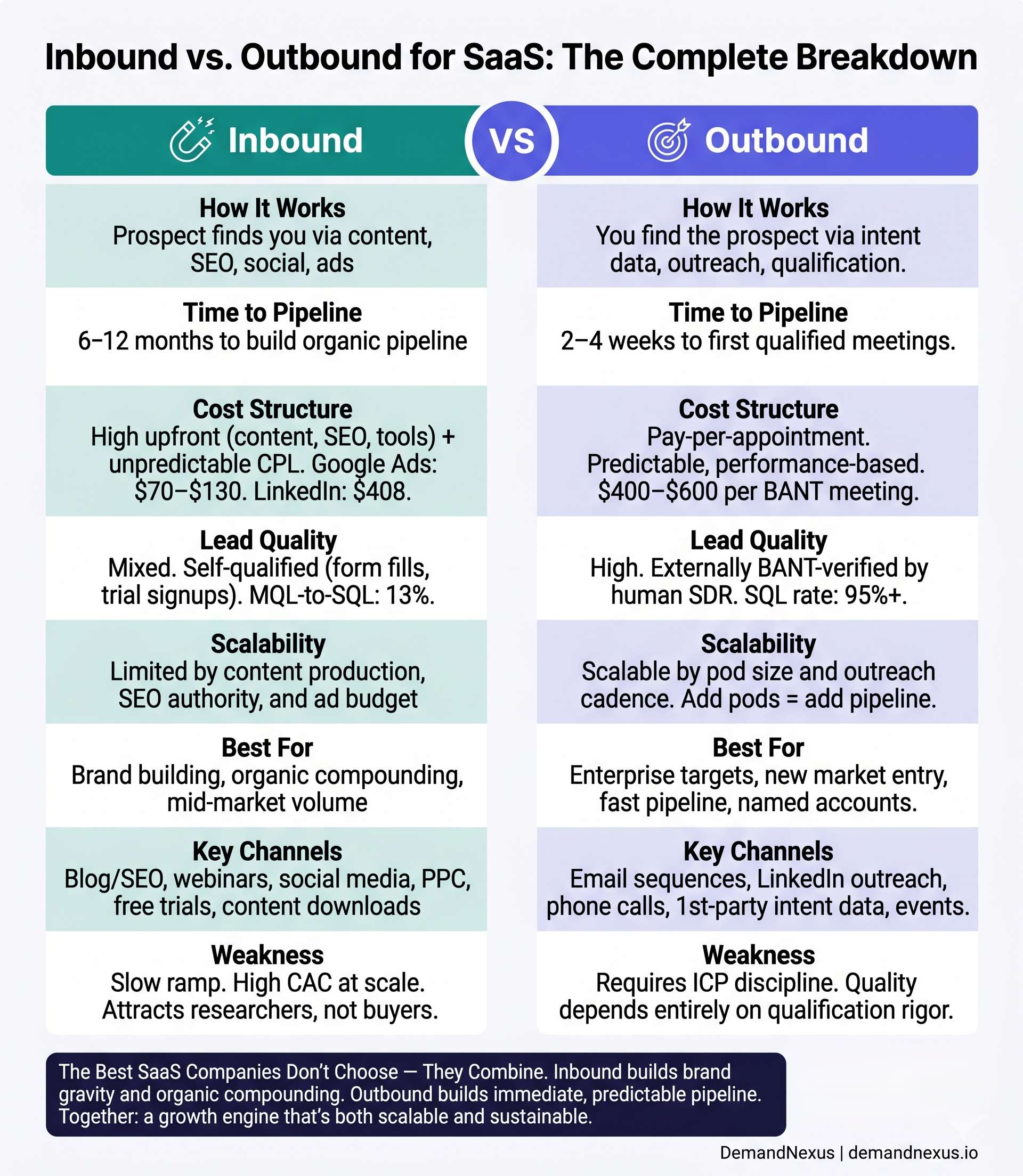
In the awareness stage, marketing teams attract prospects through SEO, content marketing, and paid advertising. Cost per lead has exploded Google Ads CPL increased 70% from 2021 to 2025, while LinkedIn CPL now averages $408 for B2B campaigns.
During consideration, leads receive webinars, case studies, and email nurturing. Sales teams spend 45-90 minutes attempting to qualify each lead from paid channels.
At conversion, the truth emerges: only 13% of MQLs convert to SQLs. The remaining 87% become what industry insiders call “the MQL Black Hole” leads that consume resources without producing results.
The Financial Impact:
Consider a mid-market B2B SaaS company generating 500 MQLs monthly at $150 each:
The initial investment reaches $75,000. With 13% MQL-to-SQL conversion, only 65 leads qualify as sales-ready. At a 30% close rate from qualified leads, this produces roughly 20 closed deals. Sales teams invest 750 hours pursuing these leads including the 87% that will never convert.
The result: $3,750 cost per closed deal and 37.5 sales hours per customer acquired.
Why Traditional Inbound and Outbound Tactics Underperform
The Inbound Challenge
Content marketing and SEO remain valuable for brand awareness, but they create a qualification bottleneck. A prospect downloading your whitepaper demonstrates interest not intent, budget, or purchasing authority.
Webinars attract engaged audiences, yet attendance doesn’t equal qualification. Case studies build credibility, but reading a success story doesn’t indicate a prospect is ready to become one.
The fundamental issue: inbound tactics generate volume without verification.
The Outbound Problem
Cold email outreach connects you directly with decision-makers theoretically. In practice, purchased contact lists contain stale, recycled data that competitors are simultaneously pursuing. Response rates plummet because there’s no demonstrated interest.
Social selling on LinkedIn builds relationships, but relationship-building without qualification data creates longer sales cycles, not shorter ones.
Paid advertising delivers instant visibility at escalating costs. With 62% of marketing teams increasing PPC budgets annually, auction dynamics ensure CPL continues rising while lead quality remains unchanged.
The Appointment Generation Alternative
The solution isn’t more leads it’s better qualification delivered earlier in the process.
The BANT Framework:
BANT qualification verifies four critical criteria before a prospect reaches your sales team:
Budget confirms the prospect has allocated funds for this type of solution.
Authority identifies whether the prospect can make or significantly influence the purchase decision.
Need validates that a specific, urgent business problem exists that your solution addresses.
Timeline establishes when the prospect intends to make a decision typically within one to six months.
When these criteria are verified before the sales conversation, conversion rates transform. Organizations prioritizing BANT-qualified leads achieve 20% higher win rates, 72% improvement in lead-to-opportunity conversion, and 202% higher close rates compared to non-qualified leads.
The Funnel Transformation:
Instead of the traditional path{ Traffic → Lead → MQL → SAL → SQL → Opportunity – the appointment generation model delivers: Outbound Outreach → BANT Qualification → Scheduled Meeting with Decision-Maker.
Sales receives only qualified opportunities with confirmed budget availability, decision-making authority, active business need, and purchase timeline within one to six months.
The Economics: MQLs vs. BANT-Qualified Appointments
The financial comparison reveals why appointment generation outperforms traditional lead generation.
Traditional MQL Model:
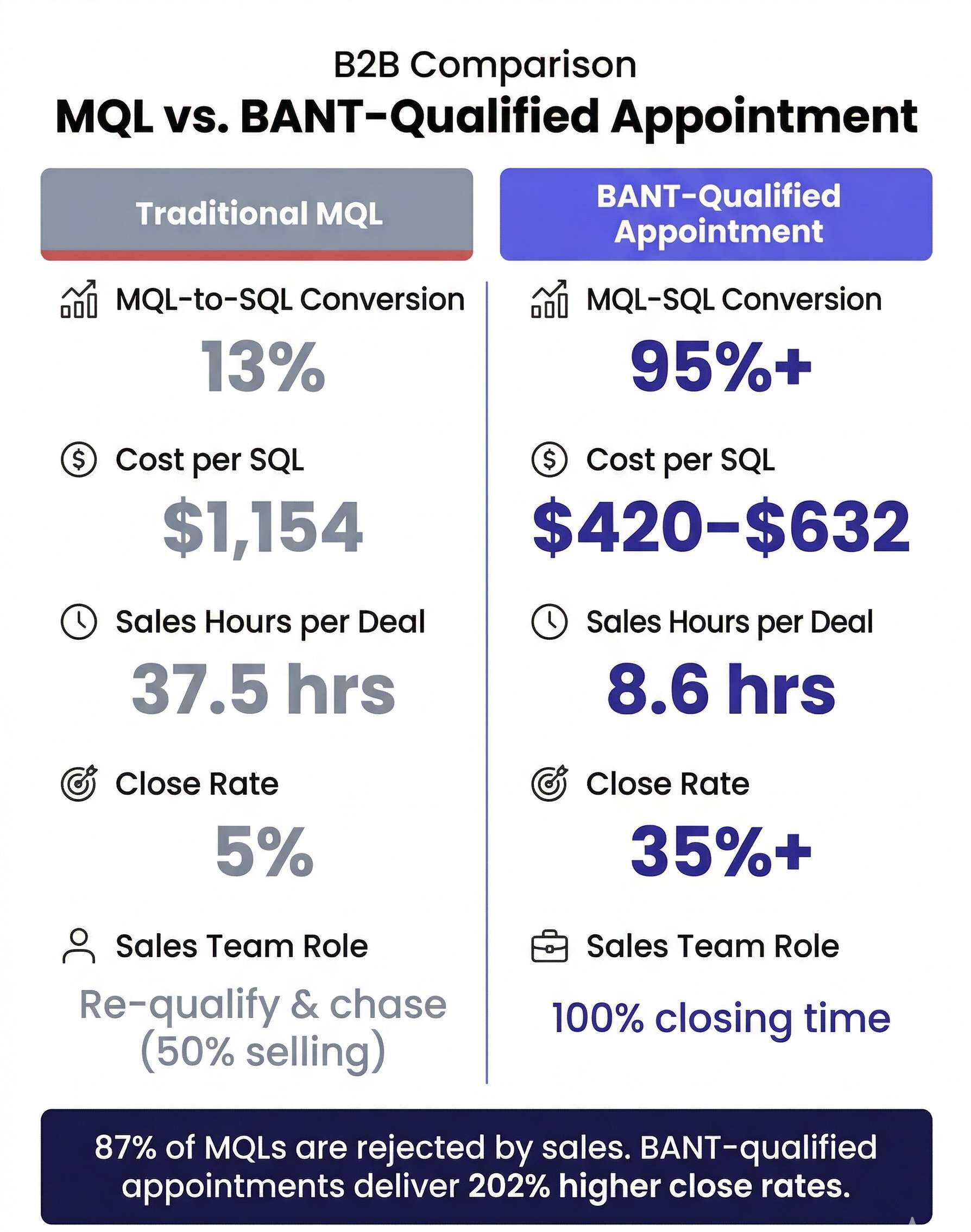
At $150 per MQL with 13% MQL-to-SQL conversion, cost per SQL reaches $1,154. Sales teams spend 8-12 hours per SQL on qualification activities.
BANT-Qualified Appointment Model:
At $400-600 per appointment with 95%+ appointment-to-SQL conversion, cost per SQL drops to $420-632. Sales hours per qualified opportunity: under one hour, since qualification happened before the meeting was scheduled.
ROI Comparison:
Generating 200 MQLs monthly at $150 each requires $30,000 investment and produces 26 SQLs. Sales teams spend approximately 300 hours pursuing these leads.
With 40 BANT-qualified appointments at $500 each, investment drops to $20,000 while producing 38 SQLs. Sales teams spend only 80 hours -100% focused on closing, not qualifying.
This represents 46% more SQLs, 33% less investment, and 220 sales hours saved monthly.
What Gets Eliminated with BANT Qualification
When appointments arrive pre-qualified, entire categories of sales friction disappear:
Lead scoring complexity becomes unnecessary – every appointment is already qualified. Marketing automation workflows designed to nurture cold leads add no value when prospects arrive sales-ready. Lead routing and assignment drama vanishes when every appointment meets your criteria.
Sales reps stop hearing “I’m just doing research,” “I have no budget,” or “Let me talk to my boss.” These objections indicate BANT failure – failure that should have been identified before the meeting was scheduled.
The Appointment Handover: Enabling Sales Success
BANT qualification alone doesn’t maximize conversion rates. Sales teams need context to close effectively.
The Appointment Handover Sheet (AHO):
Every qualified appointment should include comprehensive documentation for your account executives:
The executive summary provides the 30-second brief – prospect name, title, company, meeting date, and the primary “hook” that indicates purchase intent.
BANT verification details include specific proof points: confirmed budget amounts, identified decision-makers and buying committee members, articulated pain points in the prospect’s own words, and timeline drivers such as budget cycles or compliance deadlines.
Conversation intelligence captures key hooks from qualification discussions, hot buttons the prospect responded to, objections to anticipate, and competitive intelligence about other vendors under evaluation.
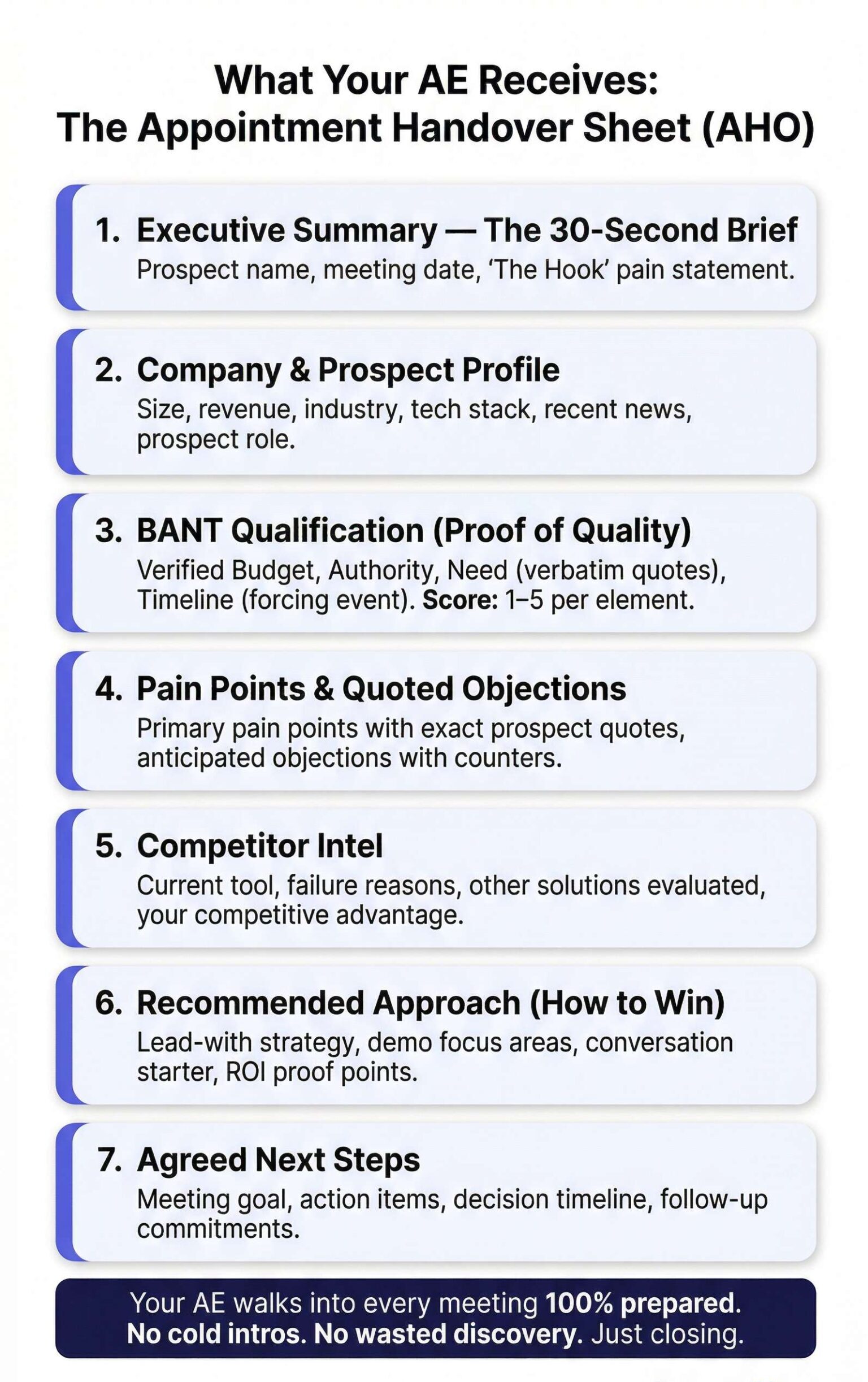
Meeting objectives outline what success looks like – specific features to demonstrate, questions to answer, and logical next steps if the meeting goes well.
Your account executive walks into every conversation 100% prepared, knowing the prospect is ready to buy, willing to buy, able to buy, and ready to buy now.
Measuring Success: Metrics That Matter
Traditional lead generation metrics like cost per lead (CPL) mask true performance. When 87% of leads fail qualification, a $70 CPL actually represents a $3,192 customer acquisition cost after accounting for wasted sales time, failed conversions, and opportunity cost.
Metrics for Appointment Generation:
Cost per qualified appointment measures actual investment in sales-ready opportunities, not raw contact acquisition.
Appointment-to-opportunity conversion tracks how many scheduled meetings progress to formal sales evaluation.
Sales hours per closed deal reveals operational efficiency – BANT-qualified appointments typically require 8-10 hours per closed deal versus 35-40 hours for traditional lead-to-close processes.
Pipeline generated per dollar invested provides the ultimate ROI measure. Top-performing appointment generation programs deliver $6M+ annual pipeline from approximately $90K investment – an ROI exceeding 3,400%.
Overcoming Common SaaS Lead Generation Challenges
Challenge: Low Lead Quality
Traditional solution: Implement more sophisticated lead scoring. Result: You’re still scoring bad leads.
Appointment generation solution: Eliminate unqualified leads entirely through human BANT verification before any sales engagement occurs.
Challenge: High Customer Acquisition Costs
Traditional solution: Balance paid advertising with organic tactics. Result: Marginal improvement while core inefficiency remains.
Appointment generation solution: Pay only for verified appointments that meet your criteria. Cost per qualified opportunity drops 60% or more compared to traditional MQL acquisition.
Challenge: Sales Team Burnout
Traditional solution: Hire more SDRs to handle qualification volume.
Appointment generation solution: Outsource qualification entirely. Sales teams focus 100% on closing deals with buyers who are ready to purchase, restoring morale and reducing turnover.
Challenge: Marketing-Sales Misalignment
Traditional solution: Implement SLAs between marketing and sales for lead follow-up.
Appointment generation solution: Align incentives around outcomes, not activities. When payment triggers only for meetings held and attended, quality becomes everyone’s priority.
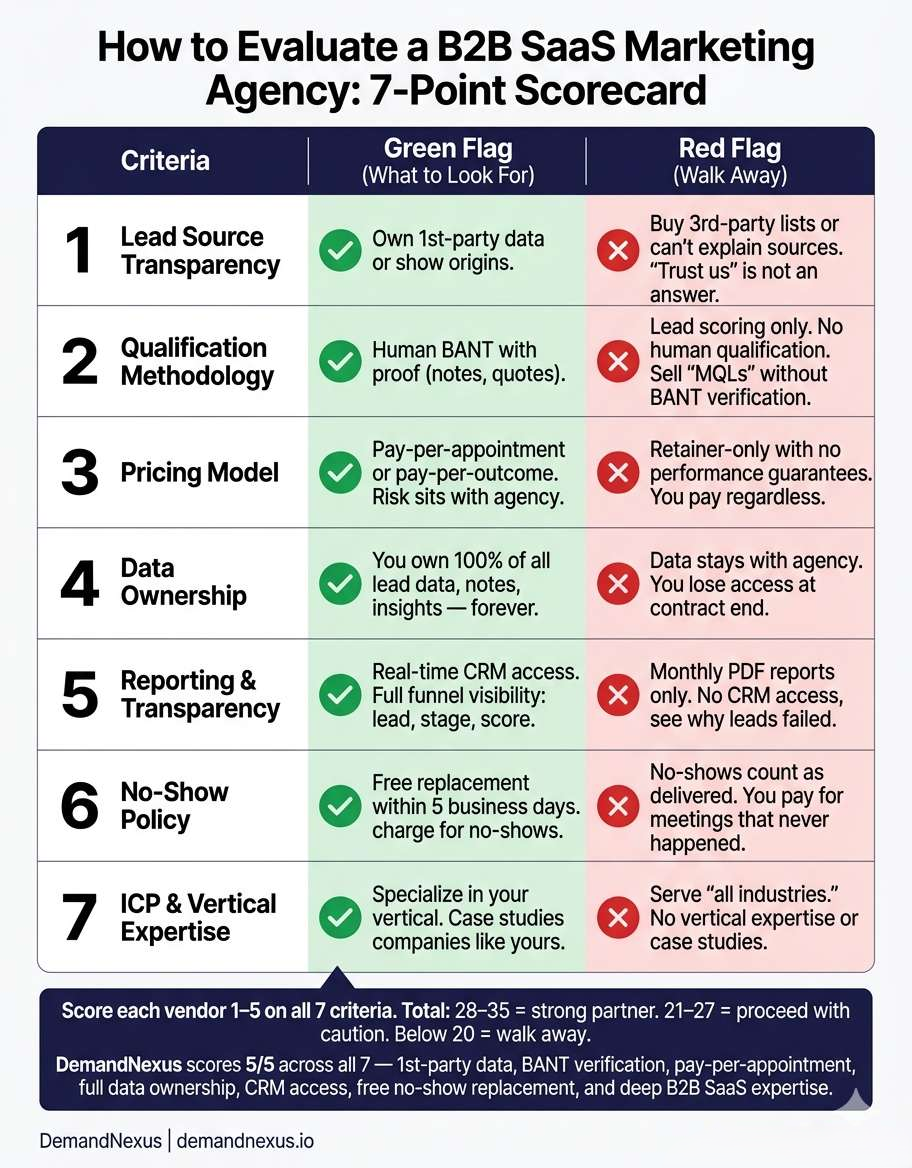
The Pay-for-Performance Model
Traditional lead generation vendors charge per lead delivered – regardless of whether those leads ever convert. You bear all the risk.
A pay-for-performance appointment model inverts this dynamic:
Payment trigger: Meeting held and attended on calendar – not form submissions or lead counts.
What you receive: Scheduled, BANT-verified appointments with confirmed attendees.
Risk allocation: The vendor bears risk for no-shows, unqualified meetings, and delivery shortfalls.
Your team’s role: Close deals. 100% of time spent selling, 0% spent qualifying.
Data ownership: Complete intelligence on every prospect touched – leads, BANT conversations, and contact data remain your asset forever.
Case Study: B2B SaaS Company Transformation
Before BANT-Qualified Appointments:
A mid-market B2B software company generated 400 MQLs monthly at $125 each, investing $50,000. At 15% MQL-to-SQL conversion, 60 leads qualified as sales-ready. With 20% SQL-to-close rate, 12 deals closed monthly.
Sales teams spent 600 hours pursuing 400 leads. Cost per deal: $4,167. Sales hours per deal: 50 hours.
After BANT-Qualified Appointments:
The same company shifted to 60 BANT-qualified appointments monthly at $500 each, investing $30,000. Since appointments were pre-qualified, 95% were immediately SQL – 57 qualified opportunities. With 30% SQL-to-close rate, 17 deals closed monthly.
Sales teams spent 180 hours on 60 meetings. Cost per deal: $1,765. Sales hours per deal: 10.6 hours.
Results:
42% more deals closed. 58% lower cost per deal. 79% reduction in wasted sales time. 40% budget savings.
Your Path to SaaS Lead Generation Success
Effective SaaS lead generation in 2025 and beyond requires rethinking the fundamental approach. Volume-based tactics that fill pipelines with unqualified contacts waste budget and exhaust sales teams.
The alternative: invest in qualification upfront. Deliver BANT-verified appointments with comprehensive handover documentation. Align vendor incentives with outcomes through pay-for-performance models. Retain complete data ownership to build compounding value over time.
Start by evaluating your current state:
What is your true MQL-to-SQL conversion rate? How many sales hours does your team spend on leads that never close? What would your pipeline look like if 95% of leads were pre-qualified?
The answers reveal whether your lead generation strategy is building pipeline – or feeding the MQL Black Hole.
Frequently Asked Questions
What is SaaS lead generation?
SaaS lead generation is the process of identifying and engaging potential B2B customers for cloud-based software products, with the goal of building recurring revenue through subscriptions. Modern approaches increasingly focus on appointment generation rather than raw lead acquisition, since 87% of traditional MQLs are rejected by sales teams.
What is BANT qualification?
BANT is a sales qualification framework that verifies four criteria: Budget (funds allocated), Authority (decision-making power), Need (specific business problem), and Timeline (expected purchase timeframe). BANT-qualified leads convert at 202% higher rates than non-qualified leads.
Why do most MQLs fail to convert?
The average MQL-to-SQL conversion rate is 13%, meaning 87% of marketing-qualified leads are ultimately rejected by sales. Primary failure reasons include lack of budget allocation, engagement from non-decision-makers, absence of urgent business need, and no defined purchase timeline.
What is the difference between lead generation and appointment generation?
BANT-qualified appointments typically range from $400-600 per meeting. While this exceeds traditional cost per lead, the effective cost per qualified opportunity drops significantly since 95%+ of appointments are already sales-ready, compared to 13% of traditional MQLs.
What should be included in an appointment handover?
Comprehensive appointment handovers include executive summary, complete BANT verification details with specific proof points, conversation intelligence from qualification discussions, competitive intelligence, and recommended meeting objectives with success criteria.
Ready to transform your SaaS pipeline from the MQL Black Hole to BANT-qualified appointments that convert? Demand Nexus specializes in pay-for-performance appointment generation for B2B technology companies, delivering 15+ guaranteed qualified meetings monthly with zero-risk billing. Contact sales@demandnexus.io to learn how appointment generation can reduce your cost per closed deal by 50% or more.