

Introduction: Why SaaS Demand Generation Is Broken
SaaS demand generation is the discipline of creating, capturing, and converting market demand for your software product. But in practice, most SaaS companies have built demand generation programs that are optimized for the wrong outcome lead volume rather than pipeline quality.
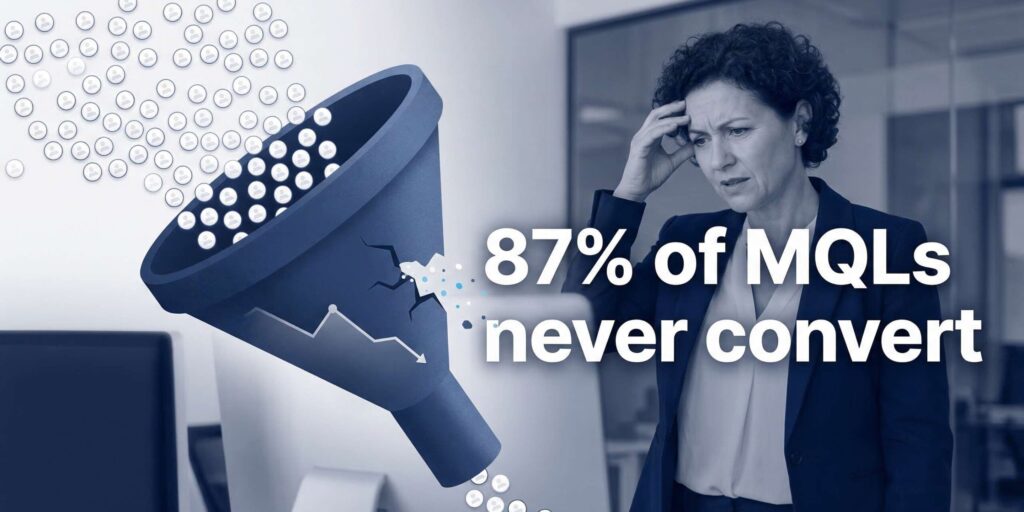
The average B2B SaaS company spends 15–20% of revenue on marketing. A significant portion of that budget flows into demand generation: paid ads, content programs, email nurture, SEO, events. Yet 87% of the MQLs those programs produce never convert to closed revenue. The metrics look active. The pipeline stays empty.

Most B2B teams lose 40–60% of qualified prospects to broken handoffs and weak qualification. Take our 2-minute diagnostic to find out where your pipeline is bleeding — and how to fix it.
Start the Quiz → Takes 2 minutes. No email required to start.This guide covers the full architecture of modern SaaS demand generation what it is, how it should work, which channels drive the highest ROI, and how to build a program that produces qualified pipeline rather than qualified-looking contacts.
What Is SaaS Demand Generation?
SaaS demand generation is the set of marketing and sales activities designed to create awareness, generate interest, and drive qualified buying intent for a software product among target business accounts. Unlike lead generation which focuses on capturing contact information demand generation is broader: it encompasses creating the conditions under which a prospect becomes aware of their problem, recognizes your software as a solution, and enters a buying process.
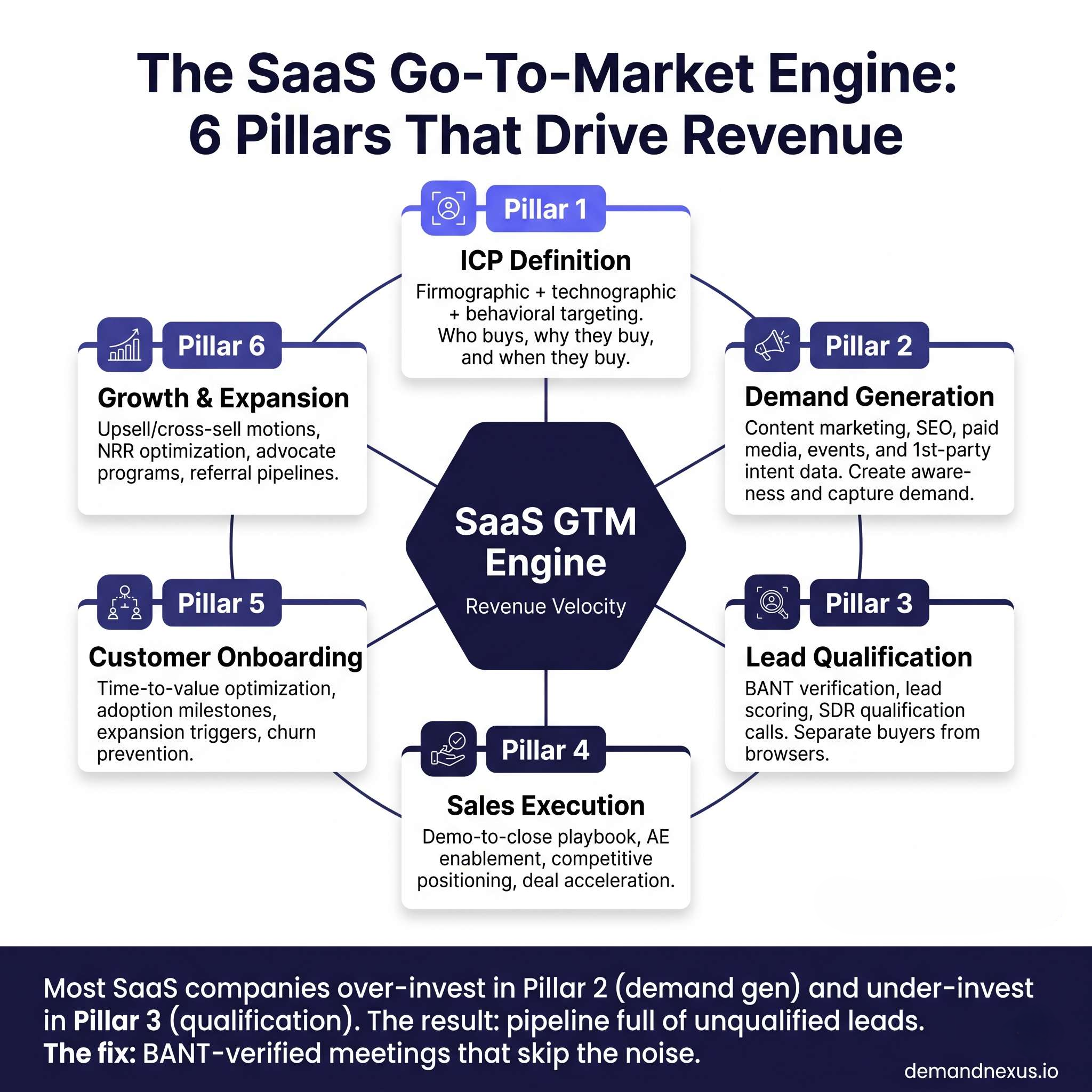

In practice, SaaS demand generation includes:
- Content marketing and SEO to capture organic search demand from buyers researching problems and solutions
- Paid acquisition (Google, LinkedIn, review platforms) to reach prospects at decision points
- Account-Based Marketing (ABM) to engage high-value target accounts with personalized programs
- Outbound SDR programs to proactively reach decision-makers with high intent signals
- Events, webinars, and thought leadership to build category authority
- Intent data programs to identify in-market buyers before competitors reach them
The output of demand generation is not a list of contacts. The output is a pipeline of qualified opportunities buyers who have demonstrated intent, confirmed fit, and are ready to engage with sales.

The SaaS Demand Generation Funnel
Top-of-Funnel: Awareness and Demand Creation
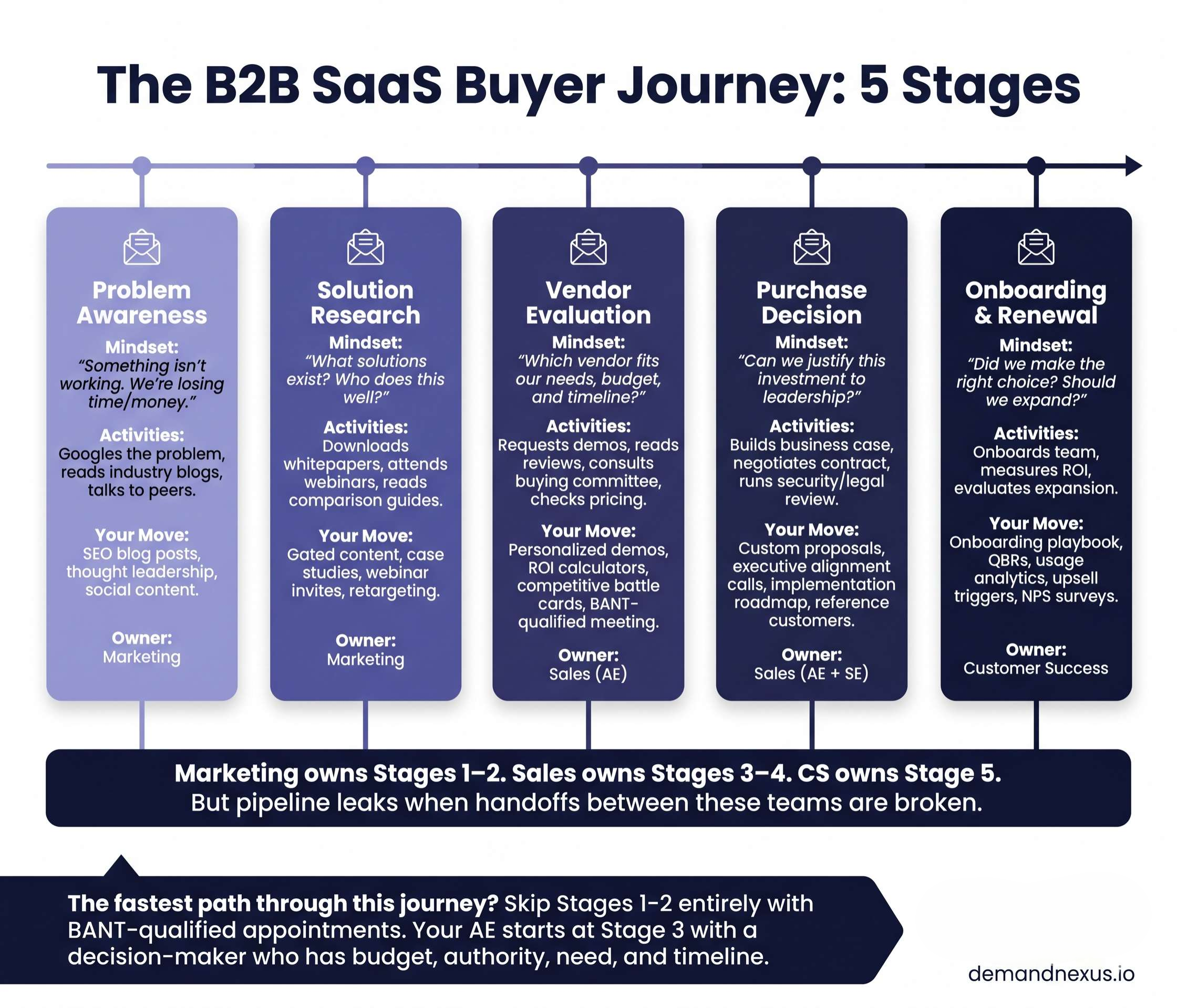
At the top of the funnel, demand generation creates category awareness helping your target audience understand the problem your product solves, even before they’re actively searching for solutions. This is where content marketing, SEO, social, and thought leadership play the most important role.
The most effective top-of-funnel demand generation for SaaS is problem-centric, not product-centric. Content that helps a VP of Sales understand why their pipeline keeps missing forecast builds more durable demand than a feature comparison sheet.
Mid-Funnel: Demand Capture
Mid-funnel demand generation captures buyers who are actively researching. Organic search particularly for comparison and solution-category keywords is the highest-ROI mid-funnel channel for most SaaS companies. This is where SEO and intent data intersect: prospects researching ‘best [category] software’ or ‘[competitor] alternative’ are in an active buying process.
At this stage, traditional demand generation programs collect MQLs a content download, a free trial signup, a demo request. But the conversion rates from MQL to pipeline are chronically low: 13% on average. The prospect who downloaded your guide may have done so for research, competitive intelligence, or idle curiosity. Activity is not intent.
Bottom-of-Funnel: Demand Conversion
Bottom-of-funnel demand generation converts high-intent signals into sales conversations. This is where the Waterfall Model operates using first-party intent data, context-aware outreach, and BANT qualification to convert engaged prospects into confirmed appointments with your AEs.
The critical distinction at this stage: a meeting is only valuable if the prospect has confirmed budget, authority, need, and timeline before the call. Without that verification, you’re scheduling conversations with contacts, not with buyers.
SaaS Demand Generation Channels: ROI Comparison
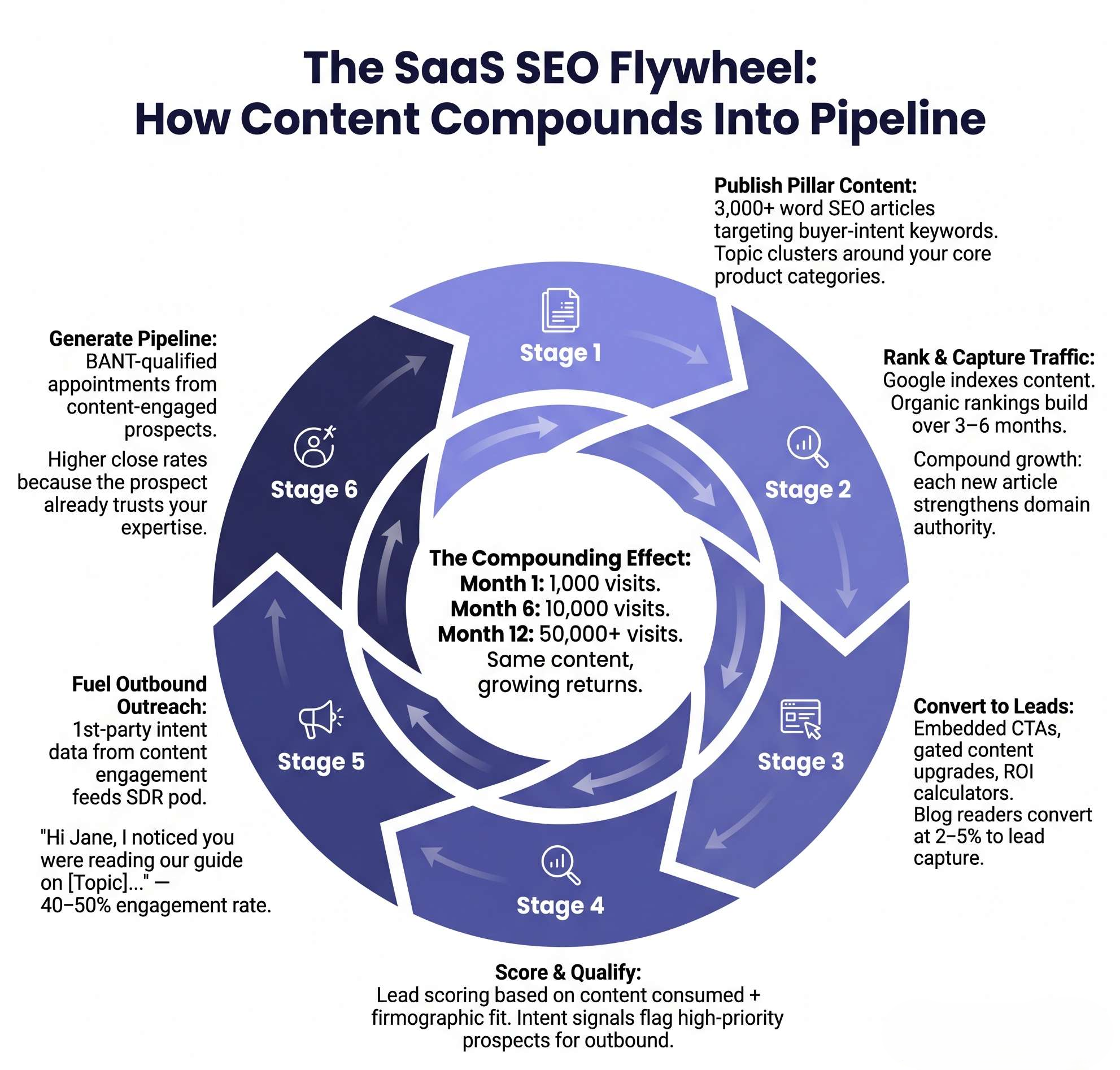
Organic Search (SEO)
SEO remains the highest long-term ROI channel for SaaS demand generation. Content that ranks for problem-aware and solution-aware keywords produces compounding traffic without per-click costs. For SaaS companies in established categories, organic search can drive 40–60% of qualified pipeline over a 12–18 month investment horizon.
Paid Search and Social
Google Ads CPL for SaaS has risen 70% since 2021, and LinkedIn CPL averages $408. Paid channels are effective for capturing in-market demand at scale, but declining ad efficiency means they cannot be the primary driver of pipeline economics. Use paid to amplify high-intent moments; don’t rely on it for baseline demand creation.
Intent Data and First-Party Media
First-party intent data behavioral signals from prospects engaging with your owned content or industry media in your category is the highest-signal demand source available. When a VP of Operations reads three articles about workflow automation on a niche B2B media site, that behavioral cluster is a stronger purchase signal than any form submission.
DemandNexus operates six owned B2B media brands (AITechTrend, MarTechTrend, HRTechTrend, FinTechFilter, LegalTechTrend, DevTechTrend) reaching 15M+ decision-makers. These properties generate first-party intent signals that power the BANT qualification process delivering 90%+ SQL conversion rates versus the 13% industry average for MQL-sourced pipeline.
Account-Based Marketing (ABM)
ABM focuses demand generation resources on a defined list of high-value target accounts. Rather than broad demand creation, ABM coordinates marketing and sales touchpoints to move specific accounts through the buying process. ABM works best when supported by intent data knowing which target accounts are actively researching gives marketing and sales the signal to accelerate engagement. See our guide to ABM and demand generation for a full comparison.
Outbound SDR Programs
Outbound remains essential for SaaS companies targeting enterprise accounts with long sales cycles. The effectiveness of outbound depends almost entirely on lead quality: SDRs working BANT-qualified leads from intent-driven programs spend 100% of their time on closing conversations. SDRs working purchased contact lists spend 30–50% of their time on re-qualification.
The Waterfall Model: A Better Architecture for SaaS Demand Generation
The Waterfall Model is DemandNexus’s Pay-for-Performance Appointment (PPA) system a multi-stage qualification framework that converts first-party intent signals into BANT-verified sales appointments.
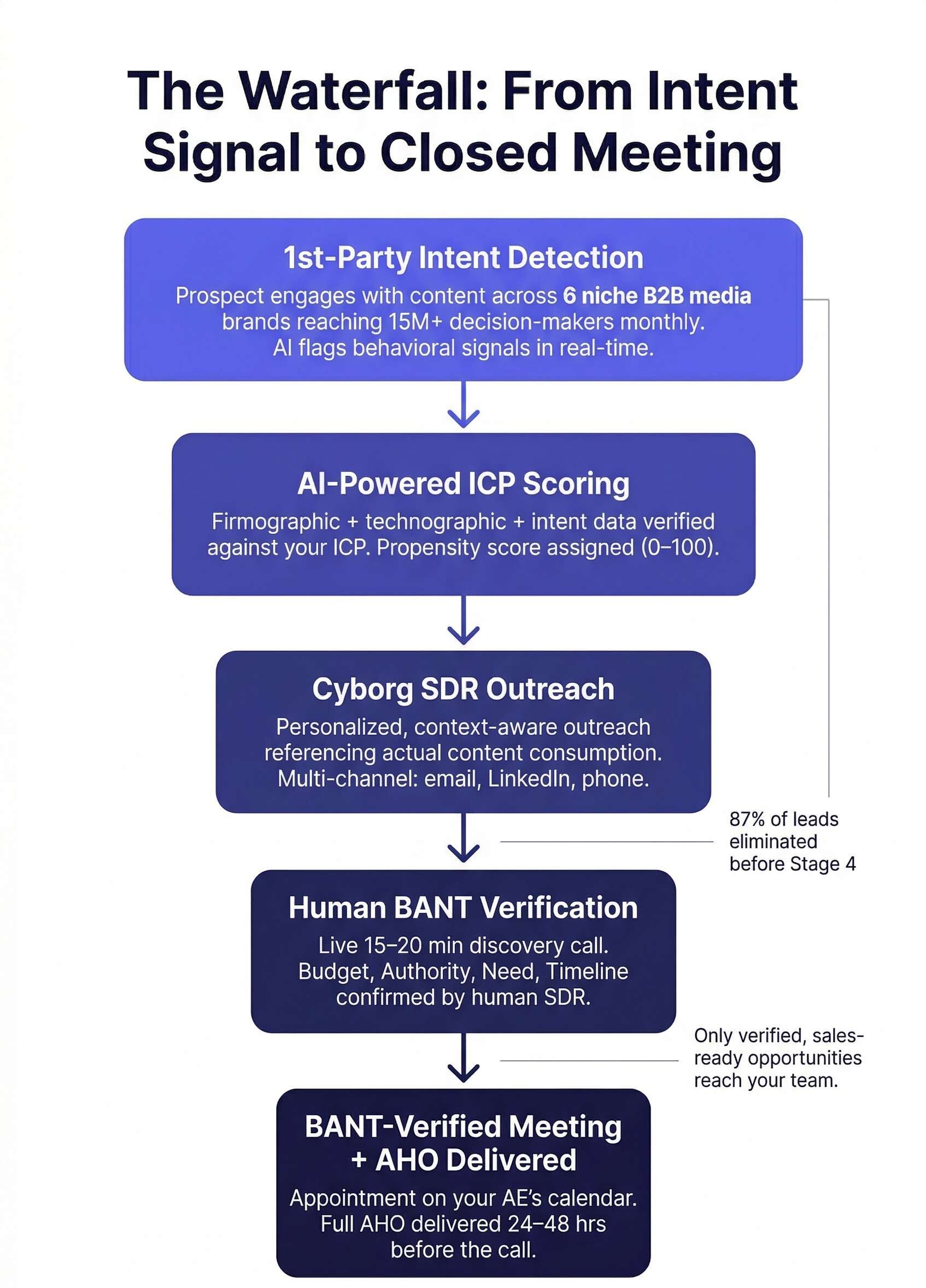
Here’s how it differs from traditional SaaS demand generation programs:
Stage 1: Intent Signal Identification
The Waterfall begins with first-party behavioral data from DemandNexus’s owned media network. When a target prospect engages with category-relevant content, the system flags the behavior and routes it to the qualification process. No purchased lists. No guessed intent. Verified, real-time behavioral data.
Stage 2: Context-Aware Outreach
Rather than generic cold sequences, outreach is crafted around the specific content the prospect engaged with. A message referencing the exact problem the prospect was researching generates a 40–50% engagement rate compared to under 5% for generic outreach sequences.
Stage 3: BANT Qualification
A human SDR conducts a structured qualification conversation. Budget is confirmed not assumed. Authority is verified not inferred from a title. Need is articulated by the prospect in their own words. Timeline is established with a specific window. Only prospects who pass all four criteria become appointments.
Stage 4: AHO Delivery
The Appointment Handover Sheet is delivered to your AE before every call, containing: intent data from Stage 1, full BANT answers from Stage 3, specific pain points and urgency drivers, decision-making stakeholders, and recommended opening strategy. DemandNexus clients see 202% higher close rates compared to non-qualified lead programs.
SaaS Demand Generation Metrics: What to Track
Pipeline Metrics
- Pipeline generated per month / quarter (not leads pipeline)
- SQL conversion rate (target: 30%+ from qualified programs; 90%+ with BANT pre-qualification)
- Cost per opportunity (not cost per lead)
- Cost per closed deal
Efficiency Metrics
- MQL-to-SQL conversion rate (benchmark: 13% industry average; best-in-class: 30–40%)
- Sales cycle length (BANT-qualified programs typically shorten cycles 20–40%)
- AE qualification time per week (target: under 5 hours with pre-qualified appointments)
Revenue Metrics
- Revenue attributed to demand generation programs
- ROI by channel (organic, paid, intent-driven, outbound)
- Customer acquisition cost (CAC) by demand gen source
Building a SaaS Demand Generation Strategy: 6-Step Framework
Step 1: Define Your ICP with Precision
Demand generation only works when you’re generating demand from the right audience. Define your Ideal Customer Profile not just by firmographic data (company size, industry, ARR) but by behavioral and situational criteria: what problems are they actively trying to solve, what content do they consume, what triggers a buying cycle for them?
Step 2: Map Intent Signals to Buying Stages
Not all engagement is equal. A first-time blog visitor is different from a prospect who has read six articles in your category, attended a webinar, and visited your pricing page. Map the behavioral signals available to you to buying stages and focus qualification effort on the highest-intent clusters.
Step 3: Build Content for Every Funnel Stage
Top-of-funnel content creates category awareness. Mid-funnel content captures active research. Bottom-of-funnel content supports conversion. A SaaS demand generation content strategy should address all three but the most underinvested stage for most companies is mid-funnel: comparison pages, solution-category guides, ROI calculators, and case studies that support an active evaluation.
Step 4: Align Sales and Marketing on Qualification Criteria
The gap between marketing and sales is almost always a qualification standards gap. Marketing defines ‘qualified’ by engagement score; sales defines it by BANT. Align on a shared definition: a qualified opportunity is one where Budget, Authority, Need, and Timeline have been confirmed by a human in a direct conversation.
Step 5: Implement a BANT Qualification Layer
Between your demand generation programs and your AE calendar, insert a BANT qualification layer. Whether you run this in-house or through a provider like DemandNexus, every prospect should be BANT-verified before consuming AE time. The ROI impact is immediate: AEs close more because they spend 100% of their time on qualified buyers.
Step 6: Measure Pipeline, Not Leads
Replace MQL targets with pipeline targets. Track cost per opportunity, cost per closed deal, and revenue attributed by source. When your demand generation program is measured on pipeline rather than lead volume, the programs that actually produce revenue get investment, and the ones that produce activity without results get cut.
FAQs
What is the difference between demand generation and lead generation?
Lead generation focuses on capturing contact information. Demand generation is broader — it encompasses creating awareness, building category consideration, capturing intent, and converting qualified prospects into sales opportunities. Demand generation produces pipeline; lead generation produces lists.
What is a good conversion rate for SaaS demand generation?
MQL-to-SQL conversion rates average 13% across the industry. SQL-to-opportunity conversion rates vary by product and sales motion, but 20–30% is a reasonable benchmark. BANT-qualified appointment programs like DemandNexus's Waterfall Model achieve 90%+ SQL conversion because qualification happens before the meeting is booked.
How much should a SaaS company spend on demand generation?
Most B2B SaaS companies spend 15–20% of revenue on marketing, with 40–60% of that allocated to demand generation programs. Early-stage companies (pre-product-market-fit) often spend higher percentages. The more important benchmark is cost per closed deal — not total spend.
What is intent data in SaaS demand generation?
Intent data tracks behavioral signals from prospects who are actively researching solutions in your software category. First-party intent data (from owned media properties) is the highest-quality signal — it reflects real engagement with content relevant to your buyer's problem, not modeled predictions.
How does the Waterfall Model improve SaaS demand generation?
The Waterfall Model converts first-party intent signals into BANT-verified appointments through a multi-stage qualification process. Rather than passing MQLs to sales, every appointment arrives with Budget, Authority, Need, and Timeline confirmed — along with a full Appointment Handover Sheet briefing your AE. The result: 202% higher close rates and 90%+ SQL conversion.
What is ABM demand generation for SaaS?
ABM (Account-Based Marketing) demand generation for SaaS focuses marketing and sales efforts on a defined list of high-value target accounts — coordinating personalized outreach, content, and engagement to move specific accounts through the buying process.
What channels drive the best ROI for SaaS demand generation?
Organic search (SEO) delivers the highest long-term ROI through compounding traffic. First-party intent data programs deliver the highest conversion quality. Paid search and social are effective for capturing in-market demand but face rising CPLs. The best SaaS demand generation programs combine multiple channels with BANT qualification as the conversion layer.
Why do SaaS demand generation programs fail?
The most common failure mode is measuring success by MQL volume rather than pipeline quality. Programs optimized for lead count produce high volumes of low-intent contacts that waste sales team time. The fix is shifting the qualification threshold from marketing engagement to BANT-verified buyer readiness.