



The market is flooded with companies calling themselves “lead generation services.” Most deliver contact lists, MQL batches, or SDR-as-a-service with zero accountability for pipeline outcomes. A few deliver something genuinely different: BANT-verified, calendar-booked appointments that your sales team can actually close.

Most B2B teams lose 40–60% of qualified prospects to broken handoffs and weak qualification. Take our 2-minute diagnostic to find out where your pipeline is bleeding — and how to fix it.
Start the Quiz → Takes 2 minutes. No email required to start.This guide breaks down the B2B sales lead generation services landscape — how the models differ, what to look for, which questions to ask, and how to evaluate providers before you commit budget.
What Are B2B Sales Lead Generation Services?
B2B sales lead generation services are third-party providers that identify, engage, and qualify potential buyers on behalf of your sales team.
They vary enormously in scope, model, and quality:

Contact list providers sell databases of company and contact information. You get names and emails; qualification and outreach are your problem.
MQL/demand generation agencies run paid advertising, content, and SEO campaigns to drive inbound leads. Volume is the deliverable; lead quality varies widely.

SDR-as-a-service companies provide outsourced sales development representatives who handle prospecting and initial outreach. Output is typically in the form of “interested leads” who have replied to an email.
Appointment generation companies go further: they handle full-cycle qualification, verify BANT criteria via live conversation, and deliver calendar-booked meetings directly to your AEs. This is the highest-value model.
What should I look for in a B2B sales lead generation service?
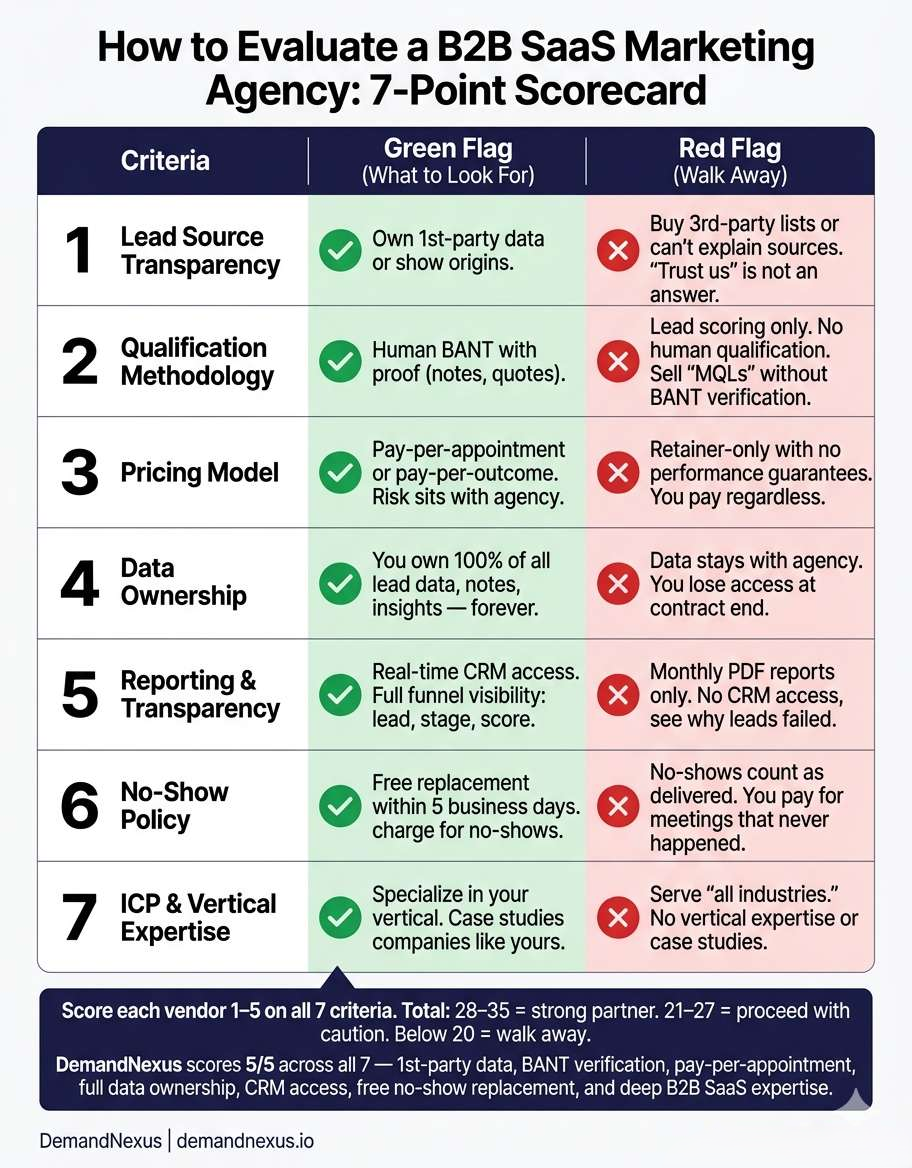
Look for: (1) clear definition of what constitutes a qualified lead or appointment, (2) transparent pricing — ideally pay-for-performance rather than retainers for activity, (3) BANT or equivalent verification methodology, (4) documented handoff process (AHO-style briefings), (5) data ownership rights — you should own every contact and conversation, and (6) SLA guarantees for minimum volume.
B2B Lead Generation Services: Model Comparison
| Model | What You Pay For | What You Get | Who Owns the Risk |
|---|---|---|---|
| Contact List / Database | Data access | Email addresses | You |
| MQL Agency / Demand Gen | Ad spend + retainer | Form fills & downloads | You |
| SDR-as-a-Service | Monthly retainer | “Interested replies” | You |
| Pay-Per-Lead (PPL) | Cost per contact | Unverified contacts | You |
| Appointment Generation (PPA) | Cost per meeting | BANT-verified, booked appointments | Provider |
The critical insight: in every model except Pay-for-Performance Appointment generation, you pay for activity — and absorb the risk that the activity never converts. In a PPA model, risk transfers to the provider.
Top Questions to Ask Any B2B Lead Generation Service
Before signing a contract with any lead generation provider, ask these questions directly:
How do you define a “qualified lead” or “qualified appointment”? The answer separates serious providers from activity-sellers. If they can’t give you a precise BANT-based definition, they are selling you MQLs dressed up as pipeline.
What is your billing trigger? Do you pay for contact data? For email replies? For booked meetings? For attended meetings? The billing trigger defines the alignment of incentives. Pay-for-performance means you pay only when meetings happen — not when leads are generated.
Who owns the data at the end of the engagement? Many providers retain ownership of all contact and conversation data. You should receive full, permanent data ownership — every prospect touched, every BANT conversation, every qualified appointment.
What happens if a meeting is a no-show? A credible provider replaces no-shows at no charge within a defined window. If they don’t offer this guarantee, factor no-show risk into your cost calculations.
How do you generate your prospect lists? First-party intent data (from owned media brands and engaged audience networks) dramatically outperforms third-party purchased lists. Ask specifically whether prospects are identified through intent signals or demographic data matching.
How to Evaluate Pricing Models in B2B Lead Generation Services
Cost-Per-Lead (CPL) Pricing
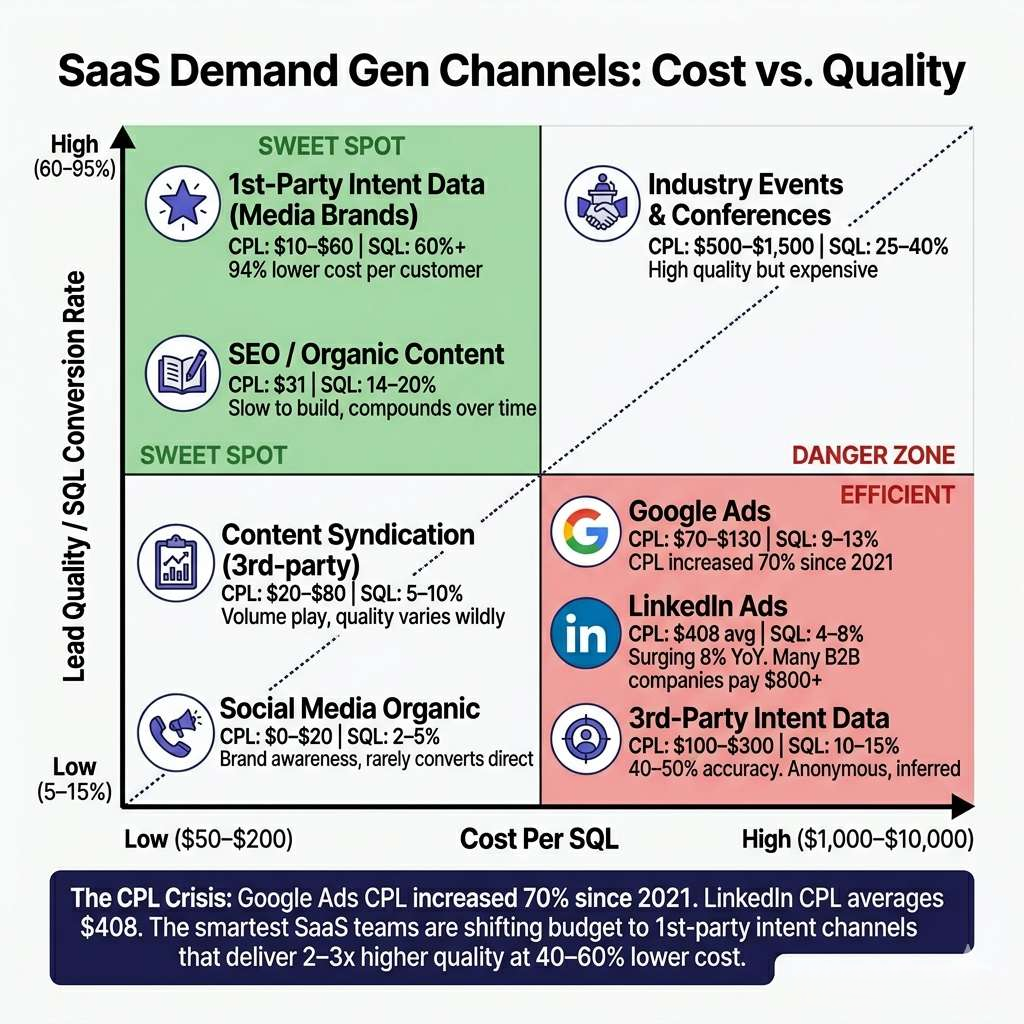
The most common and most misleading model. CPL ranges from $30–$400+ depending on channel and industry. The problem: CPL says nothing about lead quality. A $30 lead that requires 8 hours of SDR follow-up to qualify — and never converts — costs vastly more than a $500 appointment that closes at 35%.
Retainer + Performance Hybrid
Some SDR-as-a-service providers charge a flat monthly retainer plus performance bonuses. This model maintains some alignment but still doesn’t transfer risk — you pay the retainer regardless of outcome.
Pay-for-Performance Appointments (PPA)
The most aligned model: you pay only for meetings that happen and meet your BANT criteria. No meetings = no fees. This is the DemandNexus model — and it fundamentally changes the buyer-provider relationship from vendor-client to partners with skin in the game.
Is pay-per-lead or pay-per-appointment better for B2B companies?
Pay-per-appointment is superior for B2B companies with complex, high-value sales cycles. Here’s why: PPL (pay-per-lead) optimises the provider for lead volume, with no accountability for qualification quality. PPA (pay-per-appointment) optimises the provider for pipeline quality — they only earn revenue when a real, qualified meeting happens. For B2B deals averaging $50K+, the cost difference between a qualified appointment and an unqualified lead is enormous when calculated against closed-deal economics.
DemandNexus vs. Traditional Lead Generation Services
DemandNexus operates as a B2B appointment generation company — not a lead generation company. The distinction defines everything about how the service works and what clients actually receive.
What makes DemandNexus different from standard lead generation services?
The DemandNexus Waterfall Model delivers BANT-verified, calendar-booked meetings with B2B decision-makers. Clients pay only for meetings that happen and meet their qualification criteria. Three proprietary advantages drive the model:
Proprietary First-Party Intent Data from Six Owned Media Brands: AITechTrend, MarTechTrend, FinTechFilter, HRTechTrend, DevTechTrend, and LegalTechTrend generate real-time buying signals from 15M+ active decision-makers. Prospects are identified by genuine research behaviour — not third-party modelled intent scores.
The Instant Pod Team Structure: Each client account is served by a dedicated 8-person team (no shared SDR pools, no generic agents). The team manages outreach, qualification, and appointment logistics exclusively for your account.
Appointment Handover Sheets (AHO): Every booked meeting comes with a comprehensive briefing document covering BANT verification details, the prospect’s stated pain, account intelligence, and recommended conversation angles. Your AEs walk in prepared to close — not to re-qualify.
Permanent Client Data Ownership: At the end of any engagement, clients retain 100% of all contact data, BANT conversations, and account intelligence. This is a pipeline asset that compounds over time.
Explore B2B sales development services and B2B sales enablement to see how the appointment generation model fits into a full revenue stack.
B2B Lead Generation Service Pricing: 2025 Benchmarks
| Service Type | Typical Pricing | What’s Included |
|---|---|---|
| Contact database subscription | $3,000–$20,000/year | Contact data, basic intent signals |
| MQL/demand gen agency | $5,000–$30,000/month retainer | Ad management, content, MQL reports |
| SDR-as-a-service | $5,000–$15,000/month per rep | Outreach activity, “interested” leads |
| Pay-Per-Lead | $50–$400 per lead | Unverified contacts |
| DemandNexus Essentials Pod | $7,500/month | 15+ BANT-verified appointments |
| DemandNexus Growth Pod | $12,500/month | 25+ BANT-verified appointments |
| DemandNexus Enterprise Pod | $16,000/month | 40+ BANT-verified appointments |
At 35% close rates and $50K average deal size, the DemandNexus Essentials Pod generates an estimated $3.15M pipeline per year — against $90,000 investment.
FAQs
How do I know if a B2B lead generation service is legitimate?
Legitimate providers define qualification criteria precisely, offer performance-based pricing (or at minimum clear SLAs), provide transparent reporting, give you full data ownership, and have verifiable client references. Avoid providers who can’t clearly define what a “qualified lead” means in their model.
What is the difference between SDR-as-a-service and appointment setting?
SDR-as-a-service typically delivers engaged replies and “warm leads” that still require your internal team to qualify and schedule. Appointment setting delivers calendar-booked meetings with pre-qualified prospects. The qualification step is the critical difference — and it determines whether your AEs walk into prepared sales conversations or cold calls.
How long does it take to see ROI from a B2B lead generation service?
With outbound appointment generation, first meetings can appear on your calendar within 30 days of launch. ROI timelines depend on your sales cycle length — B2B SaaS deals often close in 30–90 days, while enterprise deals may run 6–12 months from first appointment to close.
Can I outsource lead generation and keep my internal sales team?
Yes — and this is the most efficient model. Outsourced appointment generation eliminates the SDR function’s prospecting and qualification burden, freeing your internal AEs to focus 100% on closing. Your internal team handles discovery, demos, and deal advancement. The appointment generation partner fills the calendar.