


Why Most B2B Demand Generation Strategies Fail
Here is the uncomfortable truth: most B2B demand generation strategies fail because they are actually lead generation strategies wearing demand generation clothing.
The symptoms are predictable. Marketing runs webinars, gated whitepapers, and LinkedIn campaigns. The MQL count looks healthy on dashboards. But when you follow those leads downstream, 80% are rejected by sales—unqualified, uninterested, or unreachable. The pipeline stays flat despite growing spend.

Most B2B teams lose 40–60% of qualified prospects to broken handoffs and weak qualification. Take our 2-minute diagnostic to find out where your pipeline is bleeding — and how to fix it.
Start the Quiz → Takes 2 minutes. No email required to start.The root cause is almost always the same: the strategy optimizes for lead volume rather than buyer readiness. When your demand generation plan rewards the number of form fills instead of the number of qualified conversations, every incentive pushes your team toward quantity over quality.
Winning strategies flip this equation. They start with the end goal—qualified appointments with decision-makers who have verified budget, authority, need, and timeline—and work backward to design every campaign, content asset, and channel selection around that outcome.
The 12 B2B Demand Generation Tactics That Work in 2026
1. Build (or Partner with) Niche Media Brands as Intent Engines
The highest-performing demand generation programs in 2026 leverage proprietary media brands that aggregate niche audiences at scale. Instead of competing for attention on Google and LinkedIn (where CPLs have risen 70% since 2021), they meet buyers inside the publications those buyers already trust.

A network of industry-specific media brands covering verticals like AI technology, marketing technology, HR technology, fintech, and legal technology provides two advantages: a proprietary first-party intent data stream that competitors cannot access, and a warm audience that already recognizes the content ecosystem when outreach begins.
The data impact is significant: first-party intent from owned media delivers 70-80% qualified signals versus 30-50% from traditional syndication.

2. Replace MQL Targets with Appointment SLAs
If your demand generation strategy is measured by MQLs generated, your team will optimize for MQLs. If it is measured by BANT-qualified appointments held, every activity—from content creation to channel selection—shifts toward buyer readiness.
Best practice: Establish a monthly meeting SLA with your demand generation partner or internal team. For example, 15+ qualified appointments per month, each verified for Budget, Authority, Need, and Timeline, each delivered with a structured Appointment Handover Sheet (AHO) so your AE walks in fully prepared. When the metric is appointments, the entire strategy tightens around quality.
3. Adopt the Waterfall Qualification Model
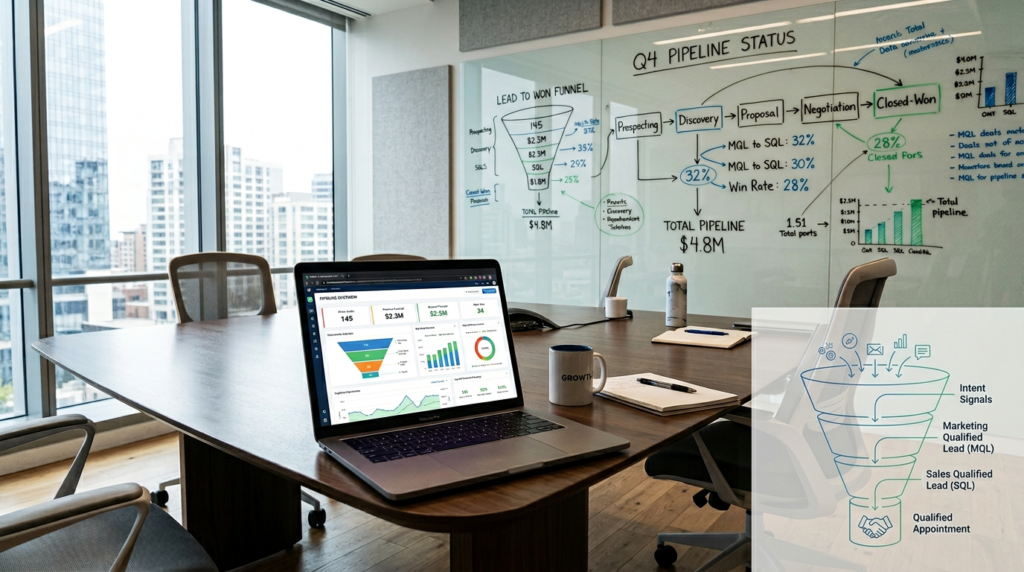
The waterfall model is a multi-stage qualification engine where prospects pass through progressively more rigorous filters:
Stage 1: Intent signal detection from first-party media engagement.Stage 2: ICP verification against your ideal customer profile.Stage 3: Multi-channel outreach with context-aware messaging.Stage 4: Human-led BANT qualification call.Stage 5: Appointment scheduling with full AHO documentation.
Each stage eliminates unqualified prospects before they consume sales resources. The result is a pipeline where 35%+ of appointments convert to closed deals, compared to the 5% industry average from traditional lead funnels.
4. Lead with Education, Not Offers
Demand generation campaigns that educate outperform those that pitch. When your content teaches prospects something valuable about their own challenges—without gating it behind a form—you build trust that compounds over time.
Publish ungated research, industry analysis, and frameworks. Let prospects consume freely. Track engagement signals in the background. When a prospect has consumed three or more pieces of content within 30 days, that behavioral signal is more valuable than any single form fill.
5. Use AI for Research, Humans for Relationships
The “Cyborg SDR” model—where AI handles research, list building, and message testing while humans handle qualification conversations and relationship building—consistently outperforms both pure-human and pure-AI approaches.
AI is excellent at monitoring intent signals across thousands of accounts, scanning job boards for hiring triggers, and A/B testing subject lines at scale. But AI cannot build trust with a CFO, handle nuanced objections about implementation timelines, or detect the difference between genuine buying interest and casual research.
The hybrid approach delivers 60 qualified meetings per month at $5,000 cost, versus 20 meetings from pure-human teams at $15,000 or 10 meetings from pure-AI tools at $500 (with extreme brand risk).
6. Deploy Multi-Channel Demand Generation Campaigns
Single-channel strategies leave pipeline on the table. The most effective B2B demand generation campaigns coordinate across email, LinkedIn, phone, content syndication, and display advertising—triggered by intent signals rather than calendar dates.
When a prospect engages with AI compliance content on a niche tech publication, the follow-up should reference that specific topic across channels: a personalized email citing their research interest, a LinkedIn connection with a relevant case study, and a phone call that opens with context (“I noticed your team has been researching AML automation—our clients in fintech are facing similar urgency”).
7. Build an Appointment Handover System
Every qualified meeting should come with documentation that prepares your AE to win. An Appointment Handover Sheet (AHO) should include the prospect’s verified BANT responses, their specific pain points in verbatim quotes, the competitive landscape (what they are currently using and why it is failing), anticipated objections, and a recommended opening approach for the meeting.
When AEs receive this level of preparation 48 hours before a meeting, they can skip generic discovery and open with tailored insights. The result: prospects feel understood from the first minute, and deal velocity increases measurably.
8. Implement Content Syndication Through Trusted Channels
Content syndication works best when distributed through channels your ICP already trusts. Publishing through niche industry media brands rather than generic syndication networks ensures that the audience is pre-qualified by interest and role.
Sponsored whitepapers, co-branded webinars, and newsletter placements within vertical publications generate higher engagement rates and lower cost per qualified meeting than broad syndication.
9. Create Demand Generation Campaign Examples That Showcase Results
Document your wins. Case studies and campaign examples that include specific metrics—number of appointments generated, close rates, pipeline value, and ROI—serve dual purpose: they function as sales enablement assets and as demand generation content that attracts prospects searching for proof of concept.
10. Leverage Account-Based Demand Generation
For enterprise targets, combine demand generation with account-based marketing principles. Identify target accounts showing intent signals, coordinate multi-threaded outreach to the buying committee, and deliver personalized content that addresses each stakeholder’s specific concerns.
11. Invest in Demand Generation Content Strategy
Your content strategy should map to the buyer journey: educational pillar content for awareness, solution-comparison content for consideration, and case studies plus ROI calculators for decision stage. Every piece should be optimized for AEO (structured FAQs and direct-answer formatting) and GEO (specific metrics and entity mentions that AI engines can cite).
12. Adopt Pay-for-Performance Pricing
The demand generation industry is moving toward pay-for-performance models where you only pay for qualified outcomes—appointments held, pipeline generated—rather than activities. This alignment of incentives ensures your demand generation partner is as invested in meeting quality as you are.
Building Your B2B Demand Generation Plan: A 90-Day Roadmap
Days 1-30: Foundation. Define ICP, establish BANT criteria, select media brand partners that align with your buyer’s reading habits, and set appointment SLA targets.
Days 31-60: Activation. Launch multi-channel campaigns targeting high-intent accounts identified through first-party data. Begin qualification conversations and refine messaging based on early call intelligence.
Days 61-90: Optimization. Analyze appointment quality data, close rates, and AE feedback. Adjust targeting, messaging, and qualification criteria. By day 90, you should have a predictable pipeline engine delivering 15+ qualified meetings per month.
FAQS
What is the best B2B demand generation strategy?
The best strategies combine first-party intent data from niche media brands with human-led BANT qualification. Rather than chasing MQL volume, they focus on delivering qualified appointments with verified decision-makers and measure success by pipeline generated and close rates.
How do you create a demand generation plan?
Start by defining your ICP and BANT criteria, then map where your buyers consume content. Build or partner with media properties in those verticals. Establish monthly appointment SLAs. Implement multi-channel outreach triggered by intent signals. Create feedback loops between sales and marketing to continuously improve qualification quality.
What are examples of demand generation campaigns?
Effective campaigns include content syndication through niche industry publications, account-based multi-channel sequences triggered by intent signals, webinar series that capture engagement data, and case study distribution targeting accounts showing competitive displacement signals.
How do demand generation tactics differ from lead generation tactics?
Lead generation tactics focus on capturing contact information (form fills, gated downloads). Demand generation tactics focus on creating awareness, educating buyers, detecting intent signals, and qualifying prospects before they ever reach your sales team. The output of demand generation is a pipeline-ready appointment, not a raw lead.
What demand generation best practices should B2B teams follow in 2026?
Prioritize first-party intent data over third-party. Measure appointments held rather than MQLs generated. Use AI for research and humans for qualification. Implement a waterfall qualification model with structured AHO documentation. Adopt pay-for-performance pricing with demand generation partners.