



Introduction
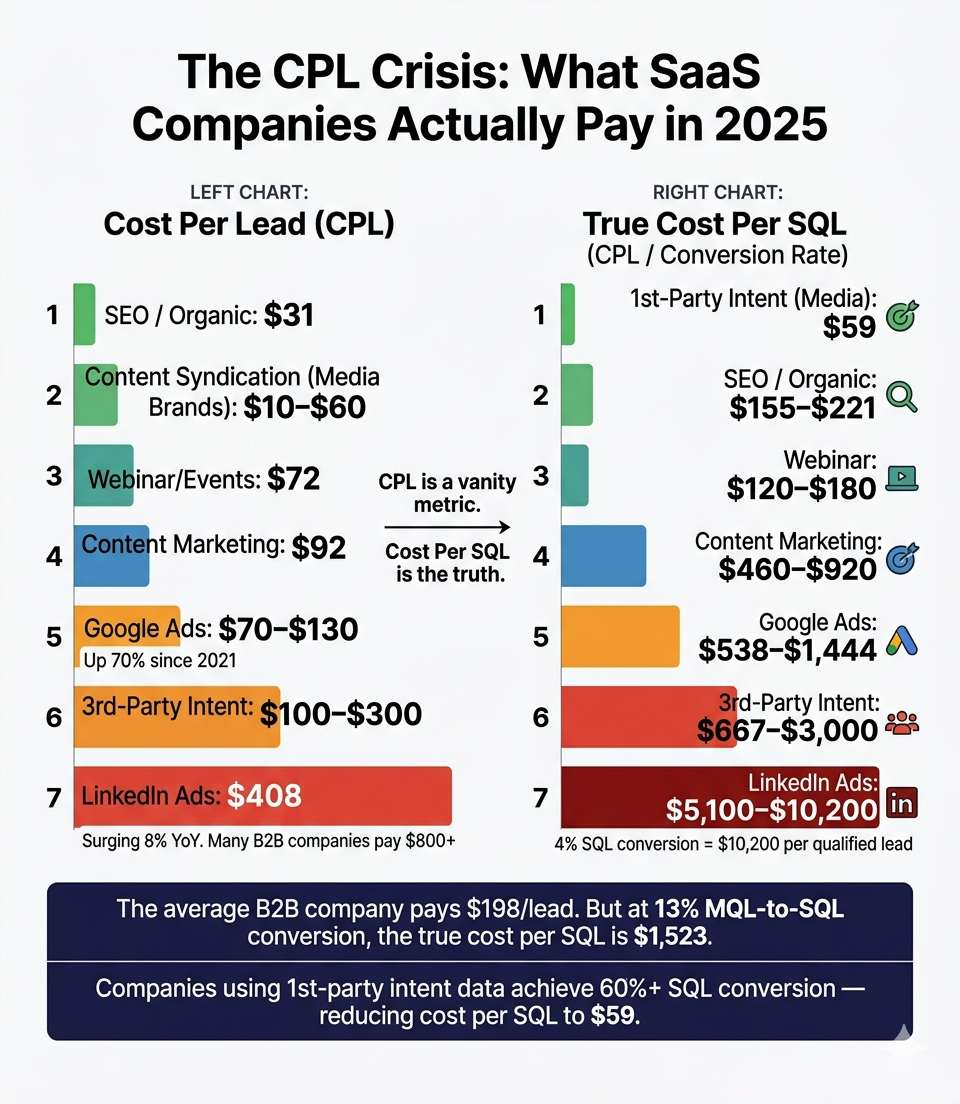
B2B SaaS marketing strategy has never been more expensive or more competitive. Google Ads CPL has risen 70% since 2021. LinkedIn CPL averages $408. Category leaders are flooding every channel with content. And despite all this investment, the industry average MQL-to-SQL conversion rate sits at 13% – meaning 87 out of every 100 marketing-generated leads never become revenue.
This isn’t a budget problem. It’s a strategy problem. Most B2B SaaS marketing strategies are built around activity metrics – leads generated, MQLs created, cost per lead – rather than pipeline metrics. The fix isn’t spending more. It’s restructuring the strategy around buyer readiness rather than buyer activity.

Most B2B teams lose 40–60% of qualified prospects to broken handoffs and weak qualification. Take our 2-minute diagnostic to find out where your pipeline is bleeding — and how to fix it.
Start the Quiz → Takes 2 minutes. No email required to start.This guide covers every component of a high-performing B2B SaaS marketing strategy: what it is, which channels to prioritize, how to align marketing and sales on qualification, and how to measure outcomes that actually predict revenue.
What Is B2B SaaS Marketing?
B2B SaaS marketing is the set of activities designed to drive awareness, demand, and pipeline for a software-as-a-service product sold to other businesses. Unlike B2C marketing – which focuses on emotional engagement and high-volume transaction – B2B SaaS marketing must navigate multi-stakeholder buying committees, long sales cycles (average 84 days for deals over $50K), technical evaluation processes, and procurement requirements.
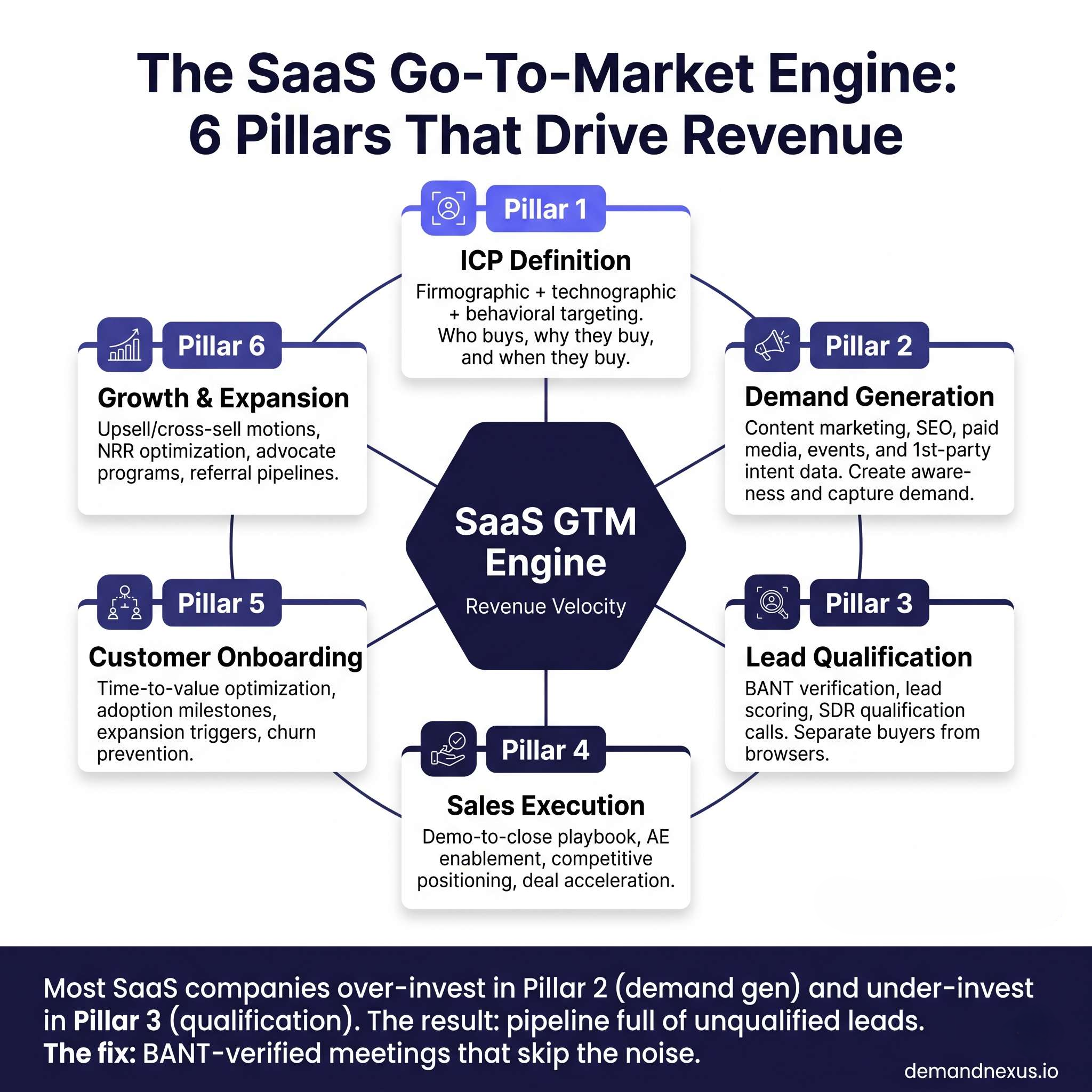

Effective B2B SaaS marketing strategy addresses all three stages of the buyer journey: problem awareness, solution evaluation, and vendor selection. Most SaaS marketing programs invest heavily in awareness and lightly in the conversion stages where revenue is actually won or lost.
The 7 Core Components of B2B SaaS Marketing Strategy
1. Ideal Customer Profile (ICP) Definition
Every effective B2B SaaS marketing strategy starts with a precise ICP. Not a broad target market, but a specific profile of the company type, job title, company size, industry, technology stack, and situational triggers that predict purchase. ICP precision drives every downstream decision – which channels to use, what content to create, how to qualify leads, and which accounts to target with ABM.

2. Demand Generation
Demand generation creates and captures buying intent across the full funnel – from category awareness at the top to qualified pipeline conversion at the bottom. The most common mistake: treating demand generation as synonymous with lead generation. Demand generation is a broader discipline that includes content marketing, SEO, paid acquisition, ABM, outbound SDR programs, and intent data programs.
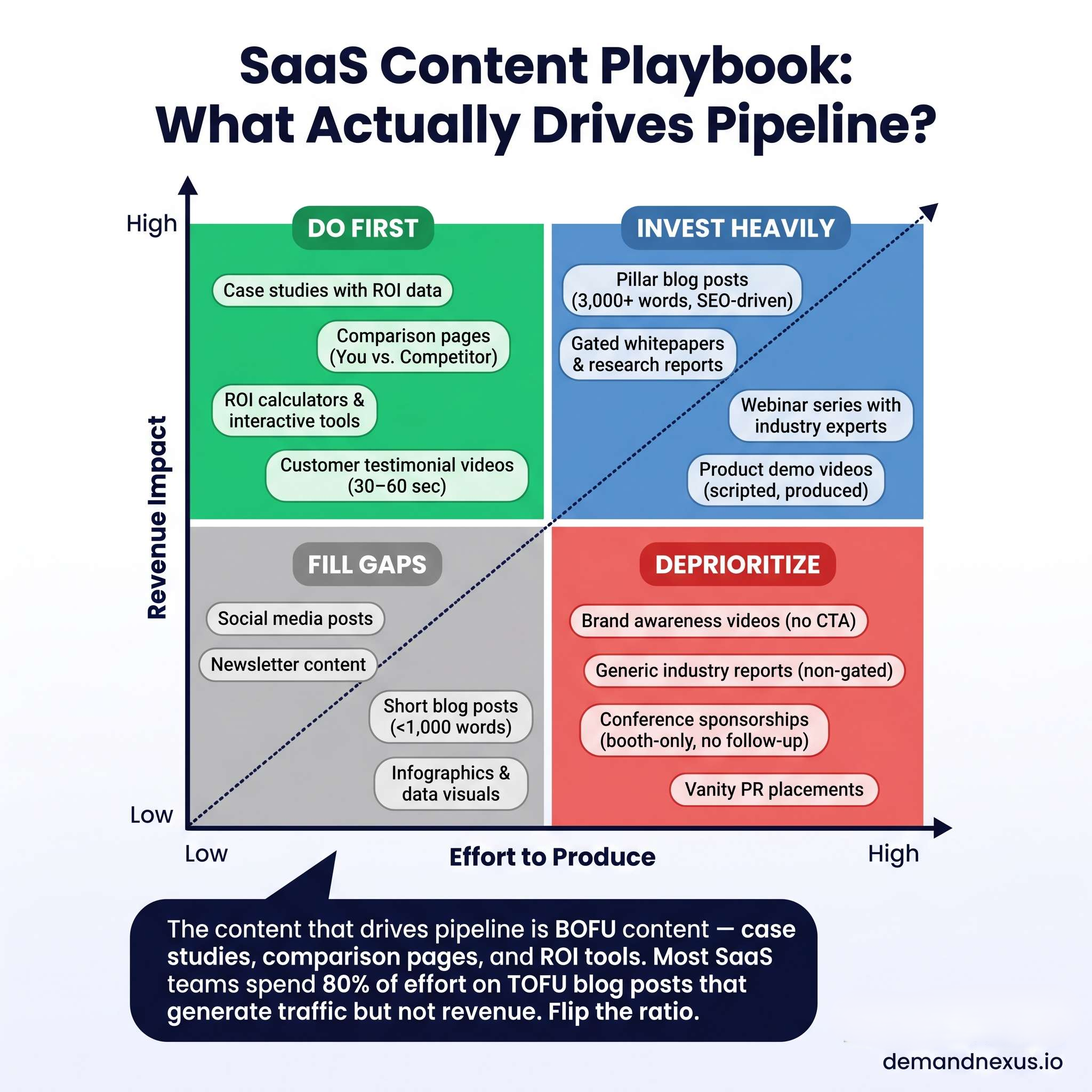
3. Content Marketing and SEO
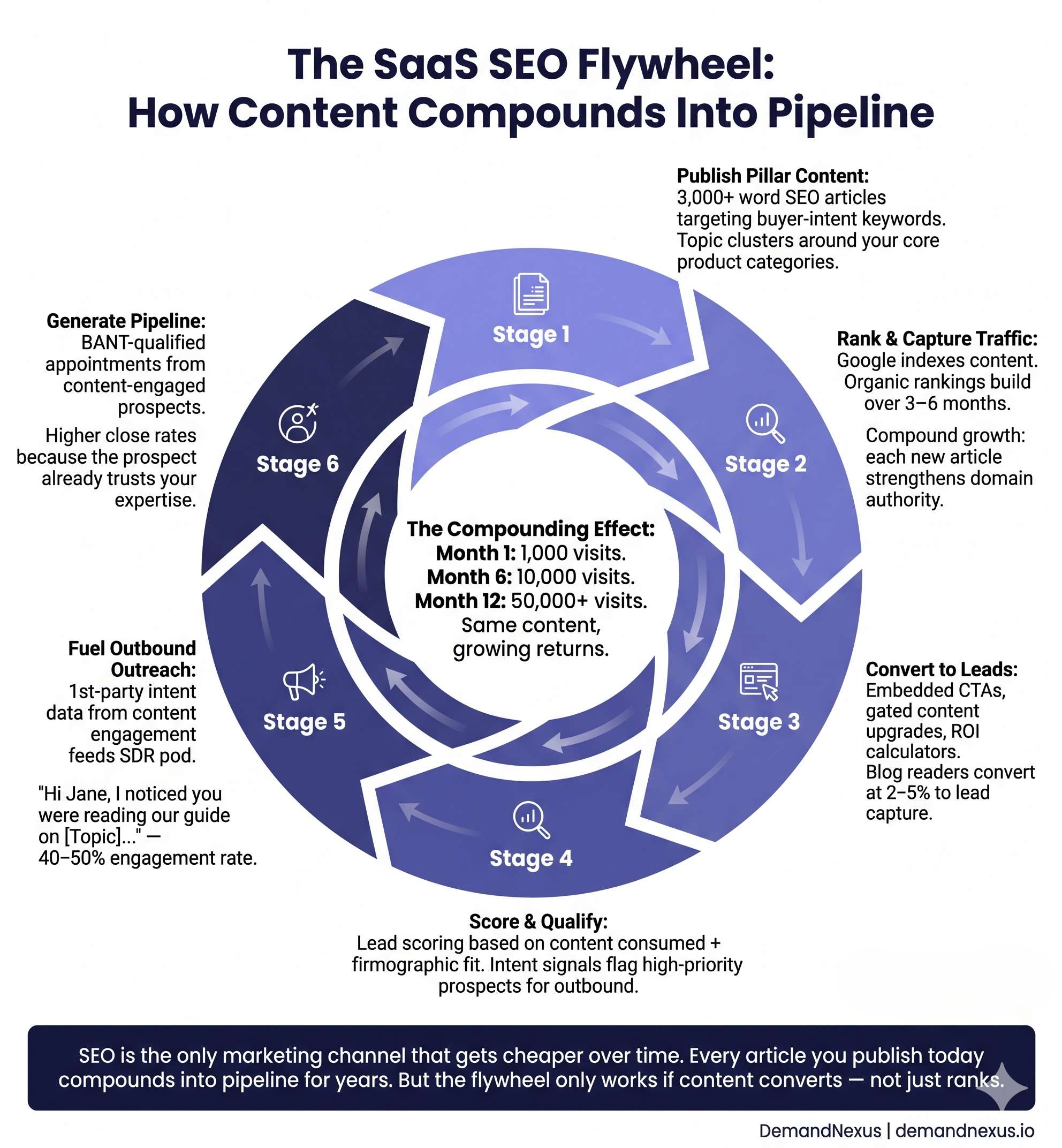
For B2B SaaS companies, organic search is the highest long-term ROI marketing channel. Content that ranks for problem-aware and solution-aware keywords drives compounding traffic without per-click costs. A mature SaaS SEO strategy targets the full keyword funnel: awareness keywords (what is [problem]), comparison keywords ([competitor] vs. [your product]), and conversion keywords (best [category] software).
4. Paid Acquisition
Paid search and paid social (primarily Google and LinkedIn) remain essential for capturing in-market demand, but efficiency has declined significantly. Use paid to amplify high-intent moments – your best-converting landing pages, your strongest case studies, your highest-performing bottom-of-funnel content. Don’t use paid as your primary demand creation engine.
5. Account-Based Marketing (ABM)
ABM coordinates marketing and sales resources on a defined list of target accounts – using personalized content, multi-channel engagement, and intent data to move specific accounts through the buying process. ABM works best when powered by first-party intent signals: knowing which target accounts are actively researching your category gives marketing and sales the trigger to accelerate engagement.
6. Sales Development and Outbound
Outbound SDR programs are the highest-intent, highest-cost demand generation channel. Their effectiveness is entirely dependent on lead quality. SDRs working BANT-qualified leads from intent-driven programs close at rates 202% higher than SDRs working cold contact lists. The ROI of outbound SaaS marketing depends almost entirely on the quality of the qualification layer above it.
7. Customer Marketing and Expansion
The highest-ROI SaaS marketing investment is often retention and expansion, not acquisition. Existing customers who expand generate 3–5x the revenue at a fraction of the acquisition cost. A complete B2B SaaS marketing strategy includes post-sale engagement programs, customer success content, upsell triggers, and advocacy programs.
B2B SaaS Marketing Channels: Where to Invest in 2026
Organic Search (SEO): Highest Long-Term ROI
SaaS SEO strategy should prioritize three keyword categories: problem-aware (what is [problem], how to solve [problem]), solution-aware (best [solution category] software, [category] tools comparison), and brand/competitor (your product vs. competitor, [competitor] alternative). The compounding nature of organic traffic makes it the most defensible and capital-efficient demand channel for SaaS.
LinkedIn: Best for ABM and Awareness
LinkedIn remains the most targeted B2B advertising platform despite high CPLs ($408 average). Its strength is precision targeting by job title, company size, industry, and seniority – making it valuable for ABM awareness campaigns and targeting specific buying committee members. Use it for targeted awareness, not as a volume lead generation channel.
Google Ads: Best for Capture, Not Creation
Search advertising captures demand that already exists – prospects actively searching for solutions. It is the most efficient channel for converting in-market buyers but creates no new demand. At 70% CPL increase since 2021, use it selectively for the highest-converting bottom-of-funnel keywords.
First-Party Intent Data: Highest Conversion Quality
First-party behavioral data from owned media properties is the most reliable intent signal available. DemandNexus’s owned media network (AITechTrend, MarTechTrend, HRTechTrend, FinTechFilter, LegalTechTrend, DevTechTrend) reaches 15M+ decision-makers and generates behavioral signals that power context-aware outreach and BANT qualification – producing 90%+ SQL conversion rates.
Why MQLs Are Failing B2B SaaS Marketing
The MQL has been the primary currency of B2B SaaS marketing for two decades. But its conversion rates tell a different story: 87% of MQLs never convert. The problem is structural.
MQL scoring measures marketing engagement – email opens, whitepaper downloads, webinar registrations. These signals indicate that a prospect is aware of your product or category. They do not indicate that the prospect has budget to purchase, authority to decide, a specific need your product addresses, or a timeline for action.
When a marketing team declares a contact an MQL and passes it to sales, what they’re actually saying is: ‘This person has engaged with our content.’ What sales needs to hear is: ‘This person has confirmed budget, has authority, acknowledges a need, and has a decision timeline.’ Those are not the same thing.
The fix: replace MQL thresholds with BANT qualification. Every appointment on your AE’s calendar should have confirmed Budget, Authority, Need, and Timeline before the meeting is booked. This single change typically reduces meeting volume by 30–40% while increasing pipeline value by 2–3x.
B2B SaaS Marketing Metrics: What to Track
Pipeline Metrics (Primary)
- Pipeline generated by source (not leads – pipeline opportunities with estimated deal value)
- SQL conversion rate by source (benchmark: 13% industry average; 90%+ with BANT pre-qualification)
- Cost per opportunity by channel
- Cost per closed deal by channel
- Revenue attributed to marketing programs
Efficiency Metrics (Secondary)
- AE qualification time per week (target: under 5 hours with pre-qualified appointments)
- Sales cycle length by lead source
- Win rate by lead source
- Customer acquisition cost (CAC) by channel
Avoid as Primary Metrics
- MQL volume (measures activity, not pipeline)
- CPL (cost per lead – often rewards low-quality volume)
- Open rates, click rates (marketing engagement, not buyer readiness)
FAQs
What is B2B SaaS marketing?
B2B SaaS marketing is the set of activities designed to build awareness, generate demand, and convert qualified buyers for a software product sold to other businesses. It encompasses content marketing, SEO, paid acquisition, ABM, outbound SDR programs, and intent data programs.
What are the best B2B SaaS marketing strategies for 2026?
The highest-ROI strategies in 2026 combine organic search (SEO) for long-term demand creation, first-party intent data for demand capture, and BANT-qualified appointment programs for conversion. ABM for enterprise accounts and customer expansion marketing for retention complete a full-funnel strategy.
Why do B2B SaaS marketing campaigns fail?
Most SaaS marketing campaigns fail because they're measured on lead volume rather than pipeline quality. Programs optimized for MQL count produce high volumes of low-intent contacts that waste AE time on re-qualification. Reorienting measurement toward pipeline generated and cost per closed deal changes which programs receive investment.
What is the MQL problem in SaaS marketing?
MQLs measure marketing engagement activity — downloads, email opens, page visits — rather than buyer readiness. The average MQL-to-SQL conversion rate is 13%, meaning 87% of marketing-qualified leads never become pipeline. The solution is replacing MQL thresholds with BANT qualification before appointments are booked.
How does content marketing fit into B2B SaaS strategy?
Content marketing serves multiple functions in SaaS strategy: top-of-funnel awareness content creates category demand, mid-funnel comparison and educational content captures active evaluators, and bottom-of-funnel case studies and ROI calculators support conversion. Organic search is the primary distribution channel and highest-ROI outcome.
What is ABM in B2B SaaS marketing?
ABM (Account-Based Marketing) is a strategy that focuses marketing and sales resources on a defined list of target accounts, using personalized engagement to move specific companies through the buying process. It's most effective when supported by first-party intent data that signals which accounts are actively researching your category.
How do I align sales and marketing in a SaaS company?
Alignment starts with a shared definition of 'qualified.' Marketing should only pass prospects to sales when Budget, Authority, Need, and Timeline have been confirmed through direct conversation — not inferred from engagement scores. This shared BANT standard eliminates the re-qualification burden that creates most sales-marketing friction.
What should B2B SaaS marketing measure?
Primary metrics: pipeline generated by source, SQL conversion rate, cost per opportunity, cost per closed deal, and revenue attributed by marketing program. Secondary: AE qualification time, sales cycle length, and win rate by source. Avoid using MQL volume, CPL, or engagement rates as primary performance indicators.