



The result is a leadership team that views appointment setting as a cost center rather than a revenue driver, and a sales org that cannot defend its pipeline investments when budgets tighten.

Most B2B teams lose 40–60% of qualified prospects to broken handoffs and weak qualification. Take our 2-minute diagnostic to find out where your pipeline is bleeding — and how to fix it.
Start the Quiz → Takes 2 minutes. No email required to start.This guide provides the formulas, benchmarks, and frameworks you need to calculate appointment setting ROI definitively, compare the economics of different appointment setting models, and identify the specific levers that maximize return on your pipeline investment.
The Appointment Setting ROI Formula
The core ROI calculation is straightforward:
Appointment Setting ROI = (Revenue Generated from Appointments – Total Investment) / Total Investment x 100

To populate this formula, you need four inputs: total appointment setting investment (provider fees, tools, internal management time), number of qualified appointments delivered, meeting-to-opportunity conversion rate, and opportunity-to-close conversion rate multiplied by average deal value.
Example calculation: Monthly investment of $7,500 produces 15 BANT-qualified appointments. At a 35% meeting-to-opportunity conversion rate, that yields 5.25 opportunities. At a 25% close rate with a $100,000 average deal value, that produces $131,250 in closed revenue. ROI = ($131,250 – $7,500) / $7,500 = 1,650%.

Even with conservative assumptions (20% meeting-to-opportunity, 15% close rate, $75K deals), the math still works: 15 meetings yield 3 opportunities, closing 0.45 deals worth $33,750 against $7,500 investment a 350% ROI. The key variable is meeting quality, which is why BANT qualification has a disproportionate impact on ROI. For detailed analysis of qualification’s impact on conversion, see our guide to qualified appointment setting.
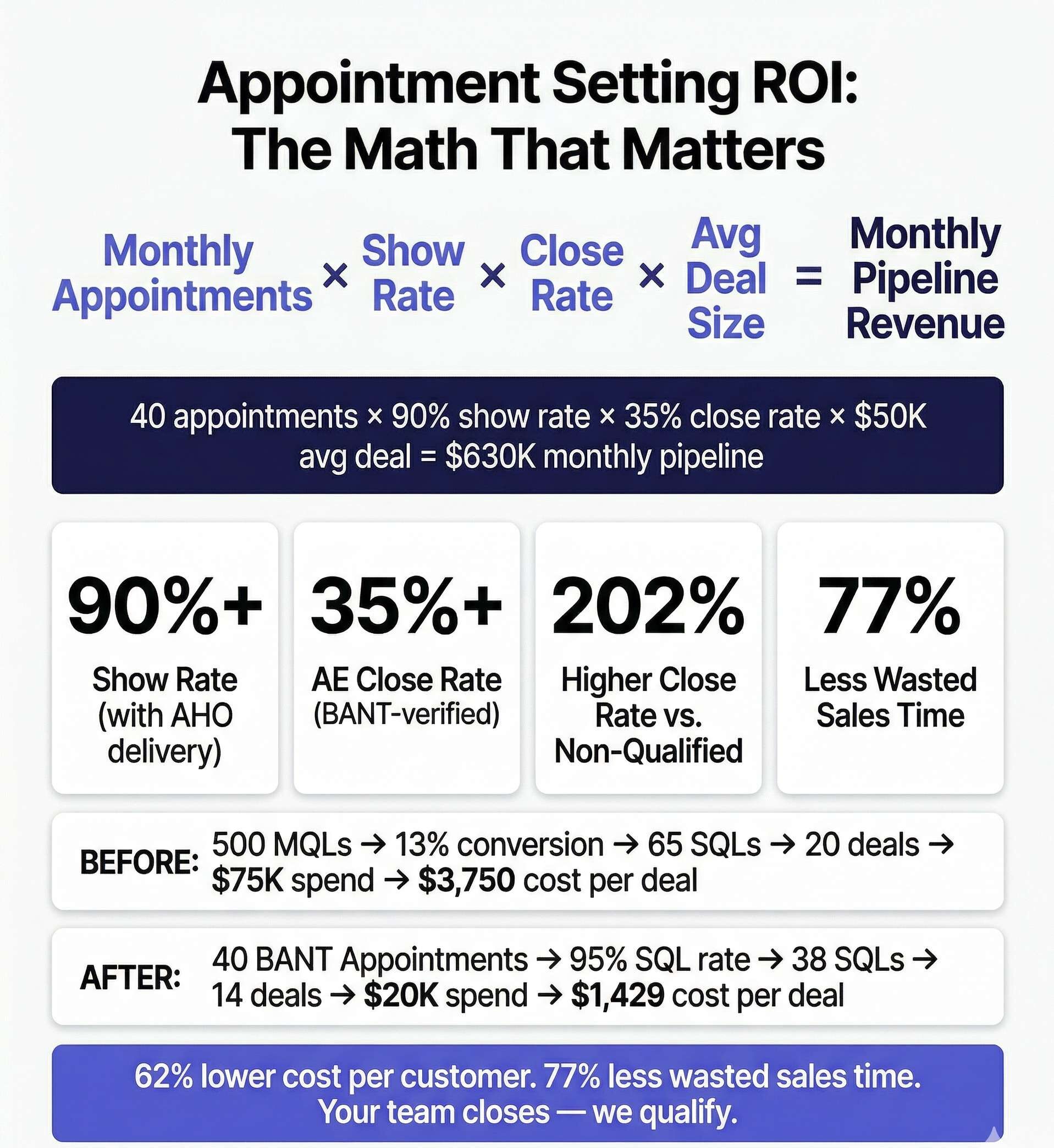
Cost Benchmarks by Model
Understanding how different models compare on a cost-per-deal basis reveals the true economics of appointment setting.
In-house SDR team: Fully loaded cost of $62,500/month (salary, benefits, tools, management) producing 10-15 meetings, of which 20% convert to opportunities, yielding approximately 2-3 deals. Cost per deal: $20,000-$31,000.
Retainer-based outsourced provider: Monthly cost of $5,000-$10,000 producing 8-12 meetings, of which 15-25% convert (depending on qualification depth), yielding 1-3 deals. Cost per deal: $3,300-$10,000.
Pay-per-appointment with BANT qualification: Monthly cost of $7,500-$16,000 (at $500/meeting for 15-32 meetings), of which 30-35% convert, yielding 5-11 deals. Cost per deal: $1,400-$1,500.
The BANT-qualified PPA model delivers the lowest cost per deal because higher meeting quality drives higher conversion rates, which compounds across the funnel. For comprehensive pricing comparisons, see our appointment setting costs guide, and for broader pipeline economics, our article on B2B marketing metrics provides the measurement framework.
The Five Metrics That Determine Appointment Setting ROI
1. Cost Per Qualified Meeting (CPQM)
This is your input cost metric. Calculate by dividing total monthly appointment setting spend by the number of meetings that meet your qualification criteria. If you spend $7,500 and receive 15 BANT-qualified meetings, your CPQM is $500. If you spend $5,000 and receive 10 loosely qualified meetings but only 4 meet BANT standards, your effective CPQM is $1,250.
2. Meeting-to-Opportunity Conversion Rate
This is the single most important quality metric. It measures what percentage of scheduled meetings result in a genuine sales opportunity (defined as entering your pipeline with a qualified stage). BANT-qualified meetings convert at 30-40%. Loosely qualified meetings convert at 10-15%. Unqualified meetings convert at 3-5%. This metric directly reflects the quality of your appointment setting provider’s qualification methodology.
3. Pipeline Generated Per Meeting
Multiply your average deal value by your meeting-to-opportunity conversion rate. If each meeting has a 35% chance of becoming a $100K opportunity, each meeting represents $35K in pipeline value. This metric helps justify appointment setting investment in pipeline terms that leadership understands.
4. AE Utilization Rate
What percentage of your AE’s time is spent in qualified selling conversations versus re-qualifying, chasing, or sitting in meetings with unqualified prospects? Teams using BANT-qualified appointment setting report AE utilization rates of 80-90% (selling time), compared to 40-50% for teams working with unqualified meetings. The productivity gain from higher utilization often exceeds the direct revenue impact. For strategies that maximize AE productivity, see our article on how to shorten the B2B sales cycle.
5. Cost Per Closed Deal
The ultimate efficiency metric. Divide total appointment setting cost by deals closed from those appointments. This accounts for both input cost and conversion quality, making it the single best comparison metric across providers and models. Target: $1,000-$2,000 per closed deal for mid-market B2B with BANT-qualified appointments.
How to Maximize Appointment Setting ROI
Three levers drive ROI improvement. First, improve meeting quality through stricter qualification. Moving from loose ICP-match qualification to full BANT verification typically doubles meeting-to-opportunity conversion rate, which doubles pipeline generated from the same number of meetings. Second, optimize AE preparation. Providing comprehensive pre-meeting intelligence (like the Appointment Handover Sheet that DemandNexus delivers with every meeting) reduces the information gap between first meeting and proposal, shortening sales cycles by 20-30%. Third, leverage first-party intent data. Targeting prospects who are actively researching solutions rather than cold-contacting demographic matches increases engagement rates, improves qualification pass rates, and accelerates time-to-close.
DemandNexus’s Waterfall model is engineered around all three levers: BANT verification eliminates unqualified meetings, the AHO document prepares AEs to close, and first-party intent data from six owned media brands ensures outreach reaches prospects during their buying window. The combined effect is ROI benchmarks of 120-180%+ annually. Explore how DemandNexus’s appointment setting services are structured to maximize pipeline ROI.
FAQs
What is a good ROI for appointment setting?
For BANT-qualified B2B appointment setting, target 120%+ annual ROI. Top-performing programs achieve 500-1,500%+ ROI. Any program producing positive ROI on a cost-per-closed-deal basis justifies continued and expanded investment.
How do I calculate cost per appointment?
Divide your total monthly appointment setting spend (provider fees + internal management time + tools) by the number of qualified meetings delivered. Benchmark: $300-$750 for BANT-qualified mid-market B2B meetings.
Why does meeting quality matter more than meeting volume for ROI?
Because conversion rates compound across the funnel. A 2x improvement in meeting-to-opportunity conversion rate (from 15% to 30%) doubles your pipeline without increasing your input cost. Adding more low-quality meetings increases cost without proportionally increasing revenue.
How long before I see ROI from appointment setting?
First meetings typically arrive within 30-45 days. Pipeline value materializes as those meetings convert to opportunities over 60-90 days. Closed revenue depends on your average sales cycle. Most programs show positive ROI within 90-120 days of launch.
What metrics should I share with leadership to justify appointment setting investment?
Lead with cost per closed deal and total pipeline generated — these are the metrics executives care about. Support with meeting-to-opportunity conversion rate and AE utilization improvement. Avoid leading with activity metrics (calls made, emails sent) that do not connect to revenue.