
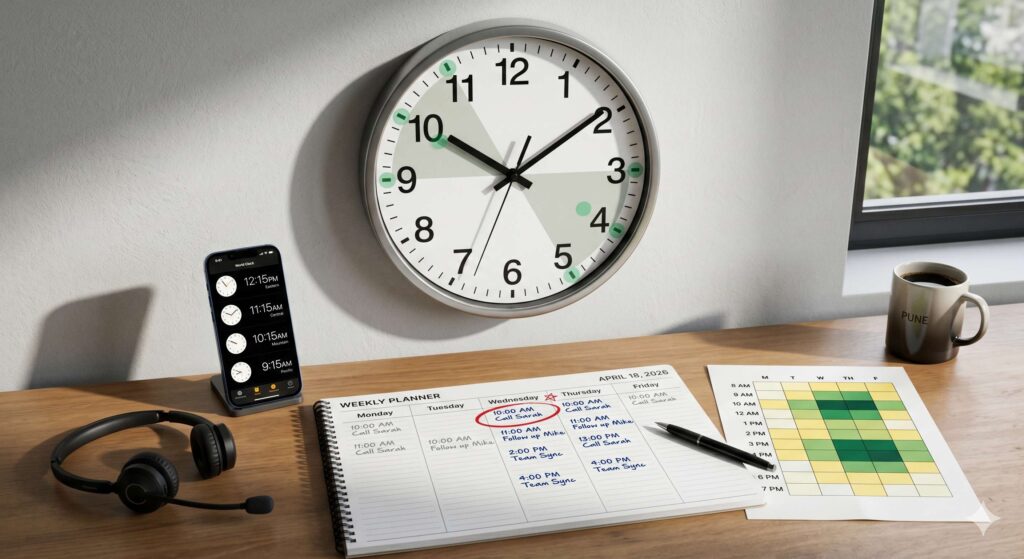


When you call matters almost as much as what you say. The same list dialed at the right time connects 40 to 70 percent more often than when dialed at the wrong time. This is not a small effect. It is the difference between a program that hits quota and one that falls short.

Most B2B teams lose 40–60% of qualified prospects to broken handoffs and weak qualification. Take our 2-minute diagnostic to find out where your pipeline is bleeding — and how to fix it.
Start the Quiz → Takes 2 minutes. No email required to start.This guide covers the data on best times: best days of the week, best hours of the day, the worst times, timezone tactics, seasonal patterns, and industry-specific variations.
The Short Answer
For B2B cold calling in the United States, the highest connect rates generally occur on Wednesday and Thursday between 10 AM and 11:30 AM, and again between 4 PM and 5:30 PM in the prospect’s local time. Monday mornings and Friday afternoons are the worst times.
But “best time” varies by industry, role, and timezone. The sections below add the detail behind this summary.

Best Days of the Week for Cold Calling
Industry data consistently shows a ranking that has held steady for years.
| Day | Relative Connect Rate | Notes |
| Monday | Below average | Meeting-heavy, backlog processing |
| Tuesday | Above average | Strong mid-morning and late afternoon |
| Wednesday | Highest | Best overall day for B2B |
| Thursday | Highest (tied) | Very close to Wednesday |
| Friday | Below average | Drops off sharply after 2 PM |
Best Hours of the Day
Two windows consistently outperform. Mid-morning (10 AM to 11:30 AM local time): prospects have cleared their inbox and morning meetings but have not started lunch mode. Late afternoon (4 PM to 5:30 PM local time): meetings have ended and prospects are winding down but still at their desk.

The worst hours: before 9 AM (prospects are in meetings or commuting), 12 PM to 1 PM (lunch), and after 6 PM (day is over).
Timezone Tactics
If you are calling across timezones, this matters enormously. An East Coast rep calling the West Coast at 9 AM their time is dialing 6 AM prospect time (terrible). The same rep calling at 1 PM East Coast is dialing 10 AM West Coast (excellent).
- Always dial based on prospect local time, not yours.
- Structure the calling day to flow across timezones: East Coast early, Central mid-morning, Mountain late morning, West Coast early afternoon.
- International: start UK calls at 3 AM East Coast (8 AM London) if you have callers in those timezones.
Seasonal Patterns
Certain weeks and months produce lower connect rates regardless of day or hour.
- The week between Christmas and New Year: near-dead zone for B2B.
- Thanksgiving week in the US: low connects Monday and Tuesday, dead Wednesday through Friday.
- July 4th week in the US: below-average connects.
- Mid-August: many executives take vacation in Europe and North America.
- Mid-December: connects drop 20 to 30 percent as holiday mode sets in.
- January first two weeks: connects often spike as budgets reset and people return refreshed.
Industry-Specific Timing
- Retail and ecommerce: avoid November and December (peak season), call heavily in Q1.
- Financial services: avoid tax season (March to mid-April) and Q4 for institutional investors.
- Education: best window is March through July (summer planning cycle).
- Manufacturing: call in the morning (decision-makers are on factory floor afternoons).
- Healthcare: avoid Monday mornings (post-weekend chaos), best window Tuesday through Thursday afternoons.
- Construction: call early morning or lunch (they are at job sites otherwise).
Role-Specific Timing
- C-level executives: early morning (7 to 8 AM) and late evening (6 to 7 PM) can reach them when gatekeepers are gone.
- Sales leaders: avoid end of quarter (too busy). Call early in new quarter.
- Marketing leaders: Tuesday through Thursday, mid-morning, is optimal.
- Technical buyers (CTO, engineering): afternoons work better than mornings.
- Finance buyers (CFO, finance leaders): avoid month-end and quarter-end.
How to Test and Personalize
These are starting benchmarks. Your prospects may behave differently. Here is how to find your own best times.
- Track connect rate by day-of-week and hour-of-day for 4 weeks.
- Segment by role and industry to find patterns.
- Reallocate dialing hours to your top two time windows.
- Re-test every quarter as buyer patterns evolve.
TIMING TABLE — BY HOUR
| Time block (local) | Relative connect rate | Notes |
|---|---|---|
| 8–10 a.m. | Medium | Senior titles settle in before meetings start |
| 10–11 a.m. | High | Strongest mid-morning window |
| 11 a.m.–1 p.m. | Low | Lunch — avoid |
| 1–3 p.m. | Medium | Post-lunch recovery |
| 4–5 p.m. | High | End-of-day availability before wrap-up |
| After 5 p.m. | Low–Medium | Gatekeepers gone; mixed results |
By day of week: Wednesday and Thursday rank highest, Tuesday is solid, Monday mornings are weakest, and Friday afternoons should be avoided.
The Timing Hierarchy
When you can only control one thing, control day of week (biggest effect). Then hour of day. Then season. Then role-specific adjustments. Getting all four right can double your connect rate over a team dialing randomly.
FAQs
What is the best time to cold call in 2026?
The strongest cold calling windows are mid-to-late morning, roughly 10–11 a.m., and late afternoon, roughly 4–5 p.m., in the prospect’s local time zone, when decision-makers are at their desks but not heads-down in meetings.
What is the best day of the week to cold call?
Wednesday and Thursday typically produce the highest B2B connect rates, while Monday mornings and Friday afternoons are the least productive times to call.
Does cold calling still work in 2026?
Yes. Cold calling remains effective when calls are well-timed, researched, and paired with multichannel outreach. Timing and relevance matter more than raw call volume.
How many cold call attempts does it take to reach a prospect?
Most B2B prospects require several attempts across different times and days before connecting, which is why varying call windows and following a structured cadence outperforms repeating the same time slot.