



We have grouped them by phase: preparation, opening, discovery, objection handling, and closing. Pick the three that fit your current weakest link and drill them this week.

Most B2B teams lose 40–60% of qualified prospects to broken handoffs and weak qualification. Take our 2-minute diagnostic to find out where your pipeline is bleeding — and how to fix it.
Start the Quiz → Takes 2 minutes. No email required to start.Preparation Techniques (Before You Dial)
1. The 90-Second Pre-Call Ritual
Before every call, spend 90 seconds doing three things: read the prospect’s last LinkedIn post, check their company’s recent news, and write down one hypothesis about what their biggest challenge might be. This takes less time than refilling your coffee and doubles the quality of your opening.
2. Block in Power Hours
Make calls in 90-minute uninterrupted blocks with a 15-minute break between them. Cold calling is mental strength training. You cannot multitask it. Teams that block power hours see 30 to 50 percent higher daily dial counts than teams who spread calls across the day.
3. Set a Dial-Count Goal, Not a Meeting Goal
Meeting goals create pressure that makes reps sound desperate. Dial-count goals create momentum. Target 60 to 100 dials per power hour depending on your dialer type. Meetings will follow.

Opening Techniques (First 30 Seconds)
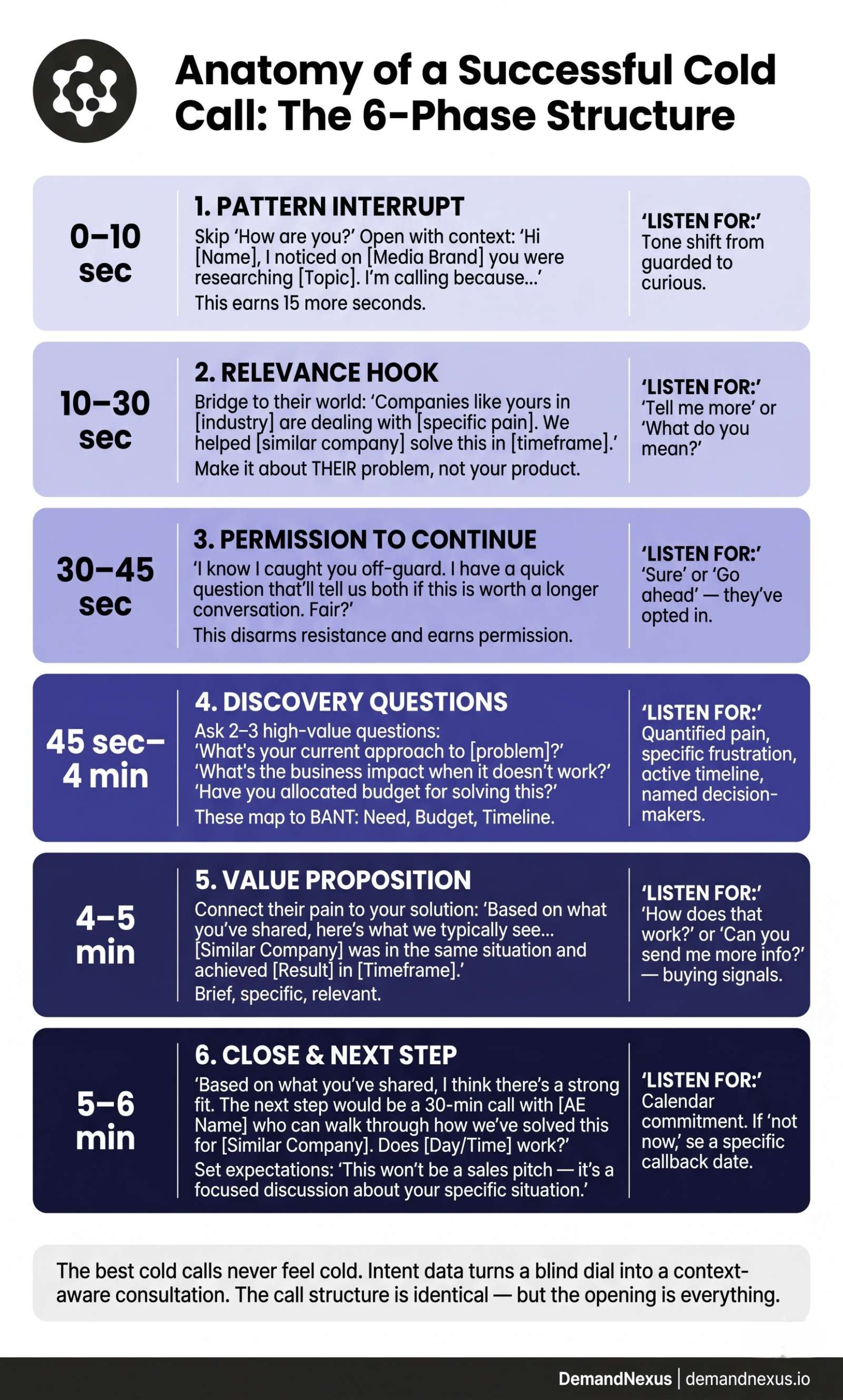
4. The Honest Interruption
“I know you were not expecting my call.” Four words that disarm nine out of ten prospects. Acknowledging that you are interrupting is the single most-effective pattern interrupt we have tested.

5. State Your Purpose in One Sentence
Do not bury the lead. Within 15 seconds of the prospect saying hello, they should know exactly why you called. Vagueness is the enemy. Specificity earns attention.
6. Ask for Permission, Not Forgiveness
“Do you have 27 seconds for me to tell you why I called?” is far more effective than plowing ahead. The prospect who says yes is already mentally committed to listening.
7. Use a Pattern Interrupt Early
Something unexpected in the first three seconds. A slightly odd sentence structure. A surprising fact. A question instead of a statement. Anything that breaks the “telemarketer cadence” they subconsciously expect.
Discovery Techniques (Middle of the Call)
8. The Peer Insight Question
“Most [role] we talk with are dealing with [specific problem]. Is that something on your plate too?” This question lets the prospect agree or disagree without feeling interrogated, and it positions you as knowledgeable about their world.
9. Mirror the Last Three Words
When a prospect says something revealing, repeat their last three words as a question. “Our onboarding takes too long.” “Takes too long?” This gets them to elaborate without you asking another question, which builds rapport.
10. The 80/20 Talk Ratio
Once you are past the opening, aim to talk 30 to 40 percent and let the prospect talk 60 to 70 percent. Reps who flip this ratio lose the call. Use short questions and let silence do the heavy lifting.
11. Ask About Their Current Solution Before Pitching Yours
“How are you handling this today?” tells you more than any discovery framework. You learn the competitive landscape, the pain level, and the budget cycle in one question.
Objection Handling Techniques
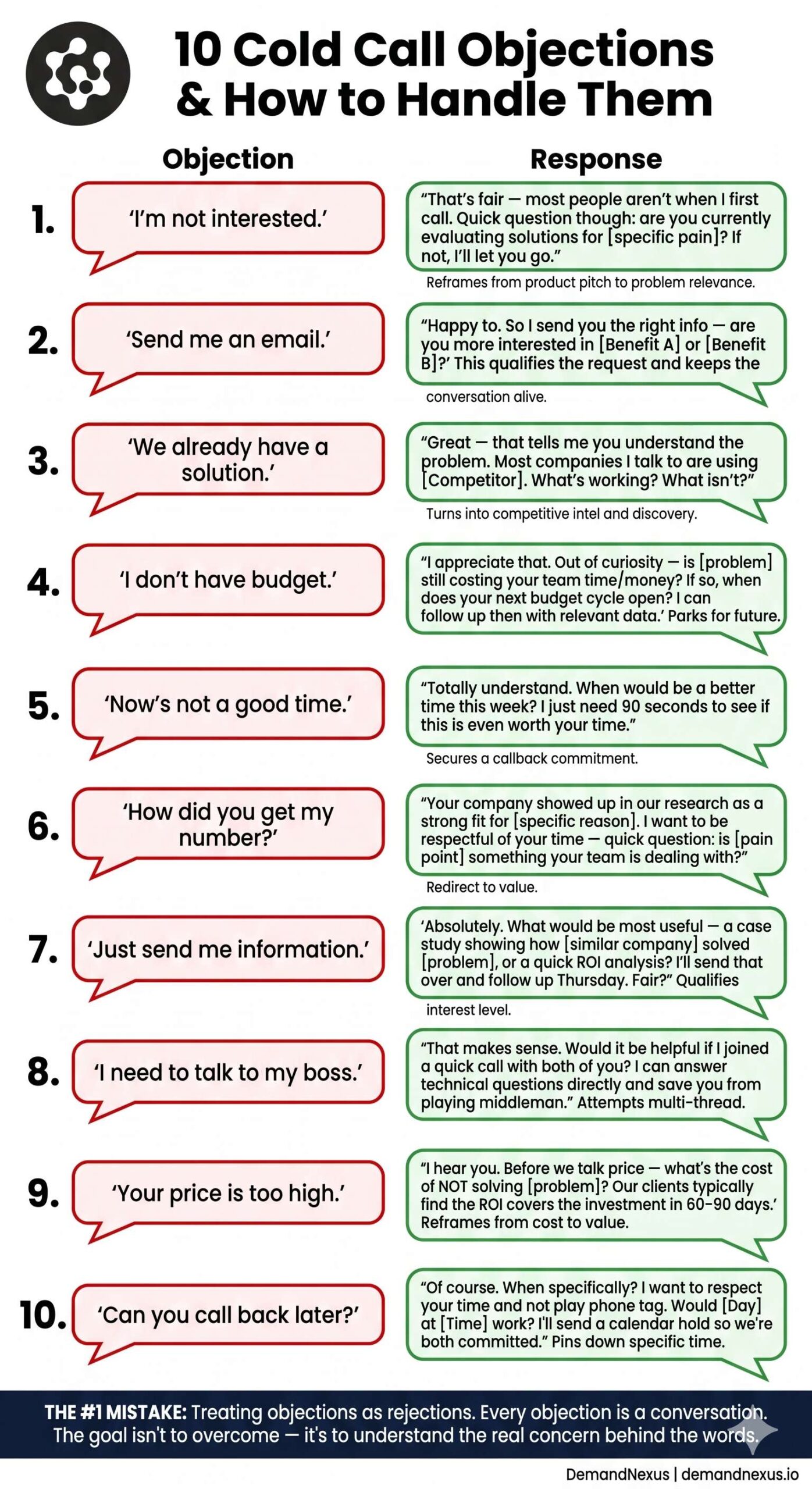
12. Validate Before Responding
Every objection gets one sentence of validation before you respond. “That makes sense.” “I hear that a lot.” “Totally fair.” Skip this and the prospect feels unheard and your rebuttal lands on defensive ears.
13. The Reframe, Not the Rebuttal
Do not argue with objections. Reframe them. “We already use [Competitor]” becomes “Most of our current clients came from [Competitor]. Want to know the one reason that usually comes up?” Curiosity beats combat.
14. The Conditional Close
When a prospect is half-in, use “If I could [specific promise], would it be worth 15 minutes?” Conditions lower the stakes and get commitment without pressure.
Closing Techniques (Last 2 Minutes)
15. Propose a Specific Time, Not a Range
“Does Thursday at 2:15 work?” converts far better than “What does your week look like?” Decision fatigue is real. Make the choice small.
16. Double-Confirm the Calendar Invite
Before you hang up, say out loud: “I am sending you a calendar invite to [email] right now. Can you accept it while we are still on the phone?” Show-rate lift: 20 to 40 percent. This single step is the highest-ROI technique in the entire guide.
17. End with a Pre-Meeting Homework Question
“Before we meet, can you think about the one question you most want answered?” This increases mental commitment and show rate, and gives you a head start on their real priorities.
How to Practice These Techniques
Pick three techniques. Practice them on 50 calls. Measure whether your connect-to-conversation or conversation-to-meeting rate moves. If it does, keep them. If not, swap them out and try three others. The worst thing you can do is try all 17 at once. You will overwhelm yourself and improve nothing.
If you want a coach watching your calls and telling you exactly which technique to drill next, DemandNexus offers sales-team coaching as a standalone service or included in our full cold calling management package.
FAQs
What is the single most important cold calling technique?
If we had to pick one: double-confirming the calendar invite before the call ends. It is the single highest-ROI technique because it directly protects the outcome you worked for 10 minutes to earn.
How long does it take to get good at cold calling?
Competent at three months of daily calls. Strong at six months. Elite at 18 months. The learning curve is brutal for the first 60 days and then accelerates rapidly if you are getting coaching.
Should I use a script or wing it?
Neither. Use a framework. Scripts are too rigid and winging it is too chaotic. A framework, which is essentially a script you have internalized, lets you be structured and conversational at the same time.