
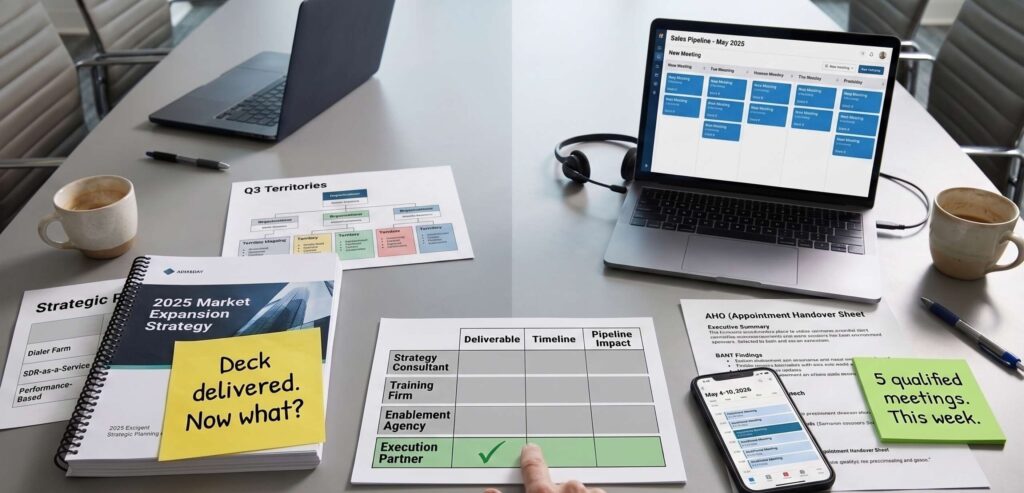


This guide identifies nine specific levers ranked by leverage—the ratio of effort invested to revenue impact. The first four levers address pipeline quality (which has the highest leverage because it reduces waste). The next three address pipeline expansion. The final two address organizational alignment and measurement. Every lever includes a concrete action you can take this quarter.

Most B2B teams lose 40–60% of qualified prospects to broken handoffs and weak qualification. Take our 2-minute diagnostic to find out where your pipeline is bleeding — and how to fix it.
Start the Quiz → Takes 2 minutes. No email required to start.Lever 1: Kill Low-Fit Leads Before They Enter the Pipeline
The single highest-leverage action in B2B sales is removing leads that will never close before they consume your AE’s time. Industry data shows that approximately 87% of MQLs are rejected by sales as unqualified. If your team processes 1,000 MQLs per quarter and rejects 870, that is 870 meetings, emails, and follow-ups that produced zero revenue.
The fix is not generating more leads—it is implementing ICP scoring criteria that filter for fit and intent before leads are routed to sales. A scoring model that weights firmographic fit (30%), technographic match (20%), intent signals (30%), and engagement behavior (20%) can reduce the 87% rejection rate to below 40%—effectively doubling the number of sales-ready opportunities from the same marketing spend.
Lever 2: Verify Intent Before Outreach
Outreach to accounts that are not actively researching your solution category has single-digit response rates. Outreach to accounts showing real-time intent signals—reading content about your category, visiting competitor websites, posting relevant job requisitions—has 3–5x higher engagement rates.
First-party intent data (from your own content properties or media brands) provides the strongest signal because it is proprietary and specific to individual contacts. DemandNexus generates first-party intent from six owned B2B media brands reaching 15M+ decision-makers monthly, feeding signals directly into outreach prioritization. Third-party intent data from aggregators like Bombora supplements this but is shared with competitors.
Lever 3: Qualify Before the AE Meeting
When qualification happens during the AE’s meeting, the AE spends 15–20 minutes asking questions that a structured BANT qualification call would have answered beforehand. Separating qualification from discovery—with a documented Appointment Handover Sheet (AHO) delivered before the meeting—frees the AE to focus on tailored solution discussion rather than basic fact-finding.

Teams that implement pre-meeting qualification with AHO delivery report 90%+ show rates (vs. 60–70% industry average) and 60%+ SQL conversion rates (vs. 13% industry median). The math is clear: qualification quality is the highest-leverage driver of downstream conversion.
Lever 4: Shorten the Handover Gap
The time between when a lead is qualified and when the AE actually engages is the handover gap. Every day of delay increases no-show risk and gives competitors time to engage the same prospect. The target is AE engagement within 24–48 hours of qualification, with the AHO delivered before—not after—the meeting is scheduled. This directly impacts sales cycle length.
Where are the biggest levers in your current pipeline? Take the assessment.
Lever 5: Multi-Thread Every Enterprise Account
Single-threaded deals—where your entire relationship depends on one champion inside the account—fail when that champion changes roles, goes on leave, or loses internal influence. Multi-threading means building relationships with three to five contacts across the buying committee: the economic buyer, the technical evaluator, an end-user advocate, and a coach who provides inside information.
Data consistently shows that multi-threaded deals close at 2–3x the rate of single-threaded deals in enterprise sales. Your SDR and AE should map the full buying committee during qualification and discovery, not wait until a deal stalls to scramble for additional contacts.
Lever 6: Fix the Pipeline Coverage Math
If your team needs 6–7x pipeline coverage to hit quota (a sign of low win rates), the problem is not pipeline generation—it is pipeline quality. Improving win rate from 15% to 30% reduces the required coverage from 6.7x to 3.3x, which cuts the volume of pipeline you need to generate by half. That is a more efficient path to the revenue target than doubling pipeline generation activity at the same win rate. See the full framework in the B2B sales pipeline stages guide.
Lever 7: Expand Within Existing Accounts, Not Just Net-New
The probability of selling to an existing customer is 60–70%. The probability of selling to a new prospect is 5–20%. Yet most B2B sales organizations allocate the majority of SDR capacity to net-new acquisition while under-investing in expansion revenue. If your NRR (net revenue retention) is below 110%, there is likely more revenue available from expansion, upsell, and cross-sell within your existing customer base than from net-new logos—at a fraction of the acquisition cost.
Lever 8: Align Marketing → Sales → CS on a Shared Definition of ‘Qualified’
When marketing defines “qualified” as “filled out a form” and sales defines it as “ready to buy,” the 87% MQL rejection rate is inevitable. Sales and marketing alignment starts with agreeing on a single definition of qualified that includes ICP fit, intent signals, and BANT verification—not just engagement behavior. Extend this alignment to CS: the definition of “qualified” should predict not just who will close, but who will succeed and renew.
Lever 9: Measure the Right KPIs
If your primary sales metric is MQL volume, you are optimizing for the wrong thing. Replace volume metrics with quality metrics: SQL conversion rate, cost-per-qualified-meeting, pipeline velocity, win rate, and revenue per rep. These metrics tell you whether you are getting better at converting, not just busier at generating.
The shift from volume to quality measurement is uncomfortable because quality metrics expose inefficiency that volume metrics hide. An MQL count of 1,000 sounds impressive until you measure that only 130 became SQLs and only 20 closed. Quality measurement forces you to confront the real economics of your pipeline—which is precisely why it drives improvement.
Calculate what pipeline quality improvement would be worth to your revenue target.
FAQs
How can I increase B2B sales quickly?
The fastest lever is improving pipeline quality by implementing structured qualification before AE meetings. Teams that add BANT verification with documented handover (AHO delivery) typically see SQL conversion rates improve from 13% to 60%+ within the first quarter—which doubles or triples closed revenue from the same pipeline volume.
What is the fastest way to grow B2B sales?
Short-term: improve qualification quality and reduce the handover gap between SDR and AE (levers 1–4). Medium-term: expand within existing accounts and improve win rates through multi-threading (levers 5–7). Long-term: align all revenue teams on shared definitions and quality metrics (levers 8–9). The fastest path to revenue growth is almost always quality improvement, not volume increase.
What marketing strategies increase B2B sales?
The marketing strategies with the highest pipeline impact are: intent-driven content marketing that captures first-party behavioral signals, ABM campaigns targeting ICP-fit accounts showing buying behavior, and lead scoring models that filter for fit + intent rather than engagement alone. Strategies that generate high volumes of low-fit leads (generic webinars, broad paid campaigns) increase MQL counts but rarely increase closed revenue proportionally.
How do I improve B2B sales performance?
Diagnose where your pipeline leaks by measuring conversion rates at every stage. If your MQL-to-SQL rate is low, the problem is qualification. If your SQL-to-opportunity rate is low, the problem is discovery. If your opportunity-to-close rate is low, the problem is deal execution. Apply the 9 levers in this guide to the specific stage where conversion drops.
What channels drive the most B2B sales?
The highest-ROI B2B sales channels are intent-driven outbound (outreach triggered by buying signals), referrals from existing customers, and direct inbound from owned content. Paid channels (LinkedIn ads at $408 avg CPL, Google Ads with CPL up 70% since 2021) are effective for brand awareness but increasingly expensive for direct pipeline generation.