
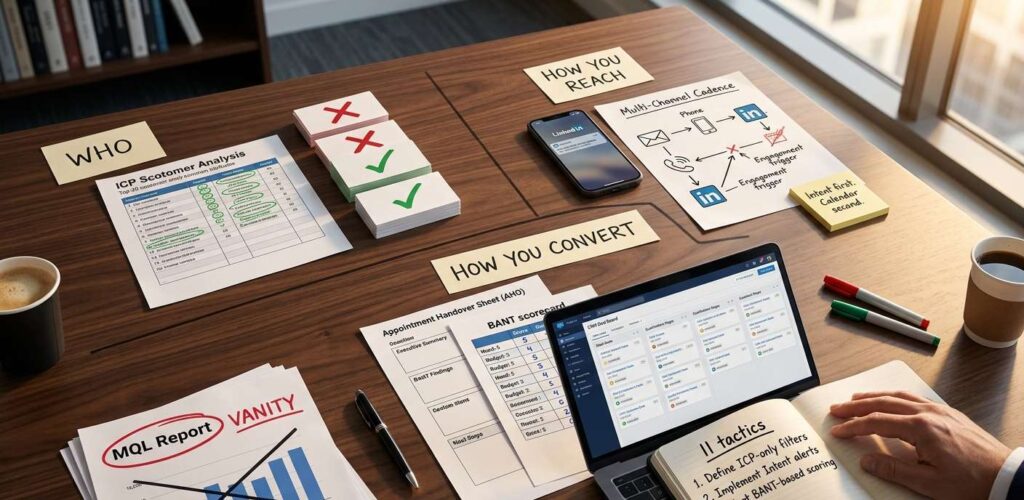


Most “B2B sales strategy” content on the internet is generic consultancy copy dressed up as thought leadership—platitudes about “building relationships” and “adding value” that could have been written in 2010. This guide takes a different approach. It gives you 11 specific tactics organized around three strategic choices, with concrete examples and an anti-advice section on what to stop doing.

Most B2B teams lose 40–60% of qualified prospects to broken handoffs and weak qualification. Take our 2-minute diagnostic to find out where your pipeline is bleeding — and how to fix it.
Start the Quiz → Takes 2 minutes. No email required to start.Strategic Choice 1: Who You Target (ICP Discipline)
Tactic 1: Build Your ICP from Closed-Won Data, Not Assumptions
Your ideal customer profile should be derived from your best existing customers—the ones who closed fastest, paid the most, churned the least, and expanded. Pull the top 20 accounts by revenue, retention, and NPS. What do they have in common? That pattern is your empirical ICP. Document it, score against it (here’s a framework for that), and enforce it.
Tactic 2: Kill Low-Fit Leads Early
The fastest way to improve your sales metrics is to stop working accounts that don’t match your ICP. If 87% of MQLs are rejected by sales (the industry median), that means marketing is spending 87% of its budget generating pipeline that will never close. The fix is not more leads—it’s fewer, better-fit leads filtered through a scoring model that weights fit and intent over engagement volume.
Tactic 3: Segment by Pain, Not Just Firmographics
Two companies in the same industry with the same headcount can have completely different pain points. One may need help with pipeline generation; the other may need help with close rates. Firmographic segmentation tells you who looks like your customer. Pain-based segmentation tells you who needs what you sell right now. Layer behavioral intent signals on top of firmographic filters to identify accounts in active buying cycles.
Strategic Choice 2: How You Reach Them (Channels + Intent)
Tactic 4: Lead with Intent, Not with Calendar
Most outreach cadences are calendar-driven: touch every account every two weeks regardless of whether they’re showing buying signals. Intent-driven outreach flips this model. You touch accounts when they’re showing behavioral signals—reading content about your solution category, visiting competitor websites, posting job requisitions that suggest a technology evaluation.
This approach requires access to intent data. First-party intent (from your own content, media brands, or website) is the strongest signal because it is proprietary and real-time. DemandNexus generates first-party intent from six owned B2B media brands reaching 15M+ decision-makers monthly, which feeds directly into outreach prioritization. Third-party intent (from aggregators like Bombora) is supplementary but shared with competitors.

Tactic 5: Multi-Channel by Default, Not by Exception
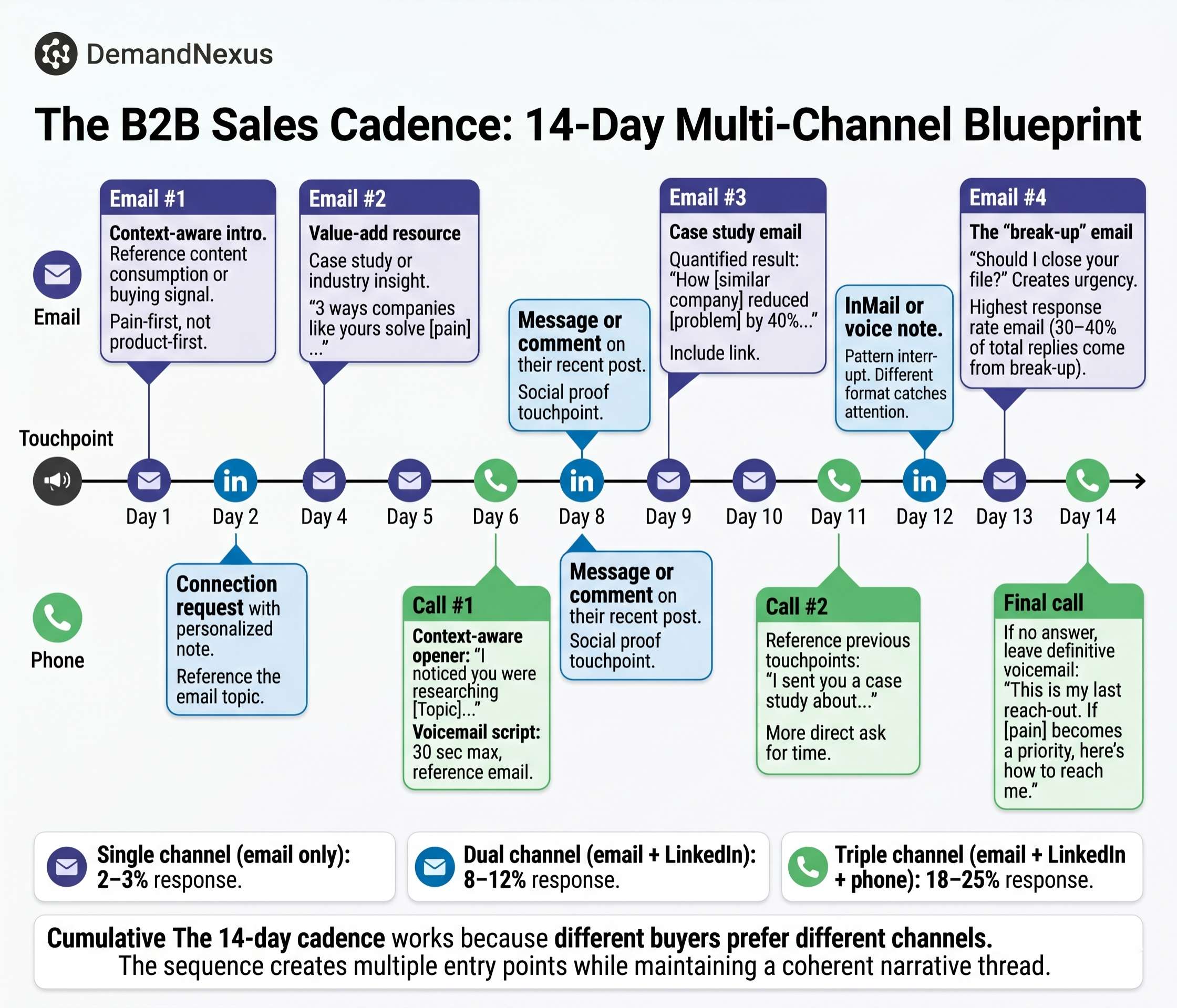
Email-only outreach has declining effectiveness. LinkedIn InMail has a 10–25% response rate but a $408 average CPL at scale. Phone connect rates are in the 3–5% range. No single sales channel is sufficient. The winning approach is multi-channel by default: email + LinkedIn + phone + targeted content syndication, sequenced based on engagement signals.
Tactic 6: Stop Paying $408 Per LinkedIn Lead
LinkedIn Ads and Google Ads are effective for brand awareness and demand capture, but CPL has risen 70%+ since 2021 for Google and averages $408 on LinkedIn. At these rates, the math only works for high-ACV products. For everything else, intent-driven outbound delivers a lower cost-per-qualified-meeting because the targeting is specific, the outreach is personalized, and the qualification is verified before the AE’s time is consumed.
Strategic Choice 3: How You Convert (Qualification + Handover)
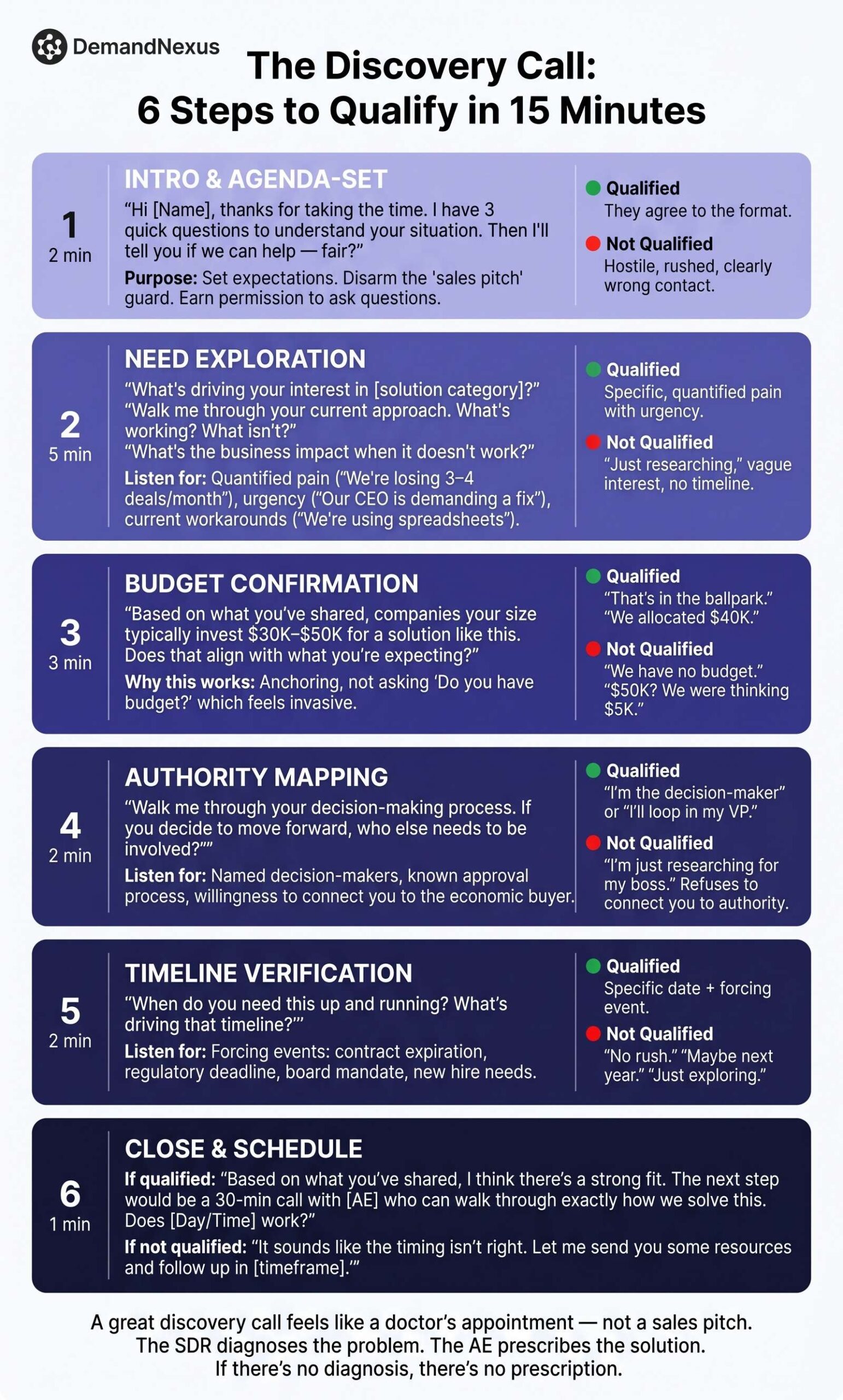
Tactic 7: Qualify Before the AE Meeting, Not During It
When qualification happens during the AE’s first meeting, the AE spends 15–20 minutes asking questions that a structured BANT qualification call would have answered beforehand. That is time the AE could spend on a tailored demo or solution discussion. The fix is separating qualification from discovery—qualification happens before the meeting, discovery happens during it.
Tactic 8: Give Your AE a Pre-Meeting Intelligence Brief
The Appointment Handover Sheet (AHO) concept—a structured document with BANT scores, verbatim prospect quotes, competitor intel, and a recommended approach—transforms the AE’s first meeting from a cold introduction to a warm, context-rich conversation. AEs who receive this level of preparation report dramatically higher close rates because the prospect’s first impression is “This team understands my problem,” not “This is another generic demo.”
Tactic 9: Shorten the Handover, Not Just the Cycle
Teams obsess over shortening the sales cycle but ignore the handover gap—the time between when a lead is qualified and when the AE actually engages. Every day of handover delay increases the no-show risk and gives competitors an opportunity to engage the prospect first. The target should be AE engagement within 24–48 hours of qualification, with the AHO delivered before the meeting, not after.
Not sure if your current strategy is leaving pipeline on the table? Take the assessment.
What to Stop Doing in 2026
Tactic 10: Stop Counting MQLs as a Success Metric
MQL volume is a vanity metric that tells you how many people filled out a form, not how many are ready to buy. When sales rejects 87% of MQLs, the MQL count is misleading the organization about the health of the pipeline. Replace MQL volume with SQL conversion rate and cost-per-qualified-meeting as the primary marketing-to-sales handoff metrics. Sales and marketing alignment starts when both teams measure the same outcome.
Tactic 11: Stop Running Generic Demos
A generic product demo is a failure of preparation, not a sales technique. Every demo should be tailored to the specific pain points, use cases, and competitive context uncovered during qualification and discovery. If your AE cannot articulate which specific problem the demo will address for this specific prospect, the demo should not happen yet.
Building a B2B Sales Playbook
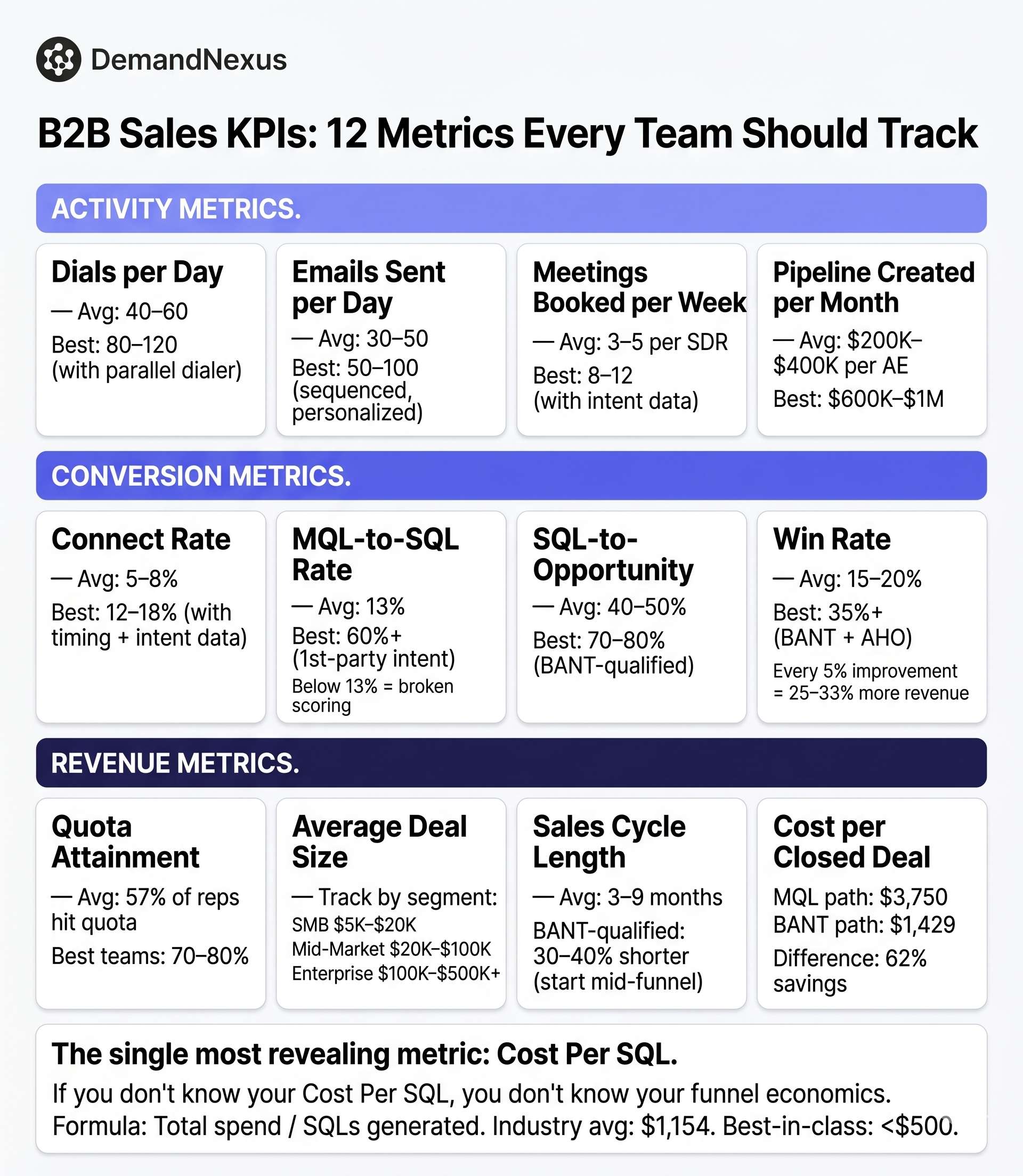
A sales playbook codifies your strategy into a repeatable, coachable document. An effective playbook includes: ICP definition with scoring criteria, target account selection methodology, outreach cadence templates by persona, qualification framework with scoring thresholds, discovery call guide with question bank, demo structure tailored to common pain patterns, objection handling responses, proposal templates, and competitive battle cards.
The playbook is a living document—updated quarterly based on win/loss analysis, competitive changes, and market shifts. Teams that maintain an active playbook report 33% higher quota attainment than those that rely on individual rep improvisation.
For a deeper dive on the qualification and handover components, see the BANT qualification guide and B2B sales process framework.
Ready to see what a performance-based pipeline strategy looks like?
FAQs
What is a B2B sales strategy?
A B2B sales strategy is a structured plan that defines how your sales organization targets, engages, qualifies, and converts business buyers. It addresses three strategic choices: who you target (ICP discipline), how you reach them (channel mix and intent-driven outreach), and how you convert (qualification and handover processes). An effective strategy is built on empirical data from your best customers, not assumptions.
What are the best B2B sales techniques in 2026?
The most effective techniques in 2026 center on intent-driven targeting (reaching accounts showing active buying signals), structured qualification (BANT-verified with documented handover), and multi-channel outreach (email + LinkedIn + phone + content, sequenced by engagement signals). The shift from calendar-based cadence to signal-based engagement is the most significant tactical change this year.
What skills does a B2B salesperson need?
Core skills include: active listening and discovery questioning, structured qualification methodology, consultative selling (solving problems rather than pitching features), multi-channel communication (email, phone, LinkedIn, video), objection handling, negotiation, and pipeline management. Increasingly, data literacy (reading intent signals, interpreting pipeline metrics) is becoming a differentiating skill.
How do you build a B2B sales playbook?
Start with your ICP definition and scoring criteria. Add outreach cadence templates, qualification framework with scoring thresholds, discovery question bank, demo structure, objection handling scripts, proposal templates, and competitive battle cards. Test the playbook with your top-performing reps, iterate based on their feedback, then roll out to the full team. Update quarterly based on win/loss analysis.
What is the 3:33:3 rule in B2B sales?
The 3:33:3 rule states that 3% of your target market is actively buying right now, 33% is open to evaluating if the timing and message are right, and the remaining 64% is not in-market. The strategic implication is that mass outreach wastes resources on the 64% while missing the 3%. Intent data helps you identify the 3% and the ready portion of the 33%, dramatically improving outreach efficiency.