

This playbook covers the four SaaS go-to-market motions, when each wins, how qualification differs in SaaS contexts, and how the intersection of product-led signals and sales-led qualification is reshaping how SaaS companies build pipeline.

Most B2B teams lose 40–60% of qualified prospects to broken handoffs and weak qualification. Take our 2-minute diagnostic to find out where your pipeline is bleeding — and how to fix it.
Start the Quiz → Takes 2 minutes. No email required to start.The Four SaaS GTM Motions
Motion 1: Sales-Led Growth (SLG)
Traditional outbound-driven sales where SDRs prospect, qualify, and book meetings for AEs. Best for enterprise SaaS ($50K+ ACV) where deals require multi-stakeholder engagement, custom scoping, and complex procurement. SLG works when your product’s value cannot be experienced in a free trial—it needs a conversation to contextualize ROI for the buyer’s specific situation.
The BANT qualification framework was built for SLG motions. In enterprise SaaS, budget cycles are formal, authority is distributed across buying committees, need must be mapped to specific use cases, and timeline is driven by contract renewals or strategic initiatives.
Motion 2: Product-Led Growth (PLG)
Users discover, try, and adopt the product through self-serve channels before sales involvement. Best for horizontal SaaS tools with low initial complexity (Slack, Figma, Notion). PLG works when the product delivers value quickly in a free or freemium tier and when individual users can adopt without organizational approval.
PLG is not a replacement for sales—it is a demand generation channel. The best PLG companies convert free users to paid customers through product-qualified leads (PQLs): users who reach activation thresholds that predict conversion (e.g., invited 5 teammates, created 10 projects, used the product for 14 consecutive days).
Motion 3: Marketing-Led Growth
Inbound marketing (content, SEO, webinars, paid acquisition) drives demand that sales converts. Best for mid-market SaaS where buyer research happens online before vendor engagement. Marketing-led motion generates MQLs that sales qualifies and converts. The challenge is the 87% MQL rejection problem—most marketing-generated leads don’t meet sales’ qualification standards.

The fix is intent-weighted ICP scoring that filters marketing-generated leads for fit and intent before routing to sales. This reduces rejection rates and ensures AEs spend time on leads that are actually in-market.
Motion 4: Community-Led Growth
Emerging motion where developer communities, user groups, or industry networks drive awareness and adoption. Best for developer tools and infrastructure products. Community-led growth builds trust at scale but is difficult to attribute directly to pipeline and requires long-term investment before ROI materializes.
Not sure which GTM motion fits your SaaS model? Take the assessment.
SaaS Sales Qualification: Free-Trial Signals vs. Enterprise BANT
SaaS qualification operates on two tracks depending on the motion. PLG deals qualify through product usage signals: activation, engagement frequency, team adoption, and upgrade attempts. These PQLs are qualified by behavior, not by conversation.
Enterprise SaaS deals still require conversational qualification. A prospect’s free trial activity tells you they’re interested. It does not tell you they have budget approved, authority to sign a contract, a specific pain your product solves at the organizational level, or a timeline driven by a forcing event. For $50K+ ACV deals, BANT verification remains essential.
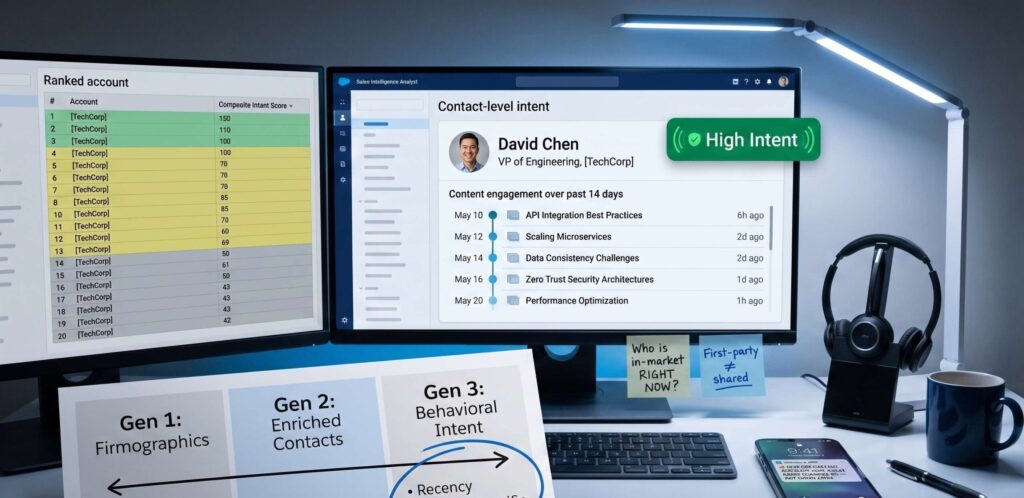
The PLG + Waterfall hybrid is an emerging model: product signals identify interested accounts, intent data from media properties confirms active research, and human-led BANT qualification verifies buying readiness before an AE is engaged. DemandNexus’s Cyborg SDR pod model supports this hybrid—combining AI-flagged intent with human-verified qualification to deliver meetings that SaaS AEs are prepared to convert.
SaaS Sales Metrics That Actually Matter
CAC Payback Period: How many months of subscription revenue does it take to recoup the cost of acquiring the customer? Target: under 18 months for healthy unit economics.
Net Revenue Retention (NRR): Revenue from existing customers compared to the same cohort a year ago, including expansion and churn. NRR above 120% means you grow even without new logos.
ACV (Annual Contract Value): Drives GTM motion selection—deals under $10K ACV need PLG or high-velocity sales; deals above $50K ACV need SLG with structured qualification.
Win Rate by Source: Compare win rates for inbound (marketing-generated), outbound (SDR-generated), PLG-converted, and intent-triggered leads. The source with the highest win rate at the lowest cost is where you should invest more. For most SaaS companies, intent-triggered outbound outperforms all other sources by win rate.
Time to Value (TTV): How quickly a new customer reaches their first meaningful outcome. TTV directly affects retention. SaaS companies with TTV under 30 days retain customers at 2x the rate of those with TTV over 90 days.
SaaS Sales Outsourcing: When It Makes Sense
SaaS companies outsource sales development when they need to scale pipeline faster than they can hire, test a new market segment before committing headcount, or supplement an in-house SDR team with intent-driven pipeline. B2B sales outsourcing works well for SaaS when the outsourced partner understands SaaS buying dynamics—annual contract negotiation, multi-stakeholder procurement, PLG signals, and the importance of trial-to-paid conversion context.
DemandNexus’s six media brands include DevTechTrend, AITechTrend, and MarTechTrend—all of which serve the SaaS buyer audience directly. This vertical alignment means the intent signals feeding the Cyborg SDR pods come from the exact audience SaaS companies are trying to reach. The result is higher response rates and more relevant qualification conversations than generic outsourced SDR firms can deliver.
See what SaaS-specific pipeline delivery looks like.
FAQs
What is B2B SaaS sales?
B2B SaaS sales is the process of selling subscription-based software to other businesses. It differs from traditional B2B sales through recurring revenue models, freemium/product-led growth dynamics, CAC payback period constraints, and the importance of expansion revenue alongside new customer acquisition.
How is SaaS sales different from traditional B2B sales?
SaaS sales involves recurring subscription revenue (not one-time purchases), product-led buyer journeys where users try before they buy, longer lifetime value calculations that affect acceptable acquisition costs, and expansion motions (upsell, cross-sell, seat growth) that often drive more revenue than new logos.
What is the average B2B SaaS sales cycle?
The average cycle varies by ACV: $5K–$15K deals typically close in 14–30 days, $15K–$50K deals in 30–90 days, and $50K+ enterprise deals in 90–180 days. Cycles are influenced by the number of stakeholders, procurement complexity, and whether a free trial or POC is part of the evaluation.
What is the best sales model for B2B SaaS?
It depends on your ACV and product complexity. PLG works for low ACV, self-serve products. Marketing-led works for mid-market with strong inbound demand. Sales-led works for enterprise with complex procurement. The highest-performing SaaS companies use a hybrid: PLG for demand generation + sales-led for conversion + intent data for prioritization.
How do you do B2B SaaS sales outsourcing?
Engage an outsourced partner that understands SaaS buying dynamics: annual contract negotiation, multi-stakeholder procurement, PLG signal interpretation, and vertical-specific buyer personas. Look for partners with first-party intent data in your target vertical, structured BANT qualification, and performance-based pricing. Expect 30–60 days to first qualified meetings.