
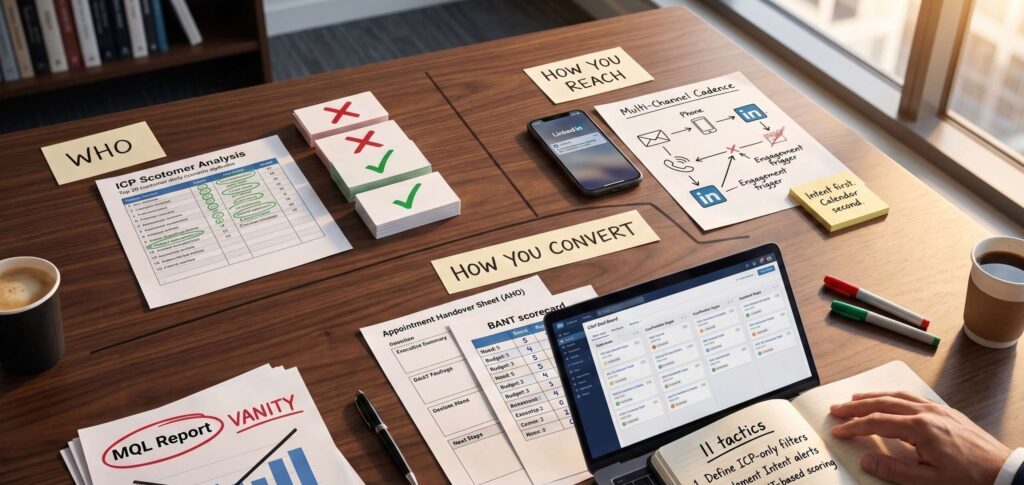


This guide provides 15 field-tested email templates across five outreach scenarios, with subject line variants, personalization guidance, and the one variable that determines whether any template works: whether you’re reaching someone who is actually in-market for what you sell.

Most B2B teams lose 40–60% of qualified prospects to broken handoffs and weak qualification. Take our 2-minute diagnostic to find out where your pipeline is bleeding — and how to fix it.
Start the Quiz → Takes 2 minutes. No email required to start.Why Most B2B Sales Emails Fail
The primary reason B2B cold emails fail is not the copy. It is the targeting. A perfectly written email sent to someone who has no need for your product, no budget to buy it, and no timeline to act will receive no reply regardless of how compelling the subject line is. Conversely, a mediocre email sent to someone who is actively researching your solution category will receive a reply simply because the timing is right.
This is why intent-driven email outreach consistently outperforms calendar-based cadences. When you know a prospect just read three articles about pipeline optimization on a relevant media publication, the email can reference that specific behavior—“I noticed you were researching pipeline velocity challenges”—which transforms the message from an interruption into a relevant conversation.
DemandNexus’s Cyborg SDR pods use first-party intent data from six owned media brands to identify which prospects are in active research cycles, then craft outreach that references the specific topics they’ve been engaging with. The result is engagement rates of 40–50%—versus the 1–3% typical of generic cold outreach.
15 Email Templates Across 5 Scenarios
Scenario 1: First Touch (Intent-Triggered)
Template 1 — Content-referenced opener:
Subject: [Specific topic they researched] at [Their Company]Hi [First Name], I noticed your team has been researching [specific topic] recently. We’ve helped companies like [Similar Company] solve [specific pain related to the topic] in [timeframe]. Would a 15-minute call to see if we can help make sense this week?

Template 2 — Trigger event opener:
Subject: Congrats on [trigger event]Hi [First Name], Saw that [Company] just [trigger event — funding round / new hire / expansion]. Companies at this stage often face [specific challenge]. We helped [Similar Company] address this and [specific result]. Worth a quick conversation?
Template 3 — Stat-led opener:
Subject: The [X%] problem at [Company]Hi [First Name], [X%] of companies in [their industry] are dealing with [specific challenge]. If that resonates, I’d love to share how [Similar Company] fixed it in [timeframe]. 15 minutes?
Scenario 2: Follow-Up After No Reply
Template 4 — Value-add follow-up:
Subject: Quick resource on [topic]Hi [First Name], I shared a note last week about [topic]. Wanted to pass along this [resource / case study / data point] that might be useful regardless of whether we connect. If it sparks any questions, I’m here.
Template 5 — Question-based follow-up:
Subject: Quick questionHi [First Name], Is [specific challenge] something your team is actively working to solve? If not, no worries—happy to reconnect when the timing is better.
Scenario 3: After Content Download / Webinar
Template 6 — Context-aware follow-up:
Subject: Following up on [content title]Hi [First Name], Noticed you downloaded [content title]. Most people who engage with that resource are dealing with [specific challenge it addresses]. Is that what prompted you to check it out? Happy to share what we’ve seen work for similar teams.
Scenario 4: Referral Introduction
Template 7 — Warm referral:
Subject: [Referrer Name] suggested I reach outHi [First Name], [Referrer Name] at [Referrer Company] mentioned you’re looking into [topic]. We helped [Referrer Company] with [specific result]. [Referrer Name] thought it might be relevant for [their company] too. Worth a quick chat?
Scenario 5: Breakup / Last Touch
Template 8 — Permission-based close:
Subject: Should I close the loop?Hi [First Name], I’ve reached out a few times about [topic]. If the timing isn’t right, totally understand. Should I check back in [timeframe], or is this not a priority right now?
Note: the above are frameworks, not fill-in-the-blank scripts. Each template should be customized with specific details from account research, intent signals, and competitive context. A template that sounds like a template will be treated like one.
Want to see what intent-triggered outreach looks like at scale?
Subject Line Best Practices
Subject lines drive open rates. The most effective patterns for B2B in 2026:
Personalized reference: “[Specific topic] at [Company]” — signals relevance immediately.
Question format: “Quick question about [specific challenge]” — lower commitment than a pitch.
Number/stat: “The 87% problem” — curiosity-driven open.
Referral: “[Name] suggested I reach out” — social proof in the subject line.
Avoid: generic subjects (“Following up”, “Introduction”, “Partnership opportunity”), overly salesy language (“Exclusive offer”, “Limited time”), and anything that sounds like it was written by an AI SDR without human review.
The Intent Variable: What Makes Any Template Work
Every template in this guide performs better when sent to a prospect who is already in an active buying cycle. The variable that separates a 2% reply rate from a 20% reply rate is not the email copy—it is whether the prospect was already thinking about the problem you’re solving when your email arrived.
This is why first-party intent data is the single most valuable input to an email outreach program. When DemandNexus’s Cyborg SDR pods identify that a VP at a target account has been reading about pipeline challenges on MarTechTrend, the outreach email can reference that behavior specifically—turning a cold email into a warm, context-aware introduction. The template matters. The timing matters more. Intent data gives you the timing.
See what intent-driven email outreach produces in qualified meetings.
FAQs
What is a good B2B sales email template?
A good template is under 100 words, opens with a personalized reference to the prospect’s specific situation, identifies a specific pain or challenge, offers a clear next step (typically a 15-minute call), and avoids jargon and pitch-first language. The most effective templates are intent-triggered—sent when the prospect is actively researching the topic, not on a fixed calendar cadence.
How do you write a cold email for B2B sales?
Start with research: understand the prospect’s role, company, and potential pain points. Open with a personalized reference (industry challenge, recent news, or content consumption). State the problem in one sentence. Offer proof that you can solve it (case study, specific result). End with a low-commitment CTA (15-minute call, not a demo). Keep it under 100 words total.
What’s the best subject line for B2B sales emails?
Subject lines that reference the prospect’s specific company or situation outperform generic subjects by 2–3x. Top patterns: “[Topic] at [Company]”, “Question about [specific challenge]”, “[Referrer] suggested I reach out”, and “The [X%] problem.” Keep subject lines under 7 words for mobile readability.
What is the reply rate for B2B cold emails?
The average B2B cold email reply rate is 1–3%. Intent-triggered emails (sent to prospects showing active buying signals) achieve 5–15% reply rates. Context-aware outreach from Cyborg SDR pods using first-party intent data achieves 40–50% engagement rates because the outreach references specific behaviors the prospect recognizes.
How long should a B2B sales email be?
Under 100 words for first-touch cold emails. Under 75 words for follow-ups. Research consistently shows that shorter emails receive higher reply rates. Every sentence should earn its place—if a sentence does not add a personalized reference, identify a pain, offer proof, or request a next step, remove it.