
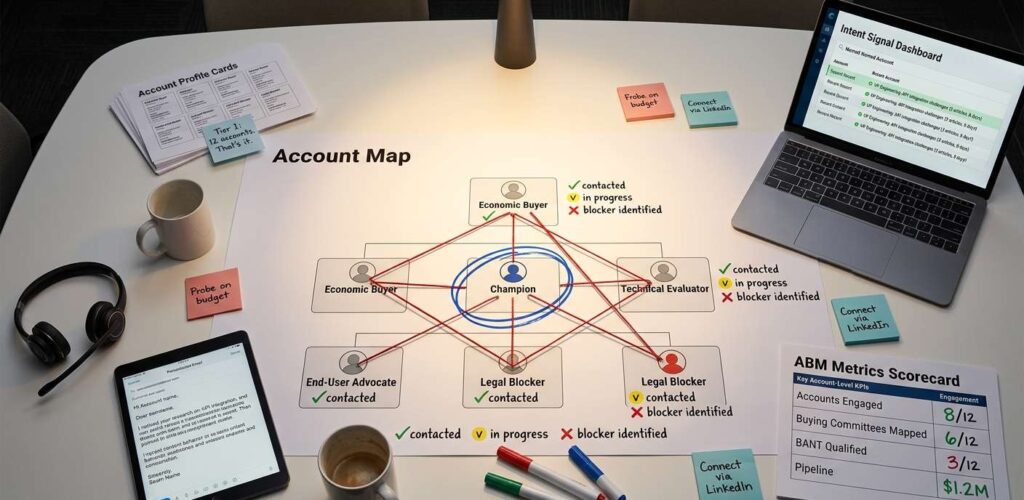


The concept has been watered down by vendors selling “ABM platforms” that amount to display ad retargeting with an ABM label. This guide separates ABM – the marketing tactic – from account-based sales – the coordinated effort between marketing and sales to win specific, named accounts through personalized multi-channel engagement backed by intent data and verified qualification.

Most B2B teams lose 40–60% of qualified prospects to broken handoffs and weak qualification. Take our 2-minute diagnostic to find out where your pipeline is bleeding — and how to fix it.
Start the Quiz → Takes 2 minutes. No email required to start.What ABM Actually Is (and Is Not)
ABM is a strategy for concentrating resources on the accounts with the highest probability of becoming high-value customers. It is not a technology category, a display advertising channel, or a way to justify sending generic emails to a target account list. Real ABM requires account selection discipline, personalized content per account or account segment, coordinated outreach across marketing and sales channels, and measurement at the account level rather than the lead level.
The distinction matters because most companies that claim to “do ABM” are actually running targeted demand generation with an account list filter – which is better than untargeted demand generation but far short of true account-based sales execution.

The Three Tiers of ABM
Tier 1: Strategic ABM (1:1)
Dedicated resources per account. Marketing creates custom content, events, and campaigns for each named account. Sales has a detailed account plan with buying committee mapping, competitive intelligence, and a multi-threaded engagement strategy. Appropriate for accounts with $500K+ potential ACV. Typical portfolio: 5–25 accounts per AE.
Tier 2: ABM Lite (1:Few)
Clustered targeting for groups of 5–15 accounts that share similar characteristics (industry, size, pain points). Marketing creates segment-specific content and campaigns. Sales runs personalized but templated outreach across the cluster. Appropriate for $100K–$500K ACV. Typical portfolio: 25–100 accounts per segment.

Tier 3: Programmatic ABM (1:Many)
Technology-driven targeting of hundreds or thousands of ICP-fit accounts with personalized advertising, content syndication, and automated outreach sequences. This tier relies most heavily on intent data to prioritize which accounts in the large pool are showing active buying signals. Appropriate for $25K–$100K ACV.
Account Selection: The Math That Makes ABM Work
ABM starts with account selection, not campaign execution. The selection process follows a TAM → SAM → target list → named accounts funnel:
TAM (Total Addressable Market): All companies that could theoretically buy your product. For a B2B SaaS company, this might be 50,000 companies.
SAM (Serviceable Addressable Market): Companies within TAM that match your ICP scoring criteria on firmographic and technographic fit. Typically 10–20% of TAM: 5,000–10,000 companies.
Target Account List: SAM accounts showing intent signals – active research behavior, competitive displacement signals, or hiring patterns that suggest a buying cycle. Typically 5–15% of SAM: 500–1,500 accounts.
Named Accounts: Target accounts assigned to specific AEs with dedicated engagement plans. The number depends on your ABM tier: 5–25 for Tier 1, 50–200 for Tier 2, 200–1,000+ for Tier 3.
The most common ABM failure is skipping the intent signal layer and treating all SAM accounts as equally worth pursuing. Without intent data, ABM becomes expensive direct marketing to a large account list – producing activity without timing, which is the same problem ABM was designed to solve.
Want to see which of your target accounts are showing buying signals right now?
Intent Data’s Role in ABM Execution
Intent data transforms ABM from a static targeting strategy into a dynamic prioritization engine. Instead of working 500 named accounts in rotation, your team works the 50 accounts showing active buying behavior this week – and that list reshuffles as signals change.
First-party intent data (from content properties and media brands you own) is the most valuable for ABM because it provides contact-level, topic-specific, real-time signals. When a VP of Engineering at a named account reads three articles about API integration on DevTechTrend, your SDR knows exactly who to call, what to reference, and when to reach out.
DemandNexus’s six owned media brands (AITechTrend, MarTechTrend, DevTechTrend, HRTechTrend, FinTechFilter, LegalTechTrend) provide precisely this signal layer for ABM execution. The Cyborg SDR pod model takes it further: AI-flagged intent triggers human-crafted, context-aware outreach that references the specific content the prospect engaged with, followed by a BANT-verified qualification call that confirms the account is ready for an AE meeting.
The result is ABM execution, not just ABM strategy: intent-qualified, BANT-verified appointments with named account contacts, delivered with Appointment Handover Sheets that give your AE full context before the conversation begins.
Multi-Thread Engagement: The ABM Sales Playbook
ABM sales requires engaging multiple contacts within the same account simultaneously. A single-threaded approach (one SDR reaching one contact) fails in ABM because enterprise buying decisions involve committees of 6–10 stakeholders.
Step 1: Map the buying committee. Identify the economic buyer, champion, technical evaluator, end-user advocate, and potential blockers using LinkedIn, org chart tools, and CRM data.
Step 2: Personalize by role. The economic buyer cares about ROI and risk. The technical evaluator cares about integration and security. The end-user cares about usability. Craft messaging that speaks to each stakeholder’s specific priorities.
Step 3: Coordinate timing. Engage multiple contacts in a compressed window so the account experiences “surround sound” – marketing touches, SDR outreach, and content delivery arriving from different angles within the same week. This creates internal conversation about your solution.
Step 4: Track at the account level. ABM metrics are account-level, not lead-level. Track accounts engaged (not leads generated), accounts qualified (not MQLs), and pipeline per account (not pipeline per lead). This aligns measurement with the strategy.
See what ABM execution with BANT-verified appointments looks like.
FAQs
What is ABM in sales?
Account-based marketing (ABM) applied to sales is a strategy where sales and marketing coordinate to target a defined set of high-value accounts with personalized, multi-channel engagement. Instead of generating broad leads and filtering down, ABM starts with named accounts and builds tailored campaigns to win them.
What does ABM stand for?
ABM stands for Account-Based Marketing. When applied to the sales function specifically, it is sometimes called Account-Based Sales (ABS) or Account-Based Everything (ABX) to reflect that the strategy spans marketing, sales, and customer success.
How is ABM different from traditional B2B sales?
Traditional B2B sales casts a wide net with broad outreach and filters prospects through a funnel. ABM starts with a defined list of target accounts and builds personalized campaigns for each account or account segment. ABM is more resource-intensive per account but produces higher conversion rates and larger deal sizes because engagement is tailored to each account’s specific situation.
What are the 3 types of ABM?
The three tiers are: (1) Strategic ABM (1:1)—dedicated resources per account for $500K+ deals, (2) ABM Lite (1:Few)—clustered targeting for groups of similar accounts in the $100K–$500K range, and (3) Programmatic ABM (1:Many)—technology-driven targeting of hundreds of accounts using intent data and automation for $25K–$100K deals.
What is an ABM sales funnel?
An ABM sales funnel is inverted compared to a traditional funnel. Instead of starting with a wide pool of leads and narrowing down, ABM starts with a selected list of target accounts, identifies buying committee members within those accounts, engages them with personalized multi-channel outreach, qualifies through structured conversations, and converts through tailored proposals. The funnel stages are: Identify → Expand (buying committee) → Engage → Qualify → Convert.