

Introduction
The SaaS marketing agency market is crowded, and the promises are uniform: more leads, lower CPL, faster pipeline. What most agencies don’t advertise is their conversion rate — how many of the leads they generate actually become closed revenue.
The reason that number stays hidden: most SaaS marketing agencies are optimized for lead generation, not pipeline generation. They’re paid on volume metrics — CPL, MQL count, traffic — not on the metric that matters to your CFO: cost per closed deal.
This guide covers how to evaluate SaaS marketing agencies, what questions to ask, and why the distinction between lead delivery and appointment delivery is the single most important factor in agency selection.
Types of SaaS Marketing Agencies
Full-Service SaaS Marketing Agencies
Full-service agencies handle strategy, content, paid media, SEO, and often demand generation under one roof. They’re appropriate for SaaS companies that want a single partner managing all marketing functions. The trade-off: breadth often comes at the expense of depth in specific disciplines like demand generation or technical SEO.
SaaS SEO Agencies
Specialist SEO agencies focus exclusively on organic search — keyword research, content strategy, technical optimization, and link building. For SaaS companies at the stage where organic traffic is a primary pipeline driver, a specialist often outperforms a generalist. Look for agencies with documented case studies in SaaS SEO, not just general web SEO.
Demand Generation and Appointment Setting Agencies
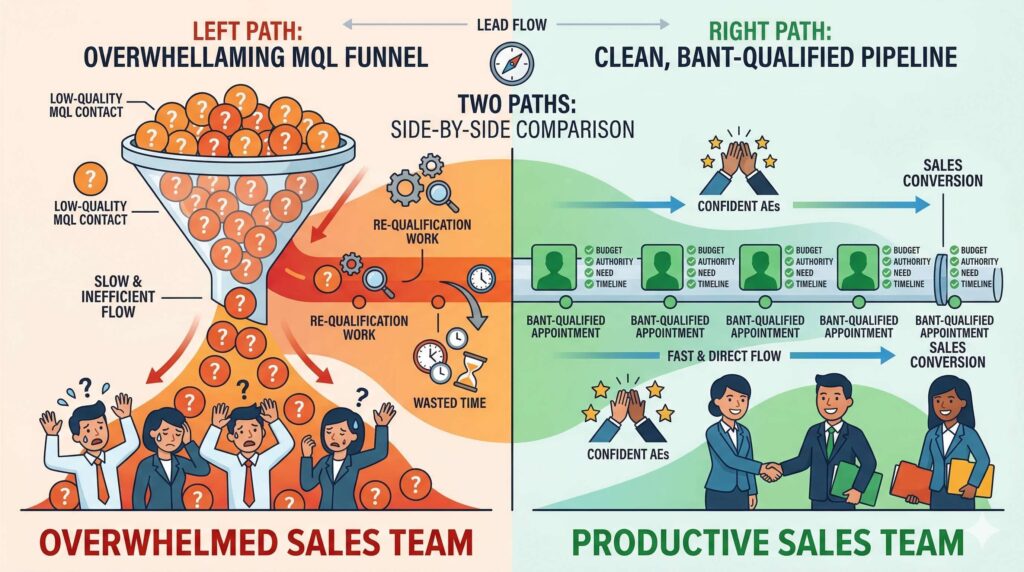
Demand generation agencies focus on pipeline creation rather than brand or content. The spectrum here is wide: some deliver MQLs (contact records with engagement scores), others deliver BANT-qualified appointments (confirmed meetings with decision-makers who have verified budget, authority, need, and timeline). The difference in conversion quality — and sales team efficiency — is substantial.
ABM Agencies
ABM agencies specialize in coordinating multi-channel engagement programs for defined target account lists. They typically work best for enterprise SaaS companies with long sales cycles and complex multi-stakeholder buying processes. ABM agencies often partner with demand generation providers to add appointment setting to their account engagement programs.
The 5 Questions Every SaaS Company Should Ask a Marketing Agency
1. What is your definition of a qualified lead?
This question separates agencies that deliver pipeline from agencies that deliver contacts. An agency that defines ‘qualified’ as ‘engaged with content’ is selling you MQLs. An agency that defines ‘qualified’ as ‘confirmed BANT criteria through direct conversation’ is selling you pipeline. Ask for their SQL conversion rate from the leads they deliver.
2. What happens when a meeting doesn’t show up?
No-show protection is a direct indicator of how much risk the agency is willing to take on behalf of outcomes. Agencies that replace no-shows at no cost are betting on their qualification quality. Agencies that don’t have a no-show policy are betting on your tolerance for waste.
3. What data do I receive?
Full data ownership means you receive every lead record, every BANT conversation note, and every contact detail — whether they become customers or not. Some agencies deliver only the leads you ‘paid for’ as a black box; others deliver full CRM visibility including prospects who were contacted but not yet qualified.
4. What intent signals power your outreach?
Cold outreach from purchased contact lists generates under 5% engagement rates. Context-aware outreach from first-party behavioral signals — prospects who have engaged with category-relevant content — generates 40–50% engagement rates. Ask where the prospect data comes from.
5. How do you brief my sales team before meetings?
A pre-meeting briefing document (Appointment Handover Sheet) is the difference between a sales team that walks into discovery calls cold and one that opens every conversation with full context on the prospect’s BANT answers, pain points, and urgency drivers. If an agency doesn’t have a structured handover process, your AEs are doing qualification work the agency should have completed.
What Most SaaS Marketing Agencies Get Wrong
The most common failure mode in SaaS marketing agency relationships is misaligned measurement. The agency is measured on leads delivered; the client cares about pipeline generated. These are not the same metric, and optimizing for one often damages the other.
High-volume MQL programs produce contacts at low CPL. But when those contacts reach your sales team, 87% of them don’t convert. Your SDRs spend 30–50% of their time on re-qualification. Your AEs spend the first 15 minutes of every ‘discovery call’ doing what the agency should have done before booking the meeting.
The alternative: pay for outcomes, not activities. Pay-for-performance appointment models — where you pay only when a BANT-qualified meeting is held — shift the risk from client to provider. The agency has skin in qualification quality because they only get paid when meetings happen.
DemandNexus: The Demand Generation Agency Built Around BANT Appointments
DemandNexus is not a traditional SaaS marketing agency. We don’t deliver MQLs, content downloads, or traffic reports. We deliver BANT-qualified appointments — confirmed meetings with decision-makers who have verified budget, authority, need, and timeline before your AE gets on the call.
What makes DemandNexus different from traditional SaaS marketing agencies:
- Pay-for-performance pricing: You pay $500 per qualified meeting. If the meeting doesn’t happen or doesn’t meet your criteria, you don’t pay.
- First-party intent data: Our six owned B2B media brands (AITechTrend, MarTechTrend, HRTechTrend, FinTechFilter, LegalTechTrend, DevTechTrend) reaching 15M+ decision-makers power context-aware outreach with real behavioral signals.
- Human BANT qualification: Every appointment is confirmed through a direct SDR conversation — no MQL proxies, no engagement-score shortcuts.
- Appointment Handover Sheet: Your AE receives a full briefing before every call, including BANT answers, pain points, and recommended conversation openers.
- Full data ownership: Every contact record, BANT note, and conversation detail is yours forever — whether they become customers or not.
The result: DemandNexus clients see 202% higher close rates and 90%+ SQL conversion — versus 13% for standard MQL programs. At Essentials Pod ($7,500/month), the estimated Year 1 pipeline impact is $3.15M (200 guaranteed appointments, 35% close rate, $50K ACV).
FAQs
What does a SaaS marketing agency do?
SaaS marketing agencies provide services to generate awareness, demand, and pipeline for software companies. Services range from content marketing and SEO to paid acquisition, ABM, demand generation, and appointment setting. The best agencies measure their success on pipeline generated and revenue influenced, not on lead volume.
How much do SaaS marketing agencies cost?
Costs vary widely by service type and model. Traditional agency retainers run $5,000–$25,000 per month for full-service SaaS marketing. SEO agencies typically run $3,000–$10,000/month. Pay-for-performance appointment programs like DemandNexus charge $500 per BANT-qualified meeting — $7,500/month for the Essentials Pod with 15+ guaranteed appointments.
What is the difference between a SaaS marketing agency and a demand generation agency?
SaaS marketing agencies typically provide broad marketing services including brand, content, and paid media. Demand generation agencies focus specifically on pipeline creation — generating, qualifying, and converting buyer interest into sales opportunities. The best demand generation agencies deliver BANT-qualified appointments rather than MQL-level lead lists.
What should I look for in a SaaS marketing agency?
Look for: a precise definition of 'qualified' that requires BANT confirmation, pay-for-performance pricing with no-show protection, full data ownership, first-party intent data sourcing, and a pre-meeting briefing process for your sales team. Avoid agencies whose primary success metric is lead volume or CPL.
How do I measure the ROI of a SaaS marketing agency?
Measure agency ROI by: pipeline generated (not leads), SQL conversion rate from agency-sourced leads, cost per closed deal, and revenue influenced. For appointment-based programs, cost per closed deal is the most direct ROI metric — DemandNexus clients see $1,220–$1,500 cost per closed deal at 35% close rates.
Why do most SaaS marketing agencies deliver MQLs instead of pipeline?
Most agencies are paid on activity metrics — leads delivered, traffic generated, CPL. Optimizing for lead volume is easier than optimizing for pipeline quality, and it creates a predictable revenue stream for the agency regardless of conversion outcomes. Pay-for-performance models realign incentives: the agency only gets paid when qualified meetings happen.
Author