

Why You Need a Demand Generation Framework
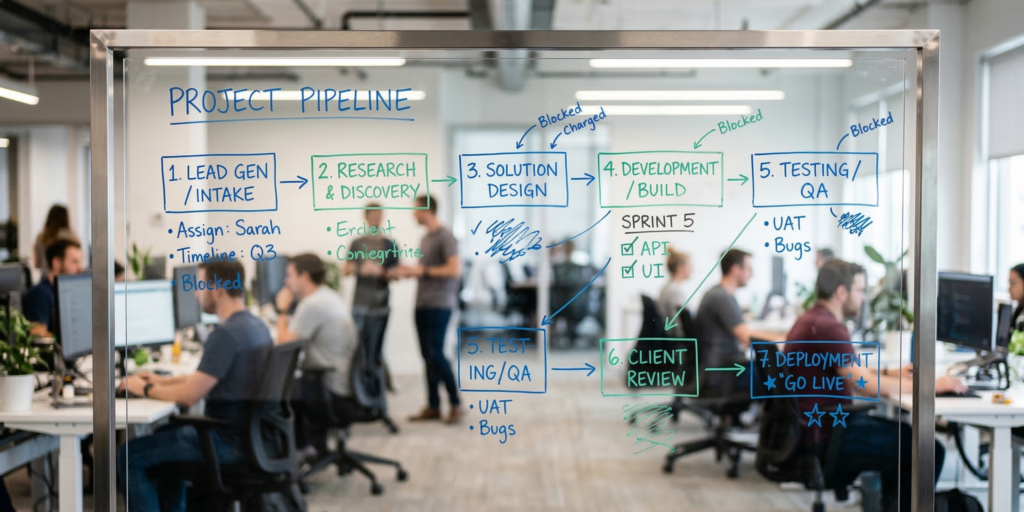
Most B2B teams run demand gen as a series of disconnected campaigns: a paid burst here, an ebook launch there, an outbound sprint when pipeline runs thin. A framework replaces this with a repeatable, measurable system. When a campaign underperforms, the framework tells you exactly which stage failed. When it overperforms, the framework tells you what to scale.

Most B2B teams lose 40–60% of qualified prospects to broken handoffs and weak qualification. Take our 2-minute diagnostic to find out where your pipeline is bleeding — and how to fix it.
Start the Quiz → Takes 2 minutes. No email required to start.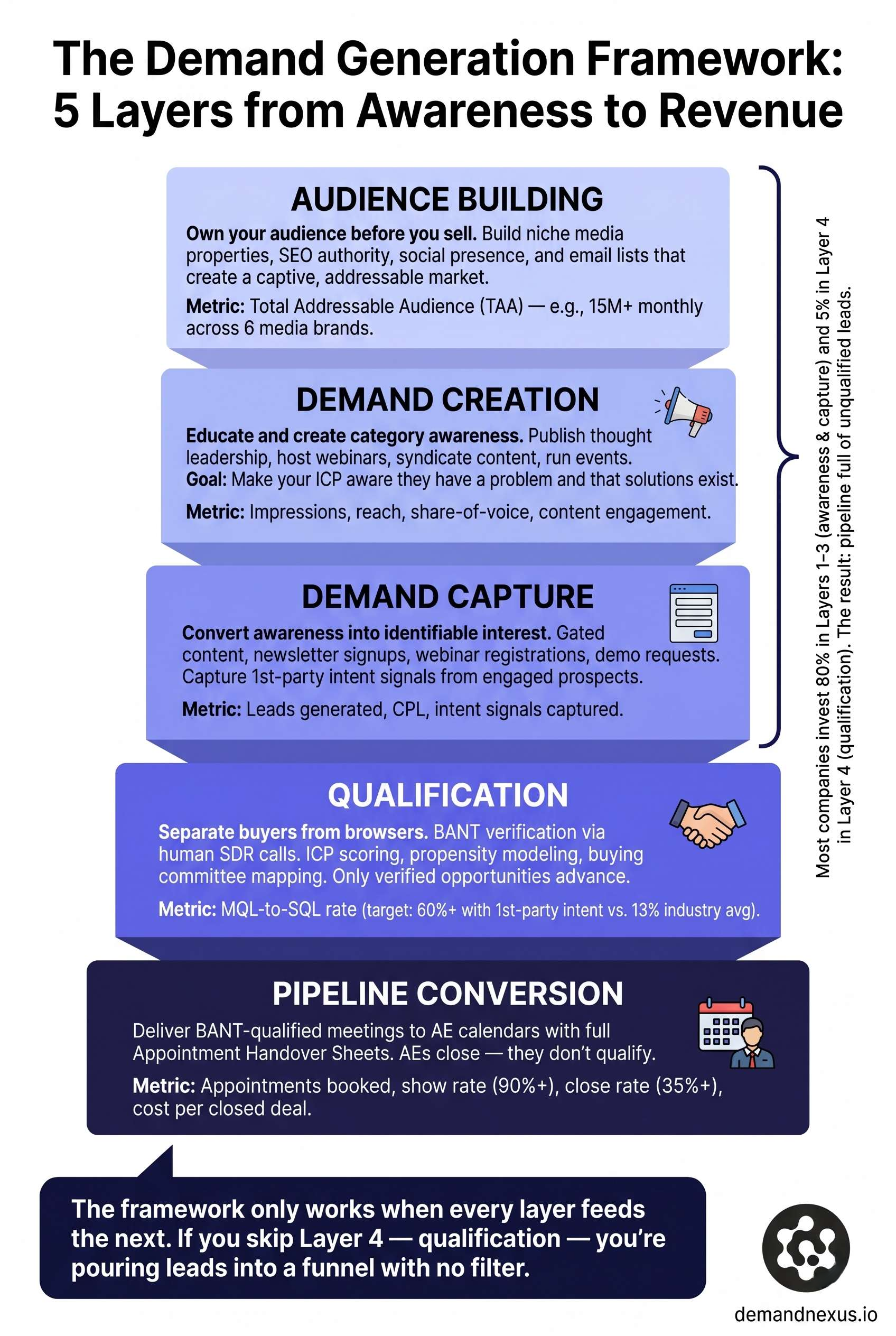
The frameworks that connect to continuous engagement, rather than treating demand as a series of one-off conversions, are the ones producing predictable pipeline in 2026. Continuous engagement means accounts that do not convert immediately stay in the engine, moving through nurture and re-qualification cycles until timing shifts.
The 7-Step Demand Generation Framework
Step 1: Define Your Ideal Customer Profile (ICP)
Every framework starts with a rigorously defined ICP. Vague ICPs produce vague pipelines. A working ICP specifies firmographics (industry, size, revenue, geography), technographics (tech stack), and behavioral signals (intent patterns, buying triggers). If your ICP fits on a sticky note, it is probably too loose.
Step 2: Map the Buyer Journey and Buying Committee
Document the full buyer journey for your ICP: how they become aware of the problem, how they research solutions, who is involved in the decision, what triggers purchase, what could kill the deal. Most B2B buying committees have 6 to 10 stakeholders. A framework that only addresses the champion will miss most committees.
Step 3: Build the Content and Intent Engine
Content drives top-of-funnel awareness. Intent data identifies accounts moving from passive to active research. The two must be connected: content that produces first-party intent signals is more valuable than content that does not, because it tells you who is actually in-market.

Step 4: Activate Multi-Channel Demand Capture
Once accounts show intent, activate multi-channel plays: paid media for broader visibility, outbound SDR for named-account penetration, retargeting for sustained presence. The goal is not maximum channel coverage; it is the right coverage for each account stage.
Step 5: Run Waterfall Qualification
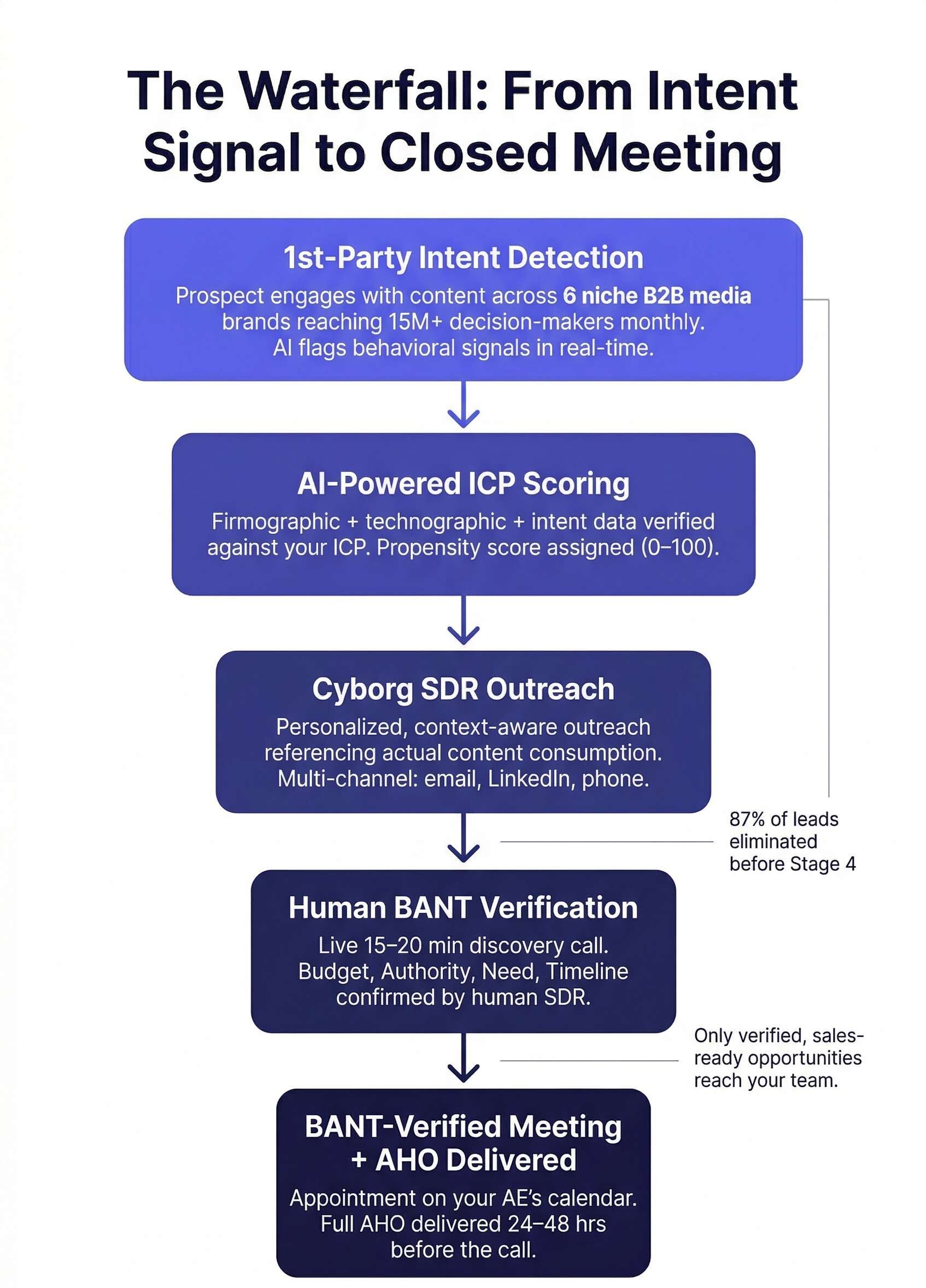
This is where most frameworks fail. Raw signals must pass through a waterfall: ICP fit filter, intent verification, firmographic enrichment, then human BANT qualification. Anything that fails any filter is rejected, not passed through with a lower score. Loose qualification is why 87 percent of MQLs get rejected by sales.
Step 6: Execute Sales Handoff with Complete Context
Every qualified appointment must arrive with full context: stakeholders in the room, identified pain, current-state tooling, decision criteria, timeline, budget range. At DemandNexus we call this the Appointment Handover Sheet (AHO). It is why our meetings show up 90 percent of the time and convert at 202 percent the rate of unqualified leads.
Step 7: Measure, Attribute, and Iterate
Track pipeline velocity, SQL conversion, opportunity-to-closed-won, and revenue attribution by source. Use this data to tune every upstream stage. Frameworks without feedback loops degrade over time; frameworks with measurement improve quarter over quarter.
The DemandNexus Waterfall Framework
The Waterfall is the specific demand generation framework we run at DemandNexus. It is designed for one thing: rejecting unqualified demand before it reaches your sales team, while ensuring qualified demand arrives with complete context.
Layer 1: Signal Intake
First-party intent signals from our six owned B2B media brands (AITechTrend, MarTechTrend, HRTechTrend, FinTechFilter, LegalTechTrend, DevTechTrend) collectively reach 15 million decision-makers monthly. Every signal enters the waterfall.
Layer 2: ICP Fit Filter
Firmographic matching against the client’s defined ICP. Accounts that fail fit are rejected immediately. Typical rejection rate at this stage: 40 to 60 percent.
Layer 3: Intent Verification
Confirm the intent signal represents real buying activity, not noise. This is where AI enrichment layers identify buying-committee activity across multiple data points.
Layer 4: Account Research
Cyborg SDR pods enrich each surviving account with technographic and organizational context: current tech stack, recent funding, hiring signals, restructuring activity, public executive statements.
Layer 5: Human BANT Qualification
Trained human SDRs run the actual BANT conversation. Budget, Authority, Need, Timeline. Any pillar failing means rejection.
Layer 6: AHO Documentation and Handover
Every surviving account becomes a qualified appointment delivered with a complete appointment handover sheet. The AE walks in prepared, not cold.
Frameworks That Connect to Continuous Engagement
Modern demand generation frameworks cannot treat accounts as one-time conversions. An account that is not ready to buy this quarter may be ready in six months. A framework that discards unconverted accounts is leaking future revenue.
Continuous engagement patterns that work in 2026:
- Nurture tracks segmented by funnel stage, with different content cadence for top, mid, and bottom-of-funnel accounts
- Re-qualification triggers based on behavioral signals (new content engagement, new stakeholder activity, new hiring patterns)
- Account-level intent monitoring, so dormant accounts re-enter active pipeline when signals change
- Sales-owned and marketing-owned plays in the same CRM, so no stakeholder is touched by both simultaneously with conflicting messages
How to Implement a Demand Generation Framework
Phase 1: Foundation (Weeks 1 to 4)
Define ICP rigorously. Map buyer journey and committee. Audit existing content and channel performance. Select initial tools for intent, outbound, and attribution.
Phase 2: Build (Weeks 5 to 12)
Launch initial content engine. Activate intent data sources. Deploy SDR outreach sequences. Implement attribution tracking. Run qualification criteria test with your sales team.
Phase 3: Scale (Weeks 13 to 24)
Optimize channels based on early CAC data. Expand content production based on what ranks and converts. Add ABM layer for top 50 to 200 named accounts. Tighten qualification based on closed-won patterns.
Phase 4: Optimize (Ongoing)
Run quarterly audits of channel performance. Adjust ICP based on actual close patterns (not assumed ones). Invest deeper in the channels producing the best cost per qualified appointment.
Demand Generation Framework Mistakes to Avoid
- Running campaigns without a framework and calling the collection a ‘strategy’
- Measuring MQL volume without measuring MQL-to-SQL conversion
- Skipping human BANT qualification in favor of automated scoring
- Treating ABM as a replacement for demand gen rather than a layer on top
- Building content without a pipeline thesis
- Using third-party intent alone without first-party signals for differentiation
- Investing in tools before fixing the underlying qualification discipline
FAQs
What is a demand generation framework?
A demand generation framework is a structured, repeatable model for creating, capturing, and qualifying B2B sales pipeline. It replaces disconnected campaign-by-campaign execution with a measurable system that tells you exactly where pipeline is being created and where it is being lost.
What is the demand generation waterfall?
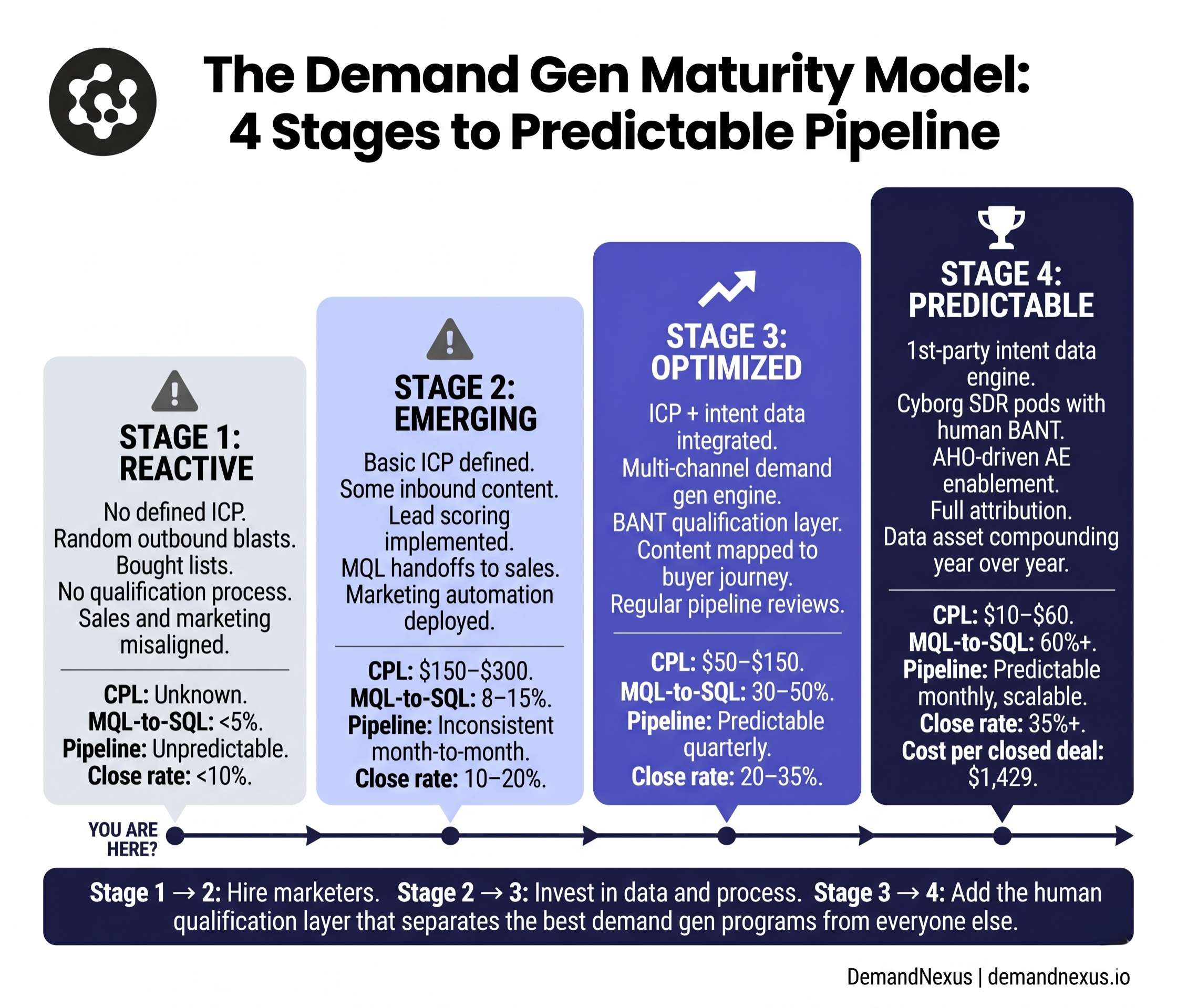
The demand generation waterfall is a qualification framework where raw signals pass through successive filters (ICP fit, intent verification, firmographic enrichment, BANT qualification) before any account reaches a sales meeting. Anything failing any filter is rejected, which is why waterfall programs convert at 60 percent plus SQL rates versus the 13 percent industry median.
How do you build a demand generation engine?
Build a demand gen engine in four phases: foundation (ICP definition, buyer journey mapping, tool selection), build (content engine, intent data, SDR sequences, attribution), scale (channel optimization, ABM layer, qualification tightening), and optimize (ongoing quarterly audits and adjustments based on closed-won data).
What frameworks connect to continuous engagement?
Continuous engagement frameworks segment accounts by stage, run nurture tracks with different cadences for each stage, monitor account-level intent for re-qualification triggers, and coordinate sales and marketing plays to prevent conflicting touches. The goal is treating unconverted accounts as future pipeline, not lost pipeline.
How long does it take to implement a demand generation framework?
Foundation takes 4 weeks. Initial build takes 8 weeks. Scale phase runs 12 weeks. Full optimization is ongoing. Most teams see first meaningful pipeline impact within 90 days and mature performance within 6 to 9 months.