


When sales rejects nearly nine out of ten leads that marketing sends over, the two teams are not misaligned on tone or tactics. They are misaligned on the definition of “qualified.” Marketing counts form fills. Sales counts buying intent. Until both teams adopt a single, shared definition of qualified that includes ICP fit, intent signals, and verified readiness to buy, the 87% gap will persist regardless of how many alignment meetings you schedule.

Most B2B teams lose 40–60% of qualified prospects to broken handoffs and weak qualification. Take our 2-minute diagnostic to find out where your pipeline is bleeding — and how to fix it.
Start the Quiz → Takes 2 minutes. No email required to start.Why the MQL Is the Root Cause, Not the Symptom
The Marketing Qualified Lead (MQL) was designed as a handoff mechanism: marketing generates interest, qualifies it to a minimum threshold, and passes it to sales for further development. The problem is that the MQL threshold in most organizations is based on engagement behavior—downloads, webinar attendance, email opens—rather than buying readiness.
A junior analyst at a 10-person startup who downloads every whitepaper you publish will score as an MQL. A VP of Sales at a $200M company who reads one article about pipeline optimization but never fills out a form will not. The MQL model systematically overvalues engagement and undervalues fit and intent—which is why sales rejects the majority of what marketing delivers.
The fix is not a better MQL definition. It is replacing the MQL as the primary handoff metric with a metric that sales and marketing both trust. That metric is the SQL: a lead that has been verified against ICP scoring criteria and passed a structured BANT qualification process before reaching an AE.

The Five-Layer Alignment Framework
Layer 1: Shared ICP Definition
Marketing and sales must agree on who the ideal customer is—not in abstract terms but in specific, measurable criteria: company size range, industry verticals, technology stack requirements, geography, and growth stage. This ICP should be derived from closed-won data (which accounts actually became customers), not from marketing personas (which accounts marketing thinks it can reach).
When the ICP definition is shared, marketing targets content and campaigns to ICP-fit audiences, and sales evaluates incoming leads against the same criteria. Disagreements about lead quality drop because both teams are using the same filter.

Layer 2: Shared Intent Signal Framework
Agreement on which signals indicate buying readiness—and which do not. A content download is a signal. A pricing page visit is a stronger signal. Three articles read on the same topic in two weeks (intent velocity) is the strongest signal. Define a signal hierarchy that both teams reference when evaluating pipeline quality.
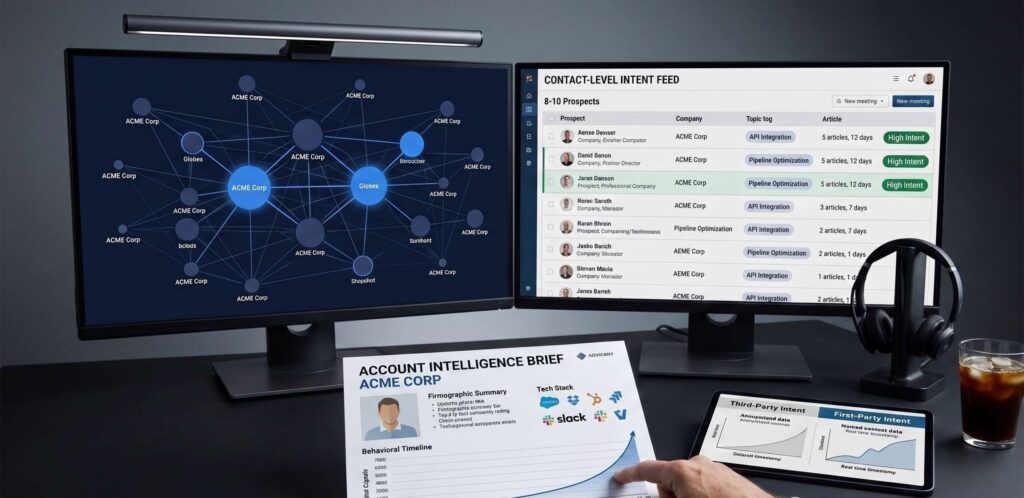
First-party intent data is the most reliable signal source because it is proprietary and specific. DemandNexus generates first-party intent from six owned media brands, providing specific behavioral signals that both marketing (for targeting) and sales (for outreach timing) can use as a shared intelligence layer. Third-party intent data supplements this but is less specific and shared with competitors.
Layer 3: Shared Qualification Criteria
Define what “qualified” means in terms both teams accept. The strongest approach: a lead is qualified when it meets ICP scoring thresholds AND passes BANT verification by a human SDR. This dual-layer definition eliminates the gap between marketing’s “interested” and sales’ “ready to buy.”
Layer 4: Shared SLA
A service-level agreement between marketing and sales specifies: marketing commits to delivering X SQLs per month at Y quality threshold; sales commits to engaging those SQLs within Z hours and providing feedback on every lead within 48 hours. The SLA creates mutual accountability—marketing cannot over-deliver garbage, and sales cannot under-engage quality leads.
Layer 5: Shared Revenue Metric
The ultimate alignment metric is pipeline revenue generated, not MQL count and not SQL count. When both teams are measured on pipeline dollars that convert to closed revenue, the incentives align naturally. Marketing optimizes for quality over volume. Sales provides honest feedback instead of blanket rejection. Both teams win when revenue grows.
Find out where your sales and marketing alignment breaks down.
Why Revenue Operations Is Winning Where Alignment Failed
The rise of Revenue Operations (RevOps) as a function reflects the failure of traditional alignment approaches. When sales, marketing, and CS each have separate ops teams with separate data, separate tools, and separate metrics, alignment is structural—it cannot be achieved through meetings and goodwill.
RevOps consolidates operations across all three revenue teams into a single function that owns the data model, the tech stack, the reporting, and the handoff processes. This structural change makes alignment the default rather than the aspiration. Companies with a dedicated RevOps function report 19% faster revenue growth and 15% higher profitability than those without one, according to Forrester research.
If you do not have a RevOps function yet, the first step is designating a single person who owns the lead lifecycle from first touch through closed-won—and who has the authority to enforce lead scoring, qualification standards, and SLAs across both teams.
The Feedback Loop That Most Teams Miss
Alignment is not a one-time exercise. It is a continuous feedback loop. After every quarter, analyze: Which ICP segments converted best? Which intent signals predicted closed revenue? Which qualification criteria correlated with deal success? Use this data to refine the shared ICP, signal framework, and qualification criteria.
The most common alignment failure mode is setting up the framework once and never revisiting it. Markets change. Buyer behavior evolves. Your product positioning shifts. The alignment framework must evolve with them—quarterly review and recalibration is the minimum cadence.
Ready to fix the handoff that costs your team the most pipeline? Book a call.
FAQs
What is B2B sales and marketing alignment?
B2B sales and marketing alignment is the practice of unifying both teams around shared goals, definitions, metrics, and processes for generating and converting revenue. True alignment goes beyond regular meetings—it requires a shared ICP definition, shared qualification criteria, a mutual SLA, and a common revenue metric that both teams are accountable for.
Why is sales and marketing alignment important?
Misalignment directly costs revenue. When marketing optimizes for MQL volume and sales optimizes for deal quality, the result is an 87% MQL rejection rate—meaning nearly 9 out of 10 marketing-generated leads are wasted. Aligned organizations close deals faster, convert more pipeline, and spend less per customer acquired because both teams are targeting and qualifying the same way.
How do you align sales and marketing teams?
Implement a five-layer framework: (1) shared ICP definition derived from closed-won data, (2) shared intent signal hierarchy, (3) shared qualification criteria (ICP fit + BANT verification), (4) mutual SLA with volume and quality commitments from both sides, and (5) shared revenue metric that both teams are measured against. Review and recalibrate quarterly.
What KPIs measure sales and marketing alignment?
The primary alignment KPI is pipeline revenue generated from marketing-sourced leads that convert to closed-won deals. Supporting KPIs include: MQL-to-SQL acceptance rate (target 40–60%), SQL-to-opportunity conversion rate, cost-per-qualified-meeting, speed-to-engagement (time from MQL to first sales contact), and feedback loop completion rate (percentage of leads with sales feedback within 48 hours).
What is an SLA between sales and marketing?
A service-level agreement (SLA) between sales and marketing defines mutual commitments: marketing agrees to deliver a specified number of qualified leads per month at a defined quality threshold; sales agrees to engage those leads within a specified timeframe (typically 24–48 hours) and provide structured feedback on every lead. The SLA creates accountability for both teams.