



B2B prospecting is the first and most consequential step in any revenue program. Get it right — targeting the right companies, reaching the right people, with the right context — and the rest of the sales process flows. Get it wrong, and your AEs spend the majority of their time chasing prospects who were never going to buy.
Most B2B teams have a volume problem masquerading as a prospecting problem. They generate enough leads. They just don’t generate enough qualified leads — contacts who have confirmed budget, authority, an active need, and a defined timeline. The result is the median MQL-to-SQL conversion rate of 13%: 87 out of every 100 marketing-generated leads fail to become real sales opportunities.

Most B2B teams lose 40–60% of qualified prospects to broken handoffs and weak qualification. Take our 2-minute diagnostic to find out where your pipeline is bleeding — and how to fix it.
Start the Quiz → Takes 2 minutes. No email required to start.This guide covers what B2B prospecting actually involves, how to build a prospecting strategy that produces pipeline rather than noise, and what a professional B2B prospecting service delivers differently from traditional lead generation. It also places prospecting within the broader B2B demand generation system — so you understand exactly where prospecting sits, what it depends on, and what it feeds into.
What Is B2B Prospecting?
B2B prospecting is the systematic process of identifying, researching, and initiating contact with organizations and decision-makers who fit your ideal customer profile and are likely to have a genuine need for your solution. It is the top-of-pipeline activity that converts a target account list into active sales conversations.
Prospecting is distinct from marketing in a critical way: it is proactive, not passive. While inbound marketing waits for prospects to raise their hand, B2B prospecting goes to them — researching their situation, identifying buying signals, and initiating contact with a message tailored to their specific context.

It is also distinct from lead generation in the way most people mean it. Generating a lead means capturing a contact’s information. Prospecting means qualifying whether that contact represents a genuine revenue opportunity — verifying that the account has budget, the contact has authority, the need is real and active, and the timeline is defined. Without that qualification layer, prospecting produces lists. With it, it produces pipeline.
Effective B2B prospecting always begins with a precisely defined ideal customer profile (ICP). The ICP defines which companies are worth pursuing — their industry, size, revenue range, tech stack, buying signals, and organizational structure. Every prospecting activity downstream of a weak ICP produces wasted effort at scale.

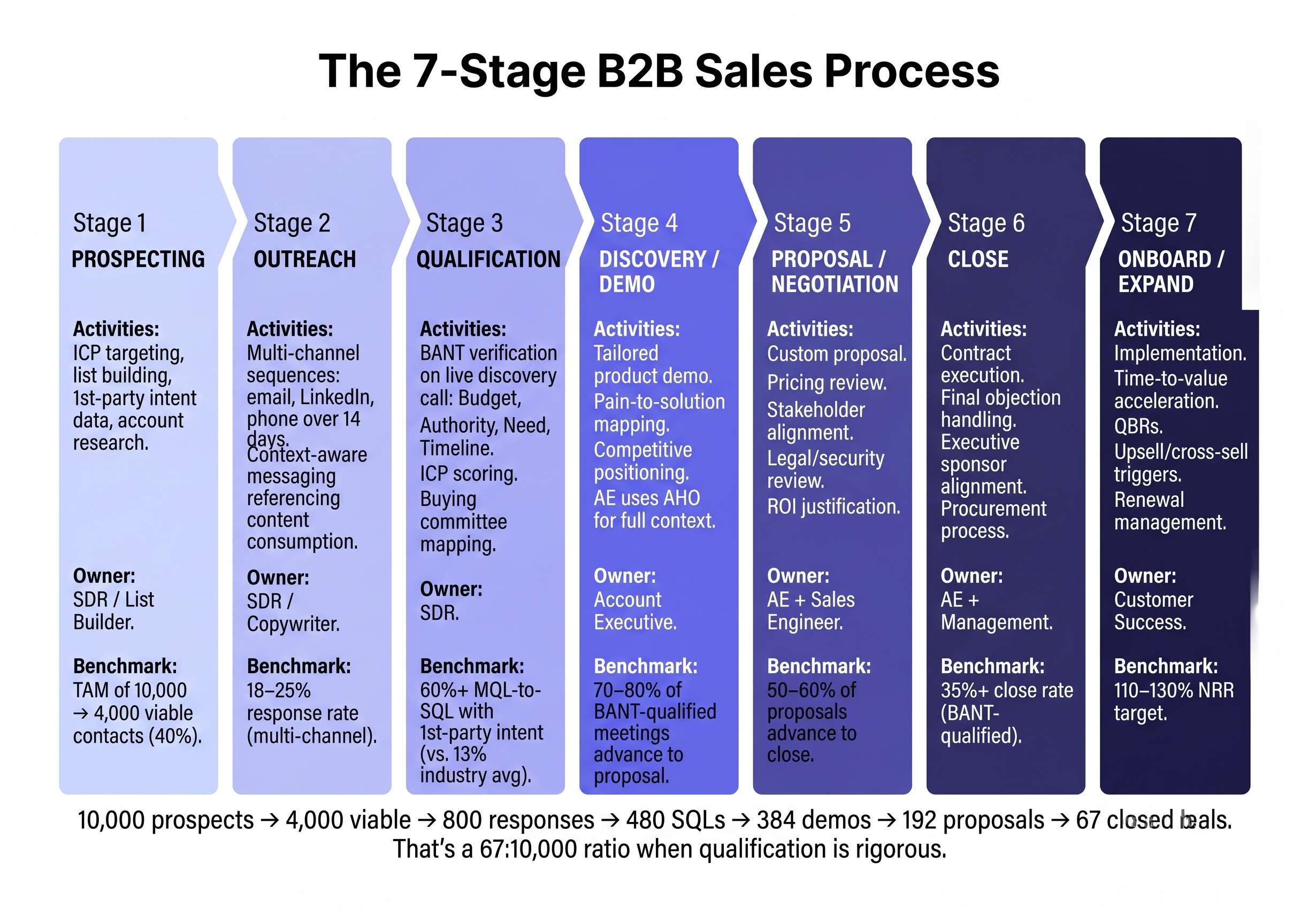
Why Traditional B2B Lead Prospecting Is Broken
The standard B2B prospecting model — build a list, run an email sequence, track engagement scores, pass MQLs to sales — is structurally flawed. Not because the individual tactics are wrong, but because the qualification gate is in the wrong place.
In the traditional model, qualification happens after marketing has already spent budget and after leads have already entered the sales pipeline. AEs discover in the first call that the prospect has no budget, is not the decision-maker, or is just doing research with no active project. Each of those discoveries costs 1.5–2 hours of AE time and delays the discovery of a real opportunity.
The B2B marketing challenges this creates are well documented: marketing-sales misalignment over lead quality, AEs spending 60–70% of their time on non-selling activities, and pipeline forecasts that look healthy on paper but collapse at conversion because the input quality was never verified.
The fix is not better lead scoring. It is moving the qualification gate upstream — using human-led BANT verification before any meeting is scheduled, so the only appointments on your AE’s calendar are with prospects who have confirmed they can and intend to buy.
B2B Prospecting vs. Demand Generation: How They Work Together
B2B prospecting and B2B demand generation are complementary functions that serve different parts of the pipeline engine. Understanding the relationship between them is essential for building a coherent go-to-market strategy.
| Dimension | B2B Prospecting | Demand Generation |
|---|---|---|
| Primary motion | Outbound — you initiate contact | Inbound and outbound — you create conditions for interest |
| Output | BANT-qualified appointments on AE calendars | Awareness, intent signals, MQLs |
| Qualification timing | Before meeting is booked | After lead is generated (or not at all) |
| Success metric | Cost per BANT-qualified meeting, AE close rate | MQL volume, CPL, engagement rate |
| Relationship to pipeline | Direct — every output is a revenue-ready meeting | Indirect — outputs require further qualification |
Demand generation creates the brand presence, content assets, and intent signals that make prospecting outreach land with context and relevance. Prospecting converts those signals into confirmed sales conversations. The two are most effective when integrated — as in a demand generation framework that sequences awareness, intent capture, and outbound qualification into a single pipeline-filling system.
The Foundation: ICP Definition and Target Account Selection
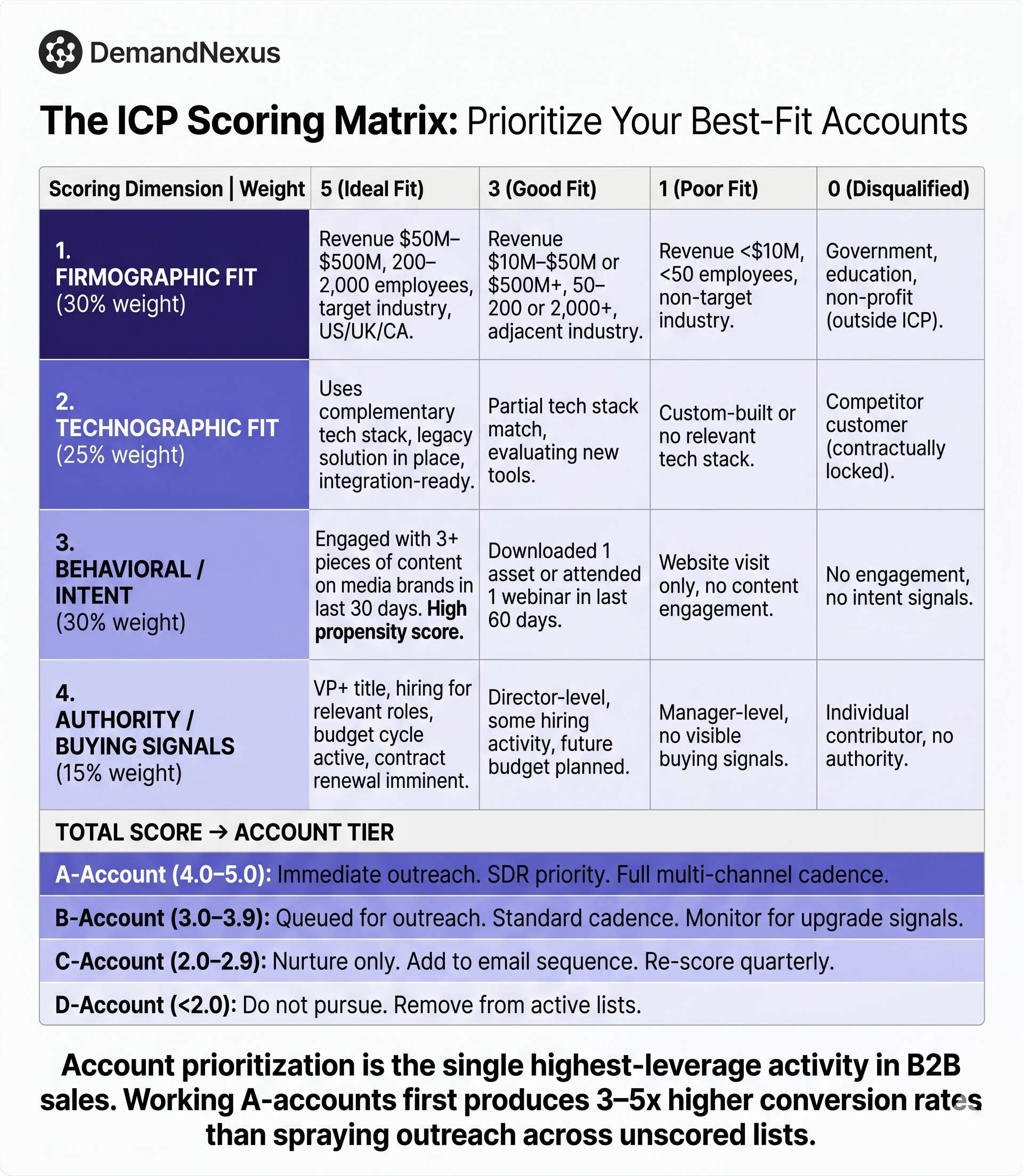
Every high-performing B2B prospecting program starts with a precise ideal customer profile. Without it, prospecting is essentially random outreach at scale — you reach a lot of people, but the vast majority are not in a position to buy, and your response rates, qualification rates, and close rates all suffer.
An effective ICP for B2B prospecting defines the account across firmographic and behavioral dimensions:
- Firmographic: industry vertical, company size (employees and revenue), geography, tech stack, organizational structure, funding stage
- Behavioral: recent funding events, hiring signals in relevant roles, technology adoption patterns, content consumption on industry media, competitive displacement indicators
- Buying committee: which titles hold budget authority, who influences the decision, who is the likely champion, what procurement process looks like for companies of this size
Once your ICP is defined, you build a prioritized target account list — sorting accounts by intent signal strength, estimated deal size, and proximity to a buying window. Accounts showing active research behavior on relevant topics (a first-party intent signal) should be contacted immediately; accounts that match ICP criteria but show no active signals enter a longer-cycle nurture sequence.
Intent-Driven Prospecting: Why First-Party Signals Outperform Lists
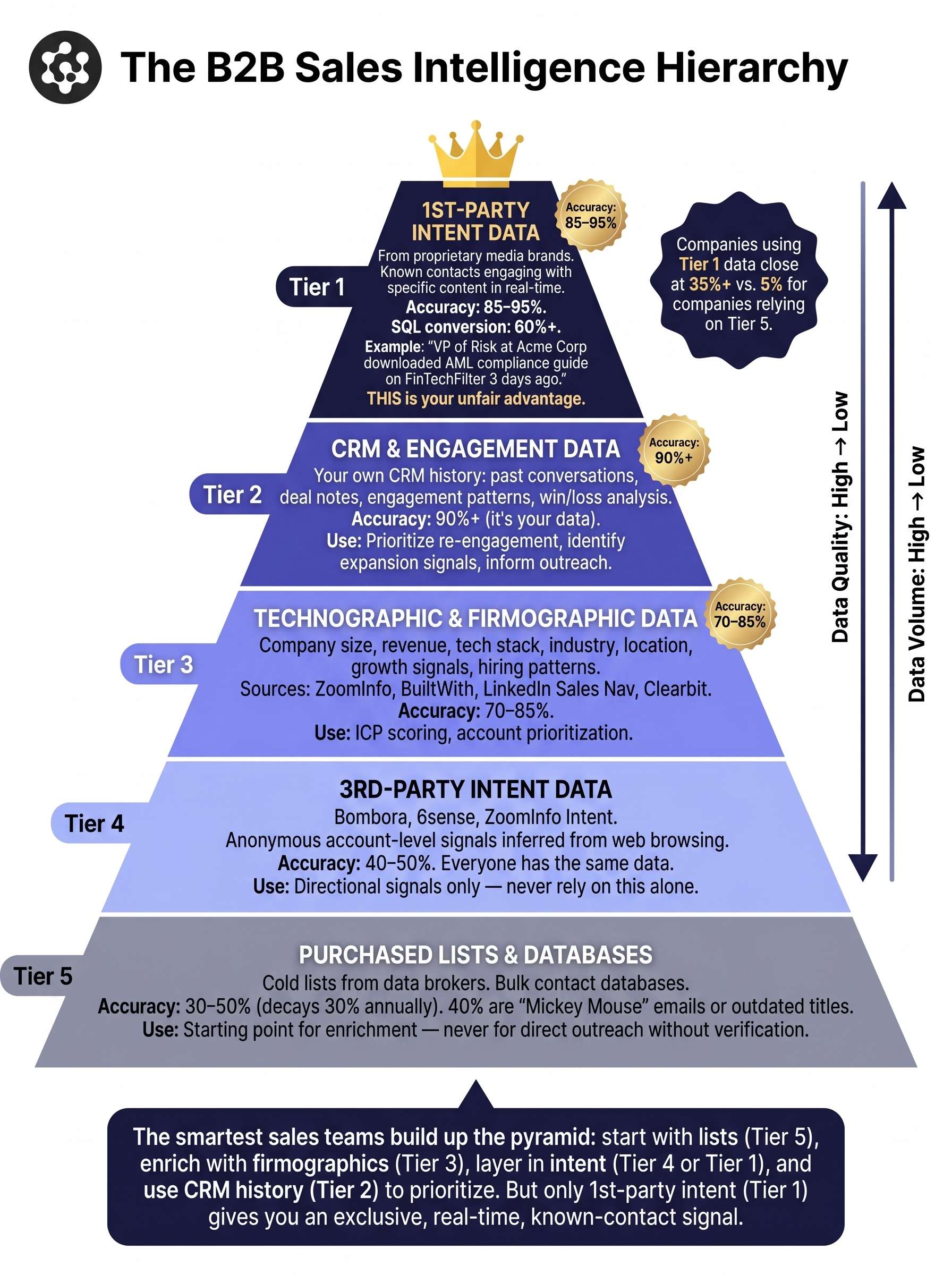
The most significant evolution in B2B prospecting over the past three years is the shift from list-based outreach to intent-driven outreach. The difference is fundamental: list-based prospecting treats all ICP-fit companies as equally worth contacting; intent-driven prospecting prioritizes companies whose decision-makers are actively researching solutions right now.
This is where intent-based marketing becomes directly relevant to the prospecting motion. First-party intent data — signals collected from your own properties and owned media — tells you who engaged, what they engaged with, and when. When a named VP of Operations at a target account downloads a whitepaper about process automation on a media brand you own or partner with, that is not an anonymous signal. It is a specific person, at a specific company, demonstrating active interest in a specific problem — at exactly the moment when outreach is most likely to land.
First-party intent signals consistently outperform third-party data for prospecting because:
- They identify named individuals, not anonymous IP-level company activity
- They capture real-time engagement, not weekly data aggregation
- They are proprietary — competitors cannot access the same signals
- They provide conversation context — SDRs can reference what the prospect actually read or attended
DemandNexus generates first-party intent data through six owned B2B media brands — AITechTrend, MarTechTrend, HRTechTrend, FinTechFilter, LegalTechTrend, and DevTechTrend — reaching 15M+ decision-makers. When a contact in your ICP engages with content on these properties, that signal feeds directly into the prospecting sequence.
B2B Prospecting Strategies That Fill Pipeline in 2025
Effective B2B prospecting is multi-channel and sequenced — not a single email blast or a cold call list. Here are the prospecting strategies that produce qualified pipeline at scale, and how they fit into a broader demand generation content and outreach system.
1. Intent-Triggered Outbound Sequencing
The highest-converting prospecting approach: monitor first-party intent signals and initiate outreach within 24 hours of the signal, referencing the specific content the prospect engaged with. Because the outreach is contextually relevant — you are calling about something the prospect was literally just reading — response rates run 3–5x higher than cold outreach with no context.
A standard intent-triggered sequence runs 8–12 touches over 4–6 weeks across email, LinkedIn, and phone. Each touch builds on the previous one: reference the content signal, establish relevance, ask a discovery question, and escalate toward a BANT qualification call.
2. Multi-Channel Cold Outreach
For ICP-fit accounts that have not yet shown intent signals, structured multi-channel cold outreach remains highly effective when personalized at the account level — not just the persona level. The sequence combines:
- Email: personalized opening hook referencing the account’s specific situation (recent news, tech stack, growth signals), one clear value proposition, one low-friction CTA
- LinkedIn: connection request with a brief context note, followed by a direct message if connected
- Phone: 15-30 second opening that references why you are calling this specific person at this specific company — not a generic pitch
The goal of multi-channel outreach at this stage is not to pitch — it is to earn a 15-minute qualification conversation where you can verify BANT criteria and determine whether a deeper meeting is warranted.
3. Account-Based Prospecting for High-Value Targets
For your highest-priority accounts — typically those with 5–10x your average deal size — prospecting should be account-based rather than persona-based. This means researching the specific account’s organizational structure, current initiatives, and buying committee before a single outreach touch is sent. It means engaging multiple stakeholders simultaneously rather than sequentially. And it means coordinating prospecting with marketing touchpoints — content, events, targeted advertising — so the account sees your brand from multiple directions before the SDR call arrives. This approach is the outbound execution layer of a demand generation vs. ABM framework — where ABM’s account-level precision is applied to the prospecting motion.
4. Content-Led Inbound Prospecting
A strong B2B content marketing strategy generates inbound prospecting opportunities by attracting ICP-fit decision-makers who are actively researching solutions. When a target-profile visitor lands on your pricing page, downloads a gated asset, or requests a demo, they have self-identified as a potential buyer. The prospecting motion here is speed: respond within the hour, qualify on the first call, and move to BANT verification before the research window closes.
5. Referral and Customer Expansion Prospecting
Existing customers who achieved clear ROI are your highest-conversion prospecting source. A structured referral program — asking satisfied customers to introduce you to peers at similar companies — consistently produces 2–3x higher close rates than cold outreach because trust is pre-established. Customer expansion prospecting (selling into new divisions or business units within existing accounts) has even higher conversion because you have account-level intelligence and relationship history.
What Do B2B Prospecting Services Actually Deliver?
B2B prospecting services and B2B sales prospecting services cover a spectrum of capabilities — from list-building and data enrichment to full-cycle SDR execution that delivers BANT-verified appointments. Understanding what you are buying matters enormously, because the difference between a list vendor and a qualified appointment provider is the difference between paying for activity and paying for pipeline.
| Service Type | What You Get | The Problem |
|---|---|---|
| List providers | Contact databases with ICP filters | You still need outreach, sequencing, qualification — and the data is often stale |
| Lead generation vendors | MQLs based on engagement scoring | 87% of MQLs fail to convert; you bear all qualification risk |
| SDR-as-a-service (activity-based) | Outreach volume, meetings attempted | Meetings booked without BANT verification — AEs still waste time re-qualifying |
| BANT-qualified appointment services | Meetings where budget, authority, need, timeline are confirmed before booking | Higher cost per meeting — but 95%+ convert to real opportunities |
The economics of BANT-qualified appointment services are straightforward when you factor in AE time. A traditional lead model might deliver 400 MQLs at $125 each ($50,000), of which 13% become SQLs (52 SQLs), of which 25% close (13 deals). Your cost per closed deal is $3,846, and your AEs spent 600 hours on that pipeline. A BANT-qualified appointment model might deliver 40 appointments at $500 each ($20,000), of which 95%+ become SQLs, of which 35% close (13 deals). Same deal count, 60% lower cost per closed deal, 80% less AE time. For the full ROI breakdown, see demand generation metrics and how DemandNexus measures pipeline performance.
How DemandNexus Delivers B2B Prospecting Services: The Waterfall Model
DemandNexus’s B2B prospecting service is built around the Waterfall Model — a multi-stage qualification process that starts with first-party intent signals and ends with BANT-verified appointments on your AE’s calendar. It is the practical implementation of a complete B2B demand generation system applied specifically to outbound prospecting.
Stage 1: Intent Signal Identification
Known decision-makers engaging with DemandNexus’s owned media properties are flagged as active intent signals. Every signal is tied to a named individual — their name, title, company, and the specific topic they engaged with — in real time. No anonymous IP guesswork.
Stage 2: ICP Filtering and Account Prioritization
Signals are filtered against your defined ICP criteria. Accounts matching on firmographics and showing active intent are prioritized for immediate outreach. This is where ideal customer profile precision directly determines prospecting efficiency — the tighter the ICP, the higher the conversion at every downstream stage.
Stage 3: Multi-Channel Outreach by Dedicated Pod
An 8-person Instant Pod — comprising a list builder, copywriter, team lead, and five SDRs — executes personalized multi-channel outreach for each prioritized account. Opening messages reference the specific content or event the prospect engaged with, creating immediate relevance rather than a cold approach.
Stage 4: BANT Verification via Live Discovery Call
SDRs conduct structured 15-20 minute discovery calls with every engaged prospect, confirming Budget (allocated or approved funds), Authority (decision-making role or influence), Need (active, urgent business problem), and Timeline (defined decision window) before any meeting is booked. Prospects who do not meet all four criteria are not passed to sales.
Stage 5: AHO-Backed Appointment Delivery
Every BANT-qualified meeting is accompanied by an Appointment Handover Sheet (AHO) — a structured pre-meeting briefing document that gives your AE full intelligence on the prospect’s pain points, decision-making structure, budget status, competitive context, and stated objectives. AEs walk in prepared to present solutions, not run generic discovery.
Stage 6: Zero-Risk Billing
DemandNexus only charges for meetings that are held, meet your BANT criteria, and show up on your calendar. No-shows are replaced within five business days at no charge.
B2B Prospecting Metrics: What to Track
Prospecting performance should be measured on outcomes, not activity. The B2B marketing metrics that matter most for a prospecting program are:
| Metric | What It Measures | Target Benchmark |
|---|---|---|
| Contact-to-meeting rate | % of prospected contacts who book a meeting | Intent-triggered: 15-25%; cold: 3-8% |
| BANT qualification rate | % of meetings where all four BANT criteria are confirmed | Target: 60-70% of discovery calls result in qualified handoff |
| Cost per BANT-qualified meeting | Total prospecting spend / qualified appointments | $400-$500 via pay-for-performance model |
| Appointment-to-opportunity rate | % of qualified meetings that become real pipeline opportunities | 95%+ for BANT-verified; 13% for MQL-based |
| AE close rate on qualified meetings | % of BANT-verified appointments resulting in closed deals | Target: 35%+ |
| Cost per closed deal | Total spend / new customers acquired from prospecting | Target: under $1,500; traditional model: $3,750+ |
For a complete view of how these metrics fit into the full revenue reporting stack, see the B2B marketing pipeline measurement framework.
B2B Prospecting for SaaS: Specific Considerations
B2B prospecting for SaaS companies has unique characteristics that affect strategy, metrics, and qualification criteria. SaaS demand generation typically involves longer sales cycles, multiple stakeholders, technical evaluation stages, and competitive shortlisting processes. This makes the quality of initial prospecting especially consequential — a poorly qualified initial meeting can consume 8–12 hours of AE, SE, and legal time before the misfit becomes obvious.
Key prospecting adaptations for B2B SaaS:
- Buying committee depth: SaaS enterprise deals involve an average of 7+ stakeholders. Prospecting should target multiple contacts at the account simultaneously, not just the most accessible title.
- Technical qualification: BANT for SaaS should include technical fit criteria — existing integrations, data residency requirements, security standards — to avoid late-stage disqualification after significant investment.
- Use-case specificity: Generic SaaS prospecting underperforms because buyers receive hundreds of outreach messages from similar-sounding platforms. Prospecting that references a specific operational problem, a recent company event, or a named competitor integration converts significantly better.
- Timing around renewal windows: For competitive displacement, the optimal prospecting window is 60-90 days before a target company’s current vendor contract renewal. This requires systematic tracking of contract timing for target accounts — a core capability of a professional B2B prospecting service.
B2B Prospecting for International Expansion
Organizations pursuing B2B international business expansion face specific prospecting challenges: different buying cultures, unfamiliar decision-making hierarchies, varying regulatory environments, and the difficulty of building brand recognition in markets where you have no existing presence.
Effective international B2B prospecting requires:
- Market-specific ICP refinement — your domestic ICP may not translate directly; qualification criteria and account selection need to be adapted for each target market
- Local intent data — partnering with media properties that have established audiences in the target market provides the same first-party intent advantage domestically, applied to new geographies
- Cultural messaging adaptation — prospecting sequences that perform in the US require rewriting for EMEA or APAC markets; formal register, meeting context, and value framing differ significantly
- Regulatory compliance — GDPR in Europe, PDPA in Southeast Asia, and CASL in Canada impose specific constraints on outbound prospecting that must be built into the outreach process
Ready to transform your prospecting approach? Demand Nexus specializes in BANT-qualified appointment generation for B2B technology companies. Our Pay-for-Performance Appointment model means you only pay for meetings that meet your qualification criteria—with zero risk for no-shows. Contact us at sales@demandnexus.io to start filling your pipeline with appointments that actually convert.
FAQs
What is B2B prospecting?
B2B prospecting is the systematic process of identifying, researching, and initiating contact with organizations and decision-makers who fit your ideal customer profile and are likely to have a genuine need for your solution. It encompasses both outbound tactics (cold email, LinkedIn outreach, phone) and inbound qualification (responding to inbound signals with rapid BANT verification). The output of effective B2B prospecting is not a list of leads — it is a calendar of qualified appointments with buyers who have confirmed budget, authority, need, and timeline.
What are B2B prospecting services?
B2B prospecting services are outsourced programs that handle the identification, outreach, and qualification of target accounts on behalf of a company's sales team. They range from list-building and data enrichment to full-cycle SDR-as-a-service programs that deliver BANT-qualified appointments directly to AE calendars. The most effective B2B sales prospecting services are structured around pay-for-performance models — where you pay per qualified meeting that shows up, not per contact or per MQL — because this aligns the vendor's incentives with your revenue outcomes. See DemandNexus's complete B2B demand generation guide for how prospecting services fit within a broader revenue system.
How is B2B prospecting different from B2B lead generation?
Lead generation typically refers to attracting contacts and capturing their information through inbound marketing — content downloads, form fills, webinar registrations. Prospecting is proactive: you identify specific companies and decision-makers, research their situation, and initiate contact. The critical difference is qualification: prospecting includes a human-led BANT verification step that confirms buying readiness before a meeting is booked. Lead generation delivers contacts; prospecting delivers qualified sales conversations.
What is BANT qualification in B2B prospecting?
BANT qualification is a structured verification process conducted by an SDR during a live discovery call before any sales meeting is scheduled. The SDR confirms: Budget (the prospect has allocated or approved funds for this type of solution), Authority (the contact has decision-making or significant purchasing influence), Need (there is an active, urgent business problem this solution addresses), and Timeline (the prospect has a defined window for evaluating and deciding). All four criteria must be confirmed before a meeting is booked.
How do you measure B2B prospecting performance?
The primary B2B prospecting metrics are: contact-to-meeting rate (% of prospected contacts who book a call), BANT qualification rate (% of discovery calls resulting in a qualified handoff), cost per BANT-qualified meeting, appointment-to-opportunity conversion rate, AE close rate on qualified meetings, and cost per closed deal. Activity metrics — emails sent, calls made, connection requests — are leading indicators useful for diagnosing operational problems, but they are not success metrics. For the complete metrics framework, see the B2B marketing metrics guide.
What is the role of intent data in B2B prospecting?
Intent data identifies companies and individuals who are actively researching solutions in your category right now — before they contact you. First-party intent data (from your own properties and owned media) is the most valuable because it identifies named individuals, is real-time, and is proprietary. When a known decision-maker at a target account engages with relevant content on a media property you own or partner with, initiating outreach within 24 hours — referencing what they read — produces response rates 3–5x higher than cold outreach. This is the practical application of intent-based marketing to the prospecting motion.
How does B2B prospecting fit within a demand generation framework?
B2B prospecting is the execution layer of a demand generation framework — it is where awareness and intent signals are converted into qualified sales conversations. Demand generation creates the conditions (brand recognition, content authority, intent signals) that make prospecting outreach land with relevance; prospecting converts those conditions into confirmed meetings. The two functions are most effective when integrated: a demand generation program that does not connect to a rigorous prospecting and qualification process produces traffic and MQLs but not pipeline.