
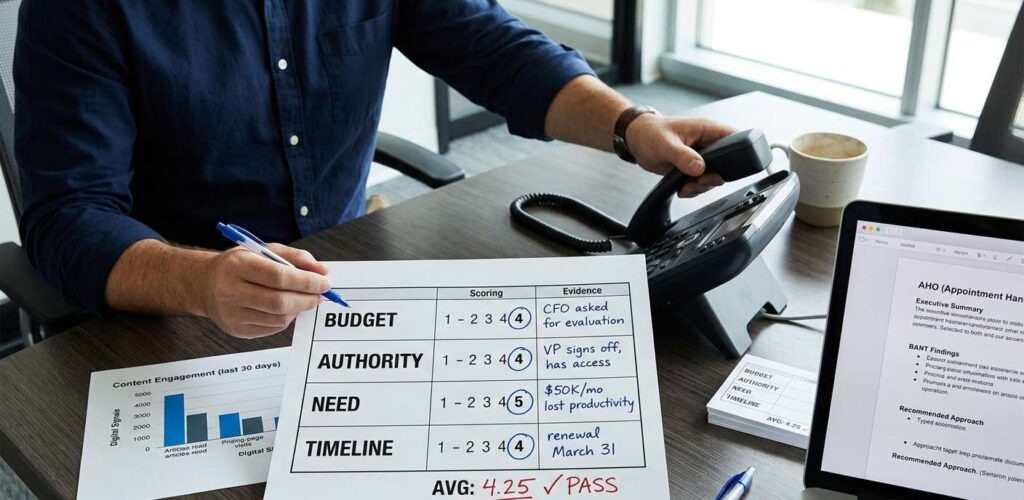


If you manage a B2B sales pipeline, you already know the problem: too many meetings with prospects who were never going to buy. BANT exists to solve that problem—but only if you use it as a verification system rather than a checkbox exercise.

Most B2B teams lose 40–60% of qualified prospects to broken handoffs and weak qualification. Take our 2-minute diagnostic to find out where your pipeline is bleeding — and how to fix it.
Start the Quiz → Takes 2 minutes. No email required to start.This guide breaks down how BANT works in practice, where it falls short, and how modern B2B teams are upgrading the framework with intent data and structured handover processes to achieve measurable pipeline KPIs that actually move revenue.
Where BANT Came From: A Brief History
IBM developed the BANT framework in the 1960s as a standardized method for its massive field sales organization to qualify enterprise prospects. At the time, IBM’s sales reps were among the most expensive in the industry, and the company needed a repeatable way to ensure those reps only spent time on opportunities with a realistic chance of closing.
The logic was simple: if a prospect has the Budget to afford the solution, the Authority to sign the contract, an acknowledged Need for the product, and a Timeline for implementation, then the opportunity is worth pursuing. If any of those four elements is missing, the opportunity is either premature or unqualified.

Over six decades later, BANT has survived every major shift in B2B sales—from solution selling to challenger methodology, from field sales to inside sales, from manual prospecting to AI-powered automation. The reason is straightforward: the four questions BANT asks are still the right questions. The controversy is about how and when you ask them.
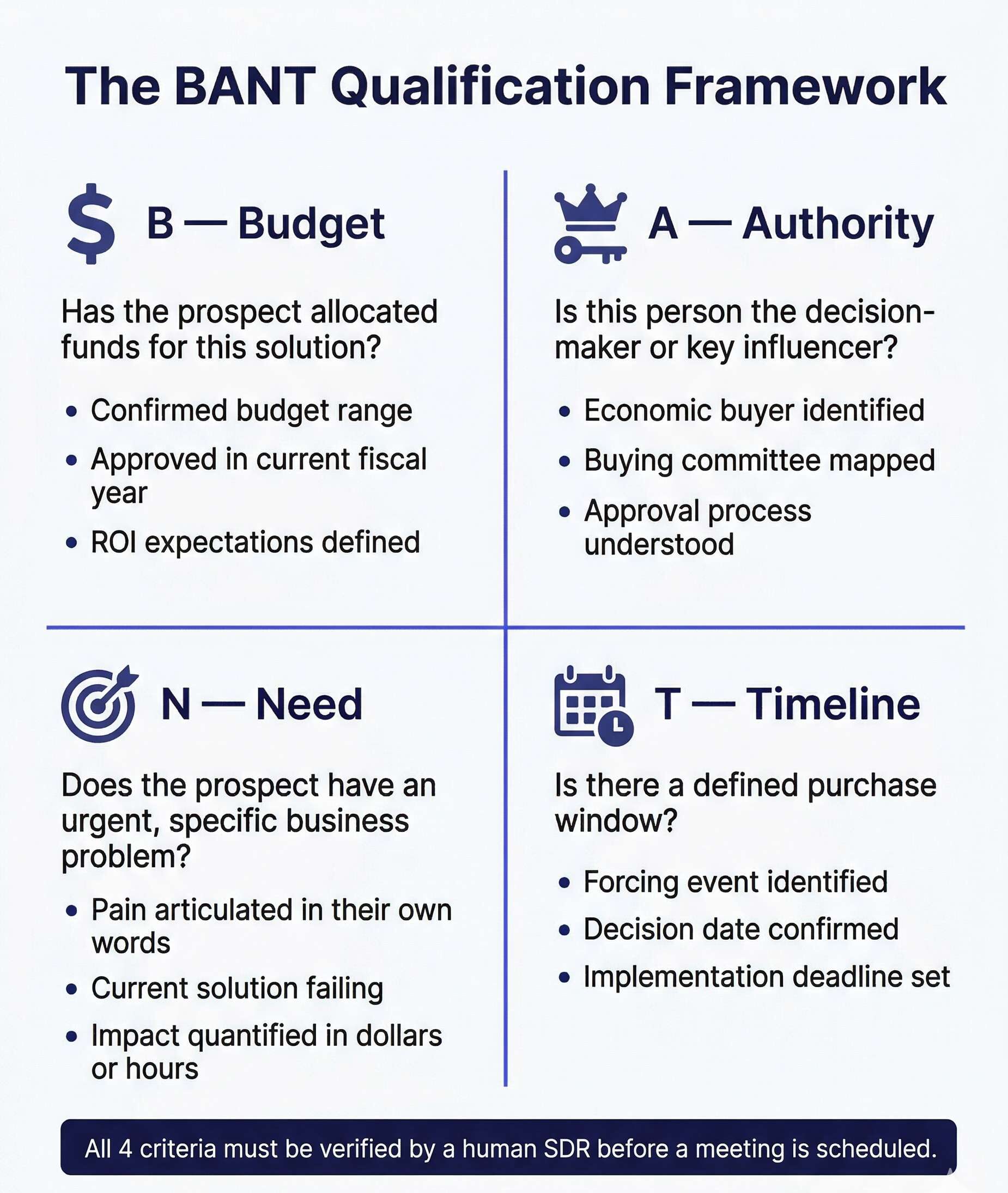

The Four BANT Pillars: What Each Actually Means in 2026
B — Budget
Budget qualification is not about asking “What’s your budget?” in the first five minutes of a call. In 2026, budget qualification means understanding three things: whether funding has been allocated, what the approval process looks like, and whether the prospect has a path to secure budget if it hasn’t been formally approved yet.
The best qualification conversations uncover budget signals indirectly. When a prospect says “We’ve been looking at this for two quarters” or “Our CFO asked me to evaluate options,” those are stronger budget indicators than a specific dollar figure. Conversely, “We’re just doing some preliminary research” is a signal that budget may not exist.
A useful scoring approach: rate budget on a 1–5 scale where 5 means budget is allocated and approved, 4 means budget is securable within 30–60 days, 3 means budget is possible within 90 days, 2 means budget may exist in six months, and 1 means there is no budget or clear path to one.
A — Authority
Authority in B2B is rarely binary. The question is not just “Are you the decision-maker?” but “Who else needs to be involved, and what does the approval process look like?”
Modern B2B purchasing involves an average of six to ten stakeholders. Authority qualification means mapping the buying committee: identifying the economic buyer (who controls the budget), the technical evaluator (who assesses fit), the champion (who advocates internally), and any blockers (legal, procurement, IT security). The ideal scenario is direct access to the economic buyer with a champion driving the process forward.
When a prospect says “I make the recommendation and my VP signs off,” that’s still qualified—as long as you can verify access to the VP. When they say “I’m doing research for my manager,” that’s a flag. The prospect may be an influencer, but without a path to the actual buyer, the opportunity is at risk.
N — Need
Need qualification goes beyond “Do they need our product?” It asks: Is there a specific, acknowledged pain that your solution addresses, and is that pain significant enough to justify action?
The strongest need signals are quantified impact statements: “We’re losing three to four deals per month because our contract cycle takes eight weeks” or “Our current tool is costing us $50,000 a month in lost productivity.” These statements indicate that the prospect has already calculated the cost of inaction—which means they’re further along in the buying process than someone who says “We’re interested in exploring options.”
Need also connects directly to your ICP scoring criteria. If the prospect’s firmographics match your ideal customer profile and they’re expressing specific pain points your solution addresses, the need qualification is strong.
T — Timeline
Timeline is the most frequently underqualified BANT element. Sales teams often accept vague answers like “sometime this year” or “when we’re ready” as valid timeline confirmation. They are not.
Strong timeline indicators include: a specific contract renewal date (“Our current vendor’s contract expires March 31”), a business event (“We’re launching in three new markets in Q2”), board or investor pressure (“Our board mandated we fix this by year-end”), or regulatory deadlines. These forcing events create urgency that survives internal delays and competing priorities.
The qualification standard should be a buying decision within one to six months, with a specific forcing event driving the timeline. Without a forcing event, timelines tend to slip—and opportunities that slip indefinitely are opportunities that were never real.
Not sure if your current pipeline is leaking revenue? Take the free DemandNexus Pipeline Assessment Quiz to find out.
BANT Scoring: How to Quantify Qualification and Remove Subjectivity
One of the biggest problems with BANT as traditionally practiced is subjectivity. When SDRs are under quota pressure, “Yeah, they have budget” becomes a checkbox to hit numbers, not a verified data point. The fix is a structured scoring system.
Score each BANT element on a 1–5 scale. A score of 5 represents an ideal state (budget allocated, economic buyer, critical pain, decision within 30 days). A score of 1 represents a disqualification signal (no budget, no authority, no pain, no timeline). Set a minimum threshold—most high-performing teams require a 4.0 average across all four elements before an opportunity is passed to an AE.
This scoring approach transforms BANT from a subjective gut feeling into a data-driven filter. It also creates a feedback loop: if AEs consistently report that meetings with a 3.5 average score waste their time but meetings with a 4.5 average convert, you can adjust the threshold with real data backing the decision.
When you combine BANT scoring with pipeline velocity metrics, you can trace the quality of qualification all the way through to closed revenue—which is the only metric that ultimately matters.
Is BANT Still Relevant in 2026? The Case For and Against
The Critiques
BANT’s critics have legitimate points. The framework was designed for a simpler buying environment: fewer stakeholders, shorter evaluation cycles, and more direct access to decision-makers. In 2026, B2B purchases involve larger buying committees, longer research phases that happen before any vendor contact, and procurement processes that can derail otherwise qualified opportunities.
Some argue that BANT is too rigid—that asking about budget early can feel transactional, or that need qualification should happen through discovery rather than a checklist. Others point to MEDDIC (Metrics, Economic Buyer, Decision Criteria, Decision Process, Identify Pain, Champion) as a more comprehensive framework that accounts for the complexity of enterprise sales.
Why BANT Still Works
The counterargument is that BANT’s simplicity is its strength. MEDDIC is powerful but heavy—it requires significant training and is difficult to enforce consistently across a team. BANT’s four questions are intuitive, scalable, and—critically—verifiable by a third party.
The real issue was never the framework itself. It was how teams applied it. When BANT is treated as a checkbox exercise (ask the questions, accept whatever answer you get, move on), it produces garbage. When BANT is treated as a verification system—where each element is probed, scored, documented, and validated—it remains one of the most effective qualification methods in B2B.
The difference between BANT-as-checkbox and BANT-as-verification is the difference between an industry-standard 13% MQL-to-SQL conversion rate and a 60%+ SQL conversion rate that teams using verified qualification frameworks consistently achieve.
BANT vs. MEDDIC: When to Use Each
BANT and MEDDIC are not competing frameworks—they operate at different stages of the sales process. BANT is an initial qualification filter: does this prospect meet the minimum criteria to warrant an AE’s time? MEDDIC is a deal execution framework: once an opportunity is in the pipeline, how do you navigate the buying process to close it?
The most effective B2B sales organizations use BANT (or a BANT-derived model) at the top of the funnel to ensure only qualified opportunities enter the sales pipeline, and then use MEDDIC or a similar framework to manage those opportunities through to close. Trying to run MEDDIC at the SDR stage is impractical—SDRs don’t have the context or access to verify all MEDDIC elements. Trying to run BANT without a deeper framework downstream is insufficient for complex enterprise deals.
Beyond BANT: How the Waterfall Model Adds Verification and Intent
The biggest limitation of traditional BANT is that it relies entirely on what the prospect tells you. Prospects exaggerate budget, overstate authority, and provide optimistic timelines. The framework doesn’t account for intent signals that exist outside the conversation—signals that can confirm or contradict what a prospect claims.
The Waterfall qualification model, used by demand generation firms like DemandNexus, addresses this gap by adding two layers on top of BANT:
First-party intent data as a pre-qualification layer. Before an SDR ever contacts a prospect, behavioral signals from content consumption—which topics they’re researching, how often, and how recently—provide an independent confirmation of need and timeline. When a VP of Sales at a SaaS company reads three articles about pipeline optimization in two weeks, that behavioral signal corroborates any need or timeline claims they make on a qualification call.
DemandNexus generates these signals from six owned B2B media brands—AITechTrend, MarTechTrend, HRTechTrend, FinTechFilter, LegalTechTrend, and DevTechTrend—reaching over 15 million decision-makers monthly. This first-party data is not bought from a third-party aggregator; it comes from audiences the company has built direct relationships with.
Human-verified BANT documentation delivered as a structured handover. The second upgrade is the Appointment Handover Sheet (AHO)—a structured document that captures the SDR’s BANT findings, verbatim prospect quotes, competitor intelligence, objections raised, and a recommended approach for the AE. The AHO is delivered 24–48 hours before every meeting, so the AE walks in prepared rather than starting from zero.
The combination of intent-verified targeting and documented BANT produces results that traditional qualification cannot match: 90%+ meeting show rates and 60%+ SQL conversion rates, compared to the industry median of roughly 13% for standard MQL-to-SQL handoffs.
Ready to see BANT-verified, AHO-backed appointments on your calendar? Book a strategy call with DemandNexus.
BANT Scorecard Template: A Framework You Can Copy
Below is a simplified BANT scorecard structure you can adapt for your team. Score each element 1–5, require a minimum average of 4.0, and document the evidence for each score.
Budget (1–5): Is funding allocated? What is the budget range? Who controls it? Evidence: [verbatim quote or supporting data].
Authority (1–5): Is the prospect the economic buyer? If not, who is, and do we have access? Evidence: [decision process description].
Need (1–5): What is the specific pain? What is the quantified impact of not solving it? Evidence: [verbatim quote, ideally with dollar or time impact].
Timeline (1–5): When does the prospect need this implemented? What forcing event drives the deadline? Evidence: [contract renewal date, board mandate, etc.].
Overall Score: [Average of B+A+N+T] — Pass threshold: 4.0+
For teams that want to go deeper, layer ICP scoring criteria on top of the BANT scorecard to create a composite qualification score that accounts for both fit and readiness.
How to Implement BANT Across Your Sales Team
BANT only works if it is applied consistently. Here is a practical implementation sequence:
- Define your BANT thresholds before you train. Decide what a 3, 4, and 5 look like for each element in your specific context. A 5 on Budget for a $10K ACV product is different from a 5 on Budget for a $500K enterprise deal. Write these definitions down and distribute them.
- Train SDRs on probing, not just asking. The difference between a checkbox BANT call and a verification BANT call is the follow-up questions. Train SDRs to ask “What’s driving that timeline?” not just “When do you need this?” Train them to ask “Who else needs to be involved?” not just “Are you the decision-maker?”
- Require documentation. Every qualified opportunity should have written BANT scores and supporting evidence before it’s passed to an AE. If the SDR can’t document the evidence, the qualification isn’t verified—it’s assumed.
- Create an AE feedback loop. After every meeting, the AE rates the qualification quality. This data feeds back into SDR coaching, threshold adjustments, and process improvements. Without the feedback loop, qualification standards decay over time.
- Audit regularly. Random call audits (10% of qualification calls reviewed by a peer or manager) catch qualification drift before it becomes a pattern. Sales coaching programs that include regular BANT audits outperform those that rely on self-reporting.
Key Takeaways
BANT is not outdated—it is under-applied. The framework’s four questions (Budget, Authority, Need, Timeline) are still the right questions for initial qualification. The failure mode is treating BANT as a checkbox rather than a verification system.
Modern BANT implementations layer first-party intent data as a pre-qualification filter, score each element on a structured scale, document findings in a standardized handover format, and create a feedback loop between AEs and SDRs to continuously improve qualification accuracy.
The result, when done correctly, is a sales pipeline that converts at rates dramatically above industry medians—not because the framework is magic, but because verified qualification eliminates the waste that plagues most B2B pipelines.
Calculate what verified pipeline would be worth to your team with the DemandNexus ROI Calculator.
FAQs
What does BANT stand for in sales?
BANT stands for Budget, Authority, Need, and Timeline. It is a sales qualification framework originally developed by IBM in the 1960s to help sales teams determine whether a prospect is a viable buyer. Each element represents a critical qualification criterion that must be verified before advancing an opportunity through the pipeline.
Is BANT still relevant in 2026?
Yes. While B2B buying has become more complex with larger buying committees and longer research phases, BANT’s core questions remain the right initial qualification filter. Modern implementations upgrade BANT with intent data, structured scoring (1–5 per element), and documented handover processes. The framework’s simplicity and scalability make it more practical for SDR teams than heavier alternatives like MEDDIC at the top of the funnel.
What is the difference between BANT and MEDDIC?
BANT is an initial qualification framework that evaluates four criteria (Budget, Authority, Need, Timeline) to determine if a prospect merits an AE’s time. MEDDIC (Metrics, Economic Buyer, Decision Criteria, Decision Process, Identify Pain, Champion) is a deal execution framework used to navigate complex opportunities through the sales cycle. Most high-performing B2B teams use BANT for top-of-funnel qualification and MEDDIC for in-pipeline deal management.
How do you verify BANT criteria?
Effective BANT verification requires three layers: (1) probing questions during the qualification call that go beyond surface-level answers, (2) independent confirmation through intent data or behavioral signals that corroborate what the prospect claims, and (3) structured documentation—such as an Appointment Handover Sheet—that captures verbatim quotes, scores, and supporting evidence for each element.
What is the BANT qualification framework?
The BANT qualification framework is a structured method for evaluating whether a B2B prospect meets four minimum criteria before receiving a sales meeting: Budget (can they afford the solution?), Authority (can they make or influence the purchase decision?), Need (do they have a specific pain your product solves?), and Timeline (do they have a deadline or forcing event?). Prospects are typically scored 1–5 on each element, with a minimum average of 4.0 required to pass qualification.