



Introduction: Why Cold Calling Success Rates Have Split in Two
If you search for ‘average cold calling success rate,’ you will find numbers ranging from 1% to 50%—and both ends of that range are correct. The difference is not the industry or the script. It is the data behind the dial.
Traditional cold calling—calling purchased contact lists with no knowledge of whether the prospect has any interest in your solution—delivers a 2–3% success rate. That means 97 out of every 100 calls produce nothing. Intent-driven cold calling, where SDRs call prospects who have already demonstrated active research behavior, achieves 40–50% engagement rates on the same phone call.

Most B2B teams lose 40–60% of qualified prospects to broken handoffs and weak qualification. Take our 2-minute diagnostic to find out where your pipeline is bleeding — and how to fix it.
Start the Quiz → Takes 2 minutes. No email required to start.This guide breaks down every meaningful cold calling metric for B2B teams in 2026: what success actually means, the benchmarks that matter, why connect rates and conversion rates diverge so sharply, and the methodology behind the companies that consistently outperform.
What Is Cold Calling Success in 2026?
Cold calling success in 2026 is not measured in dials, talk time, or even conversations. It is measured in qualified appointments — scheduled meetings with decision-makers who have confirmed Budget, Authority, Need, and Timeline (BANT) before the call even takes place.
| “A conversation with someone who agrees to ‘learn more’ is not success. A scheduled meeting with a VP who has allocated Q2 budget, confirmed decision-making authority, an urgent problem, and a 90-day contract renewal deadline — that is success.” |
The Two Definitions Producing the Stat Gap
| Metric | Traditional Cold Calling | Intent-Driven Outreach |
| Data source | Purchased contact lists | First-party content engagement |
| Prospect awareness | Zero — brand unknown | High — prospect has engaged with your content |
| Opening line | “Hi, do you have 30 seconds?” | “Hi Jane, I saw you were researching AML automation on FinTechFilter…” |
| Hang-up rate | ~90% | <60% |
| Engagement rate | 2–3% | 40–50% |
| Meeting booking rate | 3–5% of dials | 15–20% of dials |
| BANT qualification | Rarely verified | Verified on every call |
| Show rate | ~60% | 85–90% |
B2B Cold Calling Statistics: The 2026 Benchmark Data
Cold Calling Success Rate Benchmarks
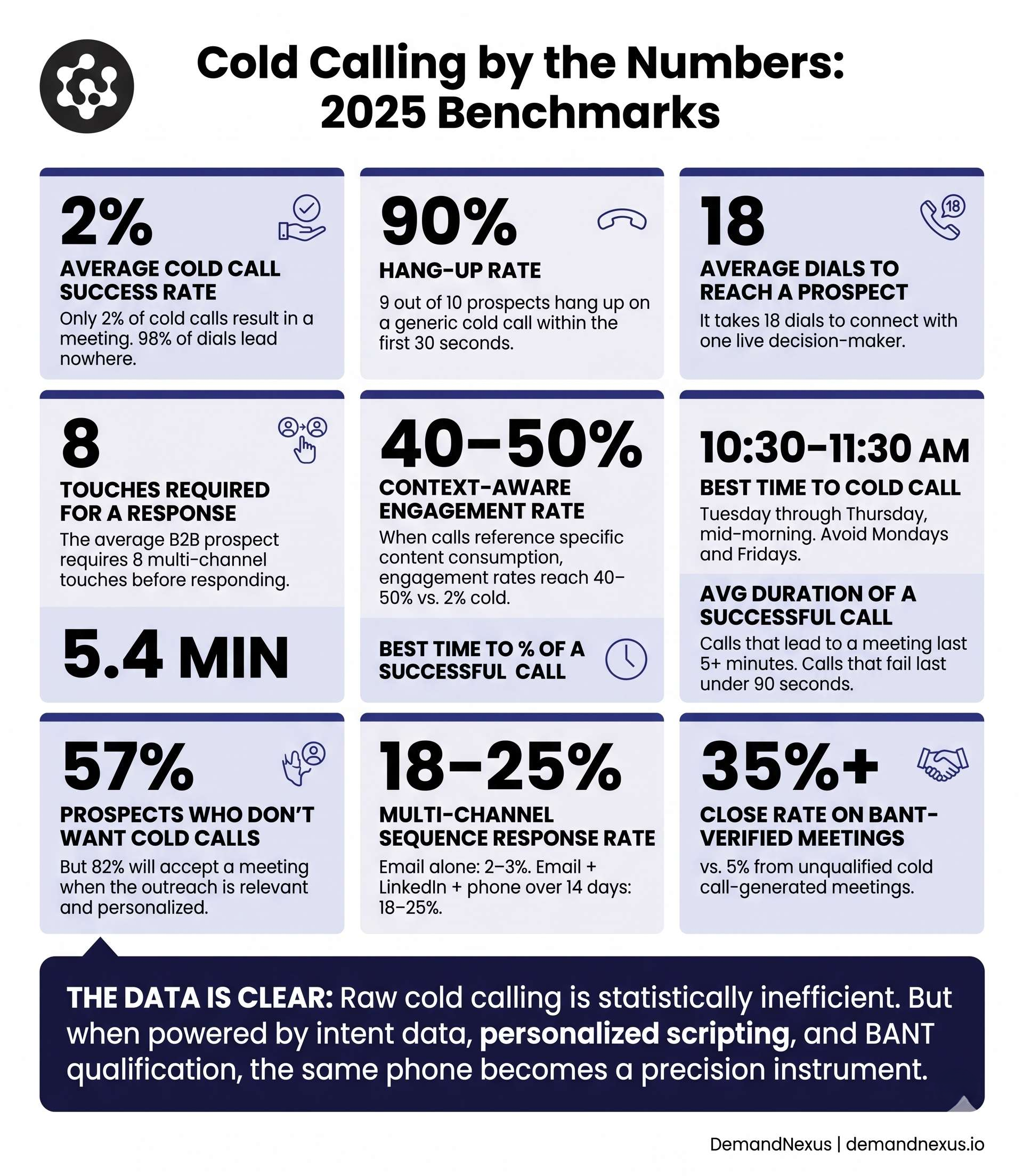
These are the benchmarks B2B sales teams should be measuring against in 2026:
| Metric | Industry Benchmark | Intent-Driven Benchmark |
| Metric | Industry Benchmark | Intent-Driven Benchmark |
| Average cold call success rate (lead generated) | 2.3% | N/A — qualified appointments, not leads |
| Cold call connect rate (prospect reached) | 15–20% (quality data) | 30–40% (first-party intent data) |
| Cold call conversion rate (call to meeting) | 3–5% | 15–20% |
| Cold call engagement rate (meaningful conversation) | 8–12% | 40–50% |
| Meeting show rate | 60–65% | 85–90% |
| Average dials to reach a prospect | 8 attempts | 4–5 attempts (intent signal = receptive timing) |
| C-level executives who prefer phone outreach | 57% | 57% |
| Sales cycles shortened by intent data | — | 30–40% |
Cold Calling Connect Rate: What the Data Shows
The cold call connect rate — the percentage of dials that result in a live conversation with a prospect — is the first bottleneck in any outbound program. Industry data shows:

- Average B2B cold call connect rate: 15–20% with verified, current contact data
- Connect rate with purchased lists (often 30%+ outdated): 8–12%
- Connect rate when calling within 24 hours of an intent signal: 30–40%
- Connect rate improvement when calling during optimal windows (10–11 AM, 4–5 PM local time): +20–30%
The connect rate gap between purchased lists and intent-signal-driven lists is not marginal. Stale data means disconnected numbers, wrong titles, and prospects who have left the company. First-party intent data, captured in real time, means you are calling someone who is active, reachable, and currently researching the problem you solve.
Cold Calling Conversion Rate: Calls to Meetings
The cold call conversion rate — calls that result in a booked meeting — is where the methodology gap becomes financially significant:
| Program Type | Dials/Week | Conversion Rate | Meetings/Week | Qualified? |
| Program Type | Dials/Week | Conversion Rate | Meetings/Week | Qualified? |
| Traditional volume dialing | 1,000 | 0.5–1% | 5–10 | Rarely |
| Quality data, no intent | 500 | 2–3% | 10–15 | Inconsistently |
| Intent-driven outreach | 200 | 15–20% | 30–40 | Yes — BANT verified |
The intent-driven model dials one-fifth as many prospects and books three to four times as many meetings — all of which are BANT-qualified before reaching your AE.
Why Cold Calling Success Rates Vary So Dramatically
The Data Quality Problem
Most cold calling fails before the first dial. Purchased lists in 2026 deliver, on average:
- 40% invalid or outdated contact information
- 30% prospects who have changed roles or companies
- Zero signal that any contact has any interest in your solution
Your SDRs spend hours dialing people who cannot be reached, do not match your ICP, or have zero awareness of why you are calling. The ‘2.3% success rate’ statistic is not a script problem or a timing problem. It is a data problem.
The Context Problem
Even with good contact data, calling without context produces the same result: the 90% hang-up. Here is why:
A traditional cold call opening — ‘Hi, do you have 30 seconds?’ — forces the prospect to answer a question before they have any reason to engage. The cognitive default is rejection.
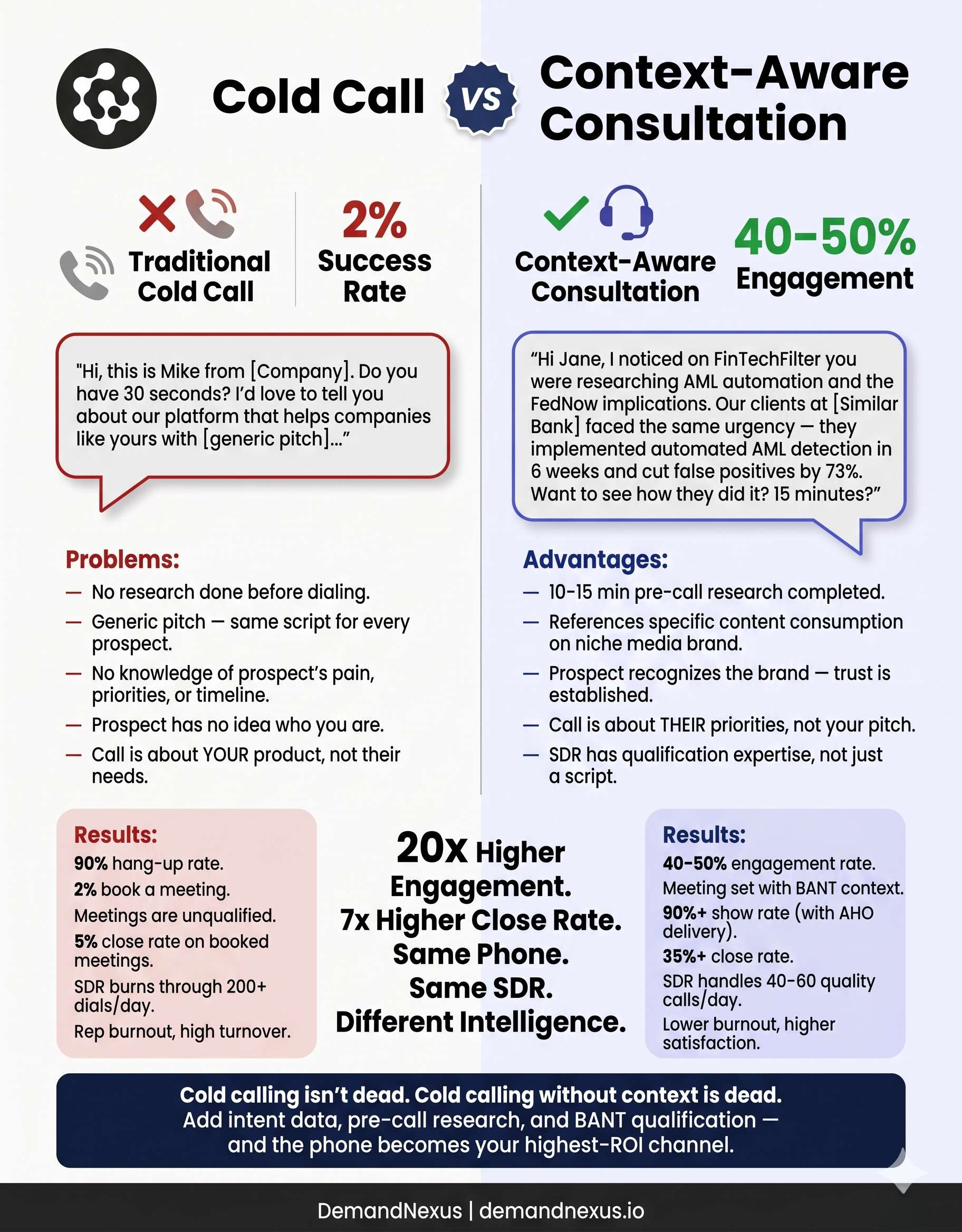
An intent-driven opening — ‘Hi Jane, I noticed you were researching AML automation and the FedNow implications on FinTechFilter. Our clients at similar banks faced the same urgency…’ — gives the prospect a reason to listen before they can decide to hang up. They recognize the brand. They recognize the topic. The call is about their priorities, not your pitch.
| Context-aware cold outreach achieves 40-50% engagement rates versus the 90% hang-up rate of traditional cold calls. The script is identical. The data is not. |
The Qualification Problem
The third reason success rates vary: most cold calling programs book meetings without verifying whether the prospect can actually buy. An SDR who books 20 meetings a month by pitching anyone who will listen is not adding pipeline. They are filling an AE’s calendar with tire-kickers.
BANT qualification on every call ensures that the meeting you book is worth your AE’s time:
- Budget: “Have you allocated budget for solving this problem this year?”
- Authority: “Who else needs to be involved in the decision?”
- Need: “Walk me through how this problem is affecting you operationally.”
- Timeline: “When do you need this in place? What is driving that date?”
A prospect who cannot answer these questions is not a sales opportunity. A prospect who answers all four is a qualified appointment — worth booking, worth preparing for, and worth your AE’s time.
How to Improve Cold Calling Success Rates in 2026
1. Replace Cold Lists with First-Party Intent Signals
The single highest-impact change you can make to your cold calling success rate is improving the quality of your contact data. Not purchased lists — first-party intent signals.
First-party intent data captures specific content a prospect has engaged with on properties you own or control. Instead of knowing ‘an anonymous IP from Acme Corp seems interested in AI,’ you know ‘Jane Doe, VP of Operations at Acme Corp, just read three articles about supply chain automation compliance.’
That specificity transforms your opening from a cold pitch into a context-aware consultation. It also means you are calling someone who is actively researching, not someone who may have vaguely visited a broad industry site six weeks ago.
2. Time Outreach to Intent Signal Decay
Intent signals decay quickly. A prospect who downloaded a whitepaper yesterday is far more receptive to your call than one who engaged three weeks ago. Best-practice cold calling programs respond to intent signals within 24–48 hours:
- Prospect engages with content → SDR notified in real time
- Copywriter crafts context-aware outreach referencing the specific content
- SDR calls within 24 hours with a personalized opening
- Follow-up sequence runs across email, LinkedIn, and phone for 14 days
This is not a cold call. It is a warm consultation with a prospect who already knows your brand and has demonstrated they are researching your category.
3. Implement BANT Qualification on Every Call
Booking a meeting is not the goal. Booking a qualified meeting is. BANT qualification ensures the meeting is with someone who can buy, not just someone who is curious.
What qualifies vs. what does not:
| BANT Element | Qualified Response | Disqualifying Response |
| BANT Element | Qualified Response | Disqualifying Response |
| Budget | “We have $150K allocated for Q1” | “I’d need to check with finance” |
| Authority | “I’m the VP — I make this call” | “I’d need to talk to my manager” |
| Need | “We’re spending 40 hours/month manually on this” | “We might need this eventually” |
| Timeline | “We need implementation by March 31” | “No specific timeline — just exploring” |
A prospect who gives disqualifying responses is not pipeline. BANT verification surfaces this before the AE wastes a 45-minute call discovering it.
4. Deliver Complete Intelligence to Your AE
The cold call is only as valuable as the intelligence that transfers to the Account Executive. A typical handoff — ‘I booked a meeting with Jane at Acme, she’s interested’ — leaves your AE walking in blind.
A best-practice handoff delivers an Appointment Handover Sheet (AHO) that includes:
- BANT verification score for each element (1–5)
- Verbatim quotes capturing the prospect’s pain in their own words
- Competitor intelligence gathered during the call
- Objections raised and how they were addressed
- Recommended opening approach for the AE
- The specific intent signals that initiated outreach
With this intelligence, the AE opens the meeting already inside the prospect’s context: ‘Jane, I understand you’re spending 40 hours per month on manual AML reporting, you have $150K allocated in Q1, and your FedNow deadline is April 1. Let me show you exactly how we’ve solved this for three banks in your peer group.’
That is not a pitch. It is a consultation. The close rate difference is measurable — from 5–10% on cold meetings to 30–35% on BANT-qualified, AHO-supported appointments.
5. Use Multi-Channel Sequences, Not Single Touches
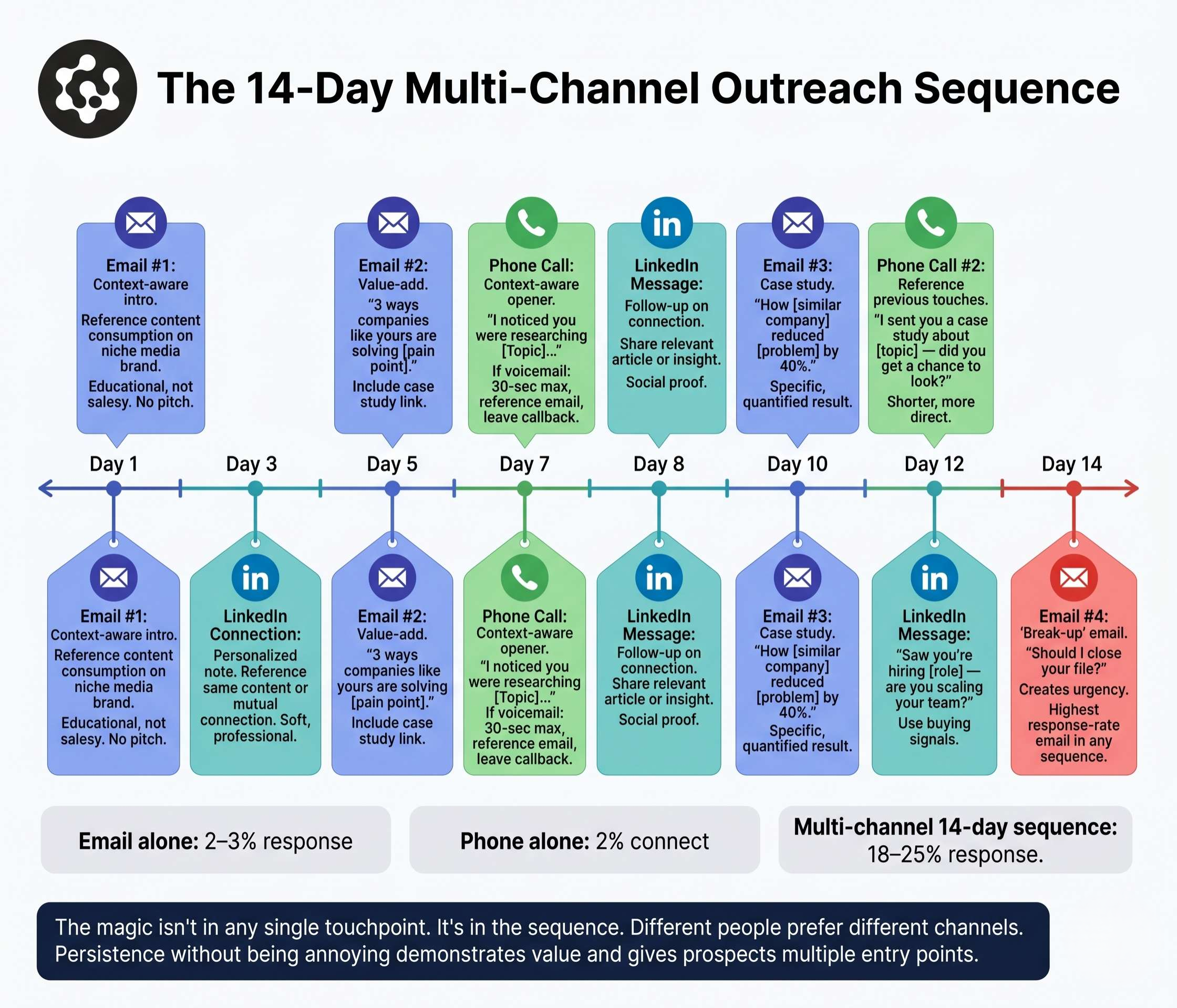
A single cold call rarely succeeds regardless of quality. Effective outbound programs combine multiple channels across 14–21 days:
| Day | Channel | Action |
| Day | Channel | Action |
| Day 1 | Intent-personalized message referencing specific content engagement | |
| Day 3 | Connection request with personalized note about content topic | |
| Day 5 | Follow-up with relevant case study or statistic | |
| Day 7 | Phone | Context-aware call referencing content and email engagement |
| Day 10 | Additional resource relevant to their research topic | |
| Day 14 | Phone + Email | Final outreach with clear value proposition and CTA |
Multi-channel sequences achieve 18–25% response rates compared to 2–3% for single-channel outreach. The prospect sees your brand across multiple touchpoints before the call, which is why the intent-driven opening converts — they recognize you.
Measuring Cold Calling Success: The Metrics That Matter
Outcome Metrics vs. Activity Metrics
Traditional cold calling programs measure activity: dials, talk time, voicemails left. Activity metrics reward volume. Outcome metrics reward quality.
| Metric | Benchmark (Standard) | Benchmark (Intent-Driven) | Why It Matters |
| Metric | Benchmark (Standard) | Benchmark (Intent-Driven) | Why It Matters |
| Connect rate | 15–20% | 30–40% | Measures data quality and targeting precision |
| Engagement rate | 8–12% | 40–50% | Measures opening quality and context relevance |
| BANT qualification rate | 15–25% | 30–40% | Measures call discovery quality |
| Meeting booking rate | 3–5% | 15–20% | Measures conversion from conversation to appointment |
| Meeting show rate | 60–65% | 85–90% | Measures prospect commitment and pre-meeting qualification |
| AE satisfaction score | 5–6/10 | 8+/10 | Measures appointment quality and intelligence handoff |
| SQL conversion from meeting | 25–35% | 85–90% | Measures downstream revenue impact |
The Financial Case: ROI Comparison
| Model | Monthly Investment | Qualified Meetings | AE Prep Time | SQL Conversion | Avg. Close Rate |
| Model | Monthly Investment | Qualified Meetings | AE Prep Time | SQL Conversion | Avg. Close Rate |
| In-house SDR team | $62,500+ | ~60 | 30 hrs/wk | 25–35% | 18–22% |
| Traditional outsourced | $5,000 | ~10 | 20 hrs/wk | 25–35% | 5–10% |
| Intent-driven, pay-per-appointment | $7,500–$16,000 | 15–40+ | <5 hrs/wk | 85–90% | 30–35% |
The ROI gap is not marginal. When an AE converts 85–90% of intent-driven, BANT-qualified appointments to SQLs versus 25–35% of traditionally sourced meetings, the revenue-per-meeting metric changes the entire pipeline math.
Does Cold Calling Still Work in 2026?
Yes — but the answer depends entirely on the methodology.
Cold calling fails when SDRs dial purchased lists, open with generic pitches, and book meetings without verifying whether the prospect can buy. That version of cold calling produces 2–3% success rates, 90% hang-up rates, and AEs who describe their pipeline as ‘full of noise.’
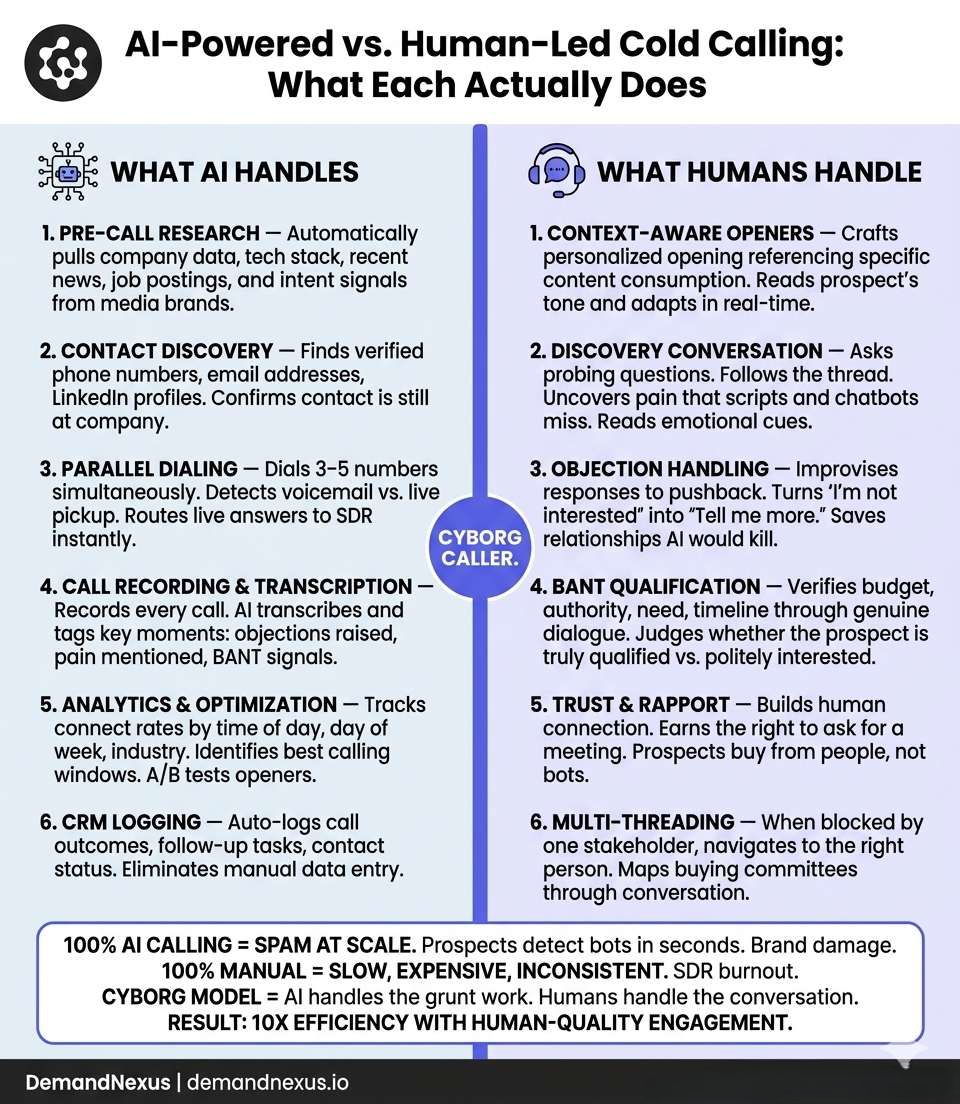
Cold calling works when SDRs call prospects who have demonstrated intent, reference that intent in the opening, verify BANT criteria on every call, and hand off complete intelligence to AEs. That version achieves 40–50% engagement rates, 85–90% show rates, and close rates of 30–35%.
The companies winning with outbound in 2026 are not using different scripts. They are using different data — first-party intent signals that tell them exactly who to call, when to call, and what to open with.
Real-World Impact: Before and After Intent-Driven Cold Calling
B2B SaaS Company — Outbound Program Transformation
| Metric | Before (Traditional Cold Calling) | After (Intent-Driven Outreach) |
| Metric | Before (Traditional Cold Calling) | After (Intent-Driven Outreach) |
| Weekly dials | 500 | 200 |
| Connect rate | 12% | 35% |
| Meeting booking rate | 3% | 18% |
| Show rate | 62% | 89% |
| AE feedback | “70% of meetings are unqualified” | “Every meeting is with a real buyer” |
| SQL conversion from meetings | 28% | 89% |
| Close rate | 18% | 35% |
| Monthly pipeline generated | $1.2M | $4.8M |
Volume dropped by 60%. Pipeline quadrupled. The lever was not motivation, scripts, or headcount — it was data quality and BANT qualification rigor.
| Ready to Transform Your Cold Calling from Activity to Accountability?
Demand Nexus delivers guaranteed, BANT-qualified appointments through the Waterfall Model — fueled by first-party intent data from 15M+ decision-makers across six proprietary B2B media brands (AITechTrend, MarTechTrend, HRTechTrend, FinTechFilter, LegalTechTrend, DevTechTrend). Every appointment includes a full Appointment Handover Sheet (AHO): BANT verification scores, verbatim pain point quotes, competitor intel, and recommended opening approach — so your AE walks in 100% prepared to close. Schedule a Waterfall Strategy Call: sales@demandnexus.io | www.demandnexus.io |
FAQs
What is the average cold calling success rate in 2026?
Traditional cold calling averages a 2.3% success rate, meaning roughly 2 out of 100 calls convert to warm leads. However, intent-driven cold calling—where reps call prospects who have demonstrated content engagement—achieves 40-50% engagement rates and significantly higher meeting booking rates.
Why does cold calling still work in B2B sales?
Cold calling offers direct access to decision-makers, immediate feedback, and real-time objection handling that digital channels cannot replicate. Research shows 57% of C-level executives prefer phone outreach. The key is calling with context (intent data) rather than calling blind from purchased lists.
How can I improve my cold calling success rate?
Focus on five areas: replace cold lists with first-party intent signals, lead with context about the prospect’s recent content engagement rather than your product pitch, implement BANT qualification on every call, document complete intelligence for AE handoff, and use multi-channel sequences rather than single touches.
What is BANT qualification in cold calling?
BANT stands for Budget, Authority, Need, and Timeline. BANT qualification means verifying during the cold call that the prospect has allocated budget, decision-making authority, an articulated business need, and a defined purchase timeline. This ensures meetings are with actual buyers, not researchers or tire-kickers.
What is the difference between cold calling and intent-driven outreach?
Traditional cold calling targets prospects from purchased lists with no visibility into their interest level. Intent-driven outreach targets prospects who have demonstrated active research behavior—downloading content, attending webinars, or engaging with specific topics—enabling reps to open with context about that engagement.
What metrics should I track for cold calling success?
Track outcome-based metrics: connect rate (benchmark: 15-20%), engagement rate (benchmark: 40-50% with intent data), BANT qualification rate (benchmark: 30-40%), meeting booking rate (benchmark: 70-80%), show rate (benchmark: 85-90%), and AE satisfaction score (benchmark: 8+/10).
How does pay-for-performance cold calling work?
Pay-for-performance models charge only for BANT-qualified appointments that appear on your sales team’s calendar. No-shows are replaced at no cost. This aligns incentives around quality rather than volume, ensuring SDRs are rewarded for booking meetings that convert, not just meetings that happen.
Benchmark Your Cold Calling Program
If your cold calling success rates fall below the intent-driven benchmarks, the gap is usually in targeting, openers, or qualification. Take the diagnostic at demandnexus.io/start-quiz/ to identify where the leakage is happening, or book a call at demandnexus.io/book-a-call for a guided benchmark review.