


This guide covers how to build an outbound cold calling program from scratch, including cadence design, team structure, tool selection, and intent-driven execution. For the core cold calling methodology, see demandnexus.io/cold-calling/. For scripts, see demandnexus.io/b2b-cold-calling-scripts/.

Most B2B teams lose 40–60% of qualified prospects to broken handoffs and weak qualification. Take our 2-minute diagnostic to find out where your pipeline is bleeding — and how to fix it.
Start the Quiz → Takes 2 minutes. No email required to start.Outbound Cold Calling vs Inbound Pipeline
Outbound cold calling and inbound pipeline are complementary, not competing, channels. Inbound pipeline comes from buyers who self-identify through content consumption, form fills, and demo requests. Outbound pipeline comes from sellers who proactively target accounts that fit the ICP but have not yet raised their hand. Inbound is reactive and dependent on the buyer’s timeline. Outbound is proactive and controlled by the seller’s targeting and cadence.
Most B2B companies need both. Inbound alone produces pipeline at the buyer’s pace, which may not match the company’s revenue targets. Outbound alone misses the buyers who prefer to self-educate before engaging with sales. The ratio between the two depends on the market maturity, deal size, and competitive dynamics. For most growth-stage and enterprise B2B companies, outbound cold calling produces 40-60% of total pipeline. For a comparison of outbound and inbound lead generation strategies, see demandnexus.io/outbound-sales-lead-generation-strategy/.
How to Design an Outbound Cold Calling Cadence
An outbound cold calling cadence is the structured sequence of touches across phone, email, and LinkedIn that an SDR executes against each target prospect. The cadence governs when to call, how many times to attempt, what to do between calls, and when to stop. A well-designed cadence balances persistence with respect for the prospect’s time.
A proven 14-day outbound cadence looks like this: Day 1 is a personalized cold email. Day 2 is a cold call attempt plus voicemail. Day 4 is a second email with a data point or content asset. Day 6 is a second cold call attempt. Day 8 is a LinkedIn connection request. Day 10 is a third cold call attempt plus a follow-up email referencing the voicemail. Day 14 is a breakup email offering a graceful exit. After the cadence, the prospect enters a long-term nurture loop and may re-enter a fresh cadence when new intent signals appear. For voicemail strategies that tie into this cadence, see demandnexus.io/cold-call-voicemails/. For broader sales cadence design, see demandnexus.io/sales-cadence-b2b/.

Outbound Cold Calling Team Structure
An outbound cold calling program requires four roles. The SDR (Sales Development Representative) executes the cadence: dials, emails, and qualifies. The SDR Manager coaches, monitors metrics, and maintains pipeline quality standards. The Data and Enrichment function maintains list quality, verifies contact data, and integrates intent signals into the calling queue. The Sales or AE counterpart receives BANT-verified meetings and provides feedback on meeting quality that informs targeting and qualification adjustments.
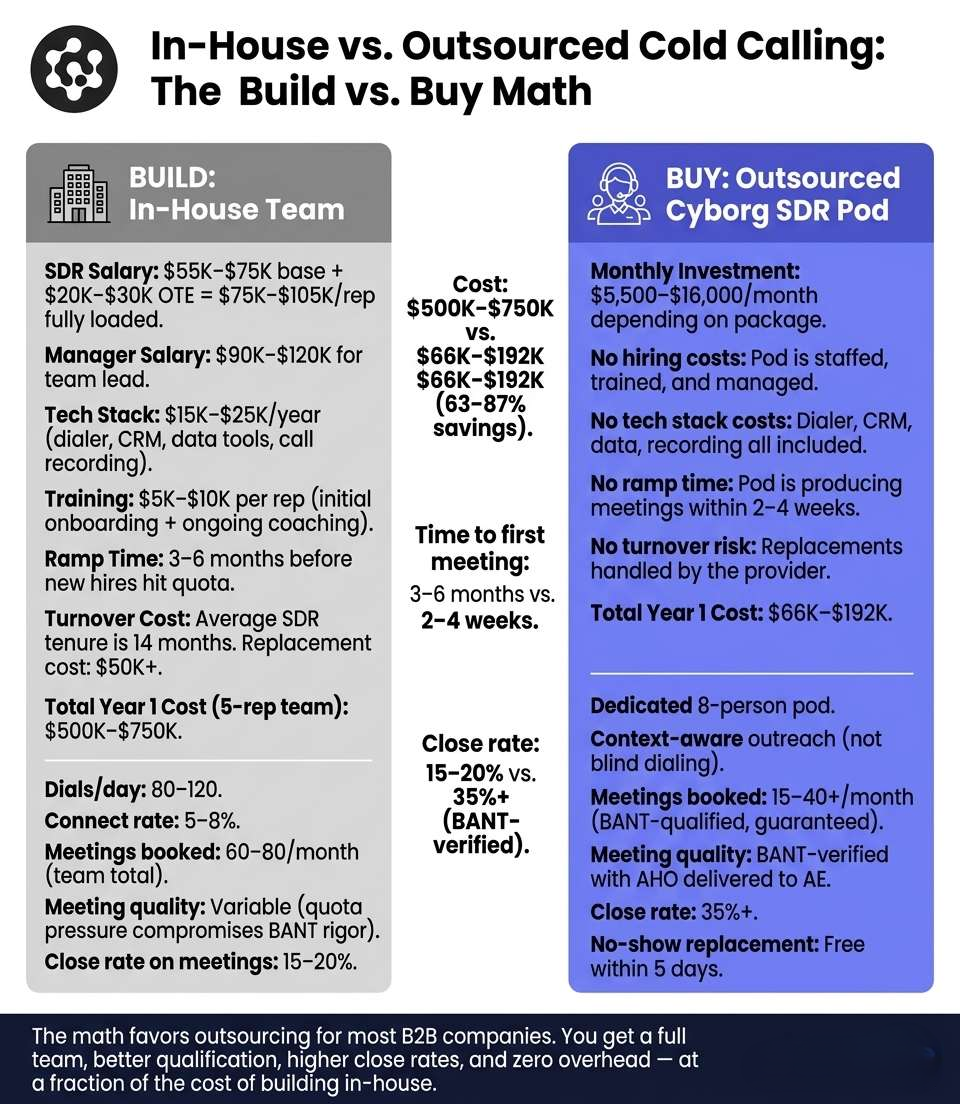
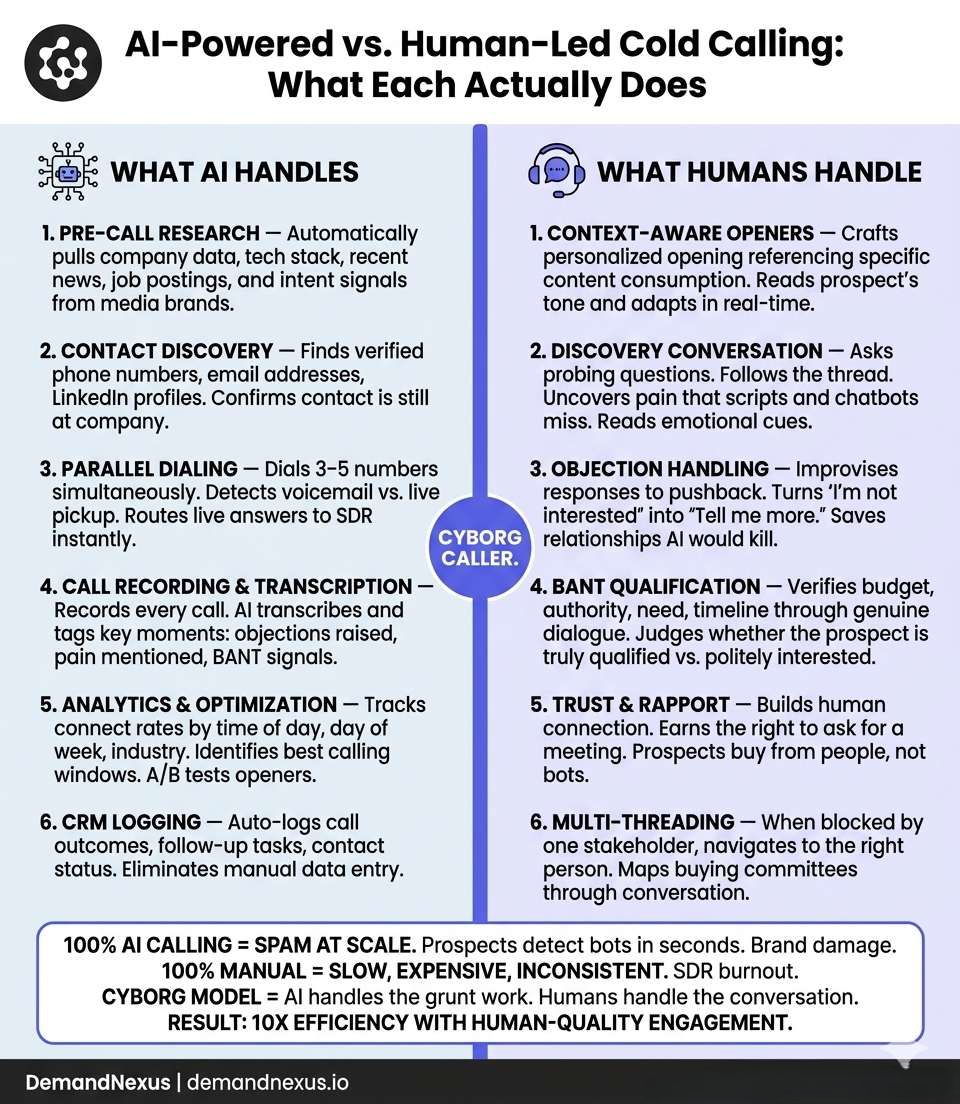
Team sizing depends on pipeline targets. A single SDR running an intent-driven program typically produces 15-25 BANT-verified meetings per month. Scale the team to hit the pipeline coverage ratio you need. Alternatively, outsource a portion of the outbound capacity to a pay-for-performance partner like DemandNexus, which provides Cyborg SDR pods (AI research plus human qualification) without the headcount investment. For more on outsourcing options, see demandnexus.io/outsource-sdr/. For a complete guide to SDR roles and career paths, see demandnexus.io/sdr-in-sales/.
Outbound Cold Calling Tools
The essential tool stack for outbound cold calling includes four categories. Dialers: parallel dialers (Nooks, Orum) for volume, power dialers (Salesloft, Outreach) for sequenced cadences. Contact data: ZoomInfo, Apollo, Cognism for verified direct dials and mobile numbers. Intent data: first-party sources (DemandNexus media properties) for exclusive signals, third-party sources (Bombora, 6sense) for broad coverage. Conversation intelligence: Gong or Chorus for call recording, analysis, and coaching. For a comprehensive breakdown, see demandnexus.io/cold-calling-software-dialers/. For tools across the broader sales workflow, see demandnexus.io/prospecting-tools/.
Measuring Outbound Cold Calling Program Performance
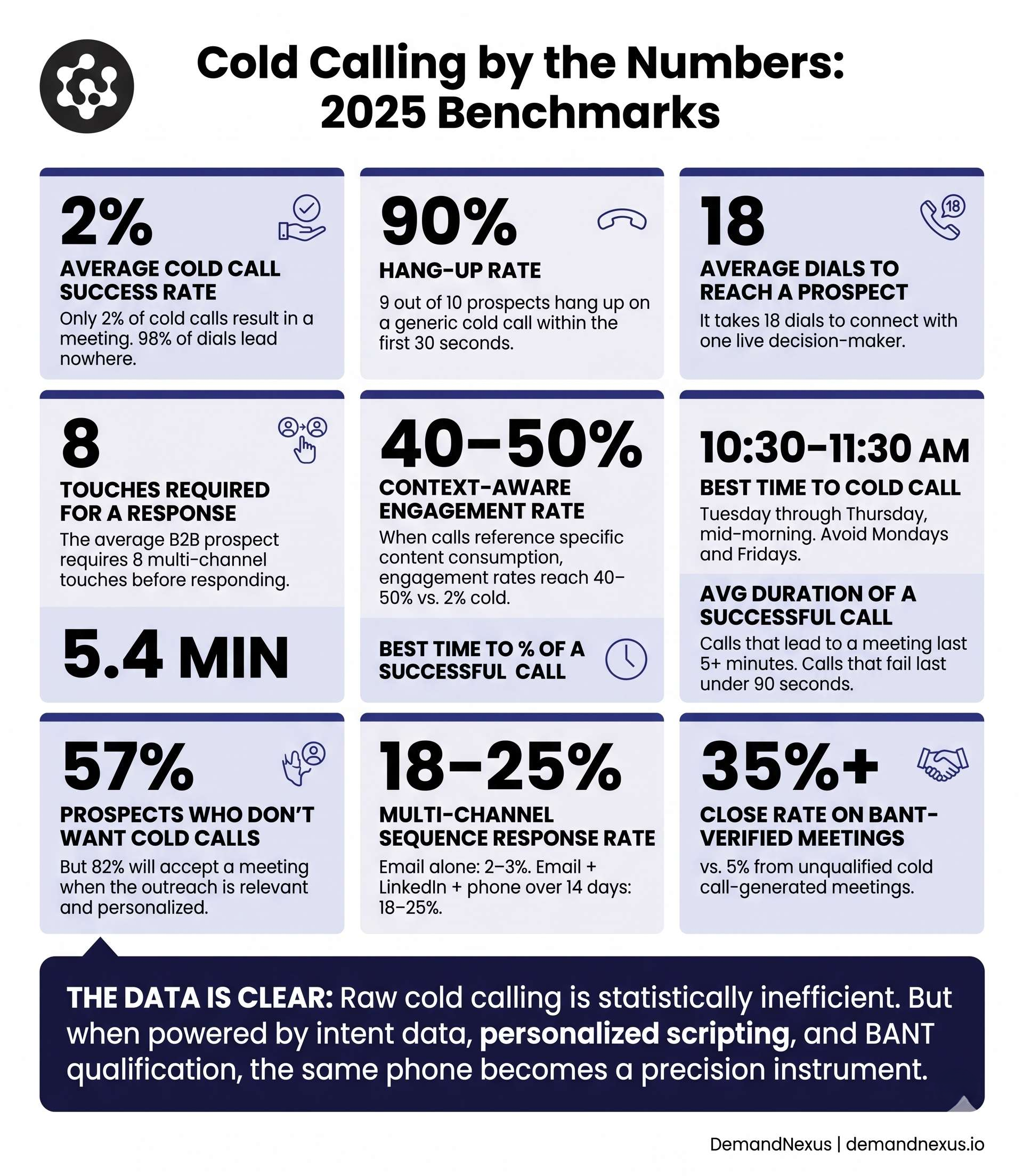
An outbound cold calling program should be measured on five metrics. Dial-to-connect rate reveals targeting and data quality. Connect-to-conversation rate reveals opener effectiveness. Conversation-to-meeting rate reveals sales skill and qualification rigor. Meeting show rate reveals qualification quality. Pipeline generated per SDR per month reveals total program output. Track all five weekly and report the first three daily to catch problems before they compound. For a complete metrics framework, see demandnexus.io/sales-lead-generation-kpis/.
FAQs
What is outbound cold calling?
Outbound cold calling is the proactive use of phone-based prospecting to initiate sales conversations with target accounts. The SDR calls prospects who have not previously expressed interest, with the goal of qualifying the prospect and booking a sales meeting. It is distinct from inbound calling, where the prospect initiates the contact.
How do I build an outbound cold calling program from scratch?
Start with five steps: define your ICP and build a target account list, select and configure your dialer and data tools, design a 14-day multi-touch cadence, train SDRs on intent-driven openers and BANT qualification, and establish a feedback loop with your AE team. First meetings should be deliverable within 4-6 weeks of program launch.
Should I build outbound in-house or outsource it?
The decision depends on cost per meeting (in-house SDR cost versus outsourced provider cost), speed to pipeline (in-house teams take 3-6 months to ramp, outsourced programs deliver in 4-6 weeks), and whether you have the intent data infrastructure to support targeting. Pay-for-performance partners like DemandNexus often outperform in-house teams on all three dimensions.
Build or Accelerate Your Outbound Program
If you are building or scaling an outbound cold calling program, the fastest way to benchmark your current approach is the qualification diagnostic at demandnexus.io/start-quiz/. For a working session on cadence design, team structure, and targeting, book a call at demandnexus.io/book-a-call.