


Why Demand Generation Metrics Matter
Demand generation is about creating awareness, nurturing interest, and converting prospects into loyal customers. But without measurable data, it’s impossible to know whether your efforts are paying off. Demand generation data provides a clear picture of campaign performance, revealing which tactics resonate with your ideal customer profile (ICP) and where improvements are needed. By focusing on the right KPIs, businesses can refine their B2B demand generation strategies to maximize impact.
DemandNexus empowers marketers with advanced analytics tools to track and analyze demand generation metrics, ensuring campaigns are optimized for efficiency and ROI.
Key Demand Generation Metrics to Track
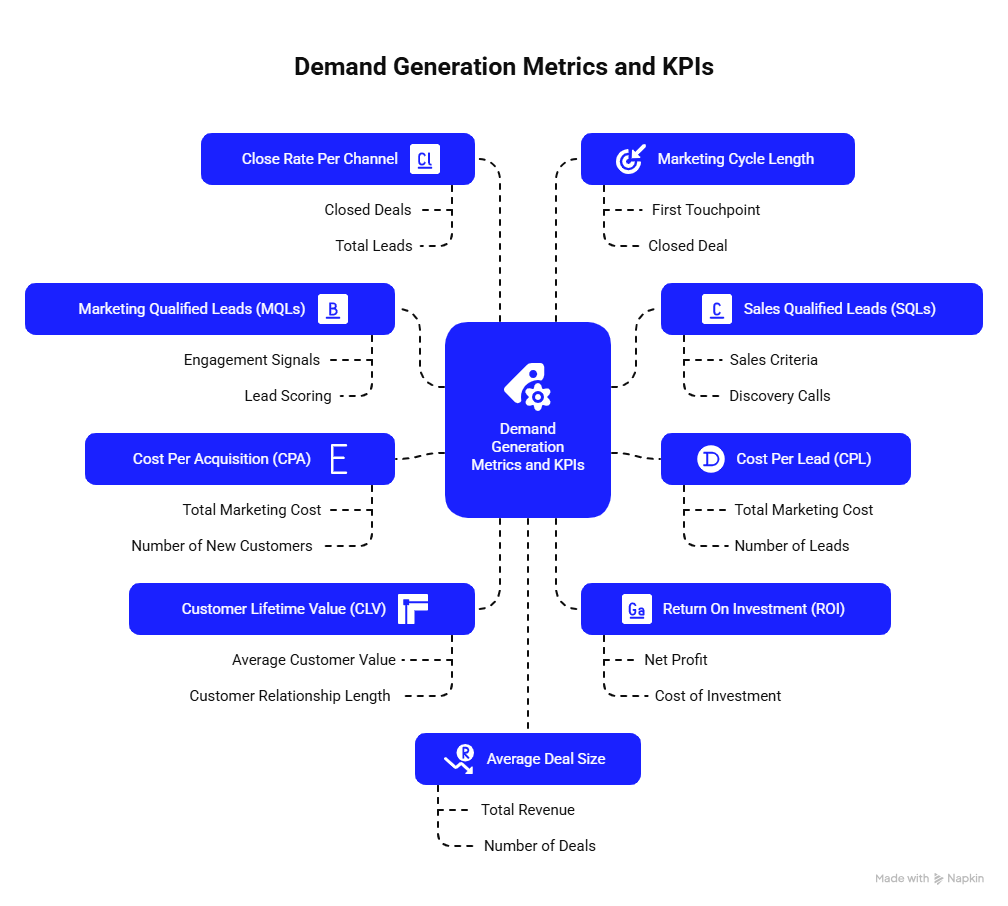
Below are the critical metrics that every B2B marketer should monitor to assess the success of their demand generation efforts.
1. Marketing Qualified Leads (MQLs)
MQLs are prospects who have shown interest in your offerings through actions like downloading a whitepaper, attending a webinar, or signing up for a newsletter. This metric indicates how effectively your demand generation content attracts high-intent leads.
How to Measure: Track engagement signals (e.g., content downloads, website visits) and use lead-scoring criteria to identify MQLs. For example, a SaaS company might classify a prospect who requests a demo as an MQL.
2. Sales Qualified Leads (SQLs)
SQLs are MQLs that have been vetted by the sales team and deemed ready for direct outreach. They exhibit strong purchase intent and align with your product’s value proposition.
How to Measure: Evaluate MQLs against criteria like budget, authority, need, and timeline (BANT). For instance, an SQL might be a prospect who schedules a product demo and confirms their budget.
3. Cost Per Lead (CPL)
CPL measures the cost of acquiring each lead, helping you assess the efficiency of your marketing campaigns.
How to Measure: Divide total marketing spend by the number of leads generated. For example, if you spend $5,000 on a LinkedIn ad campaign and generate 250 leads, your CPL is $20.
4. Cost Per Acquisition (CPA)
CPA tracks the total cost of converting a lead into a paying customer, including marketing and sales expenses.
How to Measure: Divide total campaign costs by the number of new customers acquired. A $10,000 campaign that results in 100 customers has a CPA of $100.
5. Customer Lifetime Value (CLV)
CLV estimates the total revenue a customer will generate over their relationship with your business, highlighting the long-term value of your demand generation efforts.
How to Measure: Multiply the average customer value by the average customer lifespan. For example, a customer who spends $500 annually for 4 years has a CLV of $2,000.
6. Return on Investment (ROI)
ROI measures the profitability of your demand generation campaigns by comparing revenue generated to costs incurred.
How to Measure: Use the formula: ROI = [(Revenue – Cost) / Cost] * 100. A $5,000 campaign generating $15,000 in revenue yields a 200% ROI.
7. Close Rate Per Channel
This metric evaluates the percentage of leads from a specific channel (e.g., email, social media) that convert into customers.
How to Measure: Divide the number of closed deals from a channel by the total leads from that channel, then multiply by 100. For example, 20 conversions from 200 email leads result in a 10% close rate.
8. Marketing Cycle Length
Marketing cycle length measures the average time it takes for a lead to move from initial engagement to becoming a customer.
How to Measure: Calculate the average time from first touchpoint to closed deal. A shorter cycle often indicates effective messaging and nurturing.
9. Average Deal Size
This metric reflects the typical revenue per closed deal, helping you understand customer spending patterns.
How to Measure: Divide total revenue from closed deals by the number of deals. For example, $100,000 from 10 deals yields an average deal size of $10,000.
10. Contribution to Total Revenue
This measures the percentage of overall revenue driven by specific marketing campaigns or channels.
How to Measure: Divide revenue from a marketing source by total company revenue, then multiply by 100. If webinars generate $50,000 of $500,000 total revenue, their contribution is 10%.
Demand Generation Strategy Review
A demand generation strategy review involves analyzing these metrics to identify strengths and weaknesses in your campaigns. Regular reviews help you:
- Optimize underperforming channels by reallocating budget to high-ROI tactics.
- Shorten marketing cycle length through improved lead nurturing.
- Enhance content strategies based on engagement data.
DemandNexus supports businesses with comprehensive strategy reviews, using real-time data to refine demand generation campaigns and boost performance.
Demand Generation Trends
The landscape of demand generation is evolving rapidly. Key demand generation trends to watch include:
- AI-Powered Targeting: Machine learning tools analyze buyer behavior to deliver personalized content, improving MQL and SQL quality.
- Connected TV Advertising: Streaming platforms like ESPN and Discovery+ offer premium ad placements for reaching decision-makers.
- Ungated Content: Providing free, high-value resources builds trust and accelerates engagement.
- Intent-Based Marketing: Leveraging intent data to target prospects actively researching solutions.
Demand Generation Skills
Excelling in demand generation requires a blend of technical and strategic demand generation skills, including:
- Data Analysis: Proficiency in interpreting metrics like CPL, CPA, and CLV to drive decisions.
- Content Strategy: Crafting compelling narratives that align with buyer needs.
- Marketing Automation: Using tools like CRM platforms to streamline campaigns.
- Cross-Functional Collaboration: Aligning marketing and sales teams to ensure seamless lead handoffs.
Future of Demand Generation
The future of demand generation lies in hyper-personalization and technology integration. Advances in AI and predictive analytics will enable marketers to deliver tailored experiences at scale, while privacy regulations will push brands to prioritize first-party data. Additionally, omnichannel strategies that combine digital, social, and traditional media will dominate, ensuring consistent messaging across touchpoints.
Demand Generation Reviews
Conducting demand generation reviews is essential for continuous improvement. These reviews analyze campaign performance, benchmark metrics against industry standards, and identify opportunities for innovation. For example, a demand generation marketing review might reveal that email campaigns have a higher close rate than social media, prompting a shift in budget allocation.
Conclusion
Demand generation metrics are the backbone of successful B2B marketing, providing the insights needed to optimize campaigns and drive revenue. By tracking KPIs like MQLs, SQLs, CPL, and ROI, businesses can refine their strategies, align with emerging trends, and build a sustainable pipeline. As the field evolves, mastering demand generation skills and leveraging advanced tools will be critical for staying competitive. Ready to elevate your demand generation efforts? Explore DemandNexus’s B2B demand generation solutions to harness data-driven strategies for measurable success.
Author