

What Is B2B Demand Generation?
B2B demand generation is a revenue strategy that spans the full buyer journey, from the moment a decision-maker first encounters a category problem to the moment they accept a sales meeting. It combines content, intent data, paid media, outbound, account-based plays, and sales qualification into a single engine that produces pipeline, not just form fills.

Most B2B teams lose 40–60% of qualified prospects to broken handoffs and weak qualification. Take our 2-minute diagnostic to find out where your pipeline is bleeding — and how to fix it.
Start the Quiz → Takes 2 minutes. No email required to start.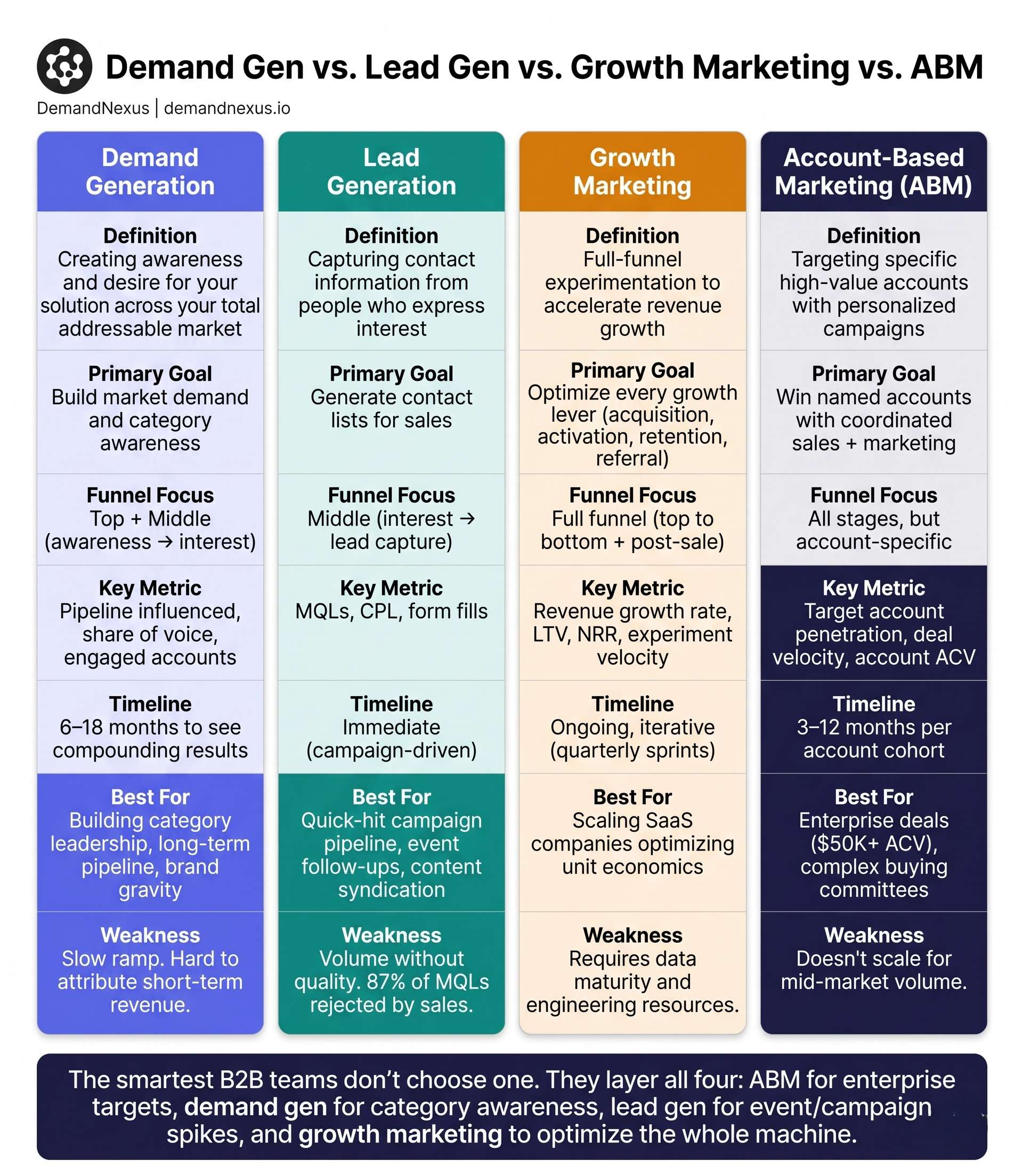
The discipline matters because B2B buying has changed. The average enterprise deal now involves 6 to 10 stakeholders, 18 touchpoints, and a buying cycle that stretches from 60 to 180 days. A single MQL is almost never the full story. Demand generation is how modern revenue teams orchestrate every touch into a narrative the buying committee can actually act on.
At DemandNexus, we define the goal of B2B demand generation narrowly on purpose: every dollar spent should trace back to a BANT-verified appointment that an Account Executive is prepared to close. Awareness without accountability is just spend.

B2B Demand Generation vs. Lead Generation: The Critical Difference
These terms get used interchangeably, but they describe two very different operating philosophies.
| Dimension | Lead Generation | Demand Generation |
| Primary Metric | Volume of leads (MQLs) | Qualified pipeline and revenue |
| Buyer Stage | Middle of funnel | Full funnel, from unaware to closed-won |
| Scoring Model | Form fills and engagement | Intent signals plus human BANT verification |
| Handoff Quality | Industry average 13% MQL to SQL | 60%+ SQL rate with first-party intent |
| Sales Experience | Cold follow-up, rejection heavy | Pre-qualified, context-rich meetings |
| Budget Accountability | Cost per lead (CPL) | Cost per appointment, cost per opportunity |
The headline number: 87% of MQLs are rejected by sales as unqualified. That is not a small leak. It is a systemic mismatch between what marketing is measured on and what sales actually needs. Modern demand generation closes that gap by qualifying before handoff, not after.

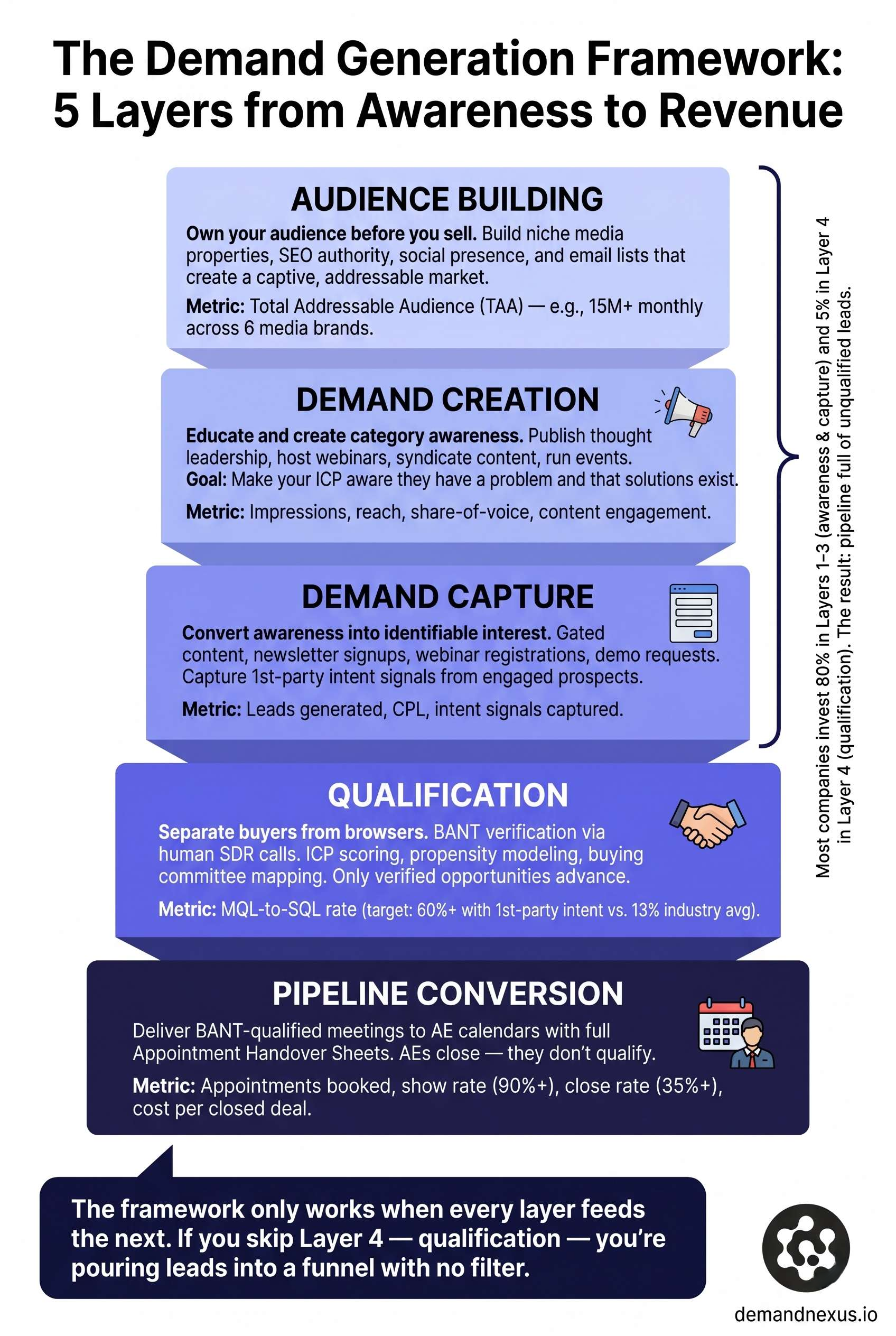
The B2B Demand Generation Funnel in 2026
The traditional funnel still applies, but the stages look different than they did five years ago. Here is how we map them at DemandNexus:
Stage 1: Demand Creation (Top of Funnel)
This is where you introduce the problem your category solves to buyers who are not actively shopping. The goal is not to capture a lead. The goal is to be remembered when the problem becomes urgent. Tactics include thought leadership content, industry research, podcast sponsorships, and paid social that educates rather than pitches.
Stage 2: Demand Capture (Mid-Funnel)
Now buyers are researching. They search Google, ask AI engines, read G2 reviews, and consume comparison content. Your job is to show up wherever they look and provide substantive answers. Search engine optimization, SEO-optimized comparison pages, webinars, and gated research reports all live here.
Stage 3: Demand Qualification (Bottom of Funnel)
This is where most programs fail. An interested buyer is not a qualified buyer. Qualification means verifying Budget, Authority, Need, and Timeline (BANT) before the meeting is handed to a closer. Skipping this step is why sales teams reject 87 of every 100 leads marketing sends over.
Stage 4: Sales Conversion and Expansion
The final stage is where qualified pipeline becomes revenue. Demand generation does not stop at the meeting booking. Proper handoff documentation, account context, and post-meeting nurture all belong to the demand gen function in modern revenue teams.
Core B2B Demand Generation Strategies
The strategies below represent the playbook modern revenue teams are using to generate predictable pipeline. No single tactic wins on its own. The teams that hit plan are the ones that orchestrate these together.
1. First-Party Intent Data
Third-party intent is getting crowded and noisy. Everyone is buying the same signals from the same providers. First-party intent, the data you own from your own media properties, is the new competitive advantage. It tells you who is researching your exact category, not just someone else’s keyword list.
DemandNexus operates six owned B2B media brands (AITechTrend, MarTechTrend, HRTechTrend, FinTechFilter, LegalTechTrend, DevTechTrend) that collectively reach 15 million plus decision-makers monthly. That reach produces first-party intent signals no third party can replicate, which is why programs using our data see SQL conversion rates above 60 percent versus the 13 percent industry median.
2. Account-Based Demand Generation
Traditional ABM and demand gen used to be separate disciplines. In 2026 they are fusing. The winning teams build account lists, identify buying committees inside those accounts, and orchestrate multi-channel plays across the full committee, not just one champion. Content, email, LinkedIn, and direct outbound all point at the same account simultaneously.
3. Cyborg SDR Pods
Pure AI SDR tools generate volume but not conversion. Pure human SDR teams scale linearly with headcount. The model that actually works is a hybrid: AI handles research, enrichment, signal monitoring, and first-draft outreach, while trained human SDRs handle conversations, objection handling, and BANT verification. DemandNexus calls this the Cyborg SDR Pod, and it is what makes our 90 percent plus show rate possible.
4. Waterfall Qualification
A waterfall model rejects anything that does not meet the next filter. Raw signals enter at the top. Firmographic fit filters first. Then intent. Then BANT verification. Only what survives the full waterfall becomes an appointment. This is why our pipeline is thinner than volume-chasing programs and also why it converts 202 percent higher than non-qualified leads.
5. Educational Outbound
Cold email that pitches on the first touch is dead. What works in 2026 is educational sequences that teach the market something useful, build recognition, and earn the right to a conversation. The pitch does not arrive until touch five or six, and by then the prospect already knows you.
6. Search, AEO, and GEO
Buyers now split research between Google, ChatGPT, Perplexity, Gemini, and Claude. Getting cited in AI Overviews and answer engines requires different optimization than traditional SEO. Structured FAQs, definition boxes, citable statistics, and authoritative outbound links all signal to AI engines that your content is worth referencing.
B2B Demand Generation Channels That Work in 2026
Channel selection depends on your ICP, deal size, and sales cycle. These are the channels producing the best unit economics for mid-market and enterprise B2B today:
| Channel | Best For | Typical CPL Range |
| First-party intent media | Enterprise, high-consideration | $120 to $250 |
| LinkedIn paid | Mid-market B2B, niche titles | $408 average (up 70% since 2021) |
| Google paid search | High-intent category terms | $250 to $500 (up 70% since 2021) |
| Outbound SDR | Named accounts, enterprise | $300 to $600 per meeting |
| Content and SEO | Long-term compounding demand | Variable, often under $50 organic |
| Webinars and events | Mid-funnel education | $150 to $300 per registrant |
| Review sites (G2, Capterra) | Bottom-funnel, category research | $200 to $400 per demo request |
Measuring B2B Demand Generation Performance
The metrics that matter in 2026 are fewer than most dashboards suggest. If you can answer these five questions, you can run a world-class demand gen program:
- Cost per BANT-qualified appointment (not cost per lead)
- Appointment-to-opportunity conversion rate
- Opportunity-to-closed-won conversion rate
- Pipeline velocity (days from first touch to closed deal)
- Revenue attributed to demand gen sourced pipeline
Vanity metrics like MQL volume, website traffic, and form fills belong in diagnostic reports, not board decks. They tell you nothing about whether you are building revenue.
The DemandNexus Approach to B2B Demand Generation
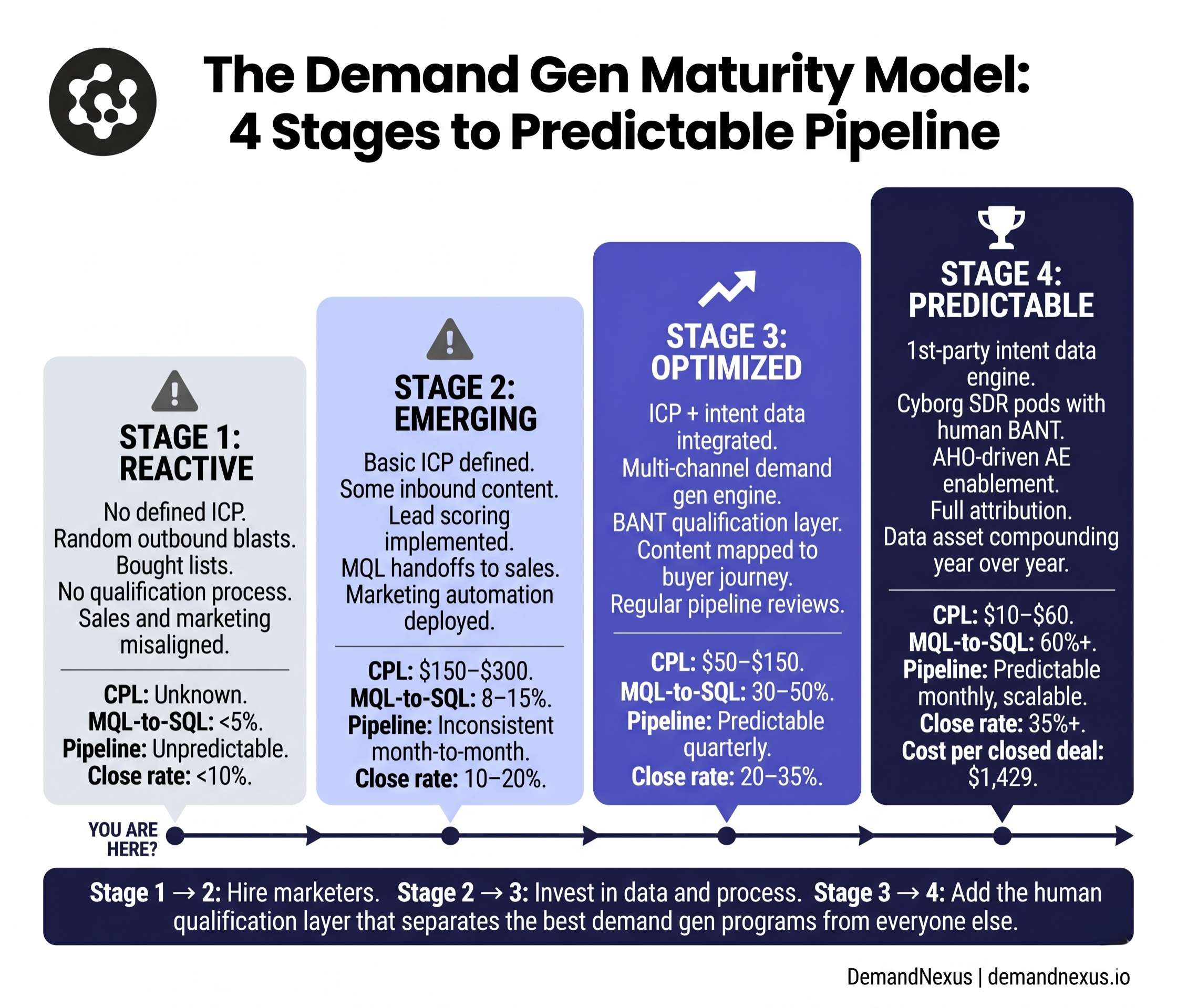
We run a pay-for-performance model. That means we do not bill for activity, we bill for outcomes: BANT-verified appointments that show up and convert. Here is how the engine works end-to-end.
First-party intent signals from our six owned media brands enter the Cyborg SDR Pod daily. AI-powered research enriches each signal with firmographic and technographic context. Trained human SDRs then run waterfall qualification, rejecting anything that does not meet Budget, Authority, Need, and Timeline criteria. Every appointment handed to the client arrives with an Appointment Handover Sheet (AHO) that documents the full discovery context, which is why 90 percent plus of our meetings show up, and why they convert at 202 percent the rate of unqualified leads.
• Demand Generation vs Growth Marketing & ABM
• B2B Demand Generation by Industry
If you are tired of paying for MQLs that never become pipeline, the demand generation quiz at demandnexus.io/start-quiz takes about 90 seconds and tells you which of our three tiers (Essentials, Growth, Enterprise) fits your revenue goals.
FAQs
What is B2B demand generation?
B2B demand generation is the full-funnel discipline of creating awareness, educating buyers, and converting interest into qualified sales pipeline. It combines content, intent data, paid media, outbound, and sales qualification into a single engine that produces BANT-verified appointments, not just leads.
What is the difference between demand generation and lead generation?
Lead generation optimizes for volume of contacts captured through forms and gated content. Demand generation optimizes for revenue-ready pipeline. The practical difference shows up in conversion rates: industry-average MQL-to-SQL sits at 13 percent, while qualified demand gen appointments convert at 60 percent or higher.
How much does B2B demand generation cost?
Costs vary widely by channel and model. Pure paid acquisition on LinkedIn now averages $408 per lead, and Google Ads CPLs are up 70 percent since 2021. Pay-for-performance pipeline models, where you pay per qualified appointment rather than per lead, typically range from $300 to $1,500 per meeting depending on ICP complexity.
What are the main B2B demand generation strategies?
The core strategies in 2026 are first-party intent data, account-based demand generation, Cyborg SDR pods combining AI and human qualification, waterfall qualification models, educational outbound sequences, and search optimization for both traditional SERPs and AI answer engines.
What metrics should I track for B2B demand generation?
Focus on five metrics: cost per BANT-qualified appointment, appointment-to-opportunity conversion rate, opportunity-to-closed-won conversion rate, pipeline velocity, and revenue attributed to demand gen sourced pipeline. Vanity metrics like MQL volume and form fills do not tell you whether pipeline is real.
How long does it take B2B demand generation to produce results?
Pay-for-performance pipeline programs typically produce first qualified appointments within 30 to 45 days. Content and SEO compounds over 6 to 12 months. A balanced program delivers short-term pipeline from outbound and intent plays while long-term compounding comes from owned content.