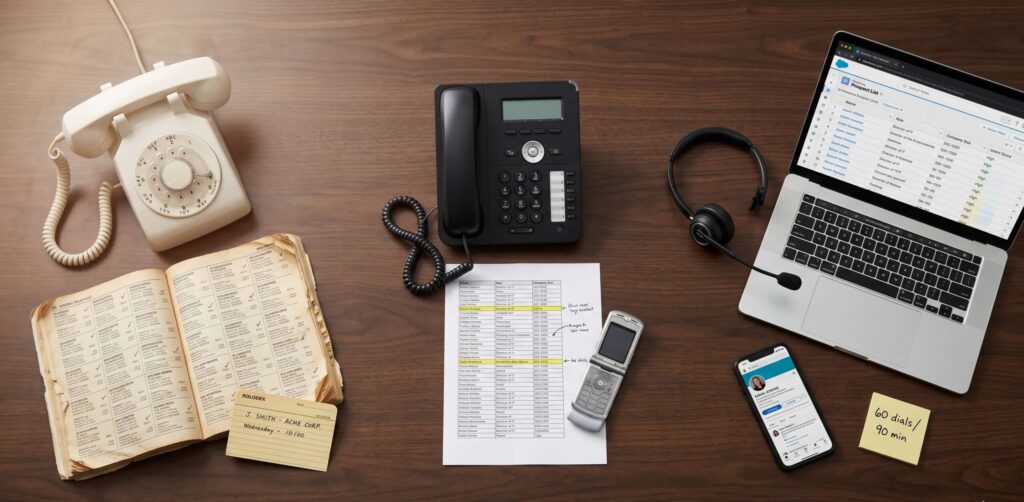


That definition has not changed since 1950. What has changed, drastically, is how cold calling is done, who it works for, and what modern buyers will and will not tolerate. This guide covers everything: the full definition, a working example, how it differs from related practices, the modern workflow, who actually uses it in 2026, and whether it still works (short answer: yes, in specific contexts, when done correctly).

Most B2B teams lose 40–60% of qualified prospects to broken handoffs and weak qualification. Take our 2-minute diagnostic to find out where your pipeline is bleeding — and how to fix it.
Start the Quiz → Takes 2 minutes. No email required to start.Cold Calling: The Formal Definition
Cold calling is an outbound sales technique where a salesperson initiates telephone contact with a potential customer who has had no prior relationship with the salesperson or their company. The call is “cold” because the recipient is not expecting it and has not opted in to be contacted.
Three elements must be present for a call to qualify as a cold call: the prospect has not previously engaged with your company, the contact is initiated by phone voice call (not text or email), and the prospect has not been warmed up by prior marketing touches.
If any of those three are missing, the activity is something adjacent: a warm call, a follow-up call, or an inbound response. That distinction matters because the techniques, regulations, and expected outcomes differ for each.
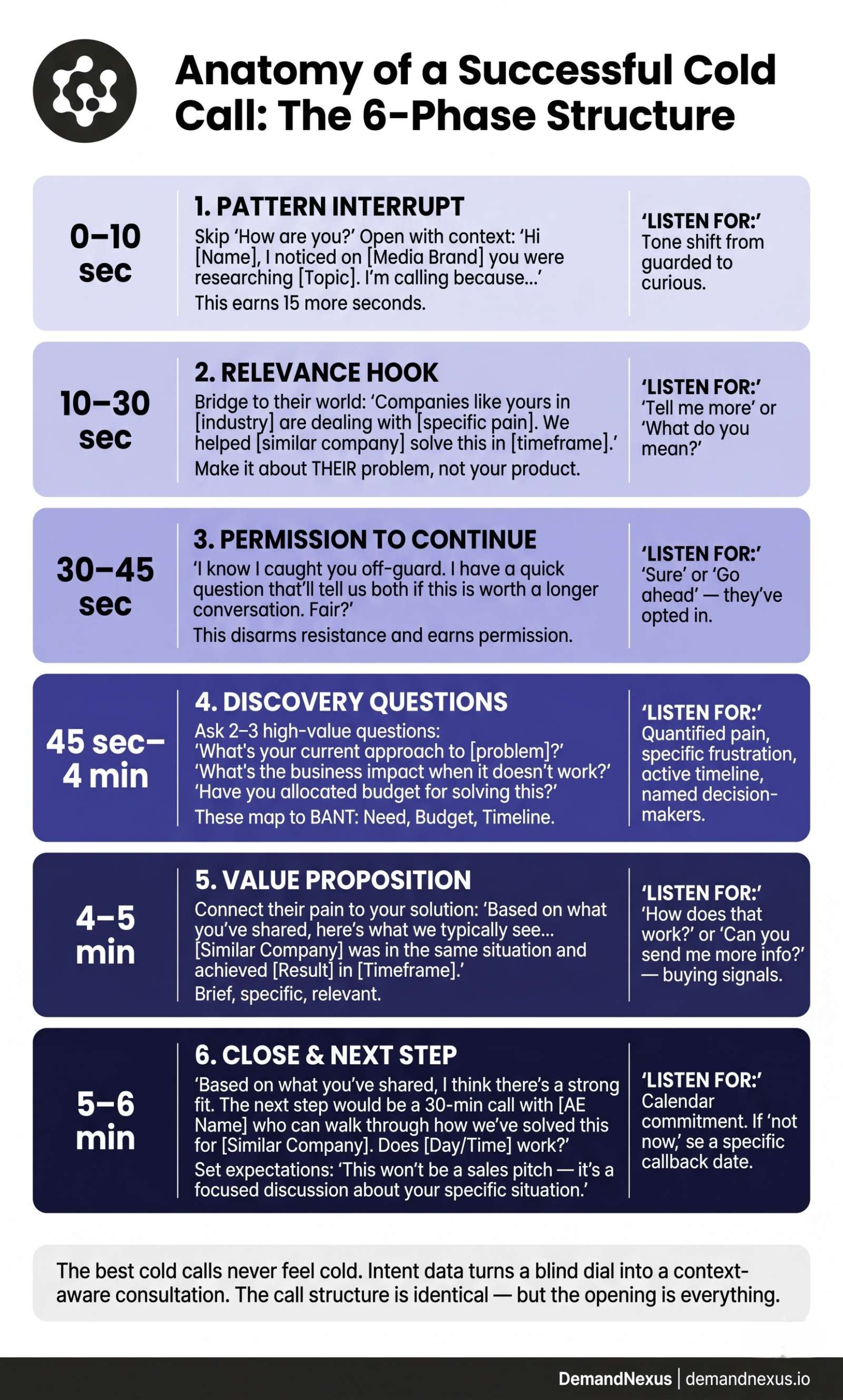
A Simple Example
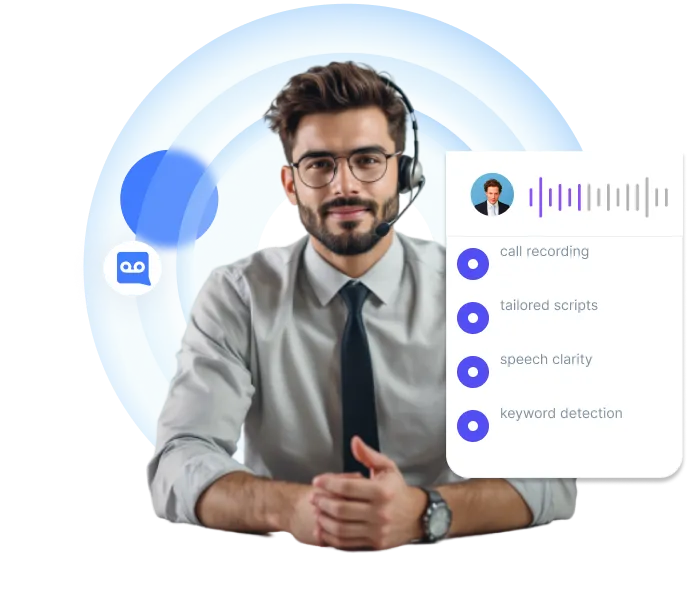
A sales development representative at a cybersecurity software company pulls a list of CIOs at mid-sized healthcare companies. Neither the rep nor the company has previously contacted these CIOs. The rep dials the first name on the list, introduces themselves, briefly explains that they help healthcare IT teams reduce the cost of compliance audits, asks if that is something worth a 15-minute conversation, and books a meeting for the following Tuesday. That is a cold call.

How Cold Calling Works in 2026
The basic mechanics are unchanged. A rep dials a list. They speak to whoever answers. They try to book a next step. But the surrounding workflow has been transformed by three forces: data, automation, and buyer expectations.
- Data: reps now call from targeted lists built with tools like Apollo, ZoomInfo, and Clay, not phone books. A typical list is filtered by 5 to 10 criteria including role, company size, tech stack, and recent trigger events.
- Automation: dialers like Orum, Nooks, and Kixie handle the dialing, local presence, voicemail drops, and CRM logging automatically. A rep today can have 400 dial attempts in 90 minutes versus 60 a decade ago.
- Buyer expectations: prospects expect cold callers to know something relevant about them before they pick up. Generic pitches that worked in 2010 get hung up on in 2026.
Cold Calling vs Other Outreach Methods
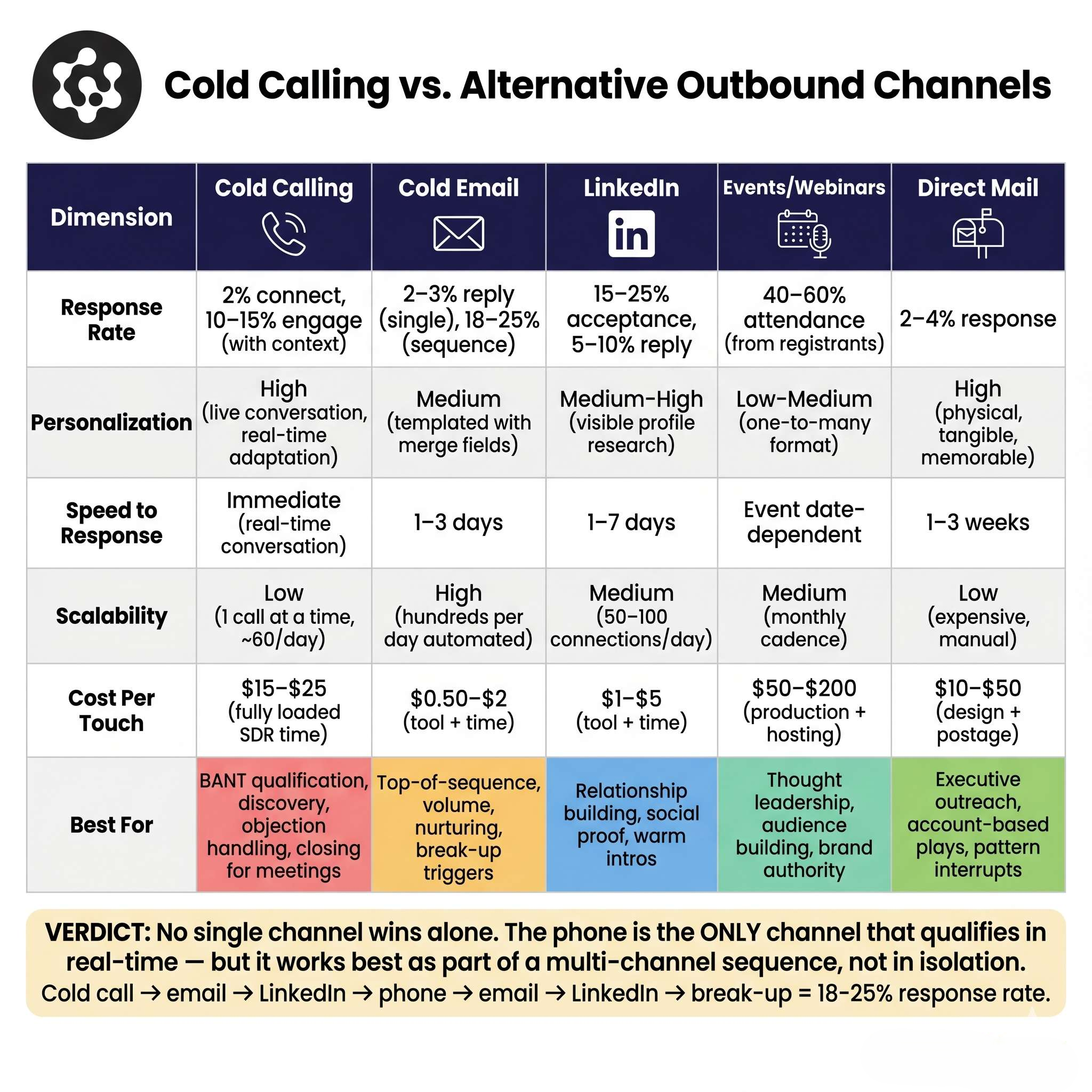
Cold Calling vs Warm Calling
Warm calling involves prospects who have had some prior touch with your company: they downloaded an ebook, attended a webinar, or were referred by a mutual contact. Warm calls have connect rates 3 to 5 times higher than cold calls. See our full cold calling vs warm calling comparison for when to use each.
Cold Calling vs Cold Emailing
Cold email is cheaper and scales easier but has lower reply rates (1 to 3 percent). Cold calling has higher per-touch conversion but lower total volume. The smart play is combining both in a sequenced cadence. We cover the data in our cold calling vs cold emailing guide.
Cold Calling vs Telemarketing
Telemarketing is usually B2C and transactional (selling directly on the call). Cold calling in 2026 is usually B2B and conversational (booking a next meeting). Different laws apply, different expectations, different techniques.
Who Actually Uses Cold Calling in 2026?
Cold calling still drives a significant share of pipeline in specific contexts: B2B software and SaaS sales to mid-market and enterprise accounts, professional services like consulting and legal, industrial and manufacturing sales, agency services for SMB buyers, and recruiting for executive-level roles. Where cold calling has mostly died: B2C retail, small-ticket consumer products, and categories with a clear inbound content-led buying pattern.
The Modern Cold Calling Workflow
- Build or buy a targeted list: 200 to 2,000 prospects matching a tight ICP.
- Enrich with trigger data: hiring signals, funding rounds, tech changes, leadership moves.
- Scrub against do-not-call registries and known bounce numbers.
- Queue into a dialer with local presence numbers.
- Run power hours: 60 to 90 minutes of uninterrupted calling in short blocks.
- Log outcomes automatically: connected, voicemail, not in service, booked.
- Follow up with email within 2 hours of each conversation.
- Book meetings to calendar with double-confirmation.
- Feed results back into list optimization for the next week.
Is Cold Calling Still Effective?
The short answer is yes, but only for specific use cases and only when done well. Recent industry data puts B2B cold call connect rates around 4 to 9 percent and conversion-to-meeting rates (from live conversations) around 20 to 40 percent. That means roughly 1 in 50 to 1 in 100 dial attempts produces a booked meeting.
For a B2B SaaS deal worth $30,000 in annual recurring revenue, that economics still works. For a $500 consumer product, it does not. We cover the full effectiveness data in our guide to whether cold calling still works in 2026.
Is Cold Calling Legal?
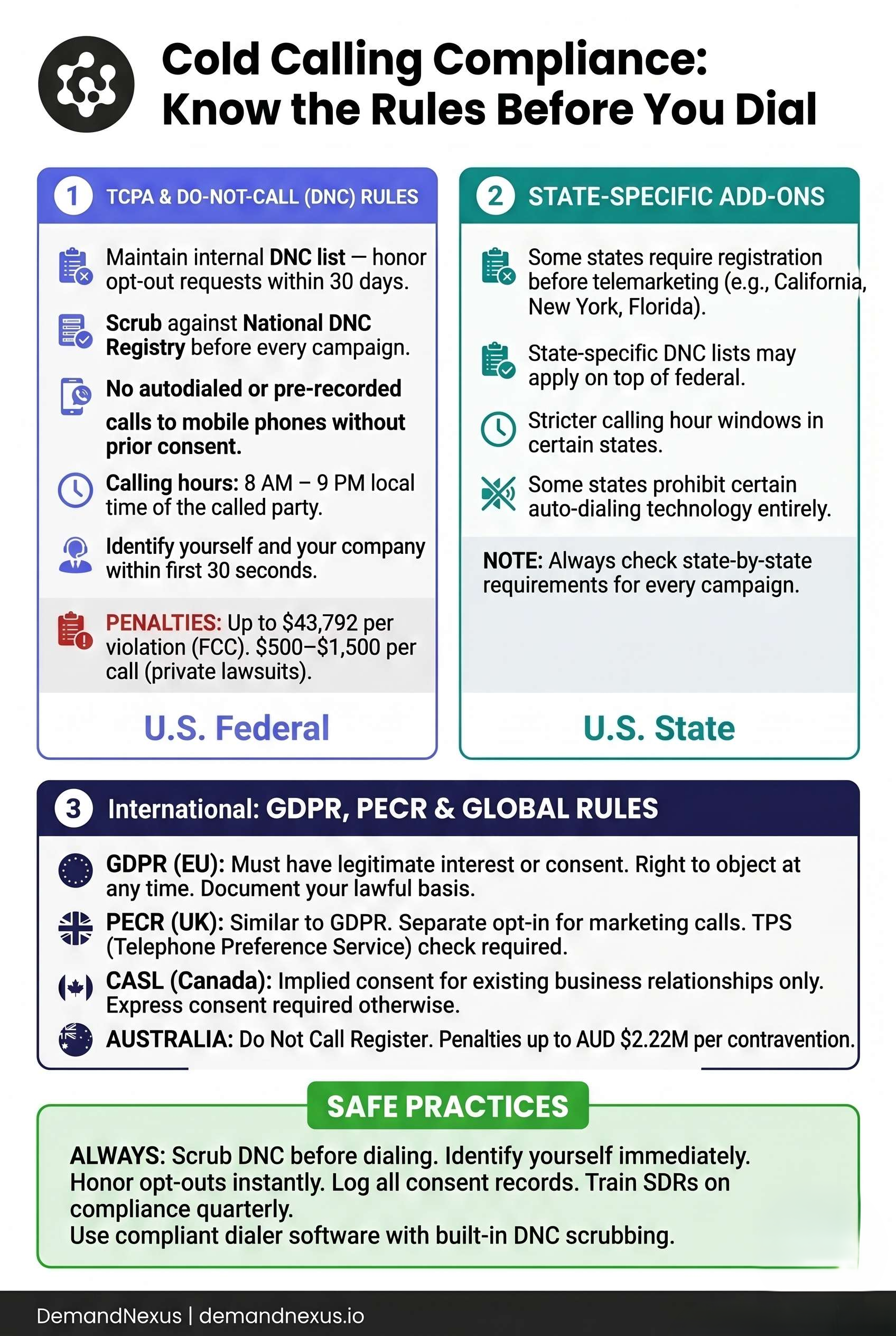
Yes, in most cases, but with significant restrictions. In the United States, B2B cold calling is largely legal under TCPA, but calling consumer numbers without consent can trigger penalties of $500 to $1,500 per violation. The UK has GDPR and PECR restrictions, and EU countries vary widely. Full compliance guide here.
Getting Started With Cold Calling
If you are building a cold calling function from scratch, the minimum viable stack looks like this: a targeted list of 500 prospects, a written script with an opening and three objection responses, a power dialer (Kixie or Aircall will do), a CRM, and a commitment to at least 60 dials per day for 90 days. Less than that and you will not have enough data to know whether it works.
If you would rather skip the building phase and have a trained team running the program for you from week two, DemandNexus offers done-for-you B2B cold calling as a fixed monthly service. See our cold calling services for current packages.
FAQs
What is cold calling in simple terms?
Cold calling is when a salesperson phones someone they have never talked to before, to try to interest them in a product or service.
What is the difference between cold calling and cold emailing?
Cold calling uses the phone and is conversational. Cold emailing uses written email and is asynchronous. Calls have higher per-touch conversion, emails scale further and cheaper.
Is cold calling dead?
No, but it has narrowed. Cold calling still works well in B2B contexts with deals over $5,000 in value. For small-ticket B2C it has largely been replaced by paid ads and content marketing. Our deep-dive on this is in "Is Cold Calling Dead".
How many cold calls does it take to book a meeting?
For B2B with a well-built list and a trained rep: 40 to 80 dials per booked meeting. For a poorly targeted list or an untrained rep: often 200+ dials per meeting.