



This guide walks through the data, the arguments on both sides, what has actually changed, and what separates the cold calling programs that are dying from the ones that are producing the best results the channel has ever seen.

Most B2B teams lose 40–60% of qualified prospects to broken handoffs and weak qualification. Take our 2-minute diagnostic to find out where your pipeline is bleeding — and how to fix it.
Start the Quiz → Takes 2 minutes. No email required to start.The Case Against Cold Calling
The case against cold calling is built on three data points. First, the average connect rate has declined as remote work and call screening have become standard. Reaching a prospect by phone is harder than it was five or ten years ago. Second, the average meeting conversion rate on traditional cold calling (2.3%) makes the unit economics unattractive at scale. Third, buyer surveys consistently show that unsolicited phone calls are one of the least preferred ways for B2B buyers to learn about new products. For a full examination of whether cold calling still works, see demandnexus.io/does-cold-calling-still-work/.
The Case for Cold Calling in 2026
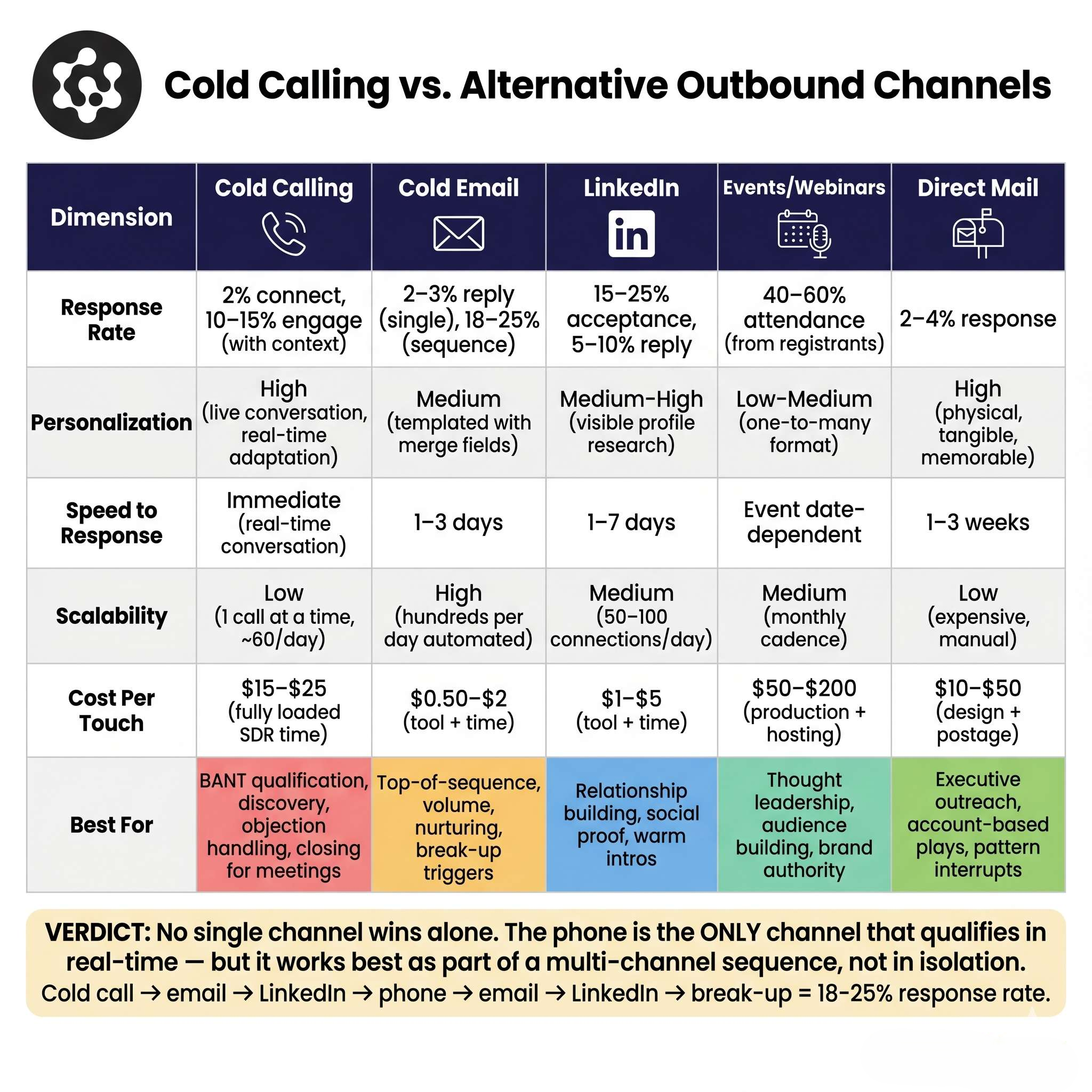
The case for cold calling is built on a different set of data. Intent-driven cold calling programs produce engagement rates of 40-50% and meeting conversion rates of 15-25%, which are among the highest of any outbound channel. Cold calling is the only outbound channel that produces real-time qualification in a single interaction. Senior executives (VP and above) who do not respond to email are often reachable by phone. And the channel produces pipeline velocity that no asynchronous channel can match: a qualified meeting can be booked in a single call, whereas email sequences take days or weeks.
The resolution of the debate is not whether cold calling is dead or alive. It is that cold calling has split into two distinct activities. The first, traditional high-volume cold calling, is dying and deserves to die because it wastes everyone’s time. The second, intent-driven qualified cold calling, is producing the best results the channel has ever seen and is gaining share among sophisticated B2B teams.
Lead Generation Without Cold Calling: What Are Your Options?
Does Cold Calling Work in 2026? What the Data Says
The data reveals a clear bifurcation: traditional cold calling is declining in effectiveness, while intelligence-driven outreach is accelerating. Here’s what the numbers show:

Traditional Cold Calling Statistics
- 2–4.8% success rate: For every 100 dials, 2–5 produce a meaningful response.
- 90% hang-up rate: Generic openers without context result in immediate disconnects.
- 28% answer rate: Less than 1 in 3 calls gets answered at all.
- 8+ attempts: Average touches required to reach a single decision-maker.
Context-Aware Outreach Statistics
- 40–50% engagement rate: When calls open with verified, specific context about the prospect’s situation.
- 57% of C-suite executives prefer phone outreach over email or social media (RAIN Group).
- 51% of directors and 47% of managers respond well to phone outreach when it’s relevant.
- 89–95% meeting-to-SQL conversion when meetings are fully BANT-qualified before reaching the AE.
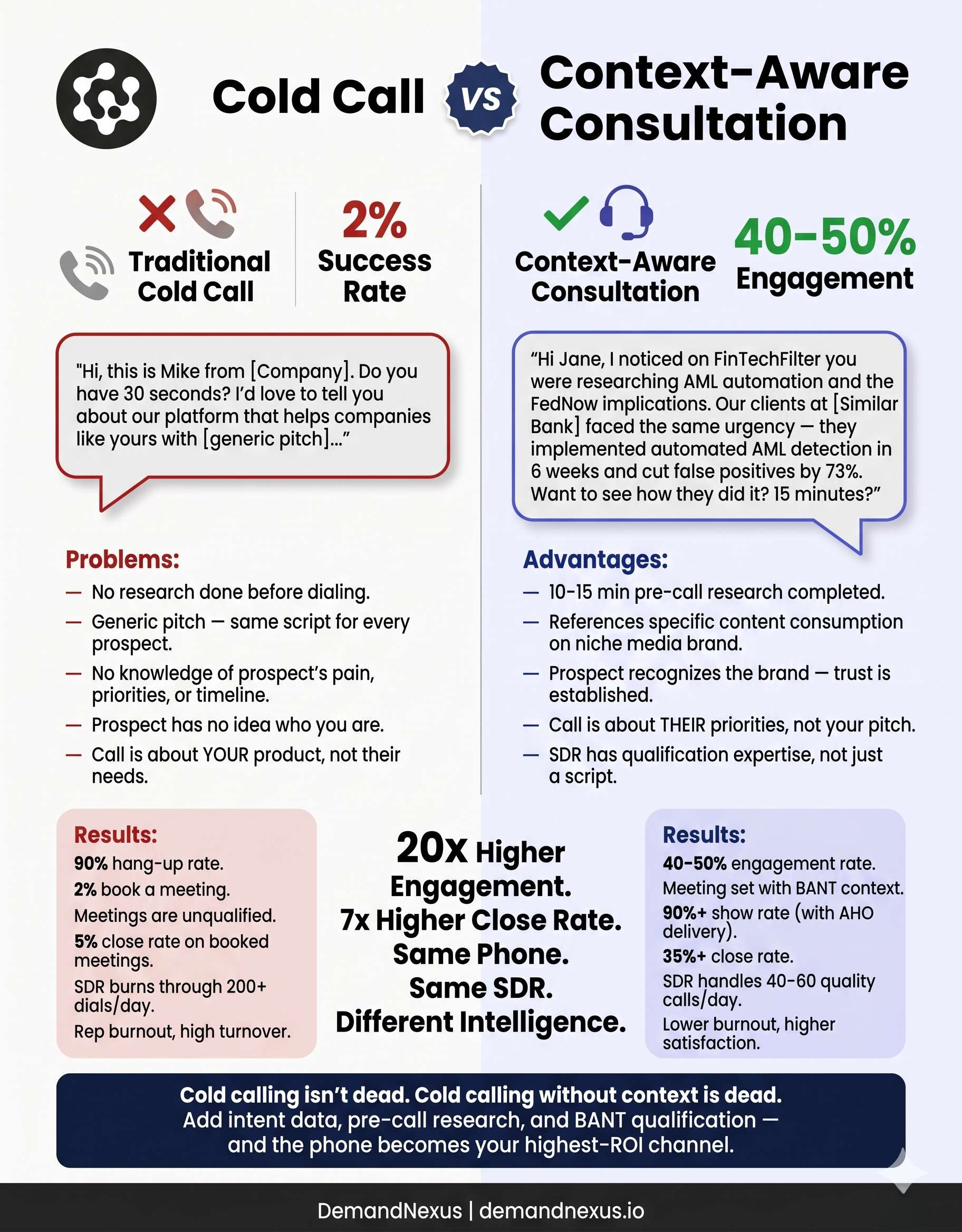
The conclusion isn’t that cold calling is dead—it’s that cold calling without intelligence is dead. The companies asking “does cold calling work in 2026” are often running the 2006 version of outbound and measuring it against 2026 buyer expectations.
If you’re measuring cold calling success by raw dial volume, you’re optimizing the wrong metric. The right metric is qualified pipeline generated per outbound hour—and that number is very much alive.
Why Traditional Cold Calling Fails in 2026
Traditional cold calling fails for predictable, structural reasons—and understanding them is the first step to fixing your outbound program.
No Intent Data or Context
Reps call without knowing whether a prospect has any current interest in solving the problem you solve. There’s no signal, no trigger, no evidence of urgency. The call sounds like every other sales pitch the prospect received that week, because it is. The opening 30 seconds are identical to a dozen other calls—and the prospect hangs up.
No Qualification Discipline
Even when a call gets answered and a meeting gets booked, quota-pressured SDRs often book meetings with prospects who aren’t decision-makers, don’t have budget, or have a timeline of “sometime next year.” The AE burns an hour on a call that was never going to close, loses confidence in the pipeline, and starts questioning the entire outbound motion.
This is the core problem B2B cold calling services need to solve: not just booking meetings, but booking meetings that actually convert.
Volume Over Value
The “dial 200, hope for 3” mentality is mathematically exhausting. It requires enormous rep effort for minimal pipeline, burns through prospect lists quickly, and demoralizes SDRs who hear rejection all day. When organizations measure SDR performance by dials and meetings booked—rather than pipeline quality—they create incentives for exactly the wrong behavior.
Weak Handoff Intelligence
Even when a qualified meeting gets booked, the handoff often consists of a calendar invite with the prospect’s name and company. Nothing else. The AE enters the call cold—spending the first 15 minutes asking questions the SDR should have already answered. The prospect feels like they’re starting over. The meeting loses momentum before the pitch begins.
These aren’t problems with the phone channel—they’re problems with outbound cold calling execution. Fix the execution, and the channel performs.
Cold Calling Effectiveness in 2026: The Intent-Driven Model
The most effective outbound programs in 2026 are built on a fundamentally different foundation than traditional cold calling. Instead of starting with a list and hoping someone is interested, they start with verified evidence that someone is actively researching a relevant problem.
First-Party Intent Data: The Foundation
Intent data tells you who is researching what, right now. But not all intent data is equal. Third-party intent data—aggregated from anonymous browsing across the open web—gives you IP addresses and topic clusters. It doesn’t tell you which specific person is interested, and it’s available to every competitor with a budget.
First-party intent data is captured when known individuals engage with specific, owned content. When a VP of Operations spends time reading about API integration challenges on a media property you control, you know:
- Who: A specific person with name, title, company, and contact information
- What: The exact topics and pain points they’re actively researching
- When: Real-time engagement—not data that’s weeks or months old
- Exclusive: Signals your competitors don’t have access to
That intelligence transforms the opening of a cold call from a generic pitch into a relevant conversation about something the prospect is already thinking about.
The Difference a Context-Aware Opening Makes
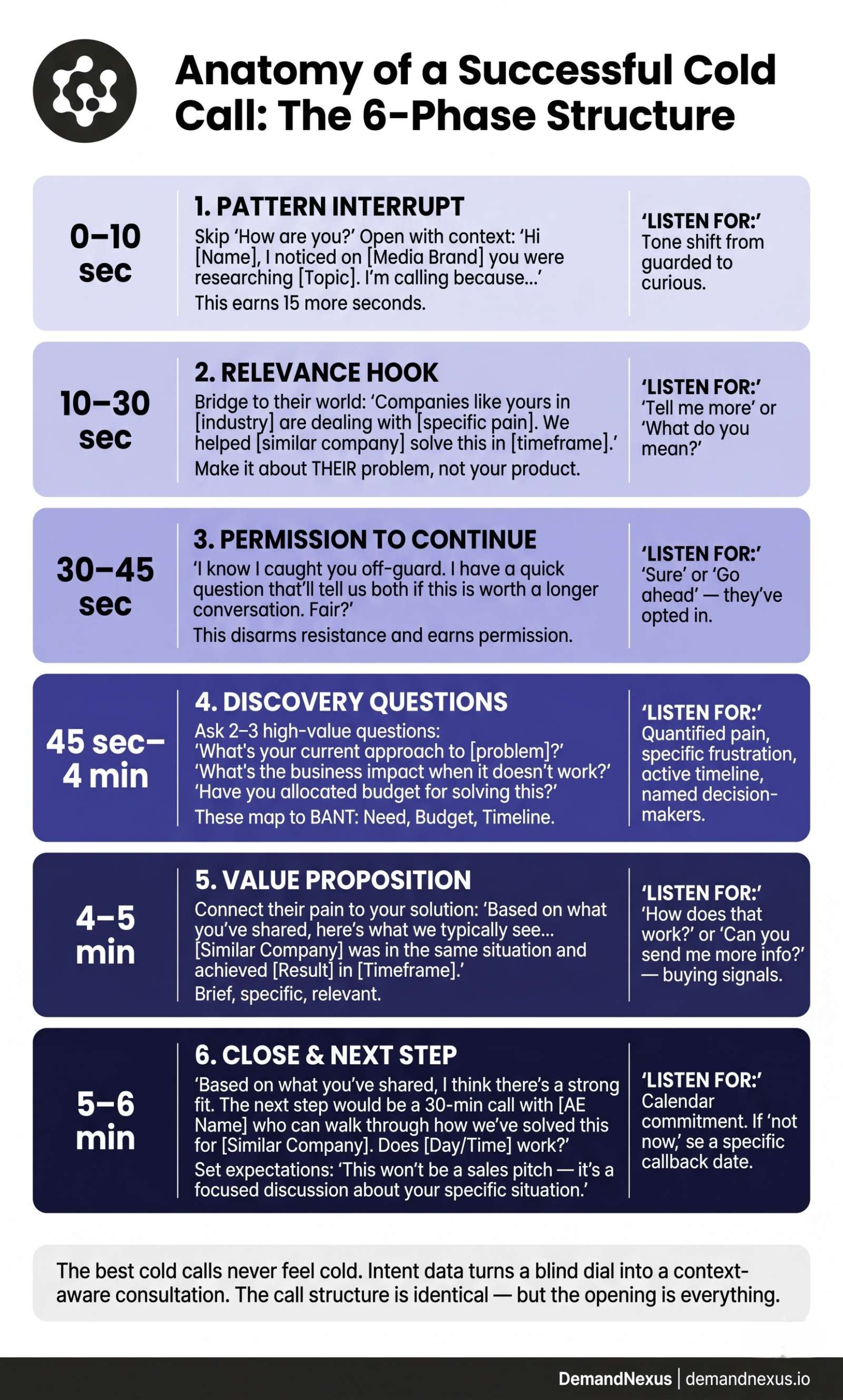
Traditional opening: “Hi Jane, do you have 30 seconds? I’m calling from [Company] and wanted to share how we help businesses like yours with…”
Context-aware opening: “Hi Jane, I’m reaching out because I saw you’ve been researching API security challenges recently. That’s something a lot of operations leaders are wrestling with right now. What’s driving the research on your end?”
The second approach demonstrates research, references her actual priorities, and opens with a question rather than a pitch. It achieves 40–50% engagement versus 10% for generic openers. That’s not a small improvement—it changes the economics of the entire outbound program.
Need help structuring these openers? See our B2B cold calling scripts and cold calling tips for frameworks that work with intent-informed outreach.
Why BANT Qualification Separates Winners from Wasters
Booking a meeting is table stakes. What matters is whether that meeting produces pipeline. And pipeline quality is determined before the AE ever joins the call—in the qualification stage.
BANT qualification—verifying Budget, Authority, Need, and Timeline—ensures that every meeting your AE attends is with a real buyer who can make a decision. Without it, your sales team is sorting through meetings to find the qualified ones. With it, every meeting is already sorted.
The Four BANT Criteria
- Budget: Have they allocated funds for this category of solution? Are those funds approved and available, or aspirational?
- Authority: Is this person the economic decision-maker, or do they need to involve someone else? If they’re not the DM, can you access the DM?
- Need: Is there an active, urgent business problem—one with measurable impact—or is this early-stage research with no committed timeline?
- Timeline: When do they need this solved? What’s the business event or forcing function driving the urgency?
A 10–15 minute qualification call that explicitly verifies all four criteria before scheduling an appointment converts your meeting queue from a lottery into a predictable pipeline engine.
What Rigorous Qualification Produces
The difference in outcomes when meetings are BANT-verified:
- Meeting-to-SQL conversion: 28% (unqualified) vs. 89–95% (BANT-verified)
- Close rate: 3–5% (unqualified meetings) vs. 25–40% (BANT-verified appointments)
- Cost per deal: Reduces by 42–58% when pipeline waste is eliminated
- Sales hours per deal: Drops from 50 hours to 10.6 hours with qualified appointments
Looking to see what scalable qualification looks like in practice? Explore how cold calling rejection handling and qualification together reduce wasted sales time.
Why Intent-Driven Cold Calling Outperforms
Intent-driven cold calling outperforms traditional cold calling because it eliminates the three sources of waste that drive the poor averages. Waste source one: calling accounts that are not in-market. Intent data removes them from the call list. Waste source two: opening with a pitch that the prospect has no reason to care about. Pre-call research and context-aware openers replace the pitch with relevance. Waste source three: booking meetings without qualification. BANT verification ensures that every meeting has budget, authority, need, and timeline confirmed. The combined effect is the 15-25% meeting conversion rate and 90%+ show rate that define intent-driven cold calling benchmarks.
DemandNexus clients see these numbers consistently because the Cyborg SDR pod model is designed to execute all three improvements: first-party intent signals from six owned media properties identify in-market accounts, AI research tools arm SDRs with context before each dial, and human-led BANT verification ensures qualification before any meeting is booked. The Appointment Handover Sheet then preserves that context through the handoff, which is why close rates run more than 200% higher than on non-qualified alternatives.
Cold Calling vs. Warm Calling in 2026
Understanding the spectrum from cold to warm outreach is important context for any outbound strategy. At cold calling vs. warm calling, the distinction matters because warm outreach—where the prospect has already engaged with your brand in some way—consistently outperforms cold outreach. The question is: how do you warm up outreach at scale?
Intent data bridges this gap. When you know a prospect has been actively researching a problem you solve, your call is no longer fully cold—you’re entering a conversation that the prospect is already having in their head. First-party intent data effectively converts cold outreach into warm outreach at scale, without waiting for the prospect to raise their hand through your own marketing funnel.
This is why intent-driven outbound consistently outperforms both traditional cold calling (no context) and passive inbound marketing (long wait times, unverified interest). It combines the proactivity of outbound with the relevance of warm engagement.
Is Cold Calling Still Necessary in 2026?
Some sales leaders argue that inbound, content marketing, and paid acquisition have made cold outbound unnecessary. The data doesn’t support this view for most B2B companies.
Inbound marketing builds brand awareness and generates leads—but it operates on long timelines, depends on SEO and content performance, and doesn’t allow you to target specific accounts proactively. For companies with defined ICPs and target account lists, waiting for the right prospects to find you is a passive strategy that leaves significant revenue on the table.
Cold calling—executed with modern intelligence and qualification discipline—allows you to:
- Target specific accounts that fit your ICP, rather than waiting for them to find you
- Create urgency by engaging prospects at the moment they’re actively researching relevant solutions
- Qualify rapidly through direct conversation, rather than relying on form fills and lead scoring algorithms
- Build pipeline predictably with defined conversion rates at each qualification stage
The companies that stop cold outbound entirely typically become dependent on inbound channels they don’t control—and when algorithm changes or ad costs shift, their pipeline dries up. Strategic outbound provides pipeline diversification that protects revenue growth.
If you’re evaluating whether to build or outsource your cold outreach capability, see our guide on how to find a call center and what to look for in a qualified outbound partner.
The State of Cold Calling in 2026: What High-Performers Are Doing Differently
The companies generating the best results from cold outreach in 2026 share a set of common practices that distinguish their approach from the outdated models that give cold calling a bad reputation.
1. Intent Before Outreach
High-performing outbound teams start every campaign with verified intent signals—not cold lists purchased from data vendors. They know which specific individuals at target accounts are actively researching relevant problems before they dial a single number.
2. Context Before Pitch
The opening of every call references something specific to the prospect’s situation. Not “I was looking at your LinkedIn” (which everyone says), but genuine intelligence about the problems they’re researching and the priorities driving their attention right now.
3. Qualification Before Scheduling
No meeting gets on the calendar without explicit BANT verification. This means some calls end without a booking—and that’s by design. A disqualified prospect who doesn’t make the meeting represents SDR time saved and AE time protected.
4. Intelligence Before the AE Call
Comprehensive handoff documentation means AEs walk into every meeting prepared to close, not prepared to discover. Objections are anticipated. The prospect’s specific situation is understood. The recommended approach is pre-planned.
5. Quality Metrics Before Volume Metrics
Meeting-to-opportunity conversion rate, AE satisfaction scores, and pipeline-per-outbound-hour matter more than dials per day and meetings booked per week. When quality metrics improve, volume often follows—because qualified prospects are more likely to refer and expand.
See real-world cold calling examples of this approach in practice, including script frameworks and objection handling patterns.
Is Cold Calling Legal? The Regulatory Landscape
Cold calling is legal in most jurisdictions but subject to meaningful regulation. Understanding these rules is essential for any compliant outbound program.
- United States: The FTC’s Telemarketing Sales Rule (TSR) and the National Do Not Call (DNC) Registry prohibit calling individuals who have opted out. Violators face significant fines.
- United Kingdom: GDPR and the Privacy and Electronic Communications Regulations (PECR) restrict calling individuals on the Telephone Preference Service (TPS) list without explicit consent. Industry-specific rules from the FCA may apply.
- European Union: GDPR requirements apply broadly. Many member states have additional telemarketing restrictions.
- Australia and Canada: Similar opt-out registries and consent requirements apply.
Compliant outbound programs use verified, regularly scrubbed contact data; respect opt-out requests immediately; and document consent where required. Using properly maintained data not only reduces legal exposure—it also improves effectiveness, because clean data means you’re calling people who are reachable and relevant.
Human Outreach vs. AI SDRs: Why the Phone Still Requires a Person
The growth of AI-powered sales tools has prompted some organizations to experiment with fully automated cold outreach—AI-written emails, AI-generated LinkedIn messages, and even AI voice systems. For certain tasks, AI delivers genuine efficiency gains.
But for C-suite and VP-level outreach—where relationships and trust determine whether meetings happen—full automation consistently underperforms. Executive buyers receive dozens of obviously AI-generated messages daily. They recognize the patterns, they filter the signals, and they respond to humans who demonstrate genuine understanding of their specific situation.
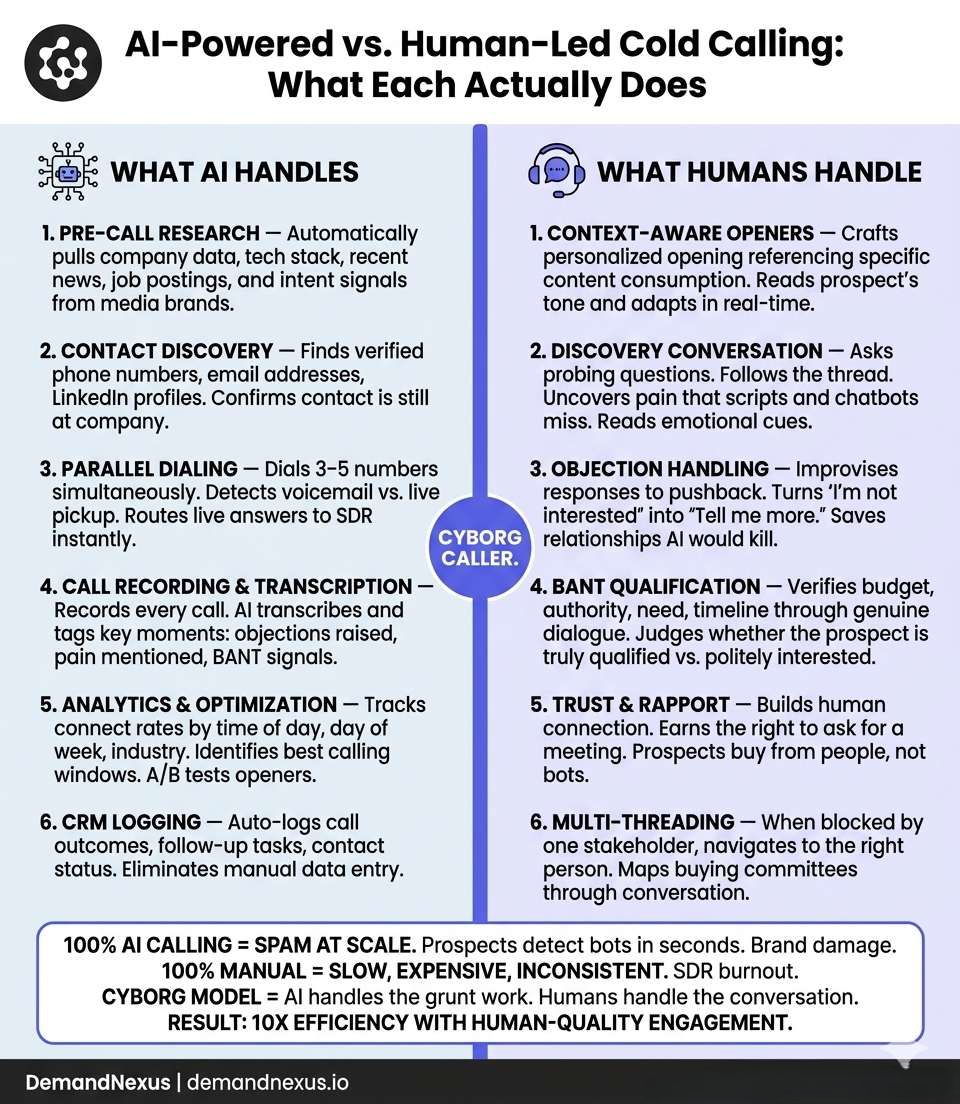
The most effective model in 2026 is what’s sometimes called the “Cyborg SDR” approach: AI handles research, list building, intent signal monitoring, and message variant testing. Human SDRs use that intelligence to have genuine conversations—conversations that AI cannot replicate, because they depend on listening, adapting, and building rapport in real time.
This hybrid approach achieves what neither pure automation nor unaugmented human effort can match: the scale benefits of AI combined with the conversion rates of human-to-human relationships.
5 Practical Strategies to Transform Your Cold Outreach Program
- Start Every Campaign with Intent Data — Build your outreach lists around verified buying signals, not contact databases. Know who is actively researching relevant problems before you dial.
- Rewrite Your Opening Statement — Replace your generic opener with a specific reference to the prospect’s situation. What are they researching? What problem are they trying to solve? Open with that.
- Implement Mandatory BANT Gates — No meeting gets scheduled without explicit verification of budget, authority, need, and timeline. Build this into your qualification call process as a non-negotiable standard.
- Create Appointment Handover Documentation — Develop a standard AHO template that captures BANT verification, prospect pain points (verbatim), competitive context, and recommended approach. Deliver this to AEs 24–48 hours before every call.
- Shift Your KPIs — Replace “meetings booked” as your primary SDR metric with “BANT-qualified meetings delivered” and “meeting-to-SQL conversion rate.” Align incentives with pipeline quality, not activity volume.
Conclusion: Cold Calling in 2026 Is Dead or Dominant — You Choose
Is cold calling dead? The truthful answer depends entirely on which version of cold calling you’re running.
The version that’s dying: uninformed mass dialing, quota-driven meeting booking without qualification, weak handoffs that leave AEs unprepared, and volume metrics that incentivize activity over quality. That approach was never great, and 2026 buyers have made it worse.
The version that’s thriving: intent-informed outreach where every call starts with verified buying signals, rigorous BANT qualification that ensures every meeting is worth the AE’s time, and comprehensive handoff documentation that sets closers up to win. Companies executing this model report meeting-to-opportunity conversion rates nearly triple the industry average.
The phone is not dead. It is, in fact, the highest-ROI outbound channel for B2B sales—when you build the intelligence infrastructure that modern buyers require. The question isn’t whether to call. It’s whether you have the data, the process, and the discipline to call well.
Ready to see what qualified appointment generation looks like in your pipeline? Book a strategy call with DemandNexus to learn how BANT-verified appointments can replace your MQL funnel.
FAQs
Is cold calling dead in 2026?
No — but traditional, uninformed cold calling is declining sharply. Strategic cold calling informed by first-party intent data, strict BANT qualification, and comprehensive appointment intelligence is generating meeting-to-opportunity conversion rates of 89–95% for companies that execute it properly.
Does cold calling work in 2026?
Cold calling works in 2026 when it's executed with intent data, a relevant opening, and rigorous qualification. Generic mass dialing without context achieves 2–4.8% success rates. Context-aware outreach informed by verified buying signals achieves 40–50% engagement rates from the same prospect universe.
What is the cold calling effectiveness rate in 2026?
Traditional cold calling achieves a 2–4.8% success rate and a 90% hang-up rate. Intent-driven outreach achieves 40–50% engagement rates. BANT-qualified appointments convert to sales opportunities at 89–95%, compared to 28% or less for unqualified meetings.
Is cold calling still effective for B2B sales?
Yes — particularly for reaching C-suite and VP-level decision-makers. Research from RAIN Group shows 57% of C-level executives prefer phone outreach over email or social media, provided the call demonstrates genuine relevance to their current priorities.
How is cold calling different from warm calling?
Cold calling targets prospects with no prior relationship with your brand. Warm calling targets prospects who have already engaged in some way. Modern intent-driven cold calling narrows this gap by using verified buying signals to ensure outreach is contextually relevant before the call begins.
What is BANT qualification and why does it matter for cold calling?
BANT stands for Budget, Authority, Need, and Timeline. It's a qualification framework that ensures every sales meeting is with a prospect who has allocated funds, decision-making power, an active business problem, and a realistic purchase timeline. Without BANT qualification, meeting pipelines contain large proportions of unqualified prospects—wasting AE time and inflating cost per deal.
How do I improve cold calling success rates?
Start with verified intent data rather than cold lists. Open with context specific to the prospect's situation. Qualify every prospect against BANT criteria before scheduling. Provide comprehensive briefing documentation to AEs before every meeting. Measure meeting-to-opportunity conversion rather than raw meetings booked.
See What Intent-Driven Cold Calling Produces
If your team has written off cold calling based on traditional results, the intent-driven model may change the calculation. Take the qualification diagnostic at demandnexus.io/start-quiz/ or book a strategy call at demandnexus.io/book-a-call to see what BANT-verified cold calling would produce for your ICP.